

ACV Packaged Boiler Systems: Factory-Tested Commercial Solutions
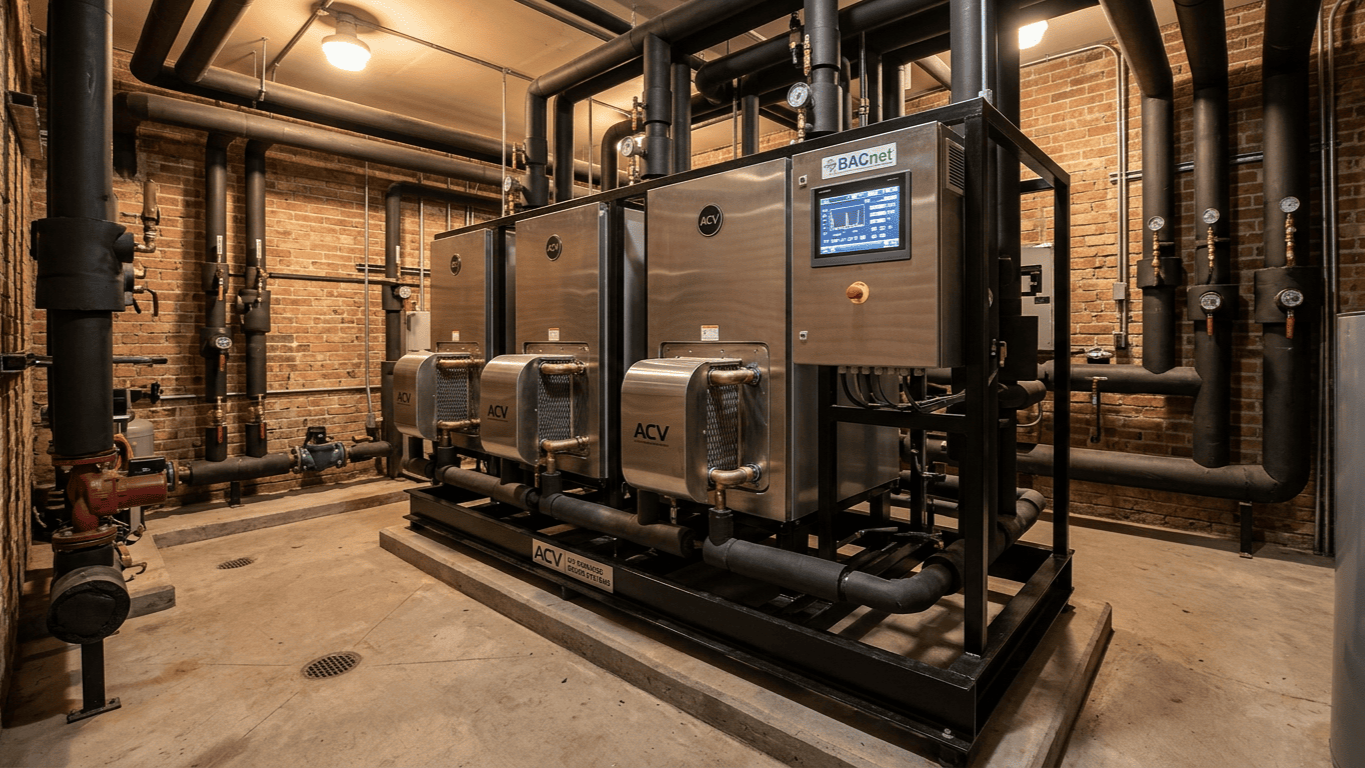
When specifying heating equipment for a commercial project, you cannot afford to get it wrong. A poorly configured boiler room costs money, wastes space, and creates maintenance headaches for years. That is why ACV packaged boiler systems have become the default choice for contractors who have learned this lesson the hard way.
These systems arrive on site as complete, factory-tested units. Everything is already assembled, wired, and commissioned before it leaves the facility. You aren't coordinating multiple trades to piece together a boiler room. You are installing a turnkey solution that has been pressure-tested and proven to work immediately. The difference isn't subtle. A traditional installation might take three weeks with multiple contractors. A packaged system is often operational within days.
What Makes A Packaged System Different
Most commercial heating installations involve separate components. You have the boiler itself, pumps, expansion vessels, control panels, pipework, and safety devices. Each arrives separately. Each needs fitting, connecting, and testing on site.
ACV packaged boiler systems integrate everything into a single skid-mounted boiler unit. The boiler sits on a steel frame alongside all ancillary equipment. Factory engineers have already done the pipework, wiring, and control integration.
Think of a skid-mounted boiler unit like a high-end, pre-built workstation computer. You wouldn't buy a motherboard, processor, and loose cables to solder together on your office desk. You buy a factory-tested machine that works flawlessly out of the box. Procuring these assemblies through Heating and Plumbing World ensures you receive a genuine turnkey solution that protects your project timeline.
Why Factory Testing Matters
Any experienced mechanical contractor knows the sinking feeling when a newly installed system won't fire up properly. You have the client breathing down your neck, the building handover is delayed, and you are trying to diagnose whether it is a wiring issue, a controls problem, or a faulty component.
Factory testing eliminates most of these scenarios. The manufacturer runs each skid-mounted boiler unit through comprehensive commissioning before dispatch. They pressure-test the hydraulics, verify all electrical connections, and run the boilers under load. If there is a fault, they find it in the factory rather than on your site. This is incredibly important for critical water heating systems in high-demand environments like hospitals or hotels. Factory testing accelerates commissioning and ensures the manufacturer holds full responsibility for the warranty.
Redundancy And Reliability
Commercial buildings cannot afford heating failures. A school without heating closes. A hospital without hot water compromises patient care. A hotel without heating loses bookings instantly.
ACV packaged boiler systems typically incorporate multiple boilers within a single package. A common configuration might include three or four smaller boilers rather than one massive unit. This approach provides built-in redundancy. If one boiler develops a fault, or an expansion vessel requires maintenance, the others continue operating.
The control system manages boiler rotation automatically. Each unit takes turns being the lead boiler, spreading wear evenly across the installation. This extends equipment life and prevents the scenario where one boiler accumulates all the running hours while others sit idle.
Space Efficiency
Traditional boiler rooms sprawl. You need space for the boilers themselves, plus room around them for pumps, expansion vessels, control panels, and maintenance access. Mechanical services often consume valuable ground floor space that could generate rental income.
Consolidating the footprint, including complex heating controls, saves massive amounts of premium real estate. A multi-boiler installation that might occupy 15 square metres as separate components reduces to roughly 8 square metres as a packaged unit. The vertical arrangement helps tremendously. Pumps and expansion vessels mount on the frame above or beside the boilers, containing everything within a defined envelope.
Integration With Building Management Systems
Modern commercial buildings do not run on manual controls. Building Management Systems monitor and adjust heating, cooling, ventilation, and lighting based on occupancy, external temperature, and precise time schedules.
These packages include a fully integrated BACnet control panel as standard. The BACnet control panel provides industry-standard communication protocols, allowing your building network to read boiler status, adjust setpoints, and receive alarms instantly without requiring aftermarket interface modules. This seamless integration connects directly to the wider building network, actively monitoring temperatures across complex heating pipe systems.
Installation Speed
Time is money on construction projects. Every week of delay costs money in extended site overheads, finance charges, and lost rental income.
On a recent school retrofit, the mechanical team allocated three weeks to pipe and assemble four loose boilers. Due to severe access restrictions and uncoordinated trade clashes, the job stretched to five weeks. By switching to a pre-assembled skid unit on their next project, they craned the assembly into place and had it commissioned within 48 hours. It was an expensive lesson in site logistics.
Packaged boiler systems cut installation time dramatically. You avoid the nightmare of waiting for separate heating pumps or components to arrive on site. The speed advantage compounds massively on multi-site rollout projects, making each installation highly predictable.
Maintenance Access
A common criticism of packaged systems is that tight integration makes maintenance difficult. If everything is crammed onto one frame, how do you access components for service?
ACV addresses this through deliberate layout design. Service points face outward. Pumps, strainers, and valves that need regular attention are positioned for easy access. You don't need to dismantle half the package to reach a pump seal. When routine servicing requires replacement boiler spares, engineers can easily reach the required modules without dismantling adjacent equipment. The hydraulic connections use unions and flanges positioned precisely for straightforward disconnection.
Efficiency Considerations
Condensing boiler technology has become standard in commercial heating. These boilers extract heat from exhaust gases that older atmospheric boilers waste. Efficiency improves from around 80% to over 95%.
ACV packages use heat exchanger technology designed specifically for commercial condensing applications. The durable stainless steel heat exchanger handles the acidic condensate produced when flue gases cool below their dew point.
Multi-boiler packages enhance efficiency through an intelligent modulating burner sequence. Rather than running one large boiler at partial load, where efficiency drops, the controls sequence smaller boilers to match the exact demand. At low loads, one stainless steel heat exchanger runs at high efficiency. As demand increases, the modulating burner sequence instructs additional boilers to fire. The control system optimises firing sequences based on real-time efficiency data, maximising the performance of the stainless steel heat exchanger array.
Applications And Sizing
These systems suit applications from small commercial buildings to large industrial facilities. Schools and universities benefit from reliable heating with minimal maintenance. Multi-boiler redundancy means heating continues even during active repairs.
Sizing ranges from around 100kW for small commercial buildings to several megawatts for large facilities. The modular approach means you can specify exactly the capacity needed rather than oversizing to the nearest standard boiler size.
Cost Considerations
Packaged systems typically cost more than buying equivalent components separately. You are paying for factory assembly, testing, and the rigorous engineering that goes into integration.
But total project cost often favours ACV packaged boiler systems. Reduced installation labour cuts mechanical contractor costs significantly. Faster installation reduces site overhead costs and accelerates project completion. The payback usually occurs entirely within the installation phase.
Choosing The Right Configuration
Specifying a packaged system requires understanding your project's specific needs. Key considerations include capacity, redundancy, space constraints, and strict efficiency targets.
Ensure your integrated BACnet control panel can communicate flawlessly with your existing building infrastructure. A modulating burner sequence manages the load perfectly, but it relies on accurate communication. Working with experienced mechanical consultants helps navigate these crucial decisions.
Conclusion
Commercial heating has moved decisively beyond the era of site-built boiler rooms. Factory-tested ACV packaged boiler systems deliver reliability, efficiency, and installation speed that traditional approaches simply cannot match.
The commercial heating market has voted with its specifications. Packaged systems have become standard practice because they work far better than the fragmented alternatives. If you are planning a commercial heating upgrade, reach out to our experts to ensure you select the perfect pre-tested configuration for your building's specific demands.