

Altecnic Reflex Expansion Vessels: Pre-Charge Adjustment For Multi-Storey Dwellings
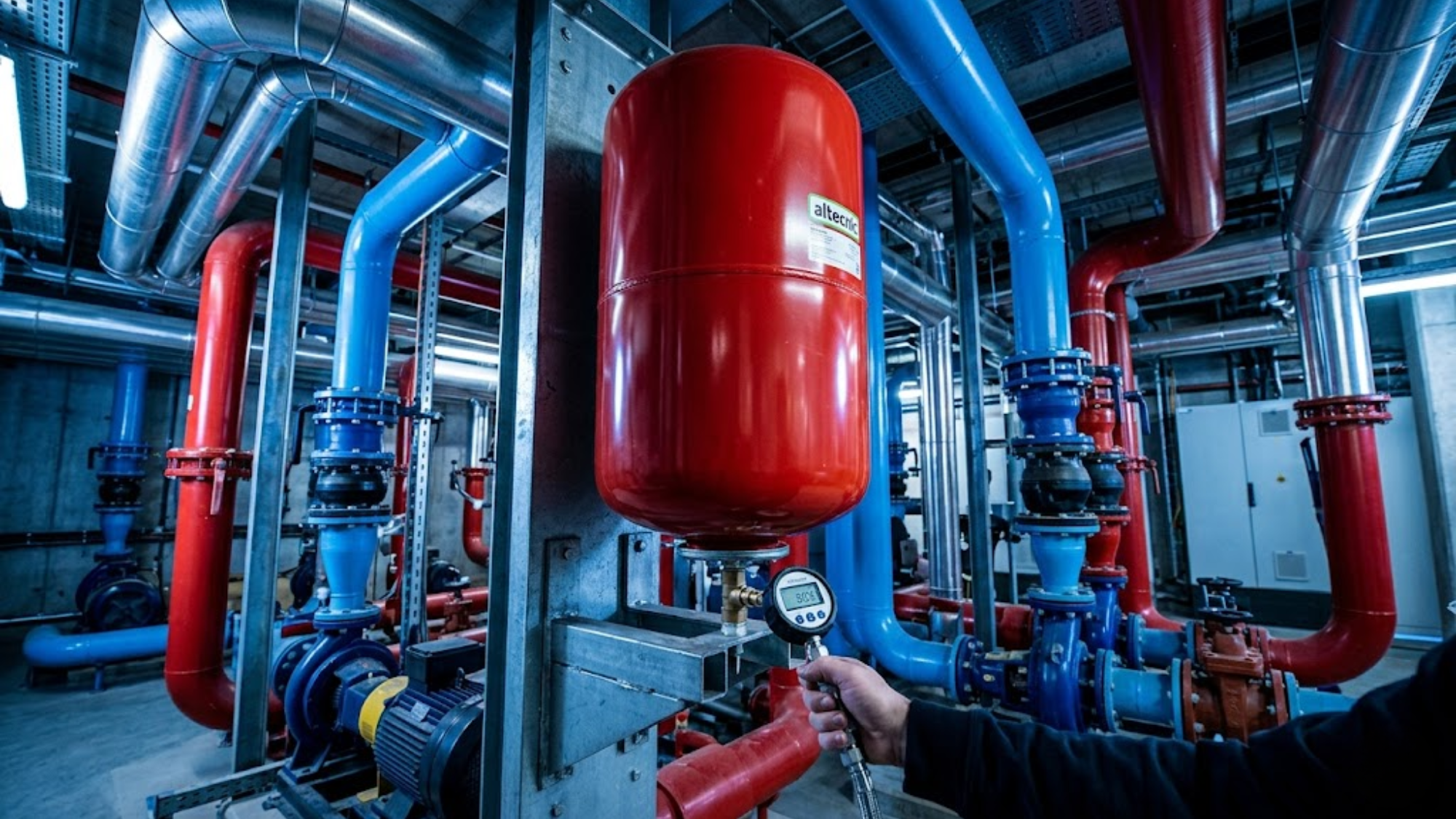
Most heating system failures in multi-storey buildings trace back to a single miscalculation: incorrect expansion vessel pre-charge pressure. We have seen boiler replacements costing thousands of pounds that could have been prevented by spending fifteen minutes with a pressure gauge and a calculator before commissioning. Mastering the altecnic reflex expansion vessels pre-charge adjustment process is a fundamental skill for any engineer working in high-rise residential or commercial environments.
Altecnic Reflex expansion vessels typically arrive factory-set at 1.5 bar. This setting is perfectly adequate for a single-storey home or a small bungalow. However, if you install that same vessel on the ground floor of a residential block without adjustment, you will likely deal with waterlogged vessels, relief valve discharge, and total system failure within months.
Why Static Height Demands Pre-Charge Adjustment
The physics of a tall building is straightforward. Every 10 metres of vertical pipework adds approximately 1 bar of static pressure to the system. A heating system serving floors 1 to 8 of a building creates 24 metres of static head, which equates to roughly 2.4 bar of pressure just from the weight of the water column.
If your pre-charge sits at the factory 1.5 bar, the system's static pressure (2.4 bar) will exceed the vessel's air charge. This forces the internal diaphragm to stay compressed against one side of the vessel, allowing water to fill the entire space. Because the vessel can no longer absorb thermal expansion, pressure spikes occur whenever the boiler fires. Professionals at Heating and Plumbing World regularly supply replacement vessels to sites where this initial calibration was skipped.
The maths becomes critical when commissioning systems across urban areas where height variations are significant. You must calculate the static head at vessel location precisely. If the plant room is in the basement and the highest radiator is 30 metres above, the minimum static pressure is 2.94 bar. To ensure the system remains functional, your cold fill pressure must be set roughly 0.5 to 1.0 bar above this static level.
Calculating Correct Pre-Charge Pressure
The formula for setting the vessel accounts for three primary variables: the cold fill pressure, the safety margin, and the specific static head at vessel location. If you have a 12-storey building with the plant room on the ground floor and the highest radiator valves are 36 metres above, your static pressure is 3.53 bar.
Adding a safety margin of 1.0 bar gives you a cold fill pressure of 4.53 bar. Since the vessel is on the ground floor (0m height), your pre-charge must match that 4.53 bar. However, if the vessel were mounted on the 6th floor (18m height), the static head at vessel location would be 1.76 bar. In that scenario, the required pre-charge would be 2.77 bar. The location of the vessel in the vertical column matters as much as the system height itself.
Adjusting Altecnic Reflex Vessel Pre-Charge
Altecnic Reflex vessels feature a standard Schrader valve on the air side, similar to a car tyre valve. To perform an adjustment, you need an accurate pressure gauge with at least 0.1 bar precision and a nitrogen cylinder with a regulator. You should never use compressed air for this process. Oxygen in compressed air permeates through the diaphragm over time, leading to internal corrosion and pressure loss. Nitrogen molecules are larger and more stable, significantly slowing the rate of pressure drop.
Think of the expansion vessel like a high-stakes tug-of-war between the water in the pipes and the air behind the diaphragm. If the air team is not strong enough (low pre-charge), the water team pulls the diaphragm all the way to their side, leaving no room for the water to expand when it gets hot. The altecnic reflex expansion vessels pre-charge adjustment ensures the air team has exactly enough "strength" to hold the water at the borderline, ready to give ground only when the system heat increases.
Start the adjustment by isolating the vessel from the system using the plumbing fittings and supplies provided at the inlet. Drain the water side completely to verify zero pressure before checking the air side. Remove the cap from the Schrader valve, attach your gauge, and add nitrogen slowly in 0.2 bar increments until you reach the calculated target.
Vessel Sizing Verification and Sizing Calculations
Adjustment only works if the vessel is sized correctly for the total system volume and the temperature differential. A common mistake is ignoring the expansion coefficient of water, which is approximately 0.034 for water heated from 10 to 80 degrees Celsius. For a 2,000-litre system with a 4.5 bar cold fill and 6.0 bar maximum operating pressure, you would require a 300-litre vessel to provide an adequate safety margin.
Undersized vessels will fail regardless of how accurately you set the pre-charge. If the air charge compresses too much during expansion, it will push the system pressure beyond the relief valve setting. We have seen 80-litre vessels specified for 1,500-litre water pipe systems, which is mathematically impossible to sustain.
Common Multi-Storey Installation Mistakes to Avoid
Many installers incorrectly mount vessels at the highest point of the system, thinking it assists with air elimination. This actually creates massive pre-charge requirements and makes maintenance difficult. It is always better to mount the vessel in the ground floor plant room where the static head at vessel location is most manageable.
Another factor involves pressure reducing valves (PRVs). Many tall buildings use pressure reducing valves to zone pressure across different floors. If your vessel is downstream of a PRV set at 3.0 bar, that setting becomes your maximum system pressure regardless of the static head. Your calculations must reflect these mechanical limits.
On a recent project in a London skyscraper, we were called to investigate a "singing" relief valve that hummed every time the pumps started. The original installer had ignored the building height and left the vessel at the factory 1.5 bar setting. The vessel was completely waterlogged. Every time the room thermostat called for heat, the pressure spiked instantly, causing the valve to weep and vibrate. A simple nitrogen top-up to the correct static level resolved the issue in twenty minutes.
Maintenance and Long-Term Performance Monitoring
Nitrogen pressure drops over time through a natural process called diaphragm permeation. Altecnic Reflex vessels typically lose between 0.1 and 0.2 bar annually. You must check the pre-charge during every annual boiler service. Isolate the vessel, drain the water side, and measure the air pressure. If it has dropped more than 0.3 bar below the commissioning value, top it up.
Sudden or significant pressure loss, such as 0.5 bar in six months, usually indicates that diaphragm permeation has accelerated into a full diaphragm failure. In these cases, the vessel must be replaced. You can diagnose this by checking for water discharge from the Schrader valve when testing the pressure. If the system is a mixed-use development, ensure the hot water cylinder expansion is also checked, as different temperature ranges mean different expansion rates.
Conclusion
Correct altecnic reflex expansion vessels pre-charge adjustment is what separates a functional multi-storey heating system from a maintenance nightmare. Anything above 5 metres of static head demands a precise calculation and adjustment before the system is commissioned.
Calculate your required cold fill pressure, adjust the pre-charge to match the vessel location, and document the final settings for future engineers. This work takes only thirty minutes during installation but saves days of troubleshooting later. If you require assistance with complex sizing calculations or high-pressure vessel specifications, get expert advice from our technical team today.