

Annual Servicing Unvented Cylinders: Checking Safety Devices
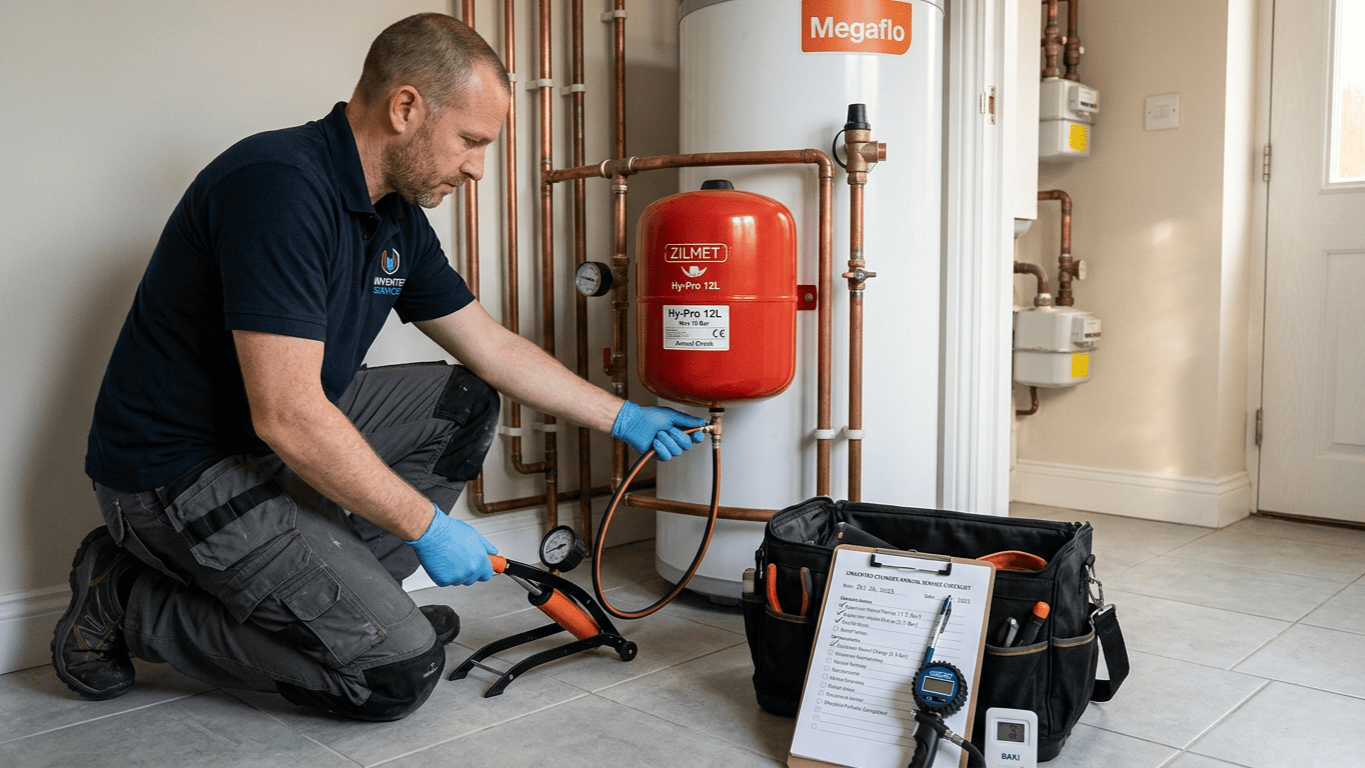
Unvented hot water cylinders have completely transformed how we heat water in modern homes. However, they simply aren't fit-and-forget systems. These pressurised vessels store water at mains pressure. Therefore, completing annual servicing unvented cylinders is absolutely essential to ensure every safety device functions perfectly.
Skip this maintenance, and you're gambling with equipment that could fail catastrophically. We've seen too many scenarios where a homeowner assumes everything is fine just because hot water still flows. Unfortunately, that isn't how safety works with unvented systems.
These vital safety devices sit entirely dormant until something goes wrong. Proper maintenance confirms they'll actually work when needed, rather than seizing up from years of neglect.
Why Safety Devices Matter On Unvented Systems
First, unvented cylinders operate at significantly higher pressures than traditional vented systems. Mains water pressure typically ranges from 1 to 3 bar in UK properties. Consequently, that pressure transfers directly into the cylinder. When water heats, it naturally expands. Without proper pressure relief, that expansion creates incredibly dangerous conditions.
Think of the safety devices like seatbelts, airbags, and crumple zones in a car. You hope you will never need them, but when a collision happens, they prevent a total disaster. Similarly, a malfunctioning valve on an overheating cylinder could easily allow pressure to build beyond safe limits. The consequences range from ruptured cylinders to scalding water discharge.
Furthermore, Building Regulations require these cylinders to meet specific safety standards. Those regulations legally mandate proper professional maintenance. This isn't just bureaucratic box-ticking. It is a vital recognition that pressurised hot water systems need professional oversight. You will always need reliable trade heating supplies to maintain them correctly over their lifespan.
The Core Safety Devices You Must Check
Every unvented cylinder incorporates several critical safety components. Understanding what each part does helps explain why these regular checks matter so much:
- Temperature and pressure relief valve (TPRV): This valve opens if water temperature or pressure climbs too high. It is your absolute last line of defence.
- Expansion vessel: As water heats and expands, the vessel absorbs that volume increase safely.
- Pressure reducing valve (PRV): This valve limits incoming mains pressure to safe levels.
- Line strainer: Positioned before the PRV, this catches debris from the mains supply.
- Check valve: This prevents hot water from flowing backwards into the cold mains supply.
- Tundish: This is an air gap device that provides a clear visible warning if the system is discharging.
Testing Temperature And Pressure Relief Valves
The tprv discharge test forms the centrepiece of your safety checks. Essentially, this valve must operate freely when lifted manually. It should then seal completely when released. We've encountered countless TPRVs that haven't been tested in years, which means they're often seized or completely stuck.
Before testing, we must confidently confirm the discharge pipework terminates safely. The discharge pipe must run to a highly visible location. In the past, we've found discharge pipes terminating into walls or under floors, all of which are incredibly dangerous.
To successfully execute the tprv discharge test, simply lift the test lever slowly. Water should discharge immediately through the tundish. When you release the lever, the discharge should stop completely within seconds. Often, while servicing the cylinder, we also check nearby boiler components. For example, we ensure the Worcester Bosch condensate pump is clear of blockages and operating smoothly.
Expansion Vessel Inspection And Testing
The expansion vessel fails much more often than most people realise. The internal diaphragm can perforate, or the air charge can slowly leak away over time. Both failures severely compromise system safety and cause nuisance discharge.
Testing always starts by isolating the cylinder and draining it down. We then execute our schrader valve testing using a standard tyre pressure gauge. The correct pressure typically ranges from 3 to 3.5 bar for domestic installations. Regular schrader valve testing prevents these hidden failures from destroying your property.
On a recent callout to a block of flats, the previous engineer had skipped draining the cylinder before checking the vessel. As a result, he read system water pressure instead of the air pre-charge. The vessel was actually completely flat, leading to constant dripping and a ruined ceiling in the flat below!
If you find a failed vessel, replacing it with a high-quality Zilmet Hy-Pro expansion vessel is the standard professional fix.
Pressure Reducing Valve Function Check
The PRV controls incoming mains pressure. Naturally, its failure negatively affects both safety and performance. We test the PRV output pressure using a gauge temporarily fitted to a drain valve downstream.
With mains water flowing, the gauge should read the correct pressure reducing valve setting. This is typically around 3 bar for most domestic systems. If you need to adjust the pressure reducing valve setting, always re-test the flow immediately. If the pressure reads high, the PRV isn't restricting flow properly.
The PRV's internal cartridge also requires close attention during this process. Performing proper line strainer cleaning involves isolating the inlet, removing the cartridge, and flushing away debris. Regular line strainer cleaning is crucial because properties with older iron mains often show incredibly heavy contamination.
Thermostat Calibration And High-Limit Testing
Unvented cylinders typically feature two vital thermostats. There is an operating thermostat that controls normal heating, and a high-limit thermostat that cuts power if the water temperature exceeds safe limits. Both parts require careful checking.
We verify the operating thermostat maintains water temperature at the correct set point. Using an accurate Baxi temperature sensor at the nearest hot tap, we confirm the actual water temperature matches the thermostat setting.
The high-limit thermostat typically trips safely at 85°C to 90°C. Performing a complete high-limit thermostat test requires specialist equipment to deliberately create an overheat condition. Before concluding the service, we always document the high-limit thermostat test results thoroughly.
We've actually encountered systems where someone has bypassed the high-limit thermostat to "fix" a nuisance tripping problem. This foolishly removes a critical safety layer. If a replacement is needed, fitting a reliable IMIT LS1 limit thermostat restores the system's integrity perfectly.
Discharge Pipework Verification
The TPRV discharge pipe must meet very specific requirements. Yet, we regularly find non-compliant installations during visits. Annual servicing includes verifying the discharge route fully complies with current standards.
To ensure strict compliance, the discharge pipework must feature the following:
- It must be made of metal from the TPRV to at least 600mm from the final discharge point.
- It must be sized correctly according to the safety valve's capacity.
- It must be routed vertically down wherever possible.
- It must be properly protected from freezing throughout its entire length.
We meticulously trace the entire discharge route during servicing. Any plastic pipework near the TPRV gets replaced immediately because plastic simply can't withstand a 95°C discharge temperature.
Control System And Electrical Safety
Modern unvented cylinders incorporate various controls beyond basic thermostats. Performing annual servicing unvented cylinders includes checking that all electrical components function correctly and safely.
We always verify the immersion heater elements operate and draw appropriate current. Excessive current draw usually indicates element scaling or impending failure. Furthermore, we thoroughly check the wiring for any signs of overheating at the terminals.
For systems with integrated gas boilers, ensuring combustion components are healthy is also vital. Checking that parts like the Oxy-Pilot NG9040 are functioning correctly forms part of a comprehensive system health check.
The Cost Of Skipping Annual Service
We've attended emergency callouts where unvented cylinders failed catastrophically simply because maintenance was neglected. The consequences extend far beyond the cylinder itself. Performing regular annual servicing unvented cylinders is the absolute best way to mitigate these massive risks.
Skipping your service can lead to several devastating scenarios:
- Ruptured cylinders: A TPRV that doesn't open during an overheat event can allow pressure to literally split the cylinder seams.
- Massive property damage: Uncontrolled flooding can destroy floors, ceilings, furnishings, and even neighbouring properties.
- Insurance claim rejections: Insurance companies increasingly reject claims where proper service records simply don't exist.
- Scalding injuries: Scalding water at 90°C causes severe burns in a matter of seconds.
Conclusion
Completing annual servicing unvented cylinders isn't just about keeping your hot water flowing. Instead, it's about ensuring multiple safety systems function correctly when an emergency strikes. These pressurised vessels store substantial energy, and their safety devices must work perfectly to prevent dangerous failures.
The annual service thoroughly checks every critical component. You must verify TPRVs open properly, expansion vessels accommodate thermal expansion, and thermostats prevent overheating. Each component plays a highly specific role in your overall system safety.
Property owners and landlords have clear legal obligations to maintain these cylinders properly. Beyond legal compliance, there is a straightforward moral duty of care to anyone who occupies the property. Please get expert advice from our dedicated team if you need to schedule a thorough safety inspection today.