

Backup Hot Water for Commercial Kitchens: Instant Heater Options
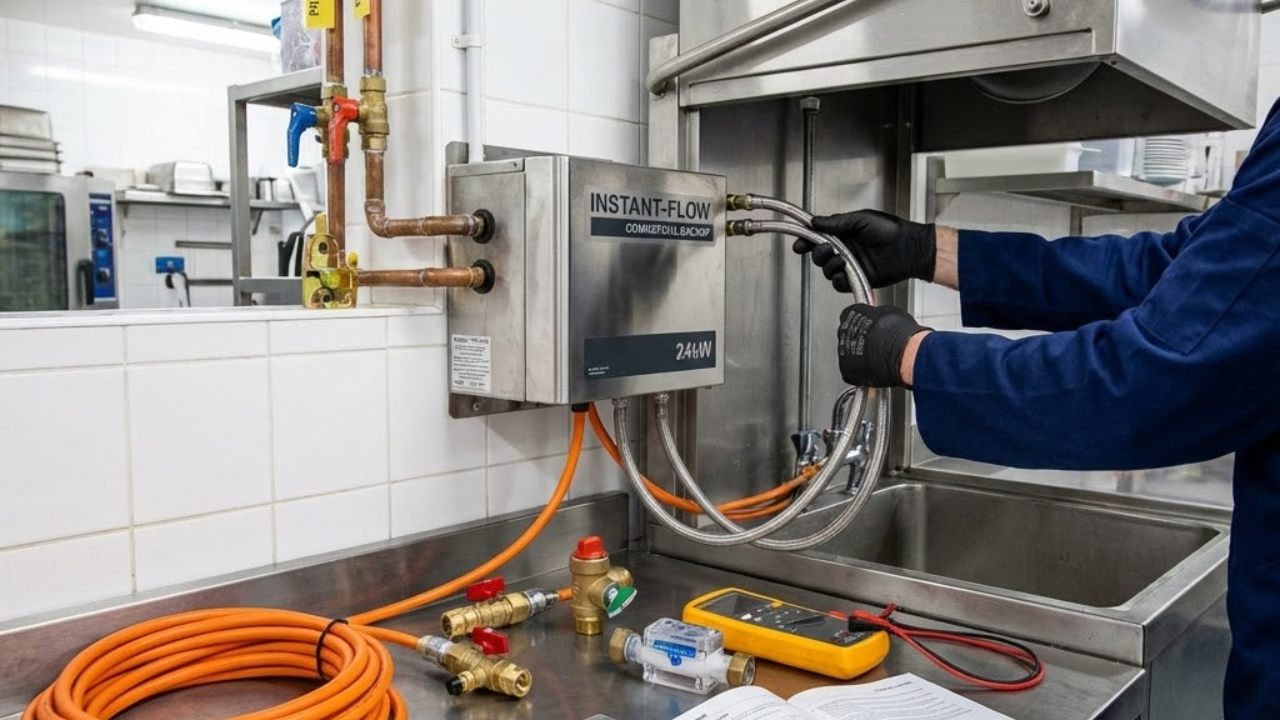
When the main hot water system fails during a lunch rush, a commercial kitchen doesn't just lose productivity. It loses revenue, risks health code violations, and jeopardises its reputation. A single breakdown can cost thousands in lost service, emergency repairs, and potential closure until the issue's resolved. That's why backup hot water systems aren't optional extras for professional kitchens - they're essential insurance against operational catastrophe.
The best backup systems aren't scaled-down versions of your primary heating. They're instant, point-of-use solutions that fire up within seconds, delivering hot water exactly where it's needed without relying on the infrastructure that's just failed. Whether you're running a hospital kitchen, a hotel restaurant, or a care home facility, the right instant heater can keep your washing stations, prep sinks, and cleaning protocols operational whilst your main system gets repaired.
Think of backup hot water like a spare wheel in a delivery van. Your main tyres are brilliant - high quality, properly maintained, designed for thousands of miles. But when one fails at the worst possible moment, that spare wheel's worth its weight in gold. It's not meant for long-distance motorway driving, but it gets you to the tyre shop without calling for a tow truck. Same principle applies to backup hot water.
Heating and Plumbing World supplies comprehensive water heating solutions for commercial kitchen installations.
Why Commercial Kitchens Need Dedicated Backup Systems
Most commercial heating systems are designed with redundancy built into the primary installation - multiple boilers, or large storage cylinders that can handle peak demand. But when that system goes down completely, whether through component failure, power loss, or maintenance work, the kitchen stops functioning. You can't wash dishes in cold water and expect to pass an Environmental Health inspection. You can't sanitise surfaces properly. Staff can't clean hands to the required standard.
The gap between "main system failure" and "engineer arrives with parts" can stretch from hours to days, depending on the fault and parts availability. During that window, an instant water heater becomes your lifeline. It doesn't need to match the capacity of your primary system. It just needs to keep critical operations running at a reduced but compliant level.
The key requirements for backup hot water in commercial kitchens include:
- Instant activation with no warm-up period or pre-heating cycles
- Point-of-use installation positioned close to critical sinks and washing stations
- Independent operation not relying on the same fuel source or infrastructure as main system
- Compliance temperatures delivering water at 60°C minimum for sanitisation
- Compact footprint fitting into tight equipment rooms or under-counter spaces
- Simple controls allowing kitchen staff to operate without specialist training
A backup system isn't about maintaining full capacity. It's about keeping your kitchen legally operational and preventing total shutdown whilst repairs happen. That distinction shapes which instant heater technologies make sense.
Instant Electric Water Heaters: The Fastest Backup Solution
Electric instantaneous heaters are the default choice for commercial kitchen backup because they eliminate every dependency that might have caused your main system to fail. No gas supply issues. No flue complications. No stored water that needs maintaining. Just a direct connection to the mains supply and an electrical feed.
These units heat water on demand by passing it through high-wattage heating elements. Flow rates are lower than your main system (typically 2-4 litres per minute at 60°C) but that's sufficient for a single pot wash sink or a handwash station during emergency operation. The advantage is immediate - flip the isolator, open the tap, and you've got hot water in under ten seconds.
Sizing considerations for electric instant heaters:
- Power requirement: Most commercial-grade units need 12-27kW three-phase supply
- Flow rate versus temperature rise: A 24kW unit delivers approximately 3.5 L/min at a 50°C rise (10°C inlet to 60°C outlet)
- Installation location: Must be within 2-3 metres of the point of use to minimise heat loss and response time
- Electrical infrastructure: Confirm your kitchen's electrical panel can handle the additional load without tripping
The limitation with electric instant heaters is that they can't serve multiple outlets simultaneously at full temperature. If you need backup for both a pot wash and a prep sink, you'll need separate units or accept that only one station operates at a time during emergency mode. For most kitchens, that's an acceptable trade-off against the alternative of complete shutdown.
Morco water heaters manufacture compact units specifically designed for commercial environments, with IP-rated enclosures that withstand the humidity and temperature swings typical of busy kitchens. When specifying a backup unit, prioritise models with adjustable thermostats and flow limiters, so staff can fine-tune output to match the task without wasting energy.
Gas Instantaneous Heaters: High-Output Backup for Larger Operations
If your kitchen has a reliable gas supply that's independent of your main heating system (or if your primary system failed for reasons unrelated to gas availability) then gas instantaneous heaters offer significantly higher flow rates than electric alternatives. A commercial-grade gas instant heater can deliver 10-15 litres per minute at 60°C, enough to run a three-bay pot wash sink at reduced capacity.
These units work by igniting a gas burner when water flow's detected, heating the water as it passes through a heat exchanger. Modern units use electronic ignition rather than pilot lights, improving reliability and reducing standby gas consumption. The key advantage over electric is output - you're not limited by electrical supply capacity, so you can install a more powerful unit that genuinely approximates your main system's performance.
Critical installation requirements for gas instant heaters:
- Flue connection: Must vent combustion gases safely; room-sealed models are preferable in commercial kitchens
- Gas supply: Minimum pipe diameter and pressure requirements must be met (typically 22mm supply for units above 20kW)
- Ventilation: Adequate air supply for combustion if using an open-flue model
- Condensate drainage: Condensing models need a drain connection for acidic condensate
The main drawback is installation complexity. You can't just mount a gas instant heater wherever it's convenient. You need to route gas pipework, install appropriate flue terminals, and ensure ventilation meets Building Regulations. That makes them less suitable as portable or temporary backup solutions, but ideal if you're planning permanent redundancy into a new kitchen design or major refurbishment.
For commercial applications, consider models from manufacturers like Andrews Water Heaters range, which produce robust instantaneous gas water heaters designed for high-demand environments. Look for units with modulating burners that adjust output based on flow rate, maintaining consistent outlet temperatures even when demand varies.
Point-of-Use Storage Heaters: Bridging the Gap
Whilst not strictly "instant" in the sense of on-demand heating, compact point-of-use storage heaters (typically 10-30 litre capacity) offer a middle ground that's worth considering for backup applications. These units maintain a small volume of water at temperature, ready for immediate use, then reheat quickly between draw-offs.
A 15-litre under-sink storage heater can deliver a continuous flow of hot water for 3-4 minutes, which is often sufficient for washing a load of pots or sanitising a work surface. The recovery time (how long it takes to reheat the stored volume) is typically 10-15 minutes with a 3kW element. That's fast enough to support intermittent use during a backup scenario.
Advantages of point-of-use storage for backup:
- Lower power demand: A 3kW unit runs on single-phase supply, easier to integrate into existing electrical infrastructure
- Consistent temperature: No variation based on flow rate; stored water's always at set temperature
- Simpler installation: Smaller electrical requirement and no flue needed
- Unvented models available: Can deliver mains pressure hot water for better flow rates at taps
The trade-off is that you're limited by storage capacity. Once the tank's depleted, you wait for recovery. In a true emergency where your main system's down for an extended period, that limitation becomes frustrating. But for short-duration tasks (handwashing, filling a bucket for mopping, rinsing vegetables) point-of-use storage heaters excel.
When specifying these units, pay attention to the connection type. Unvented models connect directly to the mains supply and deliver water at mains pressure, giving better flow rates. Vented models require a cold water cistern and deliver at lower pressure, but they're simpler to install and don't require annual safety inspections under the same regulations.
Gledhill's unvented cylinders include a range of compact unvented water heaters suitable for commercial point-of-use applications, with models specifically designed to fit under counters or in tight equipment cupboards. These units include all necessary safety devices (pressure relief valves, thermostats, and thermal cut-outs) meeting the requirements for unvented hot water systems.
Designing Redundancy Into New Installations
If you're specifying a new commercial kitchen or undertaking a major refurbishment, the time to think about backup hot water isn't when the main system fails. It's during the design phase. Properly planned redundancy doesn't just mean buying a backup heater - it means creating an infrastructure that can switch between primary and secondary systems with minimal disruption.
Design strategies for built-in redundancy:
- Dual-circuit primary systems: Install two smaller water heaters instead of one large unit, each capable of handling 60-70% of peak demand independently
- Segregated supplies: Run separate hot water circuits to critical areas (pot wash, handwash stations) that can be fed from backup sources
- Pre-installed electrical and gas supplies: Provision the infrastructure for backup heaters even if you don't install the units immediately
- Isolation valves and changeover controls: Allow staff to switch from primary to backup without calling an engineer
The cost of designing redundancy into a new installation is marginal compared to the cost of retrofitting it later, or the cost of a single day's closure due to hot water failure. You're talking about an additional few hundred pounds in pipework, valves, and electrical supplies during construction, versus thousands in lost revenue and emergency repairs down the line.
One approach that works well in larger operations is to install a high-capacity instant heater as a permanent fixture, plumbed in parallel with the main system but isolated under normal operation. When the primary system fails, staff simply open the isolation valves and close the primary supply, switching over in minutes rather than waiting for an engineer to arrive and temporarily rig something up. That instant heater sits dormant most of the time, but it's there when you need it, properly installed and tested.
Practical Installation Considerations for Backup Systems
Installing a backup water heater isn't just about bolting a unit to the wall and connecting pipes. The installation needs to be thought through so that when you're in emergency mode (possibly with reduced staffing, definitely under pressure) switching to backup is straightforward and safe.
Key installation factors:
- Accessibility: Mount the unit where kitchen staff can reach controls and isolators without climbing or moving equipment
- Clear labelling: Mark all valves, switches, and connections with durable labels explaining their function
- Emergency procedure documentation: Laminate a simple instruction sheet near the unit: "Main system failed? Here's how to activate backup"
- Electrical protection: Install dedicated MCBs or RCBOs for backup heaters, clearly labelled in the distribution board
- Water quality: Consider inline filters if your mains supply has high sediment levels that could clog instant heater elements
The biggest mistake is installing a backup system, then never testing it until the emergency actually happens. Schedule quarterly tests where you deliberately switch to backup mode, run hot water through the system, and verify that staff know the procedure. That ten-minute drill could save your operation when it matters.
For electric instant heaters, pay particular attention to cable sizing. A 24kW three-phase unit draws approximately 35 amps, requiring 6mm² cable as a minimum, protected by a 40A MCB. Undersized cables or incorrect protection devices are common installation faults that render backup systems unusable (or worse, dangerous) when they're finally needed.
Maintenance and Compliance for Backup Hot Water Systems
A backup system that isn't maintained is a backup system that won't work when you need it. The challenge with backup equipment is that it sits unused for long periods, which creates its own maintenance issues: seals dry out, elements corrode, valves seize, and safety devices fail without anyone noticing.
Maintenance schedule for backup instant heaters:
- Monthly: Visual inspection for leaks, corrosion, or damage; test activation and check outlet temperature
- Quarterly: Full operational test under load; inspect electrical connections; verify safety device operation
- Annually: Descale heat exchangers if in hard water areas; replace sacrificial anodes in storage models; test and recalibrate thermostats
- After any use: Flush system thoroughly; check for any issues that arose during emergency operation; restock any consumables used
For gas instant heaters, annual servicing by a Gas Safe registered engineer isn't just good practice. It's a legal requirement. That service should include combustion analysis, flue integrity testing, and verification that all safety devices (flame failure, overheat stats, pressure switches) are functioning correctly. Don't skip this even though the unit's barely used - gas appliances deteriorate whether they're running or not.
Electric instant heaters require less formal servicing, but they still need attention. The heating elements are the primary wear component, particularly in hard water areas where limescale buildup reduces efficiency and eventually causes failure. If your water hardness exceeds 200ppm (check your local water quality report), install a scale inhibitor upstream of the heater or plan for element replacement every 2-3 years.
Troubleshooting Common Backup System Failures
The worst time to discover your backup system doesn't work is when you desperately need it. Understanding common failure modes and their fixes helps you get a non-functioning backup operational quickly, or better yet, identify problems before they become critical.
Electric instant heater won't heat:
- Check MCB/RCB hasn't tripped; reset if necessary
- Verify flow rate meets minimum activation threshold (usually 1.5-2 L/min)
- Test heating elements with multimetre; replace if open circuit
- Inspect thermal cut-out; manually reset if tripped
Gas instant heater won't ignite:
- Confirm gas isolation valve is open
- Check for adequate water flow to activate flow switch
- Verify electronic ignition has power (check fuse/MCB)
- Inspect flue terminal for blockages (birds' nests, debris)
- Test flame sensor; clean or replace if contaminated
Inconsistent water temperature:
- Adjust thermostatic control; may have drifted over time
- Check for scale buildup in heat exchanger; descale if necessary
- Verify flow rate is within unit's designed range
- Inspect mixing valve (if fitted); may be faulty or incorrectly set
No water flow from unit:
- Check isolation valves are fully open
- Inspect inlet filter/strainer; clean if blocked
- Verify mains water supply is available
- Test pressure relief valve hasn't stuck open
Most of these issues can be diagnosed and resolved without specialist tools, which is important when your main system's already down and you can't afford to wait for an engineer to attend to the backup as well. Keep basic spares on site (replacement elements, igniters, thermostats) and ensure maintenance staff know where they're stored and how to fit them.
Regulatory Compliance and Safety Standards
Backup hot water systems in commercial kitchens must meet the same regulatory standards as primary systems. The fact that a unit's only used occasionally doesn't exempt it from Building Regulations, Water Supply Regulations, Gas Safety regulations, or health and safety requirements.
Key compliance areas:
- Water temperature: Must deliver minimum 60°C at outlets to prevent Legionella growth and ensure effective sanitisation
- Backflow prevention: Check valves or other approved devices required to prevent contamination of mains supply
- Electrical safety: Installation must comply with BS 7671 (IET Wiring Regulations); RCD protection required for most installations
- Gas safety: Installation and servicing must be carried out by Gas Safe registered engineers; annual safety inspections required
For unvented storage heaters above 15 litres, installation must be notified to Building Control and carried out by someone holding appropriate qualifications (G3 unvented hot water certification). Even though these are backup systems, they're still pressure vessels containing water at high temperature, and the safety requirements are non-negotiable.
Environmental Health Officers conducting kitchen inspections will expect to see evidence that hot water systems (including backups) are maintained and capable of delivering compliant temperatures. If your backup system can't demonstrate 60°C at the tap, it's not a compliant backup, regardless of how rarely it's used.
Cost-Benefit Analysis: Justifying the Investment
A commercial-grade instant water heater suitable for backup duty costs £500-2,000 depending on capacity and fuel type, plus installation costs of £300-1,500 depending on complexity. For a busy commercial kitchen, that's a significant but not prohibitive investment. The question is whether it's justified.
Consider the cost of a single day's closure due to hot water system failure:
- Lost revenue: A restaurant turning 100 covers per service at £30 average spend loses £6,000 per day
- Staff costs: You're still paying wages even if the kitchen can't operate
- Reputation damage: Cancelled bookings and disappointed customers have long-term effects
- Emergency repair premiums: Call-out fees and expedited parts supply add 50-100% to repair costs
Against that backdrop, a £1,500 investment in a backup system that prevents closure pays for itself the first time it's used. Even if your main system only fails once every five years, the backup's cost-justified. If you operate in a sector where closure isn't an option (hospitals, care homes, schools) the calculation's even more straightforward.
The secondary benefit is negotiating power. When your main system fails and you're not desperate, you can get normal-hours repairs at standard rates rather than paying emergency premiums. The backup buys you time to get the right engineer, source the correct parts, and have the work done properly rather than accepting whatever temporary bodge gets you operational again.
On a busy hotel kitchen project, the chef initially rejected backup hot water as an unnecessary expense. "We've got three boilers, what's the chance all three fail?" Six months after opening, a power surge took out the control boards on all three units simultaneously. The kitchen was down for 36 hours whilst replacement boards were sourced and fitted. Lost revenue from two dinner services, one wedding breakfast, and Sunday lunch totalled over £18,000. The backup system they didn't install would have cost £2,200.
Conclusion
Commercial kitchen backup hot water isn't about duplicating your primary system's capacity. It's about maintaining critical operations during the gap between failure and repair. The right instant heater, properly installed and maintained, transforms a potential multi-day closure into a manageable inconvenience.
Electric instant heaters offer the fastest, simplest backup for smaller operations or single-point applications. Gas instantaneous heaters deliver higher flow rates for larger kitchens with reliable gas supplies. Point-of-use storage heaters bridge the gap for intermittent-use scenarios where recovery time isn't critical.
The key is planning before the crisis hits. Specify backup systems during design phases, install the necessary infrastructure even if you defer purchasing the actual heater, and test your emergency procedures regularly so staff know exactly what to do when the main system fails at the worst possible moment.
The commercial kitchen that plans for failure is the one that stays operational when others shut down. That's not pessimism. It's professional preparation that protects your revenue, your reputation, and your compliance with health and safety standards.
For expert advice on selecting the right backup hot water solution for your commercial kitchen, our heating and plumbing supplies include instant heaters and point-of-use storage designed for commercial applications. Contact our support team to discuss systems that keep your operation running when it matters most.