

Best Expansion Vessels for Hard Water Areas: Protection Features
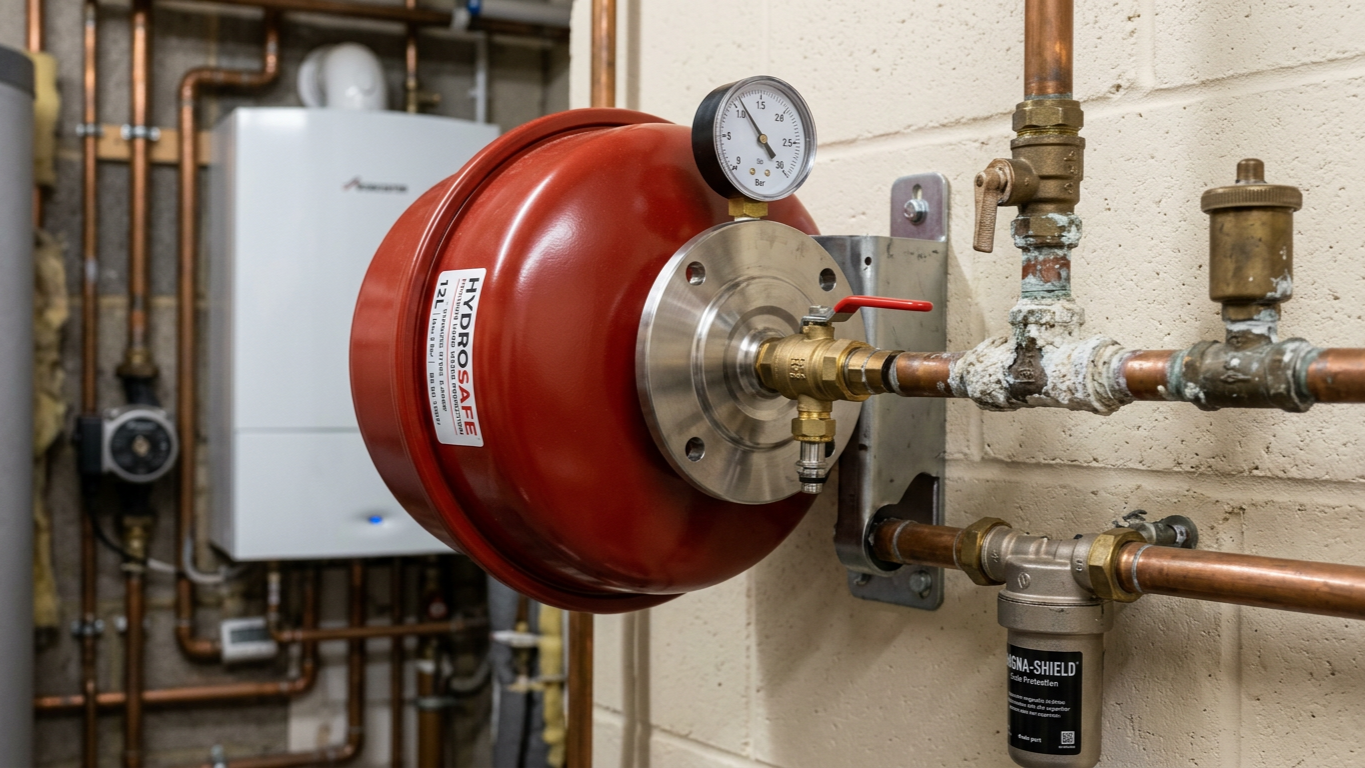
Hard water doesn't just leave limescale on taps; it systematically degrades heating system components from the inside out. Expansion vessels, those critical pressure-management devices that protect sealed heating systems, face particular challenges in areas with high mineral content. The membrane separating the water and nitrogen charge can become calcified, the internal bladder can stiffen and crack, and the connection points can corrode far faster than in soft water regions.
For heating engineers working in hard water areas across the UK, specifying the right unit isn't just about system volume calculations. It is about understanding which manufacturers build vessels that can withstand the relentless mineral assault that hard water delivers. Get this wrong, and you'll be replacing a failed vessel within three years instead of the expected ten to fifteen.
Why Hard Water Destroys Standard Expansion Vessels
Hard water contains elevated levels of calcium and magnesium salts, typically measured above 200mg/l as calcium carbonate. When heated in a sealed system, these minerals precipitate out of solution and form scale deposits on any surface they contact. The flexible membrane inside an expansion unit, usually made from standard EPDM or simple rubber, becomes a prime target for this mineralisation.
Experts from Heating and Plumbing World regularly advise that the membrane needs to flex thousands of times over its lifetime as the system heats and cools. Each expansion cycle moves water against the membrane, depositing microscopic layers of scale. Over time, this calcification stiffens the rubber, reducing its flexibility until it eventually cracks. Once the membrane fails, water crosses into the gas chamber, the vessel loses its cushioning capacity, and system pressure spikes dangerously.
Connection points suffer equally. The threaded entry where the vessel connects to the system becomes a corrosion hotspot. Hard water accelerates galvanic corrosion between dissimilar metals, particularly where brass fittings meet steel vessel bodies. This isn't theoretical; it is the reason engineers in Kent or Essex routinely find weeping units on five-year-old systems that should have another decade of service left.
Protection Features That Actually Work
Manufacturers serving the UK market have developed specific features to combat hard water degradation. These aren't marketing gimmicks; they are engineering responses to a genuine problem that costs the industry millions in premature replacements and callbacks. Standard EPDM membranes work adequately in soft water areas, but hard water demands better.
The best units for challenging water conditions use high-grade butyl rubber membranes with increased wall thickness. Butyl offers superior resistance to mineral deposits and maintains flexibility even when exposed to heavy scale formation. Quality units, such as a dedicated expansion vessel engineered for longevity in high-mineral environments, feature materials that combat this degradation. The additional material cost translates to components that maintain their pressure-absorption function for significantly longer in hard water areas.
Some premium manufacturers go further by incorporating EPDM blends with added mineral resistance. These proprietary rubber compounds include additives that reduce the adhesion of calcium carbonate to the membrane surface. Think of this protective layer like a non-stick coating on a frying pan. Just as burnt food slides right off the pan, the scale simply doesn't bond as effectively to the treated rubber, meaning far less accumulation over time.
Corrosion-Resistant Connection Systems
The threaded connection between vessel and system represents the weakest point for corrosion. Quality vessels designed for hard water areas feature stainless steel connection flanges rather than standard brass or mild steel. Stainless steel, typically 316 grade, highly resists the electrochemical corrosion that hard water accelerates.
Look for vessels with replaceable connection cartridges. This design allows you to service the entry point without replacing the entire vessel, a feature that extends operational life by years. When the connection shows signs of corrosion or weeping, you simply swap out the cartridge rather than condemning the whole unit.
Pre-charged vessels with protective coatings on all internal metal surfaces provide another layer of defence. Epoxy or powder-coated interiors prevent direct water contact with the steel shell, eliminating one of the primary corrosion pathways. This matters particularly in combination systems where vital heating system components see both primary heating water and fresh domestic hot water.
Sizing Considerations in Hard Water Systems
Standard sizing calculations focus on system volume, maximum operating temperature, and static head. In hard water areas, you need to factor in performance degradation over time. A vessel that's correctly sized today will gradually lose effective volume as scale accumulates on the membrane and physically reduces its travel.
The practical solution is to oversize by 15% to 20% in hard water areas. If your system volume calculation suggests an 18-litre vessel, specify a 24-litre unit instead. This provides capacity headroom that compensates for the inevitable reduction in membrane flexibility as mineralisation occurs over the years.
This isn't wasteful; it is pragmatic engineering that extends service intervals and reduces failure risk. A slightly oversized boiler expansion vessel costs perhaps £30 to £40 more upfront but completely eliminates the expensive callback when a borderline-sized unit fails prematurely.
System Volume and Mineral Load
Larger systems in hard water areas face compounded challenges. A 300-litre system in a hard water region will cycle more water across the membrane than a 100-litre system, accelerating scale deposition. The relationship isn't linear, it is exponential. More water volume means more dissolved minerals, which means much faster membrane degradation.
For commercial systems above 200 litres in hard water areas, consider multiple smaller vessels rather than one large unit. Three 24-litre vessels distributed around the system offer redundancy and easier replacement if one fails. They're also simpler to handle during maintenance; try manoeuvring a 100-litre vessel in a cramped plant room versus a compact 24-litre unit.
Brands That Understand Hard Water Challenges
Not all manufacturers are created equal when it comes to hard water resilience. Some build to a price point, while others engineer for longevity in challenging conditions. The difference becomes apparent around year five, when cheap units start failing and quality units continue performing flawlessly.
Top-tier manufacturers offer a dedicated expansion vessel for heating system integration that features robust construction and premium materials. These vessels justify the higher initial cost through a massively extended service life and significantly fewer callbacks for the installer.
When specifying for hard water areas, prioritise manufacturers who explicitly address water quality in their technical documentation. If the datasheet mentions butyl rubber membranes, corrosion resistance, and water conditioning compatibility, you're looking at a product designed by engineers who understand the problem.
Water Treatment as the First Line of Defence
Even the best expansion vessels benefit from reduced mineral exposure. System water treatment isn't optional in hard water areas; it is strictly essential. A properly dosed inhibitor won't eliminate hard water challenges entirely, but it dramatically reduces scale formation and extends component life.
Inhibitors work by keeping minerals in suspension rather than allowing them to precipitate onto surfaces. They also provide corrosion protection for ferrous components throughout the system. For expansion vessels specifically, inhibitors reduce the rate of membrane calcification and protect connection points from electrochemical attack.
The addition of magnetic filters offers complementary protection by capturing iron oxide and other particulates before they reach the vessel. While they don't address dissolved minerals directly, they reduce the overall contamination load on the membrane. Modern filtering components that integrate seamlessly with heating controls provide the holistic protection these systems need to reach their maximum design lifespan.
Installation Practices That Extend Vessel Life
How you install an expansion vessel in a hard water area matters as much as which vessel you choose. Poor installation practices can negate the protection features that manufacturers build into their products. Position matters immensely. You must install the vessel on the return side of the system where water temperatures are lower.
Scale formation accelerates with temperature, as every 10°C increase roughly doubles the rate of calcium carbonate precipitation. By keeping the vessel on the cooler return rather than the flow, you significantly reduce mineral deposition on the membrane.
Isolation valves are non-negotiable. Fit a full-bore ball valve immediately before the connection. A proper expansion vessel installation allows you to isolate and depressurise the unit for gas charge checks without draining the entire system. Without isolation, checking the internal pressure becomes a major job that most engineers skip, leading to undetected failures. Furthermore, support the vessel properly with a wall bracket; don't let it hang from the pipework connection, as this stresses the threaded joint.
Maintenance Schedules for Hard Water Areas
Standard maintenance advice suggests checking the internal gas pressure annually. In hard water areas, that is insufficient. Six-monthly inspections catch developing problems before they become major failures.
Check the nitrogen charge with the system depressurised and cold. The pre-charge pressure should match the static head of the system. If you find the nitrogen charge has dropped, it indicates either gas loss through the valve or membrane failure allowing water into the gas chamber.
On a recent commercial plant room service, an engineer skipped testing the nitrogen charge because the access valve was wedged tightly behind pipework. Six months later, the system dumped its pressure during a freezing weekend, shutting down the entire office block. Relocating the vessel for easy access and adhering to a strict six-month checking schedule completely eliminated the issue.
When to Replace Rather Than Repair
Vessels don't last forever, particularly in hard water environments. Knowing when to replace rather than attempt repair saves time and prevents repeat failures. If the membrane has failed and water has entered the gas chamber, replacement is the only option. You can't economically replace the membrane in a sealed vessel because the labour cost far exceeds a new unit's price.
Visible corrosion on the vessel body indicates that hard water has compromised the protective coating. Even if the membrane still functions, the vessel's structural integrity is highly questionable. Replace it before it fails spectacularly.
Age alone justifies replacement in hard water areas. A vessel that has served ten years in a high-mineral environment has done exceptionally well. Don't push for fifteen years like you might in a soft water area. The membrane will be calcified and stiff, the pressure will be unstable, and failure is imminent.
Conclusion
Specifying pressure management components for hard water areas requires understanding how mineral-rich water attacks these critical devices. Standard vessels that perform adequately in soft water regions fail prematurely when exposed to the heavy calcium carbonate precipitation that characterises hard water.
The protection features that matter, such as butyl rubber membranes, corrosion-resistant connections, alongside essential magnetic filters, aren't expensive luxuries. They are essential engineering responses to a genuine technical challenge. Combine quality selection with proper water treatment, correct installation practices, and regular maintenance. This transforms a recurring problem into a reliable system component that performs its function for a decade or more.
If you need technical advice on selecting the right unit for your specific installation or want to discuss local water hardness factors, reach out to our experts and speak with someone who understands the real-world challenges that hard water presents to heating systems.