

Boiler Spare Records That Speed Repeat Orders
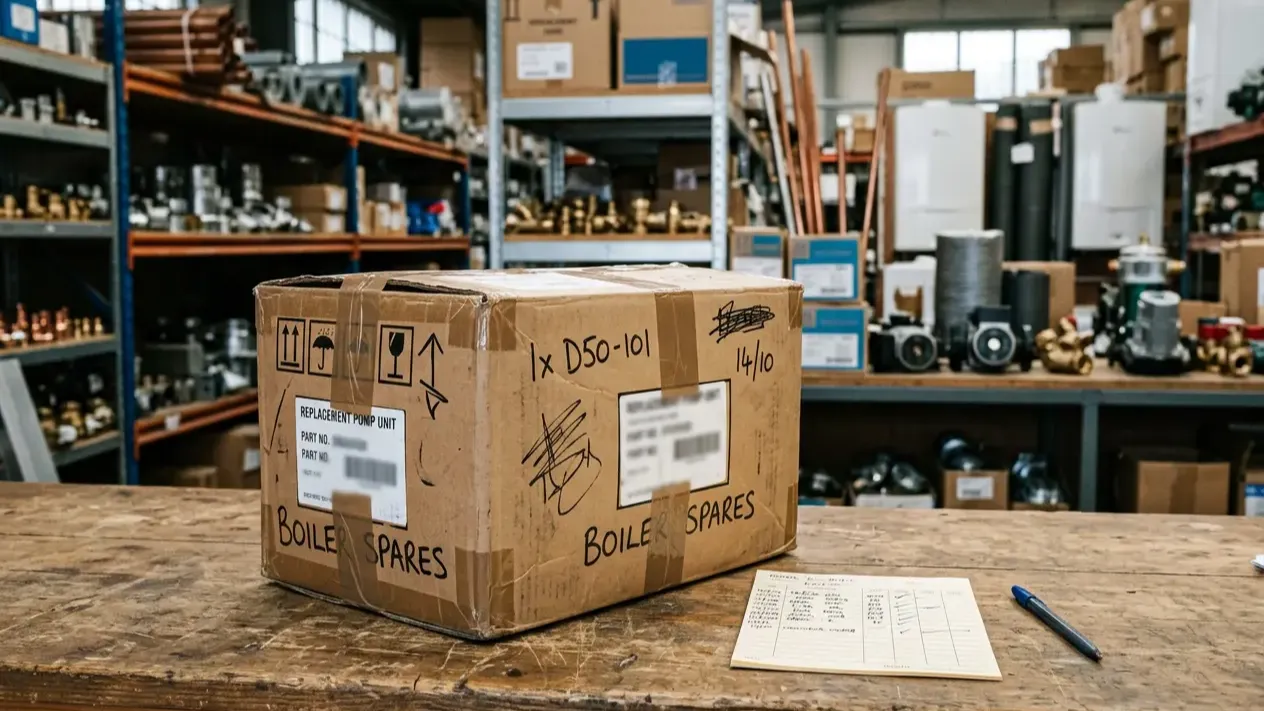
A good spare-parts record should tell the next person exactly what was ordered for a particular boiler.
For repeat orders, that means recording the spare part number actually supplied, the date, the appliance details and any additional items supplied with it. A search result or remembered part name does not provide the same certainty.
Write the record when the spare is packed. Waiting until later makes it easier to confuse part numbers, dates or appliances.
Record The Part Number, Date And Boiler Details
Start with the information that identifies both the spare and the appliance.
For boiler spares, record the exact spare part number supplied, the date it left and the boiler identification details used for the order. Depending on the product, the required details may include the make, model, GC number and serial number.
A spare name on its own is not enough. Similar components can be used across different boiler models, while a specific part number may apply only to certain appliances.
The order record should therefore connect the supplied part number to the boiler it was supplied for. Heating & Plumbing World's current ordering guidance distinguishes the appliance serial number from the spare part number, with the serial identifying the appliance and the part number identifying the component.
If the spare was supplied with additional items, record those separately. Heating products supplied alongside the main spare can be listed as extra lines rather than left in a general note.
Write The Record When The Spare Leaves
The most useful time to create the record is when the order is packed.
Write the part number on the order or packing record, then add the date and appliance details. If two different parts leave together, record both rather than relying on one description to cover the order.
This avoids turning a confirmed order into a memory exercise later.
If a part was ordered in rather than taken from existing stock, record that too. The distinction can help explain why the original repair took longer and may be useful when planning another order.
The record should reflect what actually left the counter or warehouse. Do not replace the supplied part number with the search term used to find it.
A Previous Order Does Not Remove The Need For Identification
A repeat order can be faster when the previous part number is recorded, but the old order should not replace checking the current appliance.
If the same boiler requires the same component again, the previous supplied part number provides a useful starting point. The appliance details should still be checked before the new order is placed.
If the boiler has changed, the previous record should not be carried across automatically.
This matters when several boilers are installed at the same site. A part supplied for one appliance may not be appropriate for another, even if the boilers look similar.
A record that stays linked to the appliance prevents an old part number from becoming a default choice for every boiler on the site.
Keep Extra Items On The Same Record
Repeat orders can lose useful details when only the main spare is recorded.
If the original order also included a gasket, isolation component, olive or another item, record it as an additional line. Include the size or specification where that information matters to the order.
Also record whether an item was supplied as part of the main kit or added separately.
For example, if a gasket was included with a component rather than ordered separately, the record should make that clear. Otherwise, someone repeating the order may add a second gasket unnecessarily or assume one is included when it is not.
The previous order is evidence of what was supplied at that time. It is not a guarantee that a future package will contain exactly the same items.
Check the current product description or supplier information before placing the new order.
What If The Previous Part Is No Longer Available?
A previous record can still be useful even when the original part number is no longer available.
It shows what was supplied previously and gives the supplier a reference for the appliance and component. However, the old number should not automatically become the new order.
If the supplier confirms that a different part number supersedes the original, record the new part number against the current order. Keeping the old reference as a note can also preserve the history of what was previously supplied.
The important distinction is between what was ordered previously and what can be ordered now.
A historical part number should therefore support the new enquiry, not replace it.
What If A Part Was Returned?
Returned parts should be recorded rather than silently removed from the order history.
Add the return and the reason to the record. This helps prevent the same issue from being repeated on the next order.
The reason matters because not every return means that the part number was wrong. A component might have been returned because the wrong item was supplied, because it was no longer required, or because another issue was identified.
If the return concerned the identity or suitability of the part, the next order should not simply copy that number without checking the appliance details again.
A clear return note gives the next person useful context without relying on memory.
Keep One Record For Each Appliance
Where a site has several boilers, keep the spare history tied to the individual appliance.
A single list containing parts for several similar boilers can make it difficult to tell which component belongs to which appliance. This is especially risky when model names are similar or when several engineers place orders for the same site.
Record the appliance identity clearly enough that another person can distinguish it from the others.
If a boiler is replaced, create a new record rather than continuing the old spare history as though nothing changed.
If the appliance is removed from service, close the record and add the relevant date. This prevents an old part number from being carried forward to equipment that is no longer installed.
For hire equipment, keep the record connected to the relevant serial or asset rather than the vehicle or storage location. The physical location can change, but the appliance identity remains the useful reference.
Use The Record As A Starting Point, Not A Shortcut
A good spare record speeds up the next order because it removes unnecessary searching.
It does not mean that every future order should be copied without checking.
Start with the previous supplied part number, then confirm the current appliance details. Check whether the part is still available and whether the current product description matches the requirement.
Heating & Plumbing World lists boiler spare products with part numbers and appliance-specific information, while its ordering guidance stresses checking the serial associated with the current order rather than copying an old value.
That gives the next engineer a useful reference without turning an old order into an automatic instruction.
Digital Records Can Work
The record does not have to be on paper.
A phone note, spreadsheet or other digital system can work if it keeps the essential information together. The important point is that the part number, date and appliance identification can be traced to the same order.
A photograph can also provide a useful backup record, particularly when it shows the part number clearly. However, a photograph without the appliance details can be difficult to identify later.
If photographs are used, link them to the relevant appliance record rather than leaving them buried in a general group chat.
The source record should remain clear enough for another person to understand without having to search through old messages.
When A Previous Record Is Missing
If the previous order was never recorded, treat the next enquiry as a new order rather than guessing.
A familiar site or boiler model does not confirm which part was previously supplied. Searching an old conversation may find a possible answer, but it does not necessarily establish what actually left the counter.
Ask for the appliance details and identify the required component again.
That may take longer than copying an old part number, but it avoids turning an uncertain reference into a confirmed order.
A missing record is therefore useful information in itself. It tells the next person that the previous part number has not been properly confirmed.
Build A Record That Another Person Can Use
The real value of a repeat-order record is that someone else can understand it without knowing the history of the job.
At minimum, keep:
- the appliance make and model
- the relevant plate or serial details
- the supplied spare part number
- the order or packing date
- whether the item came from existing stock or was ordered in
- additional items supplied with the spare
- any relevant return information
- any confirmed superseding part number
The exact fields can vary depending on the business and ordering system. What matters is that the record connects the spare to the correct appliance and preserves what actually happened.
A complete record makes the next order easier to verify. An incomplete record simply creates another search.
Conclusion
A repeat spare order is faster when the previous order shows what actually left, when it left and which appliance it was supplied for.
Record the supplied part number, date and appliance details at the time of dispatch or collection. Keep additional items and return information with the same record, then check the current appliance and part availability before repeating the order.
If the previous part number is missing or unclear, treat the enquiry as a first order rather than guessing. For current boiler spare information or help with an order, get in touch with the appliance details and relevant part information.