

Building Regulations Part G & L: Essential Compliance Guide For Installers
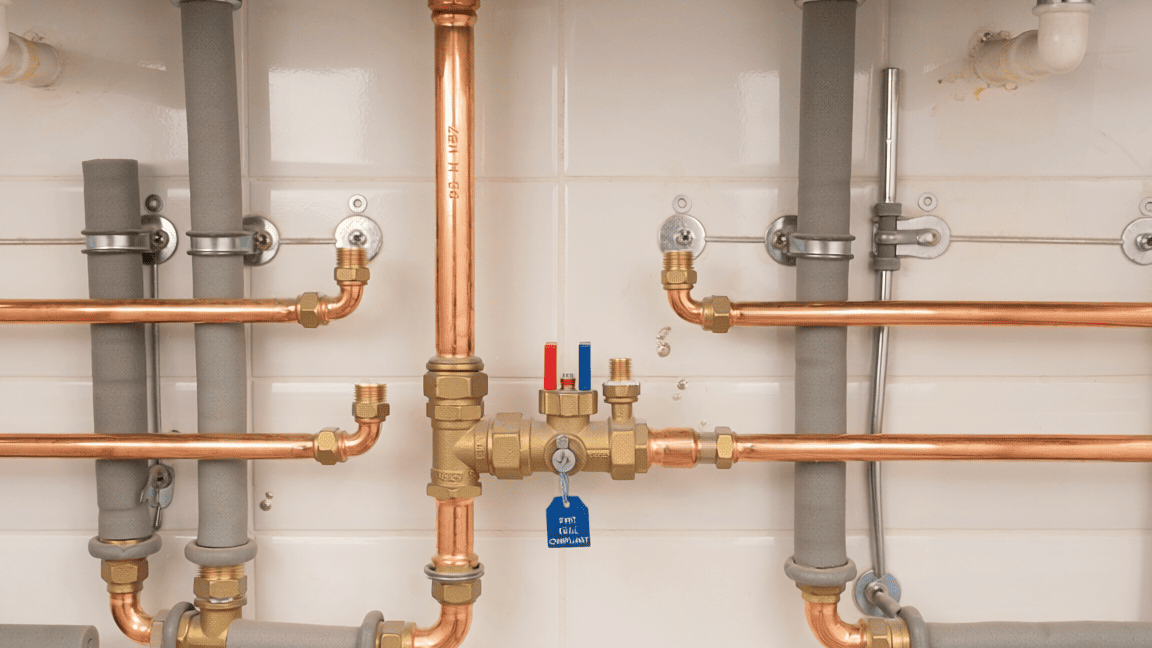
Get a plumbing installation wrong under Part G, and you aren't just risking a callback. You are potentially compromising public health. Fail to comply with Part L's efficiency requirements, and the building owner could face higher running costs for decades. Navigating Building Regulations Part G & L isn't an abstract hurdle. These are fundamental safeguards that shape how we design, specify, and install heating and plumbing systems across England and Wales.
Think of Building Regulations Part G & L like the safety checks on a commercial flight. Just as a pilot wouldn't skip the pre-flight checklist because it takes too long, you shouldn't bypass these regulations. They ensure the system won't crash and burn when put under pressure.
Part G governs sanitation, hot water safety, and water efficiency. Part L sets the standards for energy efficiency in buildings, directly impacting boiler selection, controls, and system design. For heating engineers and plumbers working on new builds, extensions, or system replacements, understanding these regulations is the baseline for legal, safe, and efficient work.
The stakes are particularly high because both regulations have been significantly tightened in recent years. The 2021 amendments to Part L introduced stricter carbon targets, whilst Part G's water efficiency requirements now mandate maximum consumption limits that affect everything from tap flow rates to WC cistern volumes. Miss these details during specification, and you'll be ripping out perfectly good kit to meet compliance.
Part G: Sanitation And Drainage Requirements
Part G of the Building Regulations addresses core areas that directly affect your day-to-day installations. Every dwelling must have adequate sanitation facilities, including a WC, wash basin, and a bath or shower where space permits. The regulations specify that at least one WC must be separated from spaces used for food preparation, which explains why you never see a toilet opening directly into a kitchen.
For commercial and public buildings, the requirements scale with occupancy. You need to calculate the number of WCs, urinals, and wash basins based on the building's use and expected visitor numbers. Get this wrong during the design phase, and you are looking at costly retrofits. If you are upgrading facilities to meet these requirements, Heating and Plumbing World supplies exactly what you need to meet strict regulatory standards.
Drainage and ventilation also fall under Part G's remit. Every sanitary fitting must discharge into a properly designed drainage system, with adequate ventilation to prevent foul air from entering occupied spaces. Soil stacks require proper venting, typically terminating at least 900mm above any opening window within 3 metres.
Part G: Hot Water Safety And Scalding Risks
Part G3 addresses protection from scalding, particularly in bathrooms accessible to the public or used by vulnerable people. The regulation recognises that water stored at 60°C or above, which is necessary to control legionella, poses a serious burn risk at the tap. Reliable heating controls and safety valves mitigate this danger.
Thermostatic mixing valves are the primary solution. For baths in new dwellings, you must install a TMV complying with BS EN 1111 or BS EN 1287, limiting the mixed water temperature to 48°C. In care homes, schools, and similar settings, thermostatic mixing valves are required on all sanitary outlets used for personal hygiene.
In some poor installations, the TMV gets fitted too close to the hot water cylinder, allowing the pipework to act as a heat store and defeating the valve's purpose. The valve needs to be located close to the point of use, with minimal dead-leg pipework. For shower installations, consider thermostatic shower valves that meet BS EN 1111. They provide both temperature control and protection against sudden pressure changes that could cause scalding.
Part G: Water Efficiency Standards
Since 2010, Part G has imposed strict limits on water consumption in new dwellings. The baseline requirement is 125 litres per person per day, but many local authorities now mandate the optional tighter standard of 110 litres per person per day through their planning conditions.
This directly affects your product choices. WC cisterns must not exceed 6 litres for a full flush. Wash basin taps should have a flow rate no greater than 6 litres per minute. Showers must not exceed 8 litres per minute, and baths are limited to 170 litres capacity.
You will need to demonstrate compliance through a water efficiency calculator, which totals the consumption of all fittings and compares it against the target. Specifying a high-flow rainfall shower head might seem like a nice touch, but if it pushes the dwelling over the 110-litre limit, it has to be removed.
Part L: Energy Efficiency In Heating Systems
Part L exists to reduce carbon emissions from buildings, and it directly governs how you design and install heating systems. The regulation is split into four documents covering new and existing domestic and non-domestic buildings. The underlying principle is completely consistent: minimise energy waste.
The 2021 update to Part L represented the most significant tightening of energy efficiency standards in over a decade, introducing the Future Homes Standard pathway. For installers, this means specifying higher-efficiency boilers, better controls, and improved insulation across all wet heating systems.
Part L: Boiler Efficiency And Seasonal Performance
Minimum boiler efficiency is now set at 92% ErP rating for gas and oil boilers in domestic properties. In practice, this means you are fitting condensing boilers in almost every scenario. Non-condensing boilers are only permissible in very limited circumstances, such as where flue positioning makes condensing operation impossible.
But the ErP rating alone doesn't tell the whole story. Part L now emphasises seasonal efficiency, which reflects how the boiler performs across the heating season, not just at full load. This is where modulating burners and weather compensation controls make a tangible difference.
When selecting central heating components like modulating pumps, ensure they match the boiler's output. A fixed-output boiler running at 28kW to heat a property that only needs 8kW for most of the season will cycle on and off repeatedly, wasting energy. A modulating boiler can turn down to match the actual heat demand, maintaining steady combustion and higher efficiency.
Part L: Heating Controls And Zoning
Part L mandates specific control requirements for all new and replacement heating systems. For domestic properties, you must provide independent time and temperature control. You can achieve this easily by using smart radiator valves for precise space heating alongside dedicated cylinder thermostats for stored hot water.
Boiler interlock ensures the boiler only fires when there is a demand for heat from either the heating or hot water circuit. Zone control is required for larger properties over 150m², or where extensions create distinct heating zones. You can easily manage these zones by adding a proper room thermostat to each area.
Weather compensation is not yet mandatory, but it is increasingly expected as best practice and can significantly improve seasonal efficiency. By modulating the flow temperature based on outdoor conditions, you reduce the boiler's cycling and improve comfort. Engineers often walk into jobs where a brand-new A-rated boiler was wired into a 20-year-old programmer with no room thermostat. That is technically non-compliant and performs well below its potential. If you replace the boiler, you should replace the controls to match.
Part L: Insulation Of Pipework And Ductwork
Part L requires all heating and hot water pipework to be insulated to limit heat losses. The minimum insulation thickness depends on the pipe diameter and location. Pipes up to 28mm diameter require at least 20mm of insulation. Pipes between 28mm and 42mm require 30mm. Larger pipes require proportionally thicker insulation.
Pipework in unheated spaces like lofts, basements, or external walls requires additional insulation. For hot water circulation loops, you will often need 40mm or more to prevent excessive heat loss.
Don't skimp on this. Uninsulated pipework in a loft can lose several hundred watts continuously, costing the homeowner money and pushing the building out of compliance. Applying quality pipework insulation makes the job faster and ensures you meet the thermal performance requirements.
Compliance Pathways And Documentation
Proving you have met Building Regulations Part G & L requires solid documentation. All work covered by these parts requires Building Control approval before you start. You can use Local Authority Building Control or engage an Approved Inspector. For straightforward heating and plumbing work, many installers use the Competent Person Scheme route to self-certify their work.
For new builds and extensions, you need a Standard Assessment Procedure calculation to demonstrate Part L compliance. The SAP calculation is typically prepared by an energy assessor, but you must provide accurate specifications for all heating equipment, ensuring your radiator system control limits energy waste.
For Part G compliance, you will complete a water efficiency calculator. This lists every water-using fitting in the dwelling and totals the daily consumption per person. Keep copies of the product data sheets confirming flow rates for all taps, showers, and WCs you've installed to prove your calculations are accurate.
Common Pitfalls And How To Avoid Them
Even experienced installers can trip up on compliance. Here are the mistakes that happen most often, and how to avoid them.
Overlooking thermostatic mixing valves is a classic error. Always check whether the building use requires TMVs. New homes, schools, care facilities, and any space used by vulnerable people need TMVs on baths and hot water outlets.
Undersized or missing pipework insulation ruins efficiency. Measure the pipe diameter and apply the correct thickness of insulation for the location. Every metre of uninsulated pipework is a compliance failure.
Failing to provide boiler interlock is another frequent mistake. On a recent 12-plot development, a contractor failed to wire the boiler interlock correctly, leaving the boilers firing constantly against closed valves because the room thermostat was bypassed. Building control spotted it during the final inspection. The contractor had to rip open finished walls in every property to run new control wiring, wiping out their entire profit margin for the job.
Ignoring zone control in larger properties breaches Part L rules. Treat extensions and separate floors as distinct heating zones. Finally, specifying high-flow showers without checking water limits guarantees a failure. Run the water efficiency calculator before you order the shower to ensure it fits within the strict consumption budget.
Practical Steps For Ensuring Compliance
Approaching Building Regulations Part G & L systematically prevents costly rework. Confirm whether Building Control approval is required before starting. Check if the project falls under your Competent Person Scheme registration. Request the necessary energy assessments from the project designer.
During routine tasks like proper expansion vessel installation, always check the system design specifications. Review the specifications to ensure the ErP rating meets the required standards. Fit controls exactly as specified in the SAP calculation.
Insulate all pipework to the correct thickness, including short runs in tight spaces. Install thermostatic mixing valves where required and set them to the correct temperature. Label all controls clearly, as Part L requires the end user to easily understand and operate the heating system. Test the system thoroughly, including checking that the boiler interlock is functioning properly.
Conclusion
Compliance with Building Regulations Part G & L protects your business and the public. These regulations are not optional extras; they form the legal framework governing how we install systems in England and Wales.
Understanding the requirements is the first step. Applying them consistently ensures compliance. The consequences of non-compliance are serious, involving enforcement action and costly remedial work. However, the benefits of getting it right are significant: safe, efficient systems that perform reliably and keep your clients' running costs down.
If you are specifying heating or plumbing products for a project, always verify they meet the current regulatory thresholds. For technical advice or product queries, speak to our team. We are here to help you get the specification right the first time.