

Care Home Hot Water Systems: Circulation Pump Selection And Zoning
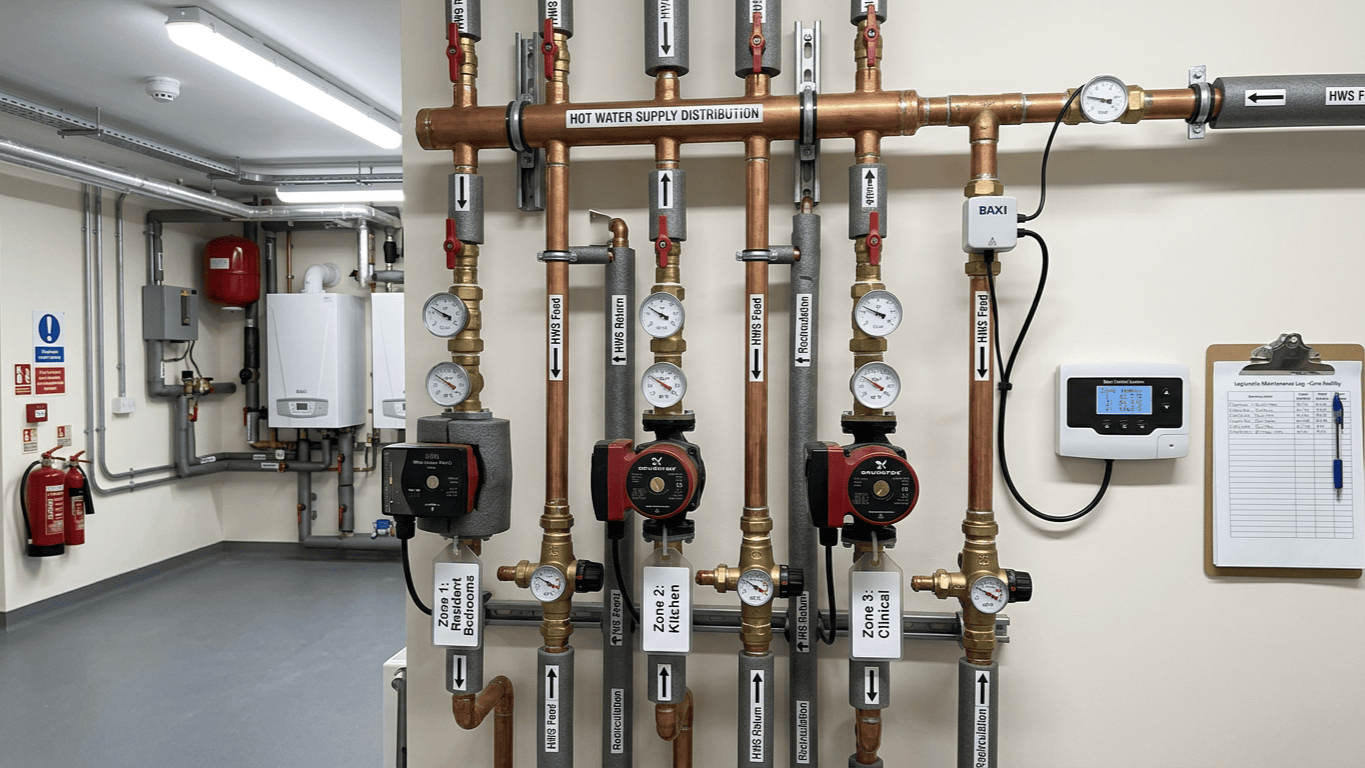
Care homes face unique hot water challenges that most commercial buildings never encounter. Residents need immediate access to safe, temperature-controlled water at any hour. This demand spans across multiple bathrooms, kitchens, and clinical spaces simultaneously. Consequently, the system cannot afford dead legs where water sits stagnant and breeds bacteria.
Think of your hot water system like the circulatory system in the human body. The boiler acts as the lungs providing heat, while the pipes are the arteries. The circulation pump acts as the heart, constantly pushing "blood" to every extremity. If that heart is too weak, the fingers (the furthest taps) go cold and the whole body faces a health risk.
We've maintained systems for dozens of facilities, and the difference between a properly zoned setup and a poor one is stark. One delivers safe water while cutting energy costs by 30%. The other creates safety risks and generates constant maintenance callouts. The stakes here aren't just about comfort; they're about the safety and dignity of vulnerable people.
Why Standard Commercial Systems Fail In Care Homes
Most commercial buildings can tolerate a 20-second wait for hot water. Care homes simply cannot. When a care assistant is helping a resident with limited mobility, every second of cold water is uncomfortable. Furthermore, it wastes hundreds of litres of water daily across a 50-bed facility.
At heating and plumbing supplies, we understand that the real issue is legionella risk management. Dead legs are sections of pipe where water sits without moving. These become breeding grounds for bacteria when temperatures sit between 20°C and 45°C. In a care home, a legionella outbreak is potentially fatal.
Standard systems also struggle with the mixed-use nature of these buildings. You need 60°C storage to kill bacteria, but only 43°C at the taps to prevent scalding. Kitchens need hotter water for sanitisation, while bedroom sinks need safety valves. This is why hot water zoning strategies are essential for a safe installation.
Understanding Circulation Pump Fundamentals
The circulation pump is the heart that keeps your care home hot water systems alive. Its job is to move hot water continuously through the pipework. This ensures every tap gets instant hot water. It also prevents any section from sitting stagnant long enough for bacteria to colonise.
Selecting the wrong pump creates problems that ripple through the entire building. An undersized pump cannot overcome the friction in long pipe runs. Consequently, water circulates too slowly and temperatures drop in distant branches.
If you are using an ACV indirect cylinder, ensure your pump matches the recovery rate of the unit. An oversized pump is just as bad for the building. It wastes energy running at excessive flow rates and creates noise that disturbs residents.
The right pump matches three critical parameters: flow rate, head pressure, and energy efficiency. Modern variable-speed models can cut electricity consumption by 60% compared to older fixed-speed units. Choosing correctly ensures your care home hot water systems remain efficient and compliant.
Calculating Your Actual Pump Requirements
You cannot select a pump from a catalogue without doing the maths first. We use a systematic approach that accounts for your building layout. Start with heat loss calculations for the pipes. Even with insulation, your circulation loop loses heat through the pipe walls.
Multiply your total pipe length by the heat loss per metre. Then, divide this by the specific heat capacity of water. This gives you the minimum flow rate needed to maintain temperature.
If you use a high-quality Gledhill GT149 sensor for monitoring, you can verify these calculations in real-time. Next, you must calculate head loss. This requires knowing your pipe diameters and the total number of fittings. Use standard head loss charts rather than guessing to ensure water reaches every corner.
Hot Water Zoning Strategies For Different Care Home Areas
A single circulation loop serving every tap is a recipe for disaster. Different areas have different usage patterns and risk profiles. Proper hot water zoning strategies create smaller circuits that deliver the right temperature efficiently. We typically divide these systems into four distinct zones.
Resident bedroom zones form the largest circuit in the building. These areas need reliable hot water at safe temperatures through mixing valves. Because usage happens day and night, the pump runs continuously. However, it can operate at lower flow rates during quiet periods to save energy.
Kitchen and food preparation areas need much hotter water for sanitisation. This zone requires its own loop without thermostatic mixing. If you are installing a high-capacity AIC Nesta 100kW condensing boiler, zoning ensures the kitchen demand doesn't affect resident comfort.
Furthermore, clinical wash stations present unique safety challenges. These areas need immediate hot water for procedures, but usage is often intermittent. We install sensors at the furthest points to run the pump only on demand. This maintains safety in clinical wash stations without wasting energy through continuous circulation.
Temperature Control And TMV Integration
Every system walks a tightrope between two competing requirements. You must store water at 60°C to kill legionella. However, you must deliver it at 43°C to prevent scalding injuries. Thermostatic mixing valves (TMVs) bridge this gap for the installer.
A common mistake is installing TMVs at each tap and then mixing down before the return point. This cools the entire return loop to 43°C, which is prime legionella temperature. The correct approach is point-of-use TMVs installed after the circulation loop takeoff. This keeps your main loop hot and bacteria-free.
Effective legionella risk management also requires constant temperature monitoring. Install sensors at the furthest point of each zone to ensure safety. A Baxi assembled temperature sensor can be integrated into your control panel to provide early warnings.
If any point drops below 50°C, you need an immediate alert to investigate the pump. Constant monitoring is the only way to prove compliance with health standards. It also allows you to catch equipment failures before they become clinical emergencies.
Variable-Speed Pumps And Energy Efficiency
Fixed-speed pumps are energy vampires in 24/7 buildings. They consume the same power at 3am as they do during the morning rush. Over a year, this results in thousands of pounds in wasted electricity. Intelligent variable-speed pumps solve this by adjusting flow to match actual demand.
The key to efficiency is temperature-differential control. This involves placing a sensor on the flow pipe and another on the return. When the temperature difference exceeds 5°C, the pump speeds up. Using temperature-differential control ensures you only pump the volume required to maintain heat.
Time-based scheduling adds another layer of savings for the manager. For smaller areas, a Kingspan 65-litre Fortic tank with a dedicated small pump might be very efficient. Variable-speed pumps also run quieter, which reduces noise disturbance for your residents during the night.
Maintenance And Monitoring Protocols
A perfectly designed system will fail without proper maintenance. We've audited care homes where expensive equipment failed basic safety checks. Monthly temperature recording forms the foundation of any maintenance protocol. You must check the calorifier flow, each zone's furthest point, and all return pipes.
Furthermore, thermostatic mixing valve servicing is a legal requirement. HSE guidance requires annual servicing for TMV2 valves and six-monthly checks for TMV3 valves. During thermostatic mixing valve servicing, a technician verifies the valve fails safe if the cold water supply is lost. This prevents accidental scalding if a pipe bursts.
On a recent audit, I found a care home that had disabled their return pumps to save money. They hadn't realised that the water in the pipes was sitting at 35°C for eighteen hours a day. After a positive legionella test, they had to spend £15,000 on a chemical flush. It was a classic example of how skipping maintenance costs ten times more in the long run.
Finally, we recommend performing a visual inspection of all safety components annually. These surveys reveal circulation problems that standard thermometers often miss. You might find a cold spot in a wall indicating a hidden blockage. Regular inspections ensure your care home hot water systems remain both safe and compliant for all residents.
Conclusion
Care home systems demand much more than standard commercial approaches. The combination of vulnerable residents and safety rules means pump selection is vital. Proper sizing ensures every tap receives hot water while preventing dangerous bacterial growth.
Strategic zoning separates kitchens and clinical rooms into dedicated circuits. This prevents high-demand areas from affecting the rest of the building. Combined with smart monitoring, this protects your residents while controlling your operational costs. The difference between a good system and a bad one is visible within months.
If you prioritise resident safety, you must invest in quality components and regular testing. A well-maintained system provides peace of mind for staff and families alike. If you need help designing a new system or upgrading your current pumps, please get expert advice from our technical specialists.