

Cascade Boiler Systems: Benefits for Large Buildings
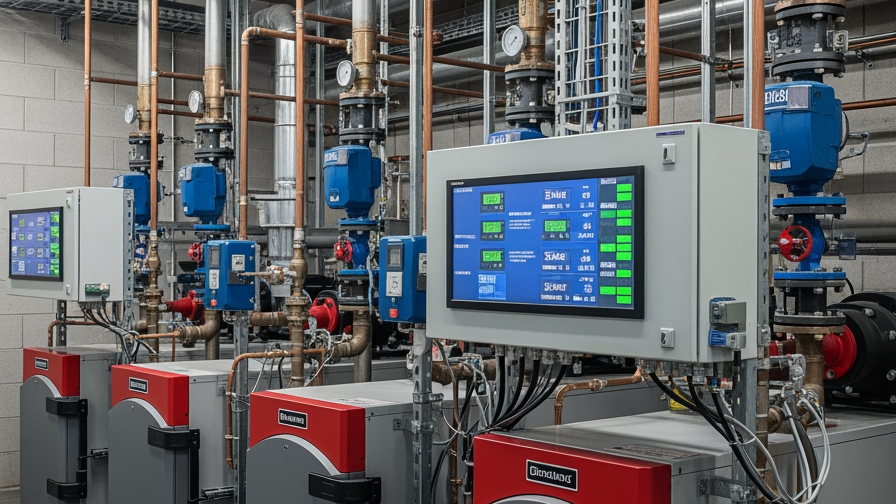
Large buildings demand heating systems that can adapt to fluctuating loads whilst maintaining efficiency. A single oversized boiler running at partial capacity wastes fuel and increases wear. Cascade boiler systems solve this by deploying multiple smaller boilers that fire in sequence based on actual demand.
How Cascade Boiler Systems Work
A cascade system connects two or more boilers through a central controller that monitors building heat requirements continuously. When demand is low, one boiler handles the load. As heating needs increase, the controller brings additional boilers online sequentially. When demand drops, boilers shut down in reverse order.
The controller uses sensors to track supply and return water temperatures, outdoor conditions, and system pressure. This data determines which boilers operate and at what firing rate. Modern systems adjust firing rates within seconds, eliminating the lag time that causes temperature swings in traditional setups.
Unlike a single large boiler that cycles on and off frequently at partial loads, cascade boiler systems keep individual boilers closer to their optimal operating range. A four-boiler cascade might run one unit at 80% capacity rather than forcing a single large boiler to operate at 20% where combustion efficiency plummets.
Efficiency Gains Through Modular Operation
Boiler efficiency drops significantly at low firing rates. A conventional boiler operating at 25% capacity might achieve only 70% efficiency, whilst the same unit running at 75% capacity reaches 85% efficiency or higher.
Cascade systems maintain higher average efficiency by matching capacity to load. During shoulder seasons when a building needs minimal heating, one small boiler runs efficiently rather than a large boiler cycling wastefully. Fuel savings of 15-30% are achievable in commercial buildings after switching from single large boilers to properly sized cascade arrangements.
The efficiency advantage compounds with condensing boilers in cascade configurations. Condensing technology extracts additional heat from flue gases, but only when return water temperatures stay below 130°F. Cascade systems achieve lower return temperatures more consistently because they can stage boilers to match loads precisely, keeping the system in condensing mode longer.
Built-in Redundancy Eliminates Single Points of Failure
A single boiler failure in a traditional system means no heat until repairs are complete. Cascade systems provide automatic backup. When one boiler fails, the remaining units compensate by increasing their output. A four-boiler cascade losing one unit still delivers 75% capacity, enough to maintain comfort in most conditions, whilst repairs proceed on a normal schedule rather than as an emergency.
Redundancy proves especially valuable in hospitals, senior living facilities, and other buildings where heat loss poses health risks. The system continues operating even during maintenance, allowing scheduled service during regular business hours instead of premium-rate emergency calls.
Rotation features extend equipment life by distributing runtime evenly across all boilers. The lead boiler position rotates automatically, preventing one unit from accumulating disproportionate wear whilst others sit idle. Balanced operation means all boilers reach their design life expectancy rather than requiring premature replacement due to overuse.
Space Efficiency and Installation Flexibility
Modern high-efficiency boilers deliver more output per square foot than older equipment. Four 500,000 BTU boilers often occupy less floor space than a single 2,000,000 BTU unit when you account for required clearances. The compact footprint matters in retrofit projects where mechanical room space is limited.
Smaller individual units also simplify logistics during cascade boiler installation. A 500,000 BTU boiler fits through standard doorways and freight elevators. Large commercial boilers may require crane access, building modifications, or even partial wall removal during replacement. These access challenges add thousands to installation costs and extend project timelines.
Cascade systems allow phased capacity additions. A building can start with two boilers and add more as occupancy or heating loads increase, spreading capital costs over time. Scalability suits growing facilities or speculative developments where future heating requirements remain uncertain.
Precise Temperature Control and Comfort
Cascade systems respond faster to load changes than single large boilers. When thermostats call for heat, the controller can stage multiple boilers simultaneously for rapid temperature recovery. When loads decrease, boilers shut down incrementally rather than cycling the entire system off and creating temperature swings.
Precise control maintains tighter temperature bands throughout the building. Occupants experience fewer cold spots and overheating episodes. The system adjusts smoothly to variables like solar gain, occupancy changes, and outdoor temperature shifts without the hunting behaviour common in oversized single-boiler installations.
Variable speed pumps from manufacturers like Grundfos integrated with cascade controls, optimise flow rates for current loads. Rather than circulating design-day flow rates year-round, the system reduces pump speed and flow when fewer boilers operate. Coordination between boilers and pumps cuts electrical consumption by 30-50% compared to constant-speed pumping.
Lower Operating Costs Beyond Fuel Savings
Reduced cycling extends component life throughout the heating system. Frequent on-off cycles stress igniters, gas valves, and heat exchangers. Cascade systems spread these cycles across multiple units whilst keeping each boiler in longer, steadier firing periods. Components last longer and require less frequent replacement.
Maintenance costs are distributed more evenly across the year. Instead of a single intensive service event for one large boiler, technicians service smaller units individually on rotating schedules. The approach prevents service bottlenecks during the pre-heating season rush when contractors are busiest and rates are highest.
Insurance carriers recognise the risk reduction from redundant systems. Some commercial property insurers offer premium discounts for buildings with cascade boiler systems because heating failures are less likely to cause frozen pipes, water damage, or business interruption claims.
Optimal Sizing for Cascade Configurations
Proper cascade design requires accurate heat load calculations. Total cascade capacity should meet design-day requirements plus a safety margin, typically 110-120% of calculated peak load. The approach avoids the 150-200% oversizing common in traditional single-boiler systems, where engineers add excessive safety factors.
The number of boilers in the cascade depends on load profile and redundancy requirements. Three or four boilers suit most commercial applications. Two boilers provide minimal staging flexibility. Five or more units add complexity without proportional benefits unless the building has unusual load characteristics.
Equal-sized boilers simplify control logic and parts inventory. Four identical 500,000 BTU boilers offer better turndown and staging options than mixing different sizes. Standardisation means stocking one set of spare parts and training maintenance staff on a single boiler model.
Integration with Building Management Systems
Modern cascade controllers communicate through BACnet, Modbus, or other standard protocols. Connectivity allows building management systems to monitor boiler performance, track fuel consumption, and receive maintenance alerts. Controls from suppliers like Honeywell and Danfoss enable facility managers to access live data on boiler staging, efficiency metrics, and alarm conditions from their central dashboard.
Remote monitoring capabilities enable predictive maintenance. Sensors track parameters like flame signal strength, ignition attempts, and burner cycles. Trending this data reveals developing problems before failures occur. Emergency service calls can reduce by 60% through remote monitoring programmes that catch issues early.
Integration with occupancy schedules optimises operation. The system can reduce capacity during unoccupied periods, stage up before occupancy begins, and adjust setpoints based on calendar events. Coordination cuts fuel waste during nights, weekends, and holidays when buildings need minimal heating.
Condensing Cascade Systems Maximise Efficiency
Condensing boilers in cascade configurations achieve the highest efficiency levels available in commercial heating. These systems extract heat from water vapour in flue gases, boosting efficiency to 95% or higher compared to 80-85% for non-condensing equipment.
Cascade arrangements help condensing boilers maintain optimal conditions. Lower return water temperatures, essential for condensing operation, occur more consistently when the system stages boilers to match loads. A single boiler operating at partial load generates higher return temperatures that prevent condensing, whilst a properly staged cascade keeps temperatures in the condensing range.
The efficiency gains translate directly to fuel savings. A building using 50,000 therms annually with 80% efficient boilers would consume 42,000 therms with 95% efficient condensing cascade equipment, an 8,000 therm reduction worth £6,000-£9,000 depending on gas rates. At current equipment costs, payback periods run 5-8 years in most commercial applications.
Emissions Reduction and Environmental Benefits
Higher efficiency means lower emissions per unit of heat delivered. A 95% efficient condensing cascade system produces 15-20% less CO2 than conventional 80% efficient equipment delivering the same heating output. NOx emissions also decrease with modern low-NOx burners standard in current cascade boiler packages.
Staging capability reduces short-cycling, which generates emission spikes during ignition. A cascade system fires individual boilers less frequently but for longer periods, creating more complete combustion and fewer startup emissions. The operating pattern helps buildings meet increasingly stringent air quality regulations in urban areas.
Some jurisdictions offer incentives for high-efficiency cascade installations. Utility rebate programmes may cover 10-20% of equipment costs for systems exceeding minimum efficiency standards. Combined with operational savings, these incentives improve project economics and shorten payback periods.
Maintenance Considerations for Cascade Systems
Cascade systems require more components than single-boiler installations, multiple burners, controls, and venting systems. However, the maintenance burden doesn't increase proportionally. Smaller boilers are simpler to service, and staged maintenance prevents the downtime required for servicing a single large unit.
Annual maintenance follows a rotation schedule. Technicians service one boiler per quarter in a four-boiler cascade, spreading costs evenly and ensuring the system never loses more than 25% capacity for maintenance. The approach eliminates the autumn service rush and allows scheduling during regular hours at standard rates.
Water treatment becomes more critical in cascade systems because multiple heat exchangers depend on clean water. Poor water quality accelerates scale formation and corrosion across all boilers simultaneously. Professional water treatment programmes with regular testing and chemical adjustments protect the investment in cascade equipment.
When Cascade Systems Make Sense
Cascade configurations suit buildings with heating loads exceeding 1,000,000 BTU/hour and variable occupancy or usage patterns. Office buildings, schools, hotels, hospitals, and multifamily housing all benefit from cascade capability. Buildings with steady, constant loads gain less advantage from staging flexibility.
Retrofit projects often achieve the best returns. Replacing an oversized, inefficient boiler with a right-sized cascade system captures maximum savings. New construction projects should compare cascade systems against single large boilers during design, considering lifecycle costs rather than just initial equipment prices.
Building planning expansions should consider cascade systems even if current loads don't require staging. Adding boilers to an existing cascade costs less than replacing an undersized single boiler later. The modular approach accommodates growth without stranding equipment investments.
Conclusion
Cascade boiler systems deliver measurable advantages for large buildings through improved efficiency, built-in redundancy, and precise capacity matching. Fuel savings of 15-30% combine with reduced maintenance costs and extended equipment life to create attractive lifecycle economics. The redundancy inherent in multi-boiler configurations eliminates the vulnerability of single-point failures whilst simplifying maintenance scheduling.
Modern controls integrate seamlessly with building management systems, enabling sophisticated optimisation strategies and remote monitoring. Condensing cascade configurations push efficiency above 95%, reducing both operating costs and environmental impact. For facilities managers responsible for buildings with substantial heating loads, cascade boiler installation represents a proven technology that balances performance, reliability, and cost-effectiveness across decades of service life.