

Choosing Designer Towel Rails for Modern Bathrooms
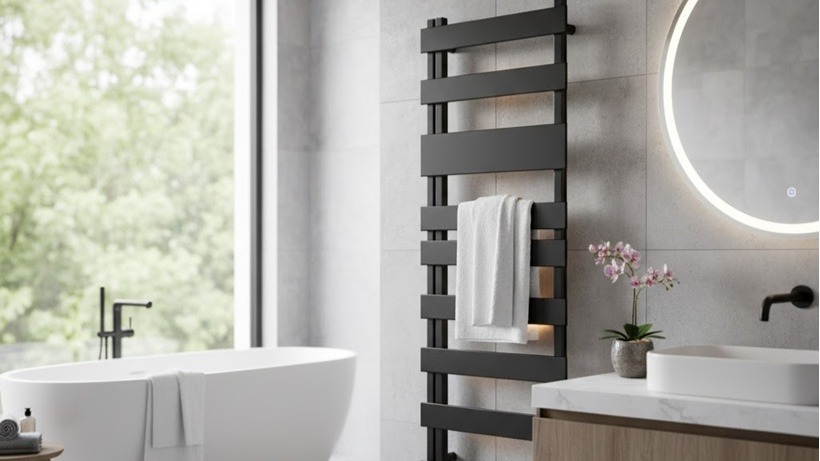
Walk into any high-end bathroom showroom, and you'll spot them instantly. Designer towel rails have transformed from purely functional fixtures into statement pieces that define a bathroom's character. They're not just keeping your towels warm anymore; they're anchoring your entire design scheme.
The shift towards modern bathroom design has elevated the humble towel rail from afterthought to focal point. Trade professionals know this better than anyone. Clients don't want a basic chrome ladder bolted to the wall. They want sculptural pieces that complement underfloor heating, work with smart home systems, and look like they belong in an architectural magazine.
But here's the tricky bit: specifying the right modern towel warmer means balancing aesthetics with thermal performance, client expectations with building regulations, and design aspirations with real-world installation constraints. Get it wrong, and you're facing callbacks. Get it right, and you've created a bathroom that feels complete.
Heating and Plumbing World stocks an extensive range of designer heating solutions that bridge this gap between form and function. The challenge isn't finding options; it's choosing the right one for each specific project.
Why Modern Towel Warmers Have Become Essential
The bathroom has evolved. It's no longer just a functional space tucked away at the back of the house. Modern bathrooms are retreats, sanctuaries, spaces where design matters as much as in the kitchen or living room.
Designer towel rails respond to this shift. They deliver heat exactly where it's needed, warming towels, taking the chill off a tiled room, and creating a comfortable environment after a shower. But they also contribute to the visual language of the space.
Think about it like selecting a radiator for a period property. You wouldn't stick a basic panel radiator in a Georgian townhouse with restored cornicing and original floorboards. The same principle applies here. A minimalist wetroom with large-format porcelain tiles and a frameless glass screen demands a towel rail that matches its sophistication.
The practical benefits remain crucial, though. Damp towels in bathrooms create condensation problems. Mould develops in corners. The room feels cold and uninviting. A properly specified towel warmer addresses all these issues whilst enhancing the design.
Material Selection: More Than Just Aesthetics
Material choice dictates everything: heat output, longevity, maintenance requirements, and price point. Stainless steel dominates the designer market for good reason. It's corrosion-resistant, maintains its finish even in humid environments, and delivers excellent thermal conductivity.
But don't dismiss other options too quickly. Mild steel towel rails, properly finished with robust powder coating, offer better heat output per pound spent. They're particularly effective in larger bathrooms where you need serious BTU delivery without the premium price tag.
Brass and copper variants sit at the luxury end of the spectrum. They develop a patina over time; some clients love this natural ageing, others expect a pristine finish indefinitely. Make sure you have that conversation before specifying.
Chrome finishes remain popular, but brushed nickel, matt black, and anthracite have gained ground in contemporary schemes. Matt finishes hiding watermarks better than polished surfaces. That's a practical consideration in family bathrooms where maintenance matters.
Here's what a London contractor told me after a high-end residential job in Kensington: he'd specified brushed stainless steel towel warmers throughout six ensuite bathrooms. Two years later, they still looked factory-fresh. The polished chrome taps? Constantly needing attention due to water spotting. Material choice has long-term consequences.
Sizing and Heat Output Calculations
You can't wing this part. Heat output needs calculated properly, accounting for room volume, insulation levels, desired temperature rise, and whether the towel rail is the primary or supplementary heat source.
Most modern bathrooms have underfloor heating or an additional radiator. The towel warmer becomes supplementary heating. That changes your calculations. You're not trying to heat the entire space from cold; you're maintaining comfort and warming towels.
A standard family bathroom (roughly 2.5m x 2m with 2.4m ceiling height) needs approximately 1,500-2,000 BTUs for supplementary heating. Check the manufacturer's BTU ratings carefully. Some quote output at ΔT50 (temperature difference of 50°C between the water in the rail and the room), others at ΔT60. These aren't directly comparable.
Physical size matters too. Measure the wall space accurately. Account for door swings, toilet positions, and basin proximity. A towel rail that looks perfect in a showroom can overwhelm a compact ensuite or look lost in a master bathroom.
Width typically ranges from 400mm to 1200mm. Height varies from 800mm to 1800mm. Taller rails hold more towels and deliver more heat, but they need adequate wall space and proper bracket support.
Design Configurations for Different Spaces
The traditional ladder-style rail still works beautifully in the right context. Horizontal bars create clean lines that suit minimalist schemes. They're straightforward to install, easy to maintain, and consistently reliable.
But modern design has pushed far beyond basic ladders. Sculptural towel warmers with curved tubes, asymmetric patterns, and architectural forms have become genuine design statements. Myson offers several striking contemporary ranges that demonstrate how far the category has evolved.
Flat-panel designs integrate seamlessly into modern schemes. They look more like designer radiators than traditional towel rails. Some models incorporate mirrored or coloured glass panels. These work particularly well in boutique hotel bathrooms or high-end residential projects where visual impact justifies the premium.
Horizontal towel warmers mounted at low level can work under windows or in awkward spaces where vertical rails don't fit. They're less common but solve specific layout challenges.
Think about towel capacity realistically. A family bathroom needs space for multiple towels. An ensuite serving a single bedroom can get away with less capacity. Match the rail's configuration to actual usage patterns.
Electric vs Hydronic: Choosing Your Heat Source
This decision often gets made by existing system infrastructure, but you've got options. Hydronic towel rails connect to the central heating system. They're running whenever the heating's on, which can be inefficient in summer months when you want warm towels but not a hot bathroom.
Dual-fuel models solve this problem. They connect to the central heating circuit but include an electric element for summer operation. You're getting flexibility at the cost of slightly more complex installation and a higher initial investment.
Pure electric towel warmers offer maximum flexibility. They can be positioned anywhere with reasonable access to power. No need to run pipework or worry about system compatibility. Installation is simpler, making them attractive for bathroom refurbishments where accessing the heating system would mean ripping out tiles.
Electric models also work with timers and smart controls more easily. Honeywell and EPH Controls both offer sophisticated control solutions that let users schedule heating cycles around actual bathroom usage patterns.
The running cost difference between electric and hydronic isn't as dramatic as some think. Electric elements are relatively efficient, and you're only heating them when needed rather than cycling all day with the heating system.
Installation Considerations That Actually Matter
Wall construction dictates mounting options. Solid masonry walls present no problems; fix brackets properly into the substrate, and you're sorted. Plasterboard on timber studwork needs more thought. Locate studs and fix brackets securely. Don't trust plasterboard fixings alone for towel rails carrying significant weight and thermal stress.
Pipework routing needs planning in hydronic installations. Can you access existing pipework without major disruption? Will pipes run concealed or surface-mounted? What about valves? Are thermostatic radiator valves (TRVs) appropriate, or should you specify manual isolation valves?
The distance between pipe centres varies by model. Check this dimension carefully. Some rails have 50mm centres, others 500mm or more. You need to know this before cutting into walls or positioning pipework.
Think about the analogy of hanging a heavy picture frame. You wouldn't trust a single nail in plasterboard for a valuable oil painting. The same principle applies here. Towel rails experience thermal expansion; they get loaded with wet towels, sometimes they get used as grab handles (they shouldn't, but they do). Your fixings need to handle all that.
Valve positions affect the visual appearance. Bottom connections look tidier than side connections in most installations. Angled valves can help pipework turn corners neatly. Straight valves work better when pipes drop vertically from above.
Energy Efficiency and Running Costs
Modern building regulations push towards energy efficiency everywhere, bathrooms included. The ErP (Energy-related Products) Directive affects towel rails just as it does radiators. Check for ErP compliance and energy ratings.
Lower water content typically means faster heat-up times and better responsiveness. That translates to lower running costs because the system isn't maintaining heat in large volumes of water unnecessarily.
Thermostatic controls make a significant difference. A towel rail running at full temperature 24/7 wastes energy. Smart controls that learn usage patterns and adjust heating schedules accordingly can cut running costs by 20-30% compared to always-on operation.
Insulation around the mounting wall affects performance. A towel rail on an external wall loses more heat to the outside than one on an internal partition. Account for this when calculating the required output.
Dual-fuel models let you run the towel warmer independent of the main heating system. That's efficient in shoulder seasons when you don't need full central heating but want bathroom comfort.
Design Styles: Matching Aesthetics to Architecture
Contemporary minimalist schemes favour clean-lined ladder rails in matt black or brushed stainless steel. Simple geometric forms. No decorative elements. Pure function expressed through refined industrial design.
Industrial-modern bathrooms can accommodate more robust designs, chunky rails with visible welding, raw metal finishes, and prominent fixtures. These spaces often feature exposed brickwork, concrete, and metal-framed shower screens.
Traditional bathrooms need careful specification. Designer towel rails with curved details and polished finishes can complement period features without looking fake-antique. The key is restraint; overly ornate rails rarely work in genuinely period spaces.
Transitional designs that blend contemporary and traditional elements offer the widest scope. These bathrooms can accept more adventurous towel rail designs because they're already mixing style languages.
Coloured finishes have become more popular. Matt black creates a dramatic contrast in light bathrooms. Anthracite grey provides sophistication without the starkness of pure black. Rose gold and brass finishes suit warmer colour schemes.
Common Specification Mistakes to Avoid
Don't underspecify heat output, thinking the towel rail is purely decorative. Even in well-heated bathrooms, an undersized rail struggles to properly warm towels. Damp towels never get properly dry, and the bathroom feels chilly.
Conversely, massively oversizing creates discomfort. A towel rail delivering 3,000 BTUs in a small ensuite turns the room into a sauna. It's uncomfortable, inefficient, and clients won't thank you for it.
Ignoring valve positions causes problems during installation. You've specified a beautiful towel rail, but the valve connections require pipework to run across visible wall surfaces. Plan the whole installation, not just the towel rail itself.
Forgetting maintenance access is another classic error. Thermostatic valves occasionally need adjusting. Bleed valves need to be accessed. If your beautiful designer rail is positioned so that the valves are behind the toilet or tucked into an impossible corner, you're creating future problems.
Not discussing the finish maintenance with clients leads to disappointment. Chrome shows watermarks. Brushed finishes hide marks better but can't be polished. Matt black looks stunning, but shows dust. Set realistic expectations.
Integration with Bathroom Lighting and Ventilation
Modern bathroom design considers all services holistically. Your towel rail specification shouldn't exist in isolation. It needs coordinated with lighting design, ventilation strategy, and overall environmental control.
Some designer towel rails now incorporate LED lighting strips. These create ambient lighting whilst serving their primary heating function. It's a clever integration, though the lighting elements add complexity and potential maintenance issues.
Ventilation becomes more important with heated towel rails. They're adding moisture to the air as damp towels dry. Adequate extraction prevents condensation problems elsewhere in the room. Don't specify a powerful towel warmer without checking the ventilation capacity.
Positioning relative to the shower or bath matters. You want the towel rail close enough for convenience but not so close that it's constantly getting splashed. A towel rail directly opposite a shower with poor screen sealing ends up covered in soap residue and water spots.
Smart Controls and Future-Proofing
Building automation is reaching bathrooms. Smart towel warmers with app control, voice activation, and learning algorithms are available now. They're not just gimmicks; properly implemented, they deliver real efficiency gains and user convenience.
Geofencing lets the towel rail warm up as you're heading home. Scheduling ensures towels are warm for morning showers without running the system overnight. Usage monitoring identifies inefficient patterns.
Danfoss offers sophisticated control solutions that integrate towel warmers with wider heating systems. This level of integration makes sense in new builds or complete refurbishments where you're specifying the entire environmental control strategy.
But don't force smart controls where they add unnecessary complexity. A straightforward timer switch and manual temperature control work perfectly for most domestic installations. Match the sophistication of the controls to the client's actual needs and technical confidence.
Making the Final Selection
You've considered heat output, design style, material, installation constraints, and budget. Now it's decision time. Create a shortlist of three or four options that genuinely meet the brief.
Present these options to clients with clear explanations of the trade-offs. Option A delivers stunning visual impact but costs more. Option B is more affordable but requires compromising on finish quality. Option C sits in the middle, balancing aesthetics and budget.
Don't just show catalogue photos. Visit showrooms where clients can see towel rails installed in context. The difference between a photo and a physical product is significant. Finish quality, physical presence, and perceived value are all clearer when you're looking at the actual product.
Check availability and lead times before finalising specifications. Some designer ranges have extended lead times, particularly for unusual finishes or bespoke sizes. Factor this into project planning.
Verify warranty terms. Premium products should include substantial warranties, at least two years, often five. This protects your client and demonstrates manufacturer's confidence in product quality.
Conclusion: Designer Towel Rails as Design Investment
Specifying designer towel rails properly requires balancing technical performance with aesthetic ambition. It's not enough to choose something that looks good in isolation. The rail needs to work effectively as part of the bathroom's environmental control system whilst contributing to the overall design vision.
The right modern towel warmer elevates a bathroom from competent to exceptional. It becomes a feature that clients notice, appreciate, and use daily. The wrong choice creates frustration, inadequate heat output, maintenance headaches, or visual disappointment.
For comprehensive guidance and access to leading brands in designer bathroom heating, contact us to discuss your specific project requirements. Professional specification support ensures you're selecting products that deliver both thermal performance and design excellence.
Modern bathrooms demand more than basic functionality. They're spaces where design, comfort, and technical performance intersect. Choose wisely, specify accurately, and the results speak for themselves.