
 -
- Commercial Cylinder Stratification: Preventing Temperature Layers
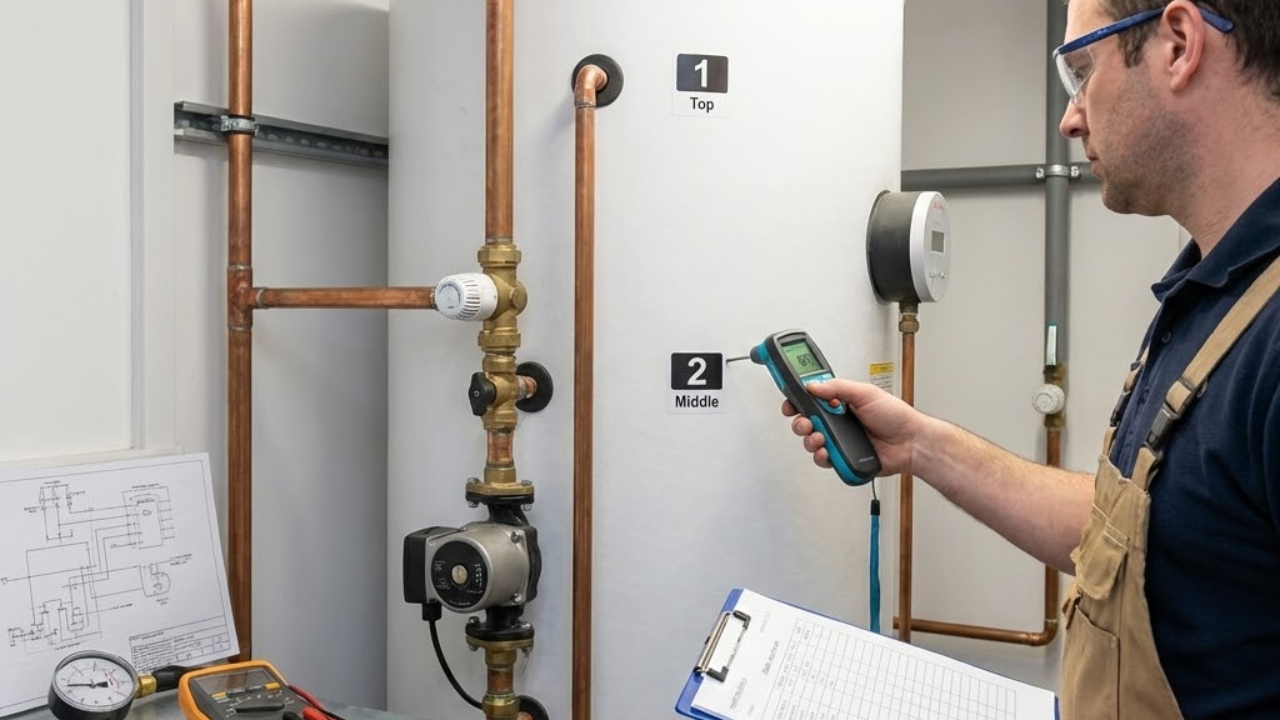
Walk into a plant room at 7am on a Monday, and you'll often find a facilities manager staring at a hot water cylinder wondering why the taps on the third floor are stone cold while the gauge reads 60°C. The culprit? Stratification. Distinct temperature layers forming inside the cylinder like oil and water refusing to mix. It's one of those invisible problems that causes very visible complaints.
In commercial hot water systems, stratification isn't just an inconvenience. It's a performance killer that wastes energy, breeds legionella risk, and creates user complaints that land squarely on your desk. Understanding why it happens and how to prevent it transforms a problematic installation into a reliable workhorse.
What Stratification Actually Means in Practice
Stratification occurs when hot and cold water separate into distinct horizontal layers within a cylinder, with minimal mixing between them. Hot water naturally rises to the top while cold water settles at the bottom, creating a thermal gradient that can span 30-40°C from top to bottom in poorly designed systems.
This isn't a theoretical concern. On a 500-litre cylinder serving a care home, you might measure 65°C at the top sensor while the bottom third sits at 25°C. Draw off 200 litres for morning showers, and you'll pull that cold layer through the system before anyone realises what's happening.
The physics are straightforward. Water density changes with temperature. At 4°C, water reaches its maximum density. As it warms, it becomes lighter and rises. In a static cylinder with no mixing mechanism using thermosyphon loops, these layers remain stubbornly separate for hours or even days.
Why Commercial Systems Are Particularly Vulnerable
Domestic cylinders rarely show severe stratification because they're small enough that natural convection and frequent draw-offs provide adequate mixing. Scale that up to 1,000 litres or more, and the game changes completely.
Large volume-to-surface-area ratios mean less heat loss through the walls relative to the stored water volume. That sounds efficient until you realise it also means less natural circulation from cooling at the boundaries. A 300-litre cylinder might see the entire volume turn over from convection currents several times per day. A 3,000-litre cylinder? Barely at all.
Commercial installations often face intermittent demand patterns that exacerbate the problem. A school uses massive volumes between 8-9am and 12-1pm, then virtually nothing for hours. During those quiet periods, any cold water entering the cylinder settles at the bottom and stays there, undisturbed. The heating coil at the bottom then has to work through that cold layer before it can contribute to the usable hot water at the top.
Multiple connection points add another layer of complexity. When you've got separate flow and return connections at different heights, plus cold feed entries and draw-off points scattered across the cylinder height, you're creating opportunities for short-circuiting where water takes the path of least resistance rather than mixing properly.
The Real Costs of Ignoring Stratification
Energy waste tops the list. When the bottom third of your cylinder sits at 30°C while the top runs at 70°C, you're storing and maintaining water at temperatures that serve no useful purpose. That cold layer still loses heat through the cylinder walls, and your heating system still cycles to maintain set points based on sensors that only measure part of the story.
Calculate the actual usable capacity of a stratified 1,000-litre cylinder, and you might find you've effectively got 600 litres of water hot enough for use. You're paying to store, heat, and insulate 400 litres of lukewarm water that contributes nothing to your hot water availability. That's not a rounding error. It's a fundamental design failure.
Legionella risk escalates in stratified systems because you create perfect breeding grounds in those lukewarm middle zones. Legionella bacteria thrive between 20-45°C. A properly mixed cylinder maintained at 60°C throughout provides no habitat for colonisation. A stratified cylinder with a 35°C band in the middle? That's an incubator.
The HSE's Approved Code of Practice L8 requires stored hot water to be maintained at 60°C throughout to control legionella risk. Stratification makes that requirement physically impossible to meet without wasteful practices like running the entire cylinder up to 70°C+ at the top just to ensure the bottom reaches 60°C.
User complaints follow inevitably. Nothing frustrates building occupants faster than inconsistent hot water delivery. The first shower gets scalding water, the third gets tepid, and by the fifth you're fielding angry calls. It looks like undersized equipment, but the real problem is that your nominal capacity is trapped in unusable layers.
Design Strategies That Actually Prevent Stratification
Preventing stratification starts at the design stage, not with band-aid fixes applied to problematic installations. Get the fundamentals right, and you'll never face the problem.
Coil positioning and configuration makes an enormous difference. Traditional bottom-entry coils create the worst stratification because they heat the coldest, densest water first. That heated water wants to rise, but it has to fight through the cold layer above it. The result? Minimal circulation and stubborn layers.
Top-entry or mid-height coils work with natural convection rather than against it. Heat the upper portion of the cylinder, and the rising water naturally circulates downward along the walls as it cools slightly, creating a gentle mixing action. This approach, combined with properly sized coils, can eliminate stratification entirely in many applications.
For larger cylinders, consider multiple coils at different heights. A Gledhill hot water cylinders with three separate coil zones allows staged heating that maintains temperature uniformity across the entire volume. The bottom coil handles initial heating, the middle coil maintains the bulk temperature, and the top coil provides final boost heating.
Inlet diffusers are criminally underused in commercial installations. When cold water enters the cylinder during draw-off, it should be distributed gently across a wide area rather than injected as a high-velocity jet. A proper diffuser spreads the incoming water horizontally, allowing it to find its density level gradually rather than plunging straight to the bottom and sitting there.
Think of it like pouring cream into coffee. Pour it directly and it sinks to the bottom in a distinct layer. Pour it over a spoon and it disperses throughout the cup. The same principle applies to cylinder inlets.
Circulation Systems and Pump Integration
For cylinders above 500 litres serving critical applications, internal circulation becomes essential. This doesn't mean the secondary return circulation that serves taps and showers. It means actively circulating water within the cylinder itself to prevent layer formation.
A dedicated internal circulation pump draws water from the bottom of the cylinder and returns it to the top, typically running on a timer or temperature differential control. Flow rates don't need to be high. Even 10-15 litres per minute provides adequate mixing in a 1,000-litre cylinder when run for 15 minutes every few hours.
The key is avoiding continuous circulation, which would waste energy and potentially cause temperature depression at the coils. Intermittent circulation (say, 15 minutes every 2-3 hours during low-demand periods) maintains uniformity without excessive pump running time. Grundfos circulation pumps and other manufacturers offer small, efficient circulators specifically designed for this application.
Thermosyphon loops provide passive mixing without pumps by creating a natural circulation path. Install a large-diameter pipe loop (typically 28mm or larger) connecting the bottom and top of the cylinder. As water at the bottom is heated by the coil, it rises through the loop and returns to the top of the cylinder, while cooler water descends to replace it.
This works brilliantly in systems where the primary heating source runs frequently enough to maintain the thermosyphon action. In systems with intermittent heating, you'll still need supplementary mixing.
Control Strategies and Sensor Placement
Where you place your temperature sensors determines whether you're measuring reality or fiction through multi-point sensing. A single sensor at the top of a stratified cylinder tells you nothing about the 40% of your water volume sitting 30°C cooler at the bottom.
Multi-point sensing should be standard practice on any commercial cylinder above 300 litres. Fit sensors at the top, middle, and bottom, then use the middle or bottom sensor as your primary control input. This forces your heating system to maintain temperature throughout the cylinder volume, not just at the top where hot water naturally accumulates.
Some modern controls average multiple sensor inputs or use the lowest reading to determine heating demand. This prevents the false economy of shutting down heating when the top is hot but the bulk of the cylinder remains cold.
Differential temperature monitoring between top and bottom sensors provides early warning of stratification problems. Set an alarm if the temperature difference exceeds 10-15°C, indicating that mixing has failed and layers are forming. This turns stratification from an invisible problem into a measurable, actionable maintenance trigger.
For systems with internal circulation pumps, use the temperature differential to trigger pump operation automatically. When the bottom sensor reads 10°C cooler than the top, run the circulation pump until the difference drops below 5°C. This responsive control prevents stratification without wasting energy on unnecessary pumping.
Maintenance Practices That Preserve Mixing
Even well-designed systems can develop stratification over time if maintenance lapses. Scale buildup on coils reduces heat transfer efficiency, forcing longer heating cycles that allow more time for layer formation. Annual coil inspection and descaling maintains the rapid, even heating that prevents stratification.
Check inlet diffusers and strainers regularly. A blocked diffuser forces incoming cold water through a restricted opening at high velocity, creating the jet effect you're trying to avoid. Clean strainers monthly in hard water areas, quarterly elsewhere.
Circulation pump performance degrades gradually. A pump that's lost 30% capacity due to wear or partial blockage might still run, but it no longer provides adequate mixing flow. Annual pump performance checks, measuring actual flow rate against design specification, catch this before it becomes a problem.
Temperature sensor calibration matters more than most engineers realise. A sensor reading 2-3°C low might not sound significant, but it means your control system thinks the cylinder is cooler than it actually is, leading to overheating at the top while the bottom remains cold. Verify sensor accuracy annually against a calibrated reference thermometer.
Retrofit Solutions for Existing Problematic Systems
Faced with a stratified cylinder in an existing installation? You've got options short of complete replacement.
Adding an internal circulation loop requires drilling and welding new connections, but it's often the most effective solution. Fit a bottom draw-off point and top return connection, install a small circulator on a timer, and you've eliminated the fundamental problem. This works on any cylinder with adequate access for the modifications.
External mixing loops offer a less invasive alternative. Connect a pump between the existing bottom drain valve and a top-mounted temperature/pressure relief valve boss (assuming you can relocate the relief valve). Run the pump intermittently to provide mixing without internal modifications.
For systems where pump additions aren't practical, modified control strategies can help. Raise the set point by 5-10°C to ensure the bottom of the cylinder reaches target temperature even with stratification present. This isn't elegant, but it's better than delivering cold water to users. Combine this with more frequent heating cycles rather than long recovery periods, which reduces the time available for layer formation.
Plate heat exchangers for instantaneous hot water production eliminate stratification entirely by removing the storage cylinder from the equation. When retrofit costs for fixing stratification approach 40-50% of a new plate heat exchanger installation, seriously consider whether stored hot water remains the right approach.
Specification Checklist for New Installations
When specifying commercial cylinders, demand these features to prevent stratification:
Multiple temperature sensor bosses at top, middle, and bottom positions
Inlet diffuser as standard, not an optional extra
Coil configuration appropriate for application: top-entry or multiple coils for larger volumes
Circulation pump connections pre-installed, even if pumps aren't fitted initially
Minimum insulation thickness of 50mm for cylinders up to 500L, 75mm for larger volumes
Vertical orientation where possible (horizontal cylinders stratify far more readily)
Height-to-diameter ratio of at least 2:1 to promote natural convection
Brands like Kingspan cylinders offer commercial cylinders with many of these features as standard, while others require custom specification. Don't accept a basic cylinder for a critical application just because it meets the volume requirement.
When Stratification Might Actually Be Useful
Controlled stratification isn't always the enemy. Solar thermal systems deliberately maintain stratified storage, with solar-heated water accumulating at the top while cooler water at the bottom feeds to the solar collectors. This maximises the temperature difference driving heat transfer and improves system efficiency.
Heat pump systems also benefit from mild stratification because the heat pump works most efficiently when returning the coolest possible water. A fully mixed cylinder at 50°C returns 50°C water to the heat pump. A stratified cylinder might return 40°C water from the bottom, improving the heat pump's coefficient of performance by 15-20%.
The difference? These systems are designed around controlled, predictable stratification with appropriate draw-off and heating arrangements. That's entirely different from the uncontrolled, problematic stratification that plagues poorly designed conventional systems.
Conclusion
Stratification in commercial hot water cylinders isn't a minor technical quirk. It's a fundamental performance issue that wastes energy, creates health risks, and frustrates users. The temperature layers that form in large cylinders without proper mixing strategies can reduce usable capacity by 30-40% while increasing legionella risk and energy consumption.
Prevention starts with proper design: correctly positioned heating coils, inlet diffusers, multi-point temperature sensing, and provision for circulation where cylinder volume exceeds 500 litres. These aren't expensive additions. They're essential features that separate professional installations from problematic ones.
For existing systems showing stratification symptoms, retrofit solutions from simple circulation pumps to modified controls can restore performance without complete replacement. The key is recognising the problem early through proper temperature monitoring and addressing it before it becomes a crisis.
At Heating and Plumbing World, we stock commercial cylinders from manufacturers who understand these principles, along with the circulation pumps, controls, and components needed to prevent stratification in any installation. Whether you're specifying a new system or troubleshooting an existing one, proper attention to stratification prevention delivers reliable hot water, lower energy costs, and satisfied building occupants. For technical guidance on specific applications, contact us to discuss your requirements with our experienced team.