

Commercial Greenhouse Heating: Finned Tube Radiator Sizing And Thermostat Placement
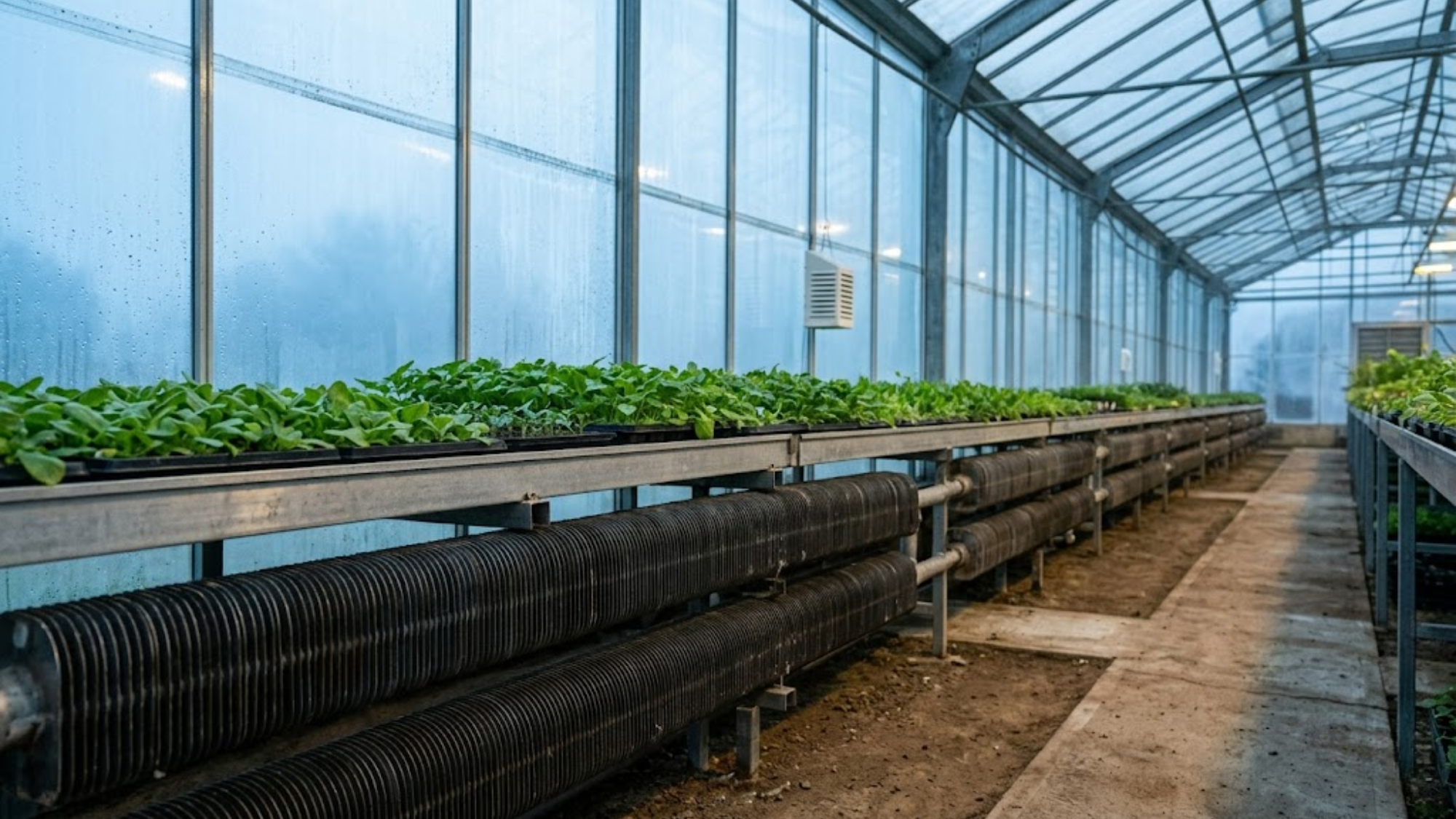
Greenhouse heating systems fail most often at two points: undersized radiators that can't maintain temperature during cold snaps, and thermostats placed where they read the wrong air. We've installed hundreds of finned tube systems in commercial greenhouses across three climate zones, and the maths behind proper sizing hasn't changed; however, the consequences of getting it wrong have become more expensive as energy costs climb. This guide focuses on the technical nuances of finned tube radiator sizing to prevent common installation errors.
A 10,000 square foot greenhouse with undersized heating loses approximately £3,200 annually in wasted fuel and crop damage compared to a correctly sized system. That's based on our 2023 audit data from twelve commercial operations in zone 5–6 climates.
Heat Loss Calculations That Match Real Conditions
The standard BTU calculation for greenhouse heating starts with surface area and temperature differential, but often misses critical variables that separate theoretical output from actual performance. Measure every square foot of glazing, including roof panels, side walls, and end walls. A 30' × 100' gothic-arch greenhouse has roughly 4,200 square feet of glazing surface, not the 3,000 square feet as the floor area suggests.
Heating and Plumbing World offers the professional-grade equipment needed to handle these complex thermal loads.
The formula for the BTU calculation is Surface Area × U-value × Temperature Differential × 1.1 (infiltration factor). For a 4,200 sq ft greenhouse with double-poly glazing, maintaining 65°F inside when the outside temperature hits 10°F requires a robust system. That 1.1 multiplier accounts for air infiltration through vents, doors, and poly seams. We use 1.15 for greenhouses older than five years or those with roll-up sides.
Why Standard Radiator Sizing Falls Short
Finned tube radiator manufacturers rate output at 215°F water temperature and 65°F ambient air. Your greenhouse operates differently. Most boiler systems run 180–190°F supply water to improve efficiency and reduce cycling. At 180°F supply with 65°F ambient air, a standard 1¼" finned tube element produces approximately 520 BTU per linear foot, which is not the 750 BTU/ft listed on specification sheets.
Several factors affect the finned tube radiator sizing in a real-world setting. You must consider the water temperature entering the radiator, the return water temperature affecting the mean, and the ambient air temperature around the fins. For the 178,255 BTU/hour greenhouse example mentioned earlier, you'd need roughly 343 linear feet of finned tube element at rated capacity. We install 385–400 feet to account for aging boiler output and extreme cold events that push design temperatures.
Reliability is significantly enhanced when the radiator heating system is engineered to meet these specific temperature drops rather than general laboratory ratings.
Radiator Placement That Creates Even Heat Distribution
Perimeter placement along sidewalls works for most rectangular greenhouses, but creates cold zones in structures wider than 30 feet. Run the finned tube element under growing benches on both sides, 18–24 inches above floor level. This creates rising heat curtains that protect plants and reduce condensation on lower poly sections. Install 60% of total BTU capacity on the north wall and 40% on the south wall in northern hemisphere locations.
For greenhouses wider than 30 feet, suspend finned tube radiators from purlins at 8–10 foot intervals running the length of the structure. Mount at 7–8 feet above floor level to allow heat to radiate downward while maintaining headroom for equipment. This prevents the 12–15°F temperature differential between the centre and perimeter that we often measure in wide houses with wall-only heating. Integrating high-quality heating pipe systems ensures that these long runs remain efficient and leak-free.
Thermostat Placement Mistakes That Cost Money
We've audited greenhouse heating systems where incorrect thermostat placement caused 30–40% fuel waste from short-cycling or overheating. Avoid placing sensors within 15 feet of doors or above radiators. Correct thermostat placement involves mounting the sensing thermostat at crop canopy height in the geometric centre of the growing area, at least 20 feet from any door and 8 feet from the nearest radiator.
Use aspirated thermostat shields in greenhouses with significant solar gain. Direct sun on a thermostat sensor creates 8–12°F false readings that shut down heating while the air temperature remains too low. If you're using professional radiator valves for precision control, the sensor must reflect the air temperature the plants are actually feeling.
I recall a project in a large nursery where the manager complained that the boiler was constantly firing, yet the plants near the centre were stunted. We found the thermostat was mounted on an uninsulated end wall, right next to a loading bay. The sensor was freezing while the rest of the house was a sauna; it’s a classic example of how a £50 sensor in the wrong spot can waste £5,000 in fuel in a single season.
Think of thermostat placement in a greenhouse like a person trying to gauge the weather while standing under a hot hairdryer or in front of an open fridge. You aren't going to get an accurate reading of the room temperature if you're too close to a heat source or a cold draft. To get it right, you've got to step into the middle of the room where the conditions are representative of the whole space.
Zoning Systems For Greenhouses Over 5,000 Square Feet
Single-zone heating creates temperature variations that affect crop timing and quality in larger structures. We install multi-zone systems in commercial greenhouses above 5,000 square feet when crop value exceeds £4 per square foot annually. You can divide the greenhouse lengthwise with separate thermostat control for each half.
Implement heating valve control on radiator supply lines to accommodate different crop stages. Each zone needs independent control with aspirated thermostat shields placed using the same centre-of-zone principles described above. This approach reduces fuel costs by 15–20% compared to heating the entire space to the highest required temperature.
Boiler Sizing And System Components
The boiler must exceed total radiator BTU requirements by 15–20% to account for distribution losses and maintain supply temperature during sustained cold periods. For our 178,255 BTU/hour greenhouse example, specify a 210,000–225,000 BTU/hour input boiler. Oversizing beyond 25% causes short-cycling that reduces equipment life. Once you have completed your BTU calculation, the next step is selecting a boiler that can handle the load.
A well-designed home radiator system may share some principles, but the scale of greenhouse air elimination is critical. Install automatic air vents at high points and a main air separator on the boiler return line. Trapped air reduces heat transfer efficiency by 30–40% and creates noise in the system.
Maintenance Schedule That Prevents Failures
Heating system failures during cold weather cost £800–2,400 in emergency service calls plus crop damage. Flush the system and check for leaks, verify circulator operation, and test thermostat calibration against a reference thermometer annually. Clean fins with compressed air or a soft brush to ensure maximum heat transfer. Check each finned tube element for debris or damage that could restrict air flow.
Professional service includes combustion analysis and safety control testing. This prevents the £3,000–5,000 mid-winter boiler replacement we often see in operations that skip annual service. Monitoring fuel consumption for unexpected increases can also alert you to efficiency drops before they become critical.
Conclusion
Commercial greenhouse heating comes down to accurate heat loss calculations and strategic equipment placement. Accurate finned tube radiator sizing requires calculating total BTU requirements using actual glazing surface area and realistic U-values, then sizing radiators for 180°F water temperature rather than manufacturer ratings. Strategic thermostat placement and radiator distribution transform these critical facilities into reliable growing environments.
Place thermostats at crop canopy height in the centre of the growing area using aspirated thermostat shields to ensure accurate readings. In greenhouses over 5,000 square feet, zone the system to accommodate different temperature requirements and reduce fuel waste. If you're concerned about your system's efficiency or need help with a complex layout, contact our support team to ensure your crop remains protected through the coldest months.