

Commercial Heating Energy Audits: Identifying Inefficiencies
Walk into most commercial buildings during winter, and you'll find radiators blazing in empty corridors, boilers cycling every few minutes, and thermostats set to 24°C because "it feels cold." These aren't isolated problems. They're symptoms of heating systems running blind, without proper oversight or measurement. A commercial heating energy audit cuts through the guesswork, revealing exactly where your system bleeds money and how to plug those leaks.
The numbers tell a stark story. Commercial heating typically accounts for 40-60% of a building's total energy consumption, yet studies show that 20-30% of this energy achieves nothing useful. It escapes through poor insulation, gets wasted by oversized boilers, or heats spaces that don't need it. For a mid-sized office building spending £30,000 annually on heating, that's £6,000-£9,000 vanishing into thin air every single year.
An energy audit transforms this invisible waste into measurable, fixable problems. It's the difference between knowing your heating costs are "a bit high" and understanding that your boiler's running at 65% efficiency when it should hit 92%, or that your pump's consuming three times the power it needs because someone set it to maximum flow fifteen years ago and forgot about it. Heating and Plumbing World supplies comprehensive heating system components and controls for commercial applications.
What a Commercial Heating Energy Audit Actually Measures
A proper audit goes far beyond checking the boiler's service sticker. It's a systematic examination of every component that affects heating performance, from the plant room to the furthest radiator.
Boiler efficiency sits at the heart of most audits. Modern condensing boilers should achieve 90-95% efficiency, but real-world performance often falls short. An audit measures actual combustion efficiency through combustion efficiency analysis using flue gas analysis equipment. The analyser checks oxygen levels, carbon monoxide, and flue temperature to calculate precisely how much fuel energy becomes useful heat. A boiler showing 75% efficiency isn't "quite old but still working." It's burning 20% more gas than necessary, every hour it runs.
Think of combustion efficiency analysis like checking your car's fuel consumption on a long motorway journey. Your vehicle's manufacturer claims 50 miles per gallon, but if you're actually getting 35 mpg, something's wrong with the engine. Similarly, a boiler rated for 92% efficiency but delivering only 75% has a problem that's costing you money every single day it operates.
System temperatures reveal how well the heating system matches the building's needs. An audit logs flow and return temperatures across different zones, comparing them against design specifications. Finding an 80°C flow temperature when the system's designed for 70°C means the boiler's working harder than necessary, preventing condensing operation and wasting energy. Similarly, a small temperature difference between flow and return (less than 10-15°C) suggests poor circulation or oversized pumps. The water's racing through too fast to transfer heat effectively.
Pump performance often gets overlooked, yet circulation pumps can consume 5-15% of a heating system's total energy. An audit measures actual power draw and compares it against the pump curve for the installed model. Many commercial buildings still run fixed-speed pumps at constant maximum flow, regardless of demand. Upgrading to variable-speed differential pressure Grundfos pumps with automatic differential pressure control typically cuts pump energy consumption by 50-70%, paying for itself within 2-3 years.
Control system operation determines whether your heating responds intelligently to actual needs or simply follows a rigid schedule. An audit examines zone valve operation, thermostat placement and accuracy, weather compensation settings, and overnight setback programming. One common finding: thermostats positioned near windows or above radiators, giving false readings that cause the boiler to overheat the entire building. Proper weather compensation from Honeywell controls adjusts flow temperature based on outdoor conditions, reducing energy waste by 10-20%.
Heat distribution balance identifies zones that receive too much or too little heat. Using infrared thermography surveys and radiator surface temperature measurements, an audit maps actual heat delivery across the building. Cold spots indicate flow restrictions or air locks. Overheated areas suggest balancing valve issues or oversized emitters. Proper hydraulic balancing (adjusting flow rates so each radiator receives its design heat load) can improve comfort whilst reducing overall system temperature requirements by 5-10°C.
The Three Levels of Energy Audits
Not all audits dig equally deep. The industry recognises three distinct levels, each suited to different situations and budgets.
Level 1: Walk-Through Assessment takes 2-4 hours and costs £500-£1,500 for a typical commercial building. An engineer visually inspects the system, reviews energy bills, checks basic settings, and identifies obvious problems. This level spots low-hanging fruit: boilers without weather compensation, pumps running 24/7, broken thermostats, or missing insulation. It provides rough payback estimates for common improvements but doesn't involve detailed measurements or calculations.
This level suits buildings where energy costs seem high but no one's examined the heating system in years. It's a screening tool, quick and affordable, revealing whether deeper investigation makes financial sense.
Level 2: Detailed Energy Audit involves 1-2 days of on-site work, costing £2,000-£5,000 depending on building size and system complexity. Engineers perform combustion efficiency analysis, log temperatures and pressures, measure pump power draw, test control sequences, and conduct infrared thermography surveys. They calculate actual heat losses, compare them against theoretical values, and model the financial impact of specific improvements.
This level provides the detail needed for capital planning. It quantifies savings from boiler replacement, identifies optimal control upgrades, and prioritises improvements by payback period. Most commercial buildings benefit from a Level 2 audit every 3-5 years, or whenever heating costs jump unexpectedly.
Level 3: Investment-Grade Audit extends over several days or weeks, costing £5,000-£15,000+. It includes continuous monitoring, detailed sub-metering, computational fluid dynamics modelling, and rigorous verification of savings calculations. This level supports major capital investments, complete system replacements or deep retrofits where banks or investors demand high-confidence financial projections.
Few buildings need Level 3 audits unless pursuing major capital projects or performance contracting arrangements where guaranteed savings matter.
Common Inefficiencies Commercial Audits Uncover
After conducting hundreds of commercial heating audits, certain problems appear repeatedly. These aren't exotic faults requiring specialist knowledge. They're mundane issues that accumulate over years of inadequate maintenance and changing building use.
Oversized boilers top the list. Many commercial buildings inherited heating plant sized for worst-case scenarios that never materialise, or for building uses that changed decades ago. An office conversion from a former warehouse might retain the original boiler, sized to heat a draughty, uninsulated space, even though modern insulation and reduced ceiling heights halved the actual heat requirement. Oversized boilers cycle frequently, running for short periods then shutting down, never reaching optimal efficiency. They spend more time heating themselves than the building.
On a recent commercial project, an engineer encountered a 300kW boiler serving a renovated office building that now required only 180kW maximum heat load. The boiler cycled every 8-12 minutes during mild weather, never condensing properly. A simple modulation adjustment extended run times, immediately improving combustion efficiency analysis results from 78% to 86% - saving the client £3,200 annually without replacing anything.
Missing or failed weather compensation means the boiler maintains constant flow temperature regardless of outside conditions. On a mild spring day requiring minimal heating, the system delivers the same 75°C water it provides during January cold snaps. Weather compensation controls adjust flow temperature based on outdoor temperature, reducing boiler output when conditions allow. Buildings without this control typically waste 10-20% of heating energy.
Constant-speed pumps running continuously consume far more power than necessary. Many commercial systems run pumps 24/7 throughout the heating season, maintaining full flow even when the building's empty or half the zones are closed. Variable-speed differential pressure pumps adjust speed to match actual demand, dramatically reducing pump energy whilst improving comfort and reducing system noise.
Poor system balancing creates hot and cold zones, prompting occupants to open windows in overheated areas whilst complaining about cold spots elsewhere. The boiler works harder trying to satisfy the coldest zone, overheating everywhere else in the process. Proper balancing (adjusting lockshield valves so each circuit receives its design flow rate) often delivers 10-15% energy savings whilst eliminating comfort complaints.
Inadequate insulation on pipework and vessels wastes energy that never reaches occupied spaces. An uninsulated 100mm flow pipe at 80°C loses roughly 150W per metre. A 50-metre run wastes 7.5kW continuously, equivalent to running a small electric heater in the plant room. Pipework insulation typically pays for itself within 1-2 years through energy savings alone.
Failed or bypassed controls allow systems to run when they shouldn't. Thermostats with broken sensors stuck in "call for heat" mode, time clocks with flat backup batteries defaulting to continuous operation, or motorised valves manually opened during a fault and never closed. One audit found a building heating system that had run continuously for three years because a faulty timer was bypassed temporarily, and everyone forgot about it.
Calculating the Return on Audit Investment
The audit itself costs money. The improvements it recommends cost more. How do you know whether it's worth it?
Start with your current heating costs. A commercial building in the UK typically spends £8-£15 per square metre annually on heating, depending on building type, insulation quality, and operating hours. A 2,000m² office building might spend £20,000-£30,000 on heating fuel and electricity for pumps and controls.
Industry data shows that buildings without recent audits typically waste 20-30% of heating energy through the inefficiencies described above. That's £4,000-£9,000 annually for our example building. Money that could be saved through relatively straightforward improvements.
A Level 2 audit costing £3,000 identifies specific improvements with quantified savings. Typical recommendations might include:
Weather compensation controls: £1,500 installed, saving 15% of heating costs (£3,000-£4,500 annually). Payback: 4-6 months.
Variable-speed differential pressure pump upgrade: £2,500 installed, saving 60% of pump energy plus 5% of heating energy (£1,500-£2,000 annually). Payback: 15-20 months.
System balancing and TRV upgrades using Danfoss thermostatic valves: £3,000 installed, saving 10% of heating costs (£2,000-£3,000 annually). Payback: 12-18 months.
Pipework insulation: £2,000 installed, saving £800-£1,200 annually. Payback: 20-30 months.
Total investment: £9,000 for audit and improvements. Total annual savings: £7,300-£10,700. Simple payback: 10-15 months.
These aren't optimistic projections. They're conservative estimates based on measured performance improvements across hundreds of commercial buildings. The audit doesn't just pay for itself; it identifies improvements that deliver 30-50% returns on investment year after year.
What Happens During an On-Site Audit
Understanding the audit process helps you prepare properly and maximise the value you receive.
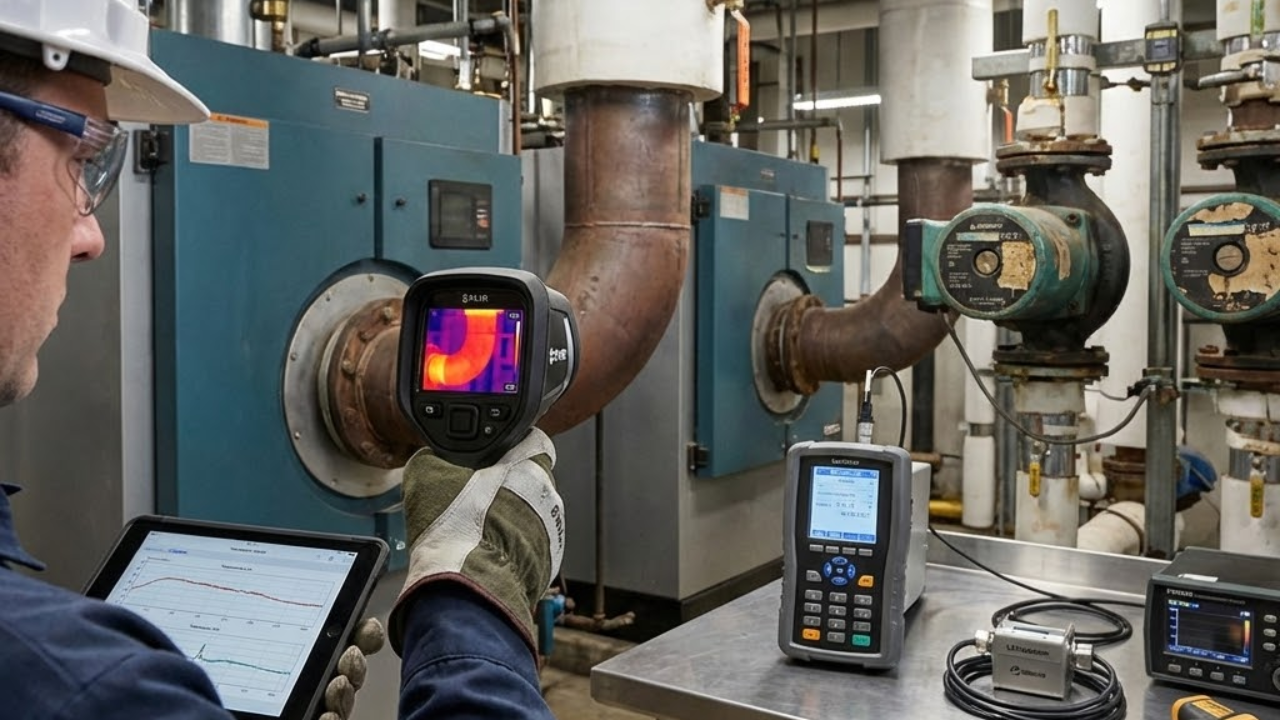
The engineer arrives with a toolkit that's evolved considerably from the clipboard-and-thermometer days. Modern audit equipment includes a calibrated flue gas analyser for combustion efficiency testing, infrared thermometer and thermal imaging camera for temperature mapping, ultrasonic flow meter for measuring actual circulation rates, power analyser for pump and control energy consumption, and data loggers for continuous temperature and pressure monitoring.
Initial walkthrough establishes the system layout and identifies obvious issues. The engineer examines the plant room, noting boiler type and age, pump specifications, expansion vessel and pressurisation equipment, and control system configuration. They trace primary circuits, identify zone divisions, and check valve operation. This reconnaissance reveals whether the installed system matches any available documentation. Often it doesn't, due to undocumented modifications over the years.
Combustion efficiency analysis provides the most critical boiler performance data. The engineer drills a small test hole in the flue (if one doesn't exist), inserts the gas analyser probe, and measures oxygen, carbon monoxide, and temperature in the exhaust gases. The analyser calculates combustion efficiency, excess air levels, and CO/CO₂ ratio. Results reveal whether the boiler's burning cleanly and efficiently, or wasting fuel through poor combustion or excessive flue losses.
Flue gas analysis often uncovers problems invisible from external observation. A boiler might fire smoothly and maintain temperature perfectly, yet run at 72% efficiency because the burner's air-fuel mixture drifted out of specification. That's a 20% fuel penalty that continues until someone measures it and adjusts the burner.
Temperature and pressure logging maps how the system behaves over time. The engineer installs data loggers at key points (boiler flow and return, primary circuit, zone supplies) recording temperatures every few minutes. Some audits run loggers for a week or more, capturing how the system responds to varying weather and occupancy patterns. This reveals cycling frequency, temperature overshoots, and whether controls actually do what they're supposed to.
Thermal imaging surveys conducted on cold days reveal heat loss patterns and distribution problems. The infrared camera shows missing insulation, thermal bridging, radiators with air locks or sludge accumulation, and zones receiving inadequate heat. It's particularly valuable for identifying issues hidden behind walls or above ceilings. Pipework running through voids that's losing heat uselessly.
Control system evaluation tests whether heating responds appropriately to building needs. The engineer checks thermostat calibration, zone valve operation, EPH programmers and other control settings, and weather compensation curves. They verify that optimum start/stop functions work correctly, overnight setback actually reduces temperatures, and frost protection prevents damage without wasting energy.
One common finding: control systems configured incorrectly during installation and never corrected. Weather compensation might be enabled but set to the wrong curve, providing too much or too little temperature reduction. Or optimum start calculates warm-up time incorrectly, firing the boiler two hours early when 45 minutes would suffice.
Turning Audit Findings into Action
The audit report arrives as a thick document full of measurements, calculations, and recommendations. What happens next determines whether you've bought expensive paper or a roadmap to lower costs and better comfort.
Prioritise by payback period, not by technical complexity or equipment age. The best improvement isn't necessarily the shiniest new boiler. It's the change that delivers the fastest return on investment. Weather compensation controls, pump speed reduction, and system balancing typically offer paybacks under 18 months and should move to the front of the queue. Boiler replacement might wait until the existing unit actually fails, unless efficiency is so poor that replacement pays for itself within 3-5 years.
Phase improvements logically. Some changes create opportunities for others or make subsequent work easier. It makes sense to install weather compensation and optimise controls before replacing the boiler. You might discover the existing boiler performs adequately once controlled properly, saving the capital cost entirely. Similarly, balance the system and fix distribution problems before upgrading pumps, ensuring the new pumps work with a properly configured system.
Verify savings after implementation. The audit predicted specific energy reductions. Did they materialise? Compare energy consumption for equivalent periods before and after improvements, adjusting for weather differences using degree-day data. If predicted savings don't appear, something's wrong. Perhaps controls weren't commissioned properly, or occupant behaviour changed, or the improvement wasn't implemented as specified. Verification ensures you actually receive the benefits you paid for.
Schedule regular follow-up audits. Heating systems drift out of optimal operation over time. Controls get adjusted, pumps wear, boilers accumulate deposits, and thermostats fail. A building achieving excellent efficiency today will likely waste 10-15% more energy three years from now without ongoing attention. Plan to repeat detailed audits every 3-5 years, with annual basic checks of combustion efficiency and control operation.
Beyond Energy: The Wider Benefits of Auditing
Reduced fuel bills provide the obvious financial return, but commercial heating audits deliver additional benefits that often exceed the direct energy savings.
Extended equipment life results from systems running closer to design conditions. Boilers cycling less frequently experience fewer thermal stress cycles, reducing failure rates and extending service life. Pumps operating at appropriate speeds rather than constant maximum output last longer and require less maintenance. Controls working correctly prevent the temperature extremes and rapid cycling that damage components.
Improved comfort and productivity follow from better heat distribution and more responsive controls. Eliminating hot and cold spots, reducing temperature swings, and ensuring heating meets actual needs rather than following rigid schedules makes buildings more pleasant to occupy. Studies consistently show that comfortable employees are more productive, take fewer sick days, and report higher job satisfaction. For office buildings, the productivity gains from improved comfort often exceed the energy cost savings.
Reduced maintenance costs emerge as systems run more reliably. Boilers operating efficiently produce less soot and corrosion, extending service intervals. Properly balanced systems eliminate the pump cavitation, valve erosion, and pipework noise that generate maintenance calls. Controls that work correctly don't need constant adjustment or emergency repairs.
Regulatory compliance becomes easier to demonstrate. Commercial buildings face increasing pressure to reduce carbon emissions and improve energy performance. An energy audit provides documented evidence of system efficiency and identifies the improvements needed to meet current and future regulations. It's considerably easier to plan compliance work systematically based on audit data than to react hastily when regulations tighten.
Asset value protection matters for property owners. Buildings with documented, efficient heating systems command higher valuations and rental rates than comparable properties with ageing, inefficient plant. Energy Performance Certificates (EPCs) increasingly influence commercial property values. An audit identifies the improvements needed to achieve better ratings.
Choosing an Audit Provider
Not all energy audits deliver equal value. The quality of recommendations depends entirely on the engineer's experience and the thoroughness of their investigation.
Look for professional qualifications and certifications. Engineers should hold relevant credentials such as Gas Safe registration for boiler work, certification in combustion efficiency analysis, and membership in professional bodies like CIBSE (Chartered Institution of Building Services Engineers). Many qualified auditors hold Energy Managers Association certification or similar credentials demonstrating expertise in building energy assessment.
Experience with your building type matters enormously. Commercial heating varies significantly between offices, retail spaces, warehouses, schools, and healthcare facilities. An auditor with deep experience in office buildings might miss critical issues in a hospital or manufacturing facility. Ask for references from similar buildings and examples of previous audit reports.
Independence from equipment suppliers ensures objective recommendations. Some "audits" are thinly disguised sales pitches, recommending expensive equipment replacements because the auditor works for a manufacturer or installer. Truly independent auditors have no financial interest in which improvements you choose. Their fee comes from the audit itself, not from subsequent equipment sales.
Comprehensive reporting distinguishes thorough audits from superficial inspections. The report should include measured data (not just observations), calculations showing how savings estimates were derived, specific recommendations with costs and paybacks, and prioritised implementation plans. Vague statements like "the boiler is old and inefficient" without supporting measurements provide no useful basis for decision-making.
Making Commercial Heating Audits Work for Your Building
A commercial heating energy audit isn't a one-time fix. It's the foundation of ongoing energy management. The buildings that achieve the lowest heating costs and most reliable comfort don't just audit once; they build continuous monitoring and optimisation into their operational culture.
Start by establishing baseline energy consumption. Gather at least two years of heating fuel and electricity bills, along with degree-day data for the same periods. This baseline lets you measure improvement accurately and spot problems quickly when consumption rises unexpectedly.
Commission a professional audit when baseline data shows consumption significantly above benchmarks for your building type, when heating costs increase without obvious cause, or every 3-5 years as part of planned maintenance. The audit investment pays for itself many times over through identified savings and avoided equipment failures.
Implement recommendations systematically, starting with quick wins that deliver fast paybacks. Use the savings from early improvements to fund more substantial upgrades, creating a self-financing improvement cycle.
Monitor performance continuously after improvements. Modern building management systems and smart meters make it easy to track daily energy consumption and spot problems immediately. Many of the efficiency gains from an audit erode over time if no one watches the data and responds to changes.
The most successful commercial buildings treat heating efficiency as an ongoing priority, not a one-off project. They audit regularly, implement improvements systematically, and monitor performance continuously. If you need help improving your commercial heating efficiency, get expert advice to discuss audit recommendations and implementation strategies.