

Commercial Heating System Inspections: What's Required
Commercial heating failures don't just cost money. They shut down operations, breach tenancy agreements, and in the worst cases, put lives at risk. A manufacturing facility in the Midlands lost three days of production last winter when their ageing boiler failed overnight. The fault? A corroded heat exchanger that would've been flagged months earlier during a proper inspection. That's £40,000 in lost output, not counting the emergency call-out fees.
The regulatory landscape around commercial heating has tightened considerably. Between the Building Safety Act 2022, updated gas safety requirements, and stricter environmental standards, facility managers and building owners face more scrutiny than ever. Yet many still treat inspections as box-ticking exercises rather than the critical risk management they actually are.
This isn't about compliance theatre. It's about understanding what inspectors actually look for, why those checks matter, and how to avoid the costly surprises that come from cutting corners.
Legal Framework and Compliance Requirements
Gas Safety (Installation and Use) Regulations 1998 remain the foundation for any commercial heating system using gas appliances. Every gas appliance, flue, and associated pipework must be inspected annually by a Gas Safe registered engineer through Gas Safe registration requirements. This isn't negotiable. Non-compliance is taken seriously by the HSE, with the potential for substantial fines and severe legal penalties for landlords and building owners. Heating and Plumbing World provides comprehensive support for commercial heating installations with extensive technical expertise.
The inspection must cover every gas appliance in the building, including boilers, water heaters, and auxiliary equipment. The engineer will issue a CP42 certificate (the commercial equivalent of a domestic CP12) detailing the condition of each appliance and any remedial work required.
But gas safety is only part of the picture. The Pressure Systems Safety Regulations 2000 apply to any system operating above 0.5 bar, which includes most modern commercial heating installations. These regulations require a written scheme of examination, typically conducted by a competent person on a periodic basis, though the exact interval can vary based on system complexity and risk assessment.
For buildings with F-gas refrigerant systems (common in heat pumps and hybrid systems), the F-Gas Regulations 2015 mandate regular leak checks. Systems containing significant amounts of refrigerant need routine, documented inspections, with records kept for several years. Given that many heat pump installations now fall under these thresholds, it's a requirement that catches facility managers off guard.
What Inspectors Actually Examine
Walk into a boiler room with an experienced inspector, and they're not just ticking boxes on a checklist. They're reading the system like a diagnostic scan, looking for the telltale signs of deterioration, poor maintenance, or dangerous modifications.
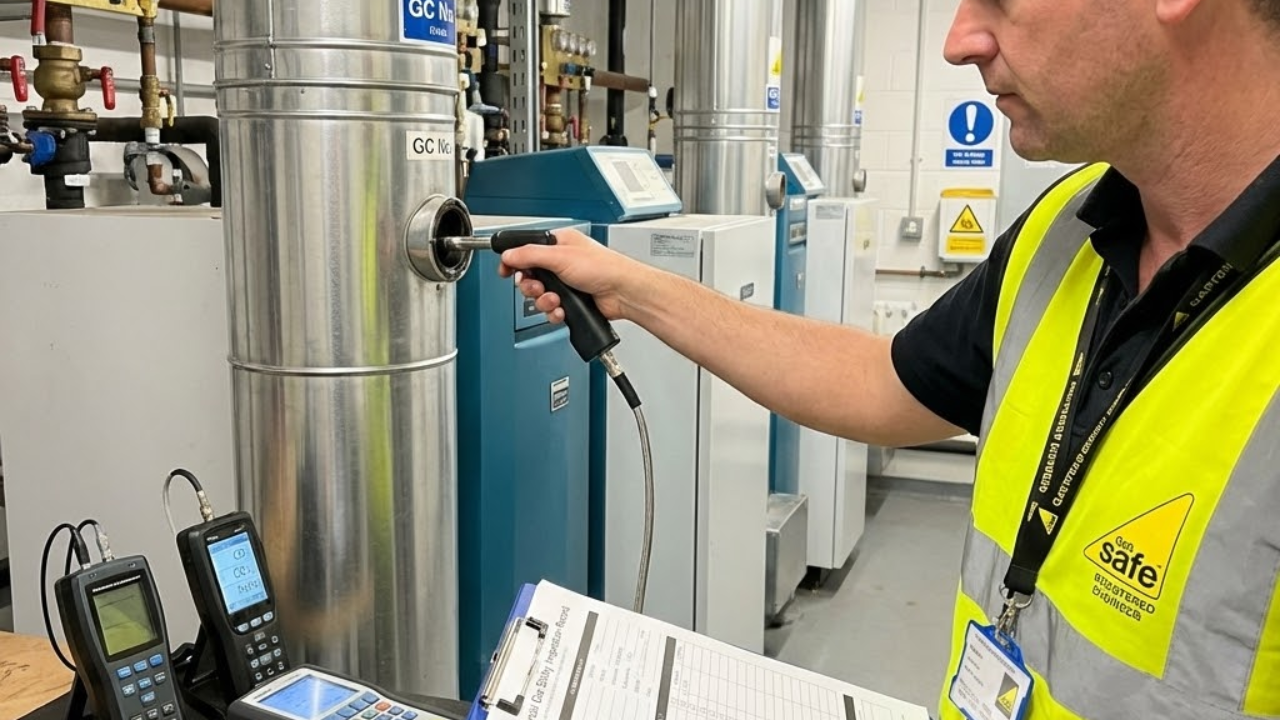
Combustion analysis comes first for gas and oil-fired plant. The inspector will measure flue gas composition, checking CO and CO₂ levels against manufacturer specifications. High CO readings indicate incomplete combustion, potentially deadly if flue gases are spilling into occupied spaces. Excess CO₂ suggests the burner's running too rich, wasting fuel and generating soot that'll clog heat exchangers.
Think of flue gas composition testing like a health check-up for your boiler's lungs. Just as blood tests reveal what's happening inside your body before symptoms appear, flue gas readings expose combustion problems before they cause complete system failure or create dangerous conditions.
The flue system gets particular attention. Inspectors check for corrosion, blockages, and proper termination. A flue that's sagging or showing white staining around joints is leaking combustion gases. An immediate fail. They'll verify adequate air supply to the plant room too. Modern condensing boilers need more combustion air than older atmospheric types, and many older buildings haven't been retrofitted properly.
Heat exchangers are examined for signs of corrosion, scale buildup, and stress cracking. On cast iron boilers, inspectors look for weeping joints and section deterioration. Stainless steel heat exchangers in condensing boilers can suffer from chemical attack if the system water chemistry isn't maintained properly. Minor leaks today become catastrophic failures tomorrow.
The control system inspection covers everything from room thermostats to BMS integration. Inspectors verify that safety interlocks function correctly: high-limit stats, low-water cutoffs, and flame failure devices. They'll test the sequence of operations, ensuring burners fire smoothly without hunting or lockouts. A system that short-cycles isn't just inefficient. It's wearing itself out faster than necessary.
Pumps and circulators receive scrutiny for bearing noise, seal leaks, and correct operation. A Grundfos MAGNA3 or similar variable-speed pump should modulate smoothly based on system demand. If it's running flat-out constantly, something's wrong. Either the system's undersized, or there's a control fault burning unnecessary energy.
Pressure vessels, including expansion vessels and pressurisation units, must be checked for correct pre-charge pressure and membrane integrity through pressure vessel inspection protocols. An expansion vessel that's lost its pre-charge puts the entire system at risk of overpressure trips or, worse, safety valve discharge. Inspectors will isolate the vessel, drain it, and verify the nitrogen charge matches the system's requirements.
Frequency and Scheduling Considerations
The annual gas safety inspection is mandatory, but it's nowhere near sufficient for complex commercial installations. A medium-sized office building with a modular boiler setup, multiple pump sets, and BMS controls needs more frequent visual inspections at minimum, with more detailed examinations twice yearly.
Seasonal timing matters more than most facility managers realise. Scheduling your main inspection in September, just before heating season starts, gives you time to address issues before they cause outages. Leaving it until November means you're gambling on getting through winter without failures. Emergency repair costs are typically much higher than planned maintenance costs.
High-demand facilities (hospitals, care homes, manufacturing plants) should consider frequent walk-throughs by in-house maintenance staff, supplemented by professional inspections. It's not overkill. A hospital that loses heating in winter is potentially breaching compliance requirements and putting vulnerable patients at risk.
For multi-site operators, staggered inspection schedules prevent the administrative nightmare of managing dozens of expiring certificates simultaneously. Spread inspections across the year, grouped by region or facility type. This also means your maintenance budget isn't hit with a massive quarterly spike.
Common Inspection Failures and How to Avoid Them
Inadequate ventilation tops the list of avoidable failures. Plant rooms get repurposed over time. Someone adds a storage rack here, boxes a pipe run there. Suddenly the combustion air vents are blocked. The fix costs nothing: clear the space. Yet it is one of the most common causes of failed inspections.
Poor water quality causes more long-term damage than any other single factor. Systems filled with mains water and never treated will accumulate scale, magnetite, and dissolved oxygen. Within a few years, you'll see pump failures, pinhole leaks, and heat exchanger corrosion. The solution? Dose the system with inhibitor annually, and actually test the water chemistry. A basic test kit is inexpensive and takes minutes to use.
Neglected expansion vessels are another frequent issue. The vessel absorbs pressure changes as the system heats and cools. When the pre-charge fails, the system can't accommodate expansion, and you get constant safety valve discharge or pump cavitation. Checking the pre-charge pressure takes minimal time and prevents failures that'll cost thousands.
Outdated or modified controls often fail inspection because they don't meet current safety standards. A boiler with no high-limit stat, or one that's been bypassed by a previous contractor, is an immediate prohibition notice. Before inspections, verify that all safety devices are present, functional, and haven't been tampered with.
On a retail park project, the facility manager learned this the expensive way. A maintenance contractor had bypassed a faulty flow switch rather than replacing it, and the system ran for six months without low-flow protection. When the inspector found it during the annual Gas Safe registration inspection, the entire system was red-tagged until properly repaired. Days of closure during peak trading season followed.
Documentation and Record-Keeping Requirements
Inspectors will ask to see your maintenance logbook immediately. This should contain every service visit, repair, and modification since installation. If you can't produce records, inspectors assume the worst: that maintenance has been neglected and undocumented faults exist.
The annual gas safety certificate requires a CP42 certificate for commercial installations, which expires exactly one year from the inspection date. If your inspection was on 15th March 2024, the next one's due by 14th March 2025, regardless of when the engineer actually sent you the certificate. Set calendar reminders well in advance of expiry.
Pressure system examination reports must be retained under PSSR 2000. These reports detail the condition of pressure vessels, safety devices, and associated pipework through comprehensive pressure vessel inspection findings. Keep them accessible for inspectors and insurance assessors.
For F-gas systems, you'll need separate records showing leak check dates, refrigerant quantities, and any top-ups performed. Regulatory bodies can audit these records and impose significant financial penalties for non-compliance.
Digital record-keeping has transformed this area. Cloud-based maintenance management systems let you photograph certificates, log work automatically, and set reminder alerts for upcoming inspections. But paper logbooks still have a place. They don't require WiFi or battery power, and inspectors can flip through them in seconds.
The Role of Competent Persons
The regulations repeatedly reference "competent persons," but what does that actually mean? For gas work, it's straightforward. The engineer must be Gas Safe registered for the specific appliance types being inspected. But for broader system inspections, competency becomes murkier.
A competent person must have sufficient training, experience, and knowledge to identify defects and assess risk. For complex commercial systems, this typically means someone with formal HVAC qualifications (HNC/HND level minimum) or equivalent demonstrable expertise, several years of commercial experience, and manufacturer-specific training on the equipment being inspected.
The person writing your pressure system scheme of examination needs even higher qualifications. Often a chartered engineer or someone with equivalent demonstrable competence. This isn't a job for your general maintenance contractor unless they can prove specific expertise in pressure systems.
Many facility managers use a tiered approach: in-house staff handle routine visual inspections and basic maintenance, whilst specialist contractors perform annual statutory inspections and complex diagnostics. This balances cost against competency, provided the in-house team receives proper training and knows when to escalate issues.
Emerging Standards and Future Requirements
The push toward net zero is reshaping commercial heating inspections. New government regulations increasingly require energy efficiency assessments for communal heating systems. Inspectors are increasingly asked to comment on system efficiency, not just safety and compliance.
Heat pump installations bring new inspection requirements. Unlike gas boilers, heat pumps need refrigerant circuit checks, outdoor unit inspections for coil damage and debris, and verification that defrost cycles operate correctly. Many traditional heating engineers lack heat pump competency, creating a skills gap as installations proliferate.
The Building Safety Act introduces the concept of "responsible persons" for high-risk buildings, with explicit duties around mechanical systems. For high-risk buildings, expect more rigorous inspection regimes and mandatory reporting of significant defects.
Smart building integration is changing how we monitor and inspect systems. Continuous monitoring via BMS can flag developing faults before they cause failures, potentially reducing the frequency of manual inspections. But regulators haven't caught up. You still need annual physical inspections regardless of how sophisticated your monitoring is. Honeywell heating controls provide reliable components that support commercial heating system operations.
Cost Implications and Budgeting
A basic annual gas safety inspection for a small commercial premises with a single boiler typically costs £150-300. Scale up to a multi-boiler plant room with complex controls, and you're looking at £800-1,500 for a comprehensive inspection covering gas safety, pressure systems, and water treatment analysis.
But the inspection cost is trivial compared to failure costs. A boiler that fails inspection and requires immediate heat exchanger replacement might cost tens of thousands in parts and labour. If that failure happens mid-winter and requires emergency out-of-hours work, costs can escalate dramatically.
Planned maintenance contracts typically bundle inspections with routine servicing, spreading costs across the year and often including emergency cover. For a medium-sized commercial building, expect to budget £2,000-4,000 annually for comprehensive maintenance including all statutory inspections.
The false economy of skipping inspections becomes obvious when you model failure scenarios. A facility that saves £1,000 by delaying inspection risks a catastrophic failure costing £20,000 in emergency repairs, plus business interruption losses that can dwarf the repair bill itself.
Preparing for Your Inspection
The best inspections are the ones where nothing's a surprise. Two weeks before your scheduled inspection, conduct your own pre-inspection walk-through. Check that the plant room is accessible, well-lit, and clear of stored materials. Verify that all system documentation is current and readily available.
Test the basics yourself: Are all pumps running smoothly? Do thermostats respond correctly? Are there any visible leaks or unusual noises? Address obvious issues before the inspector arrives. It's cheaper to fix a dripping pump gland seal on your terms than to have it flagged as an urgent defect.
Ensure your maintenance logbook is up to date with recent work. If you've had repairs or modifications done since the last inspection, make sure those records are included. Inspectors view missing documentation as a red flag suggesting other maintenance has been neglected.
For multi-tenanted buildings, notify occupants about the inspection schedule. Some checks require temporary system shutdowns or access to tenant spaces. Planning this properly avoids the awkwardness of discovering mid-inspection that you can't access a critical area.
Conclusion
Commercial heating inspections aren't bureaucratic obstacles. They're the difference between reliable operation and expensive failures. The regulatory framework exists because heating systems, when poorly maintained, kill people and destroy property. The annual gas safety check is non-negotiable, but it's only the baseline. Complex commercial systems need more frequent attention, better record-keeping, and competent professionals who understand what they're looking at.
The facility managers who treat inspections as opportunities rather than obligations are the ones who avoid the 2am emergency calls. They budget properly, maintain comprehensive records, and address minor issues before they become major failures. Their systems run efficiently, reliably, and safely. Exactly what commercial heating should do.
When you're specifying new equipment or upgrading existing systems, remember that maintainability affects long-term costs as much as the initial purchase price. Components from established manufacturers come with comprehensive support and spare parts availability that makes inspection and maintenance straightforward. Danfoss heating components offer proven reliability for commercial applications.
The question isn't whether you can afford proper inspections. It's whether you can afford not to have them. For specialist support with heating system design or component selection, contact us for guidance tailored to commercial installations.