

Commercial System Water Quality Testing: Standards and Frequency
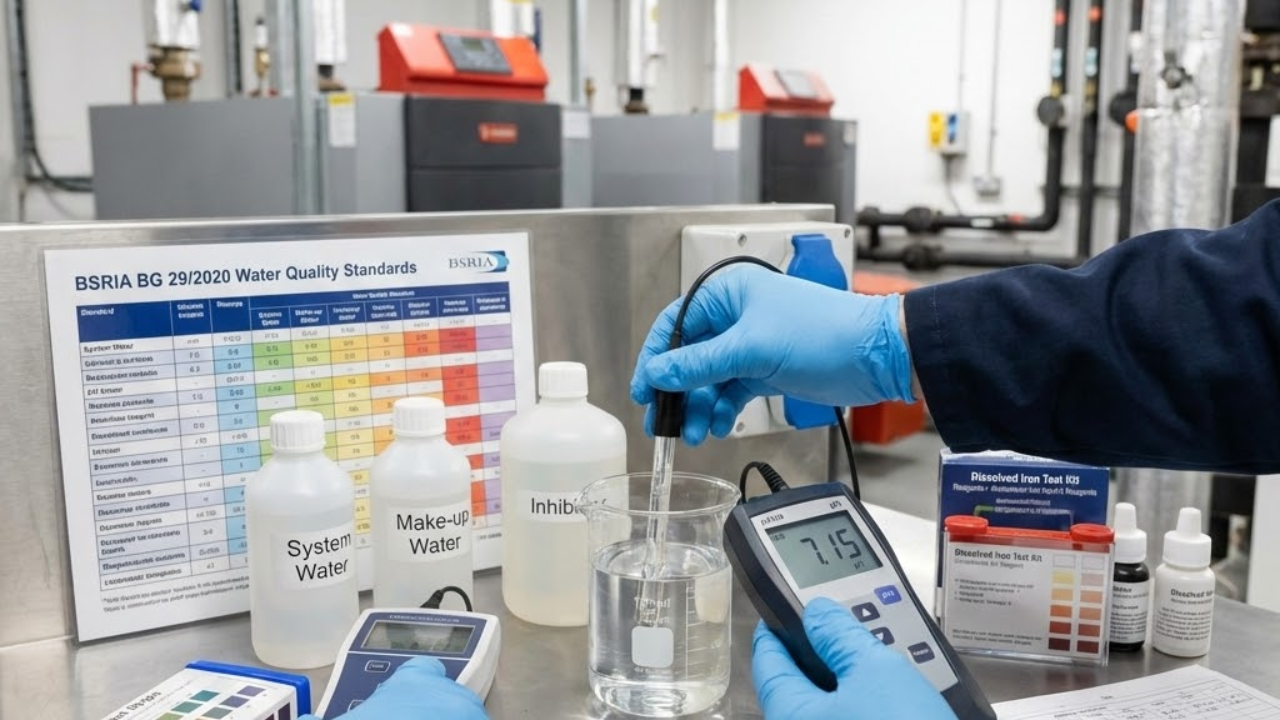
Poor water quality destroys commercial heating systems from the inside out. Scale deposits choke heat exchangers, corrosion eats through pipework, and bacterial growth creates sludge that kills pump efficiency. A single system failure on a commercial site doesn't just cost thousands in repairs. It shuts down operations, breaches compliance obligations, and lands you with liability claims.
Yet most facilities managers only test water quality when something's already gone wrong. By then, the damage is done. Professional water quality testing isn't just about ticking a box for building compliance. It's about protecting capital equipment, maintaining system efficiency, and avoiding catastrophic failures that could have been prevented with a £200 test kit and 30 minutes of your time.
The difference between a system that runs reliably for 20 years and one that needs a complete overhaul after five often comes down to water chemistry. This guide explains exactly what you need to test, how often, and what the standards actually mean for your commercial installation. Heating and Plumbing World supplies comprehensive water treatment solutions and testing equipment for commercial heating systems.
Why Commercial Systems Demand Different Testing Standards
Domestic heating systems operate at relatively low volumes, typically 100-300 litres for an average house. Get the water chemistry slightly wrong, and you might see some efficiency loss or need to replace components like Danfoss thermostatic valves. It's not ideal, but it's manageable.
Commercial systems operate at a completely different scale. Think of it like the difference between maintaining a garden pond and managing a public swimming pool. Both need clean water, but the pool requires professional-grade testing, precise chemical balance, and constant monitoring through systems like Honeywell controls because the consequences of getting it wrong affect hundreds of people and cost far more to fix.
A medium-sized office building might contain 5,000 litres of system water. A hospital or manufacturing facility could hold 50,000 litres or more. When you're circulating that volume through expensive plant equipment like Andrews boilers, plate heat exchangers, and variable speed pumps, the consequences of poor water quality multiply exponentially.
Corrosion rates accelerate with system volume and temperature. A pH level that causes minor surface corrosion in a domestic radiator will eat through commercial pipework in months. Scale formation in a commercial heat exchanger doesn't just reduce efficiency by 10%. It can drop heat transfer rates by 40% and cause complete blockages that require full system shutdowns and costly descaling operations.
The financial stakes are higher, too. Replacing a domestic boiler costs around £2,000-£3,000. Replacing a commercial boiler plant? You're looking at £30,000-£150,000 depending on capacity, plus the cost of downtime. That's why commercial water quality testing follows stricter standards and requires more frequent monitoring than domestic installations.
The Core Standards: BSRIA BG 29/2020 and CIBSE Guide C
Two documents govern commercial heating and cooling water quality in the UK: BSRIA BG 29/2020 (formerly BG 50) and CIBSE Guide C. These aren't optional guidelines. They're industry standards that insurers, building surveyors, and legal teams reference when something goes wrong.
BSRIA BG 29/2020 provides the most comprehensive framework. It defines acceptable water quality parameters for different system types, explains testing methodologies, and sets out maintenance procedures. Most importantly, it establishes clear benchmarks that tell you whether your system water is within acceptable limits or heading towards trouble.
CIBSE Guide C covers broader building services engineering but includes detailed sections on water treatment for closed heating and cooling systems. It aligns closely with BSRIA BG 29/2020 guidance but adds context around system design, treatment dosing, and long-term maintenance strategies.
Both standards recognise that commercial systems face three primary water quality threats: corrosion, scale formation, and microbiological contamination. Each requires different testing approaches and different remedial actions.
Essential Water Quality Parameters You Must Test
Walk onto any commercial site with a proper water testing kit, and you should be checking six core parameters. Miss any of these, and you're flying blind.
pH level sits at the top of the list. BSRIA BG 29/2020 specifies a target range of 8.5-10.0 for inhibited systems. This slightly alkaline environment protects steel pipework and radiators from corrosion. Drop below 8.5, and you'll see accelerated corrosion of ferrous metals. Push above 10.0, and you risk attacking non-ferrous components like compression fittings and aluminium heat exchangers.
Testing pH is straightforward. Digital pH meters give instant readings, though you need to calibrate them regularly. Litmus strips work in a pinch but lack the precision needed for commercial systems where 0.5 pH units can make a significant difference.
Electrical conductivity measures the total dissolved solids in your system water. High conductivity indicates excessive mineral content, which accelerates both corrosion and scale formation. BSRIA BG 29/2020 recommends keeping conductivity below 500 μS/cm for most systems, though this varies depending on whether you're running inhibited or uninhibited water.
Pure water has low conductivity. As you add minerals, salts, and treatment chemicals, conductivity rises through electrical conductivity measurement readings. If you're seeing readings above 1,000 μS/cm, you've got too much dissolved material in the system. Either from initial fill water quality, corrosion products, or over-dosing of treatment chemicals.
Hardness directly affects scale formation. Hard water contains calcium and magnesium salts that precipitate out when heated, forming the white crusty deposits that choke heat exchangers and coat heating surfaces. Total hardness should be below 50 mg/l CaCO₃ for most commercial systems.
If you're filling a system with untreated mains water in a hard water area, you could be introducing 200-300 mg/l of hardness. That's a recipe for rapid scale formation. This is why using deionised or softened water for initial system fill is essential, particularly on larger commercial installations.
Chloride content accelerates pitting corrosion, particularly in stainless steel components. BSRIA BG 29/2020 sets a maximum limit of 50 mg/l for inhibited systems. Chlorides typically enter systems through poor-quality fill water or contamination from external sources. Once present, they're difficult to remove without partial or complete system drainage.
Dissolved iron indicates active corrosion of ferrous metals. Your pipework, radiators, and boiler heat exchangers. Fresh system water should contain minimal iron (less than 1 mg/l). If you're seeing readings above 5 mg/l, you've got active dissolved iron corrosion happening right now. Above 10 mg/l, and you need immediate remedial action.
On a recent facilities audit, an engineer tested water from a five-year-old office building showing 12 mg/l dissolved iron. The system looked fine externally, but that iron reading revealed severe internal corrosion. A magnetic filter inspection confirmed thick black sludge accumulation. The facilities team had skipped annual water testing to save £300, but now faced a £15,000 system flush and component replacement. That's an expensive lesson about the value of regular testing.
The iron test tells you what's happening inside the system that you can't see. Rising iron levels over successive tests prove that your inhibitor has failed or your pH has dropped out of range. It's an early warning system that catches problems before they cause visible damage.
Inhibitor concentration protects the system from corrosion. Most commercial systems use proprietary inhibitor blends that combine corrosion inhibitors, scale inhibitors, and dispersants. Each manufacturer specifies a target concentration, typically measured as a percentage or in mg/l.
Testing inhibitor levels through inhibitor concentration testing requires manufacturer-specific test kits. A generic conductivity reading won't tell you if your inhibitor concentration is correct because other dissolved solids affect the result. You need the actual chemical test kit that matches your treatment product.
Testing Frequency: When and Why
Here's where most facilities teams get it wrong. They test water quality during commissioning, file the results, and don't look at it again until something breaks. That approach works fine until you're explaining to senior management why the entire heating system needs replacing ten years early.
Initial commissioning testing should happen before the system goes live. This establishes your baseline water quality and confirms that the system has been filled with suitable water, flushed properly, and dosed with the correct inhibitor concentration. You should test all six core parameters and document the results.
Many commissioning engineers skip proper water quality testing because it adds time to an already tight schedule. Don't let this happen. The commissioning phase is your only opportunity to start with clean, properly treated water. Get it wrong now, and you'll spend years fighting corrosion and efficiency losses.
First-year monitoring requires monthly testing for the first three months, then quarterly for the remainder of the year. This catches early problems with inhibitor degradation, pH drift, or contamination before they become established. New systems are particularly vulnerable because residual flux, installation debris, and initial corrosion products can alter water chemistry rapidly.
After the first year, annual testing becomes the minimum standard for most commercial systems. BSRIA BG 29/2020 recommends annual testing for stable, well-maintained systems operating within normal parameters. This annual check confirms that inhibitor levels remain adequate, pH hasn't drifted, and no new corrosion or contamination issues have developed.
However, six-monthly testing makes more sense for larger systems, critical applications, or installations with a history of water quality problems. The additional cost of twice-yearly testing is negligible compared to the cost of system damage. For hospitals, data centres, or manufacturing facilities where heating system failure causes operational shutdown, six-monthly testing should be standard practice.
Event-driven testing is equally important. Any time you add significant quantities of make-up water, you should test. Top-ups dilute inhibitor concentrations and can introduce contaminants. As a rule, if you've added more than 5% of total system volume, test the water and adjust treatment accordingly.
Similarly, test after any major maintenance work, particularly if you've drained sections of the system or opened up pipework. Test if you notice unexplained efficiency losses, unusual noises, or discoloured water at drain points. These symptoms often indicate water quality problems that testing will confirm.
How to Collect Representative Samples
Water quality varies throughout a commercial system. The water sitting in a rarely-used radiator circuit might have completely different chemistry to the water circulating through the boiler plant room. That's why sample collection technique matters.
Always sample from a dedicated test point if one exists. Most commercial systems should have sample points installed at strategic locations, typically in the plant room, close to the main circulator or near the boiler return. These points allow you to draw water that's representative of the system as a whole.
Flush the sample point thoroughly before collecting your test sample. Run off at least one litre to clear any stagnant water sitting in the sample line. The water you test should be actively circulating system water, not water that's been sitting in a dead leg for weeks.
Use clean sample bottles, preferably provided with your test kit. Contamination from a dirty bottle will skew results. Fill bottles completely to exclude air, particularly for dissolved oxygen testing. Label each sample clearly with the date, location, and system identifier.
For large or complex systems, consider taking samples from multiple locations. Compare water quality at the flow and return, in different zones, or at the top and bottom of tall buildings. Significant variations between sample points indicate poor system circulation, stratification, or localised corrosion problems.
Interpreting Results and Taking Action
Raw test results mean nothing without context. A pH reading of 9.2 might be perfect for one system and problematic for another. You need to compare your results against the target parameters for your specific system type and treatment regime.
Start by checking if all parameters fall within the acceptable ranges specified in BSRIA BG 29/2020 or your water treatment supplier's guidelines. If everything's in range, document the results and continue with your normal testing schedule. Stable water chemistry over successive tests proves your treatment programme is working.
Single parameters outside range require investigation but don't necessarily indicate immediate danger. A pH reading of 8.3 (just below the 8.5 minimum) might simply mean you need to adjust your inhibitor dose. Check the trend. Is pH falling over time, or was this a one-off anomaly?
Multiple parameters outside range suggest system problems that need urgent attention. High conductivity combined with high dissolved iron and low pH indicates active corrosion with significant metal loss. This scenario requires immediate remedial action: drain and flush the affected sections, investigate the cause of corrosion, re-dose with inhibitor, and implement more frequent testing.
Rising iron levels over successive tests prove that corrosion is ongoing. Don't wait for iron to reach the maximum limit before acting. If you see iron climbing from 2 mg/l to 5 mg/l to 8 mg/l over three quarterly tests, you have an accelerating corrosion problem. The system is eating itself, and you need to find out why.
The Role of Professional Water Treatment Companies
Most commercial installations benefit from partnering with a professional water treatment company. These specialists don't just supply chemicals. They provide regular monitoring, dosing adjustments, and expert interpretation of water quality trends.
A typical water treatment contract includes quarterly or bi-annual site visits where a technician collects samples, tests all parameters, adjusts inhibitor dosing, and provides a written report. This outsourced approach ensures consistent testing, removes the burden from your maintenance team, and provides documented evidence of proper system care.
The cost is modest, typically £300-£800 per year for a medium-sized commercial system, depending on complexity and visit frequency. That's cheap insurance against system damage that could cost tens of thousands to repair.
However, don't abdicate all responsibility to your water treatment contractor. You should still understand what they're testing, why it matters, and what the results mean. Ask questions. Review the reports. If your contractor recommends action, understand the reasoning behind it.
Some facilities teams prefer to handle water testing in-house, particularly if they have skilled maintenance engineers who understand water chemistry. This approach works well if you invest in proper test equipment, train your team thoroughly, and maintain rigorous testing schedules. The Grundfos range of water quality testing equipment provides professional-grade tools suitable for in-house testing programmes.
Common Mistakes That Compromise Water Quality
Even experienced facilities teams make water quality mistakes that undermine system performance. One of the most common is over-dosing inhibitor. More isn't better. Excessive inhibitor concentration increases conductivity, can cause foaming, and wastes money. Dose to the manufacturer's recommended concentration, test regularly, and adjust only when needed.
Topping up with untreated water dilutes your carefully balanced system chemistry. Every litre of mains water you add brings in dissolved oxygen, hardness minerals, and chlorides. Small top-ups (less than 1-2% of system volume) won't cause immediate problems, but regular significant top-ups indicate a leak that you should find and fix rather than continuously diluting your treatment.
Ignoring gradual parameter drift is another frequent mistake. Your pH might drop from 9.5 to 9.2 to 8.9 over successive tests. Each individual result seems acceptable, but the trend shows deteriorating water quality. Act on trends, not just on whether today's number falls within range.
Mixing incompatible inhibitors can cause chemical reactions that reduce effectiveness or create precipitates. If you're changing water treatment suppliers or products, consult both the old and new suppliers about compatibility. Sometimes you'll need to drain and flush before introducing a different inhibitor chemistry.
Delayed remedial action allows minor problems to escalate into major failures. A slightly low pH reading at one test becomes a serious corrosion problem six months later. A small rise in dissolved iron becomes catastrophic metal loss after two years. Test regularly, act promptly, and don't wait for problems to fix themselves. They won't.
Conclusion
Commercial heating system water quality isn't something you can set and forget. The chemistry changes over time as inhibitors degrade, corrosion products accumulate, and make-up water dilutes treatment concentrations. Regular testing catches these changes early, when they're easy and cheap to fix.
The standards exist for good reason. BSRIA BG 29/2020 represents decades of industry experience distilled into practical guidance that prevents the most common causes of system failure. Following those standards (testing the right parameters at the right frequency and taking prompt action when results fall outside range) protects your capital equipment and maintains system efficiency.
Think of water quality testing as preventive maintenance for your heating system's circulatory system. You wouldn't run a commercial boiler without regular servicing. You shouldn't run a commercial heating system without regular water quality testing. The cost is minimal. The protection is substantial. And when your system is still running efficiently after 20 years whilst others are being replaced, you'll know the testing programme was worth every penny.
For comprehensive water treatment solutions and testing equipment suited to commercial installations, explore the specialist brands available through our complete product range. If you need guidance on implementing a water quality testing programme for your specific system, get expert advice from our technical team.