

Danfoss H-Piece Valves: Two-Pipe System Radiator Balancing Procedures
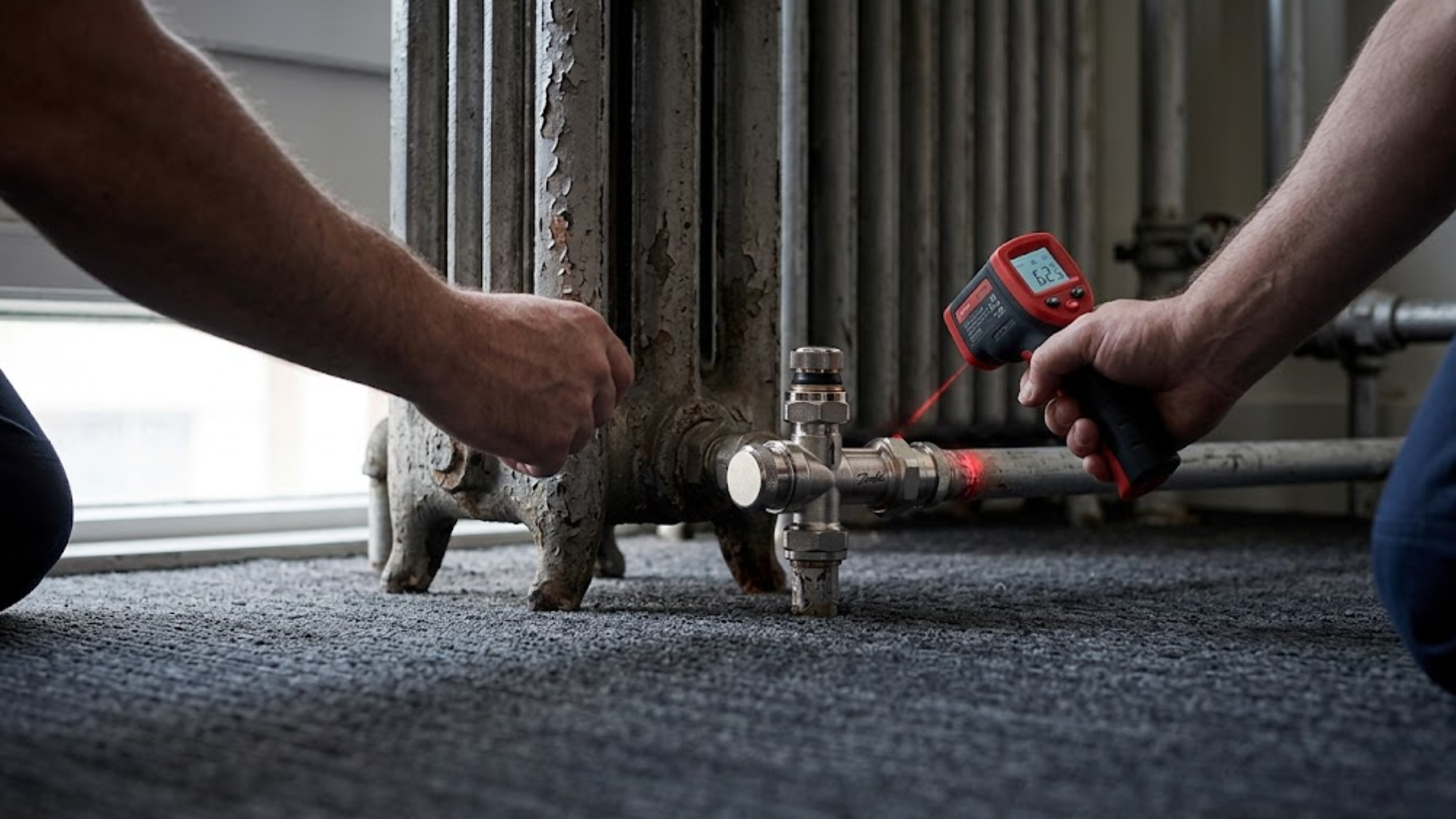
Two-pipe heating systems require highly precise balancing to deliver consistent heat across all radiators. When one radiator runs cold while others scorch, or when ground floor units drastically outperform upper floors, the culprit is almost always improper valve adjustment. Danfoss H-Piece Valves solve this persistent issue through a straightforward balancing mechanism that competent technicians can master within a single project. The process completely transforms erratic, inefficient setups into perfectly tuned thermal networks.
What Makes Two-Pipe Systems Different
Two-pipe configurations send hot water to radiators through one dedicated flow pipe and return the cooled water through another. Unlike single-pipe systems where water flows sequentially through every unit, two-pipe setups allow simultaneous flow. This design delivers far better overall control but creates a specific physical challenge. The radiators situated closest to the boiler receive water first and at a much higher pressure, which naturally starves the distant units of adequate flow.
Think of an unbalanced heating circuit like a busy road network without any traffic lights. All the water simply takes the shortest possible route back to the boiler, causing a massive traffic jam of heat at the beginning of the circuit while completely starving the distant suburbs. The valves act as those necessary traffic lights, slowing down the immediate flow to ensure the entire network runs smoothly.
The valve directly addresses this physical imbalance by restricting the flow at each radiator individually. This creates deliberate, calculated resistance points throughout the entire property, forcing the water to distribute evenly rather than taking the path of least resistance. Implementing proper two-pipe system radiator balancing relies entirely on manipulating this resistance accurately. Utilizing genuine components sourced from Heating and Plumbing World guarantees that these adjustments remain stable under high pressures.
Required Tools And Pre-Balancing Checks
Before touching any valves or making adjustments, you must verify the system operates correctly as a baseline. Run the boiler at full capacity for 30 minutes. Check that the dedicated water circulation pump actually moves the water efficiently. You will hear it running and feel a slight vibration on the casing. Confirm all radiators have been thoroughly bled of air pockets. Air locks make accurate balancing completely impossible.
Gather your necessary tools, including a digital thermometer or an infrared temperature gun with a ±0.5°C accuracy minimum. You also need an adjustable wrench or a specific valve key, alongside a notepad for recording data and a system schematic showing the radiator locations. Most two-pipe system radiator balancing failures stem directly from skipping the air-bleeding step. Even tiny air pockets create highly false readings that lead technicians to over-restrict working units while leaving problem areas unchanged.
Understanding The H-Piece Valve Mechanism
The Danfoss H-Piece Valves sit on the return side of the radiator. They contain an adjustable internal orifice that strictly controls how much water exits the unit. Turning the valve clockwise reduces the opening, generating tight orifice flow restriction and forcing more water onward to other radiators. Turning it counterclockwise increases the flow to that specific unit.
The valve body shows numerical markings, typically 1 to 6 or 1 to 7. These numbers aren't precise flow measurements. They serve purely as reference points. A setting of 3 on one radiator doesn't equal the exact same flow rate as a 3 on another unit if those radiators differ in size or distance from the heat engine. When integrating modern radiator valves, you must trust your actual temperature readings rather than relying blindly on these preset numerical formulas.
The Balancing Sequence
Start with all the valves fully open by turning them counterclockwise until they completely stop. This action establishes a clean baseline. Run the system for 20 minutes to reach standard operating temperature.
Step 1 involves identifying your index radiator. The index radiator is the unit furthest from the boiler or the one that currently heats the absolute slowest. This becomes your master reference point. You will leave its valve fully open and adjust all the others to match its specific performance. In a three-story building, this is typically a top-floor unit sitting at the very end of the piping run.
Step 2 requires precise temperature differential measurement. At the index radiator, measure the pipe temperature exactly where the water enters on the flow pipe and where it exits on the return pipe. The difference between these two readings provides your absolute target differential. For most residential systems, this sits between 10°C and 12°C. Commercial spaces may target 15-20°C depending on the overall radiator heat output required. Record this baseline number. Every other radiator in the system must match this specific differential within a 1-2°C margin.
Step 3 dictates working backward from the index. Move to the radiator second-furthest from the boiler. Execute your temperature differential measurement. If the differential is smaller than your index radiator, such as reading 6°C versus the target 12°C, that radiator is flowing too much water. Close its valve one full turn clockwise to introduce the necessary orifice flow restriction. Wait five minutes for the system to physically stabilize, then measure it again. Continue adjusting in half-turn increments until it matches the index. Work systematically closer to the boiler, as nearby units typically require the heaviest restriction.
Troubleshooting Stubborn Radiators
When a radiator simply won't reach the target differential no matter how much you open its valve, check several specific mechanical issues. An undersized radiator demands far more water flow just to compensate for the room's heat loss. You cannot balance this fundamental design flaw away.
Verify your lockshield valve adjustment. The opposite end of the radiator houses a lockshield valve that must stay fully open during the entire balancing procedure. Confirm it hasn't been accidentally closed by a previous occupant. If the lockshield is clear, investigate sludge accumulation. Black iron oxide sludge heavily blocks internal waterways. If the radiator body shows prominent cold spots when running, the internal blockage requires power flushing or replacement. Ensure any replaced units integrate flawlessly using high-quality push fit joint connections to prevent future leaks.
Fine-Tuning For Seasonal Changes
Temperature differentials shift slightly between deep winter and mild summer operation. The exact target differential established in January may read a few degrees differently in May when ambient outdoor temperatures rise and the boiler runs less aggressively.
Recheck the balancing at the start of each new heating season. Most systems only require very minor tweaks. A quarter-turn lockshield valve adjustment on two or three specific radiators typically restores optimal performance without needing a full system overhaul.
System Efficiency Gains
Properly balanced systems cut raw fuel consumption by 8-15% compared to unbalanced, erratic configurations. This happens because the boiler doesn't need to drastically overheat the water simply to compensate for poor thermal distribution. When all radiators receive adequate flow, you can lower the boiler setpoint while maintaining perfect comfort levels through the overarching temperature control system.
On a recent commercial project, an apprentice attempted balancing a massive 40-radiator system starting from the boiler outward rather than locating the index radiator first. Three days later, the system was completely out of equilibrium. Applying the correct reverse-order method fixed the entire building's distribution in just four hours. In 2023, properly balancing a similar 200m² office building reduced annual gas consumption from 42,000 kWh down to 36,500 kWh simply through accurate orifice flow restriction.
Documentation And Maintenance Records
Always photograph each valve's final setting or physically record the exact number of turns from fully open. When someone later adjusts a thermostatic head or performs routine maintenance, you will need this specific baseline to restore proper balance immediately.
Mark the index radiator clearly in the system documentation. Future technicians absolutely must know which unit serves as the master reference point. Clear documentation saves hours of wasted diagnostic time during future service visits.
Common Mistakes That Waste Time
Balancing from the boiler outward seems perfectly logical but creates severe cascading errors. Each adjustment heavily affects all the downstream radiators, forcing technicians to backtrack repeatedly. Starting at the index and working strictly backward minimizes this re-work. Ensure your heating pipe systems are thoroughly mapped before starting.
Insufficient stabilization time ruins the data. Adjusting a valve and immediately measuring the temperature gives entirely false readings. The system needs 5-10 minutes to reach true equilibrium after each physical change. Rushing this step always leads to heavy over-correction. Finally, balancing with thermostatic valves partially closed gives meaningless results. Set them to maximum before beginning.
Conclusion
Mastering two-pipe system radiator balancing with Danfoss H-Piece Valves delivers highly measurable comfort improvements and guaranteed energy savings. It requires a systematic process that any competent technician can execute accurately. Start with the furthest radiator as your index, measure the temperatures precisely, and work progressively toward the boiler while restricting the flow to any over-performing units.
The initial investment of a few hours for a typical residential system returns massive dividends through reduced fuel costs and the total elimination of cold spots. Document your final settings carefully, recheck the balance annually, and the system will maintain optimal performance for years. When the differentials simply won't equalize despite proper lockshield valve adjustment, the issue lies in the fundamental architectural design rather than your balancing technique. If you encounter systems requiring extensive component redesigns, reach out to our experts for dedicated support and pipework sizing guidance.