

Danfoss RET2000: Frost Protection Thermostat Wiring In Commercial Plant Rooms
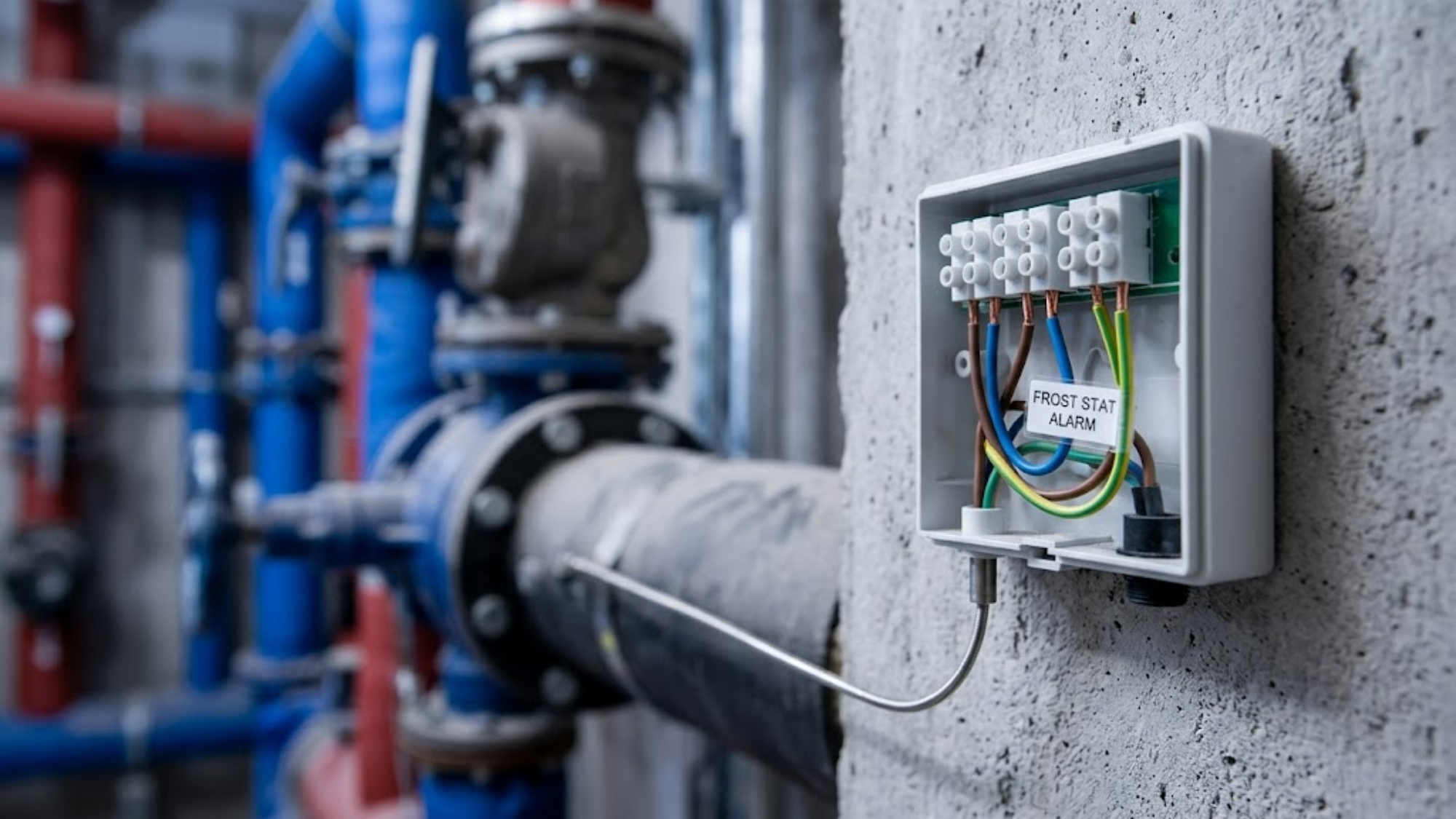
Commercial plant rooms face a constant threat during winter months: frozen pipes that can burst and cause thousands of pounds in damage within hours. The Danfoss RET2000 prevents this scenario by cutting power to heating systems when temperatures drop to dangerous levels, but only when wired correctly. Engineers have installed dozens of these stats across commercial buildings, and the wiring mistakes encountered during maintenance calls follow predictable patterns. A thermostat wired backwards won't protect anything. One connected to the wrong circuit might trigger false alarms or fail when you need it most. Proper frost protection thermostat wiring is your only defense against catastrophic freezing.
What The Danfoss RET2000 Actually Does
The Danfoss RET2000 monitors ambient temperature in plant rooms, boiler houses, and mechanical spaces. When sourcing units directly from Heating and Plumbing World, facilities managers ensure they have the exact hardware required to maintain safety in these volatile environments. When the temperature drops below your setpoint, typically 5°C, it breaks the circuit to trigger an alarm or activate backup heating.
This isn't a standard room thermostat. The unit uses a remote capillary sensor that you position away from heat sources, giving accurate readings of the actual room temperature rather than hot spots near pipework. This reliably protects expensive central heating components from freezing solid and shutting down building operations. The sensor contains liquid that expands and contracts with temperature changes, mechanically operating the switch contacts.
Think of the remote capillary sensor like a submarine's periscope. Just as a periscope extends above the water to see the real surface conditions while the sub stays safely hidden below, the capillary extends away from the localised heat of the equipment to measure the true ambient temperature of the room.
The unit handles up to 16A at 250V AC, which is enough to control most commercial heating contactors or valve actuators directly. It is typically wired to break a control circuit rather than switch the full heating load. This extends the contact life and provides much cleaner switching operation over the years.
Terminal Layout And Contact Configuration
The back of the unit features three specific terminals. Terminal 1 acts as the switching common connection. Terminal 2 is normally open, making contact when the temperature rises above the setpoint. Terminal 3 is normally closed, breaking contact when the temperature rises above the setpoint, which enables precise thermostat control in critical commercial environments.
Most applications use terminals 1 and 3 for the common and normally closed configuration. This means the circuit stays closed during normal operation and breaks when the temperature drops below your setpoint, which is exactly what you need to trigger a low temperature alarm. Use 1.5mm² cable for most installations because it fits the terminals cleanly and handles the current without unnecessary bulk inside the backbox.
Wiring For Low Temperature Alarm Systems
The most common application connects the Danfoss RET2000 to a building management system (BMS) or a standalone alarm panel. This setup alerts facilities teams when the plant room temperature drops dangerously low. Effective low temperature alarm systems rely entirely on this precise electrical integration.
For standard alarm wiring, connect the BMS alarm input common to terminal 1. Then, connect the BMS alarm input signal to terminal 3. Set the dial to 5°C and complete your capillary sensor positioning at breathing height, far from any heat sources.
When the room temperature drops below 5°C, the contacts open and trigger the alarm input. The BMS logs the event and can send alerts via text, email, or a dedicated heating control app depending on your notification setup. Always label both ends of this wiring clearly with "FROST STAT ALARM" at the unit and "PLANT ROOM FROST ALARM" at the BMS panel. Months after installation, when an engineer troubleshoots a fault at 2 AM, these labels save hours of frustration.
Controlling Backup Heating Contactors
Some installations use the unit to activate electric heaters or open heating valves when the temperature drops. This requires different frost protection thermostat wiring because you want the heating to turn on when the temperature is low, not just trigger an alarm.
For this specific application, wire to terminals 1 and 2. These contacts close when the temperature drops below the setpoint, completing the circuit to your heating contactor coil. Bring the 230V supply to the heating contactor coil terminal A1, connect contactor coil terminal A2 to terminal 1, and connect terminal 2 to the neutral. Set the dial to 8°C, which is intentionally higher than the alarm setpoint, to activate heating well before reaching critical freezing temperatures.
When the plant room temperature drops below 8°C, the contacts close, energizing your backup heaters or a secondary radiator heating system. This wiring must include a manual override switch in parallel with the contacts. During commissioning or routine maintenance, you need to test the heaters without waiting for the temperature to drop naturally.
Proper Capillary Sensor Positioning
The 1.5-metre capillary gives great flexibility in sensor placement, but positioning matters massively. Correct capillary sensor positioning makes or breaks the effectiveness of the entire setup.
On a recent commercial retrofit, an apprentice coiled the capillary tube directly behind a massive uninsulated hot water cylinder. When a sudden freeze hit over the weekend, the ambient room temperature plummeted to 2°C, but the sensor stayed warm against the tank. The pipes burst, flooding the entire lower floor before anyone noticed. Proper placement would have prevented the disaster entirely.
Place the sensor 1.5 metres above floor level to capture the average room temperature. Keep it at least 1 metre away from heat sources. Localised warm zones do not represent the actual room temperature. Position it in air flow paths near doorways, but keep it firmly out of direct sunlight. Secure it with plastic clips every 300mm to prevent damage, maintaining a minimum 25mm bend radius to avoid cracking the fragile tube.
Common Wiring Mistakes To Avoid
Reversed connections represent the most frequent and dangerous error. Installers sometimes wire terminals 1 and 2 for an alarm circuit, expecting it to trigger when the temperature drops. Instead, the alarm stays completely silent during a frost event and triggers when the plant room warms up. Always verify contact operation with a multimeter before energizing the circuit.
Inadequate cable sizing causes major issues too. The unit can switch 16A, but that doesn't mean you should run thin 0.5mm² cable to a heavy heater contactor. For instance, if the plant room houses a large combi boiler and backup electric heaters, size your cables for the actual load. Every circuit also needs appropriate overcurrent protection to maintain safety standards.
Finally, don't wire multiple thermostats in parallel for redundancy. If any single thermostat fails closed, the alarm never triggers regardless of how cold the room gets. Wire multiple stats to separate alarm inputs instead.
Integration With Building Management Systems
Modern BMS platforms handle the inputs as simple digital points. The real sophistication comes from how you program the response. Configure these alerts as critical priority in the BMS so they override lower-priority alerts and trigger immediate notifications for your low temperature alarm systems.
Set a 5-minute alarm delay before triggering to prevent nuisance alarms from brief temperature fluctuations when doors open. Frost alarms should auto-reset when the temperature recovers, but ensure the system logs every occurrence for maintenance review.
The Danfoss RET2000 provides a highly reliable volt-free contact, making it compatible with almost any BMS regardless of the manufacturer. This universal compatibility via a volt-free contact is exactly why senior engineers specify it over proprietary sensors that lock you into specific, expensive control systems.
Testing, Commissioning, And Maintenance
Never assume a newly wired stat works correctly without testing it first. Verify all wiring against the schematics using a multimeter. Check the contact resistance; it should read under 0.5 ohms when closed and over 1M ohm when open. Set the thermostat above room temperature to verify the contacts are in the expected state, then gradually reduce the setpoint to confirm they switch accurately.
Routine maintenance keeps the unit reliable. Every six months, clean dust from the unit body and the capillary sensor. Dust accumulation slows the response time, potentially delaying frost protection by critical minutes. Check the terminal tightness, as thermal cycling slowly loosens connections over time.
The unit has no user-serviceable parts. When it fails, you replace it. Replace the unit immediately if you see capillary damage, contact failure with arcing, or erratic operation where the switching point varies drastically. You can source reliable heating spares to maintain readiness. Keep spare units for critical plant rooms, as the cost of a spare is negligible compared to the thousands in damage from a single burst pipe event.
Conclusion
The Danfoss RET2000 provides robust frost protection when wired correctly to the appropriate alarm or control circuits. Terminal selection dictates whether you trigger an alarm or activate backup heating. Proper capillary sensor positioning ensures accurate ambient temperature monitoring away from direct heat sources.
Avoid common frost protection thermostat wiring errors like reversed contacts and inadequate cable sizing to guarantee system reliability. Test every installation thoroughly and perform six-monthly inspections to catch developing faults before they turn into expensive failures. If you require expert guidance on configuring your plant room controls or selecting the right hardware, speak to our team for dedicated support.