

Digital vs Analogue Pressure Gauges: Accuracy Comparison
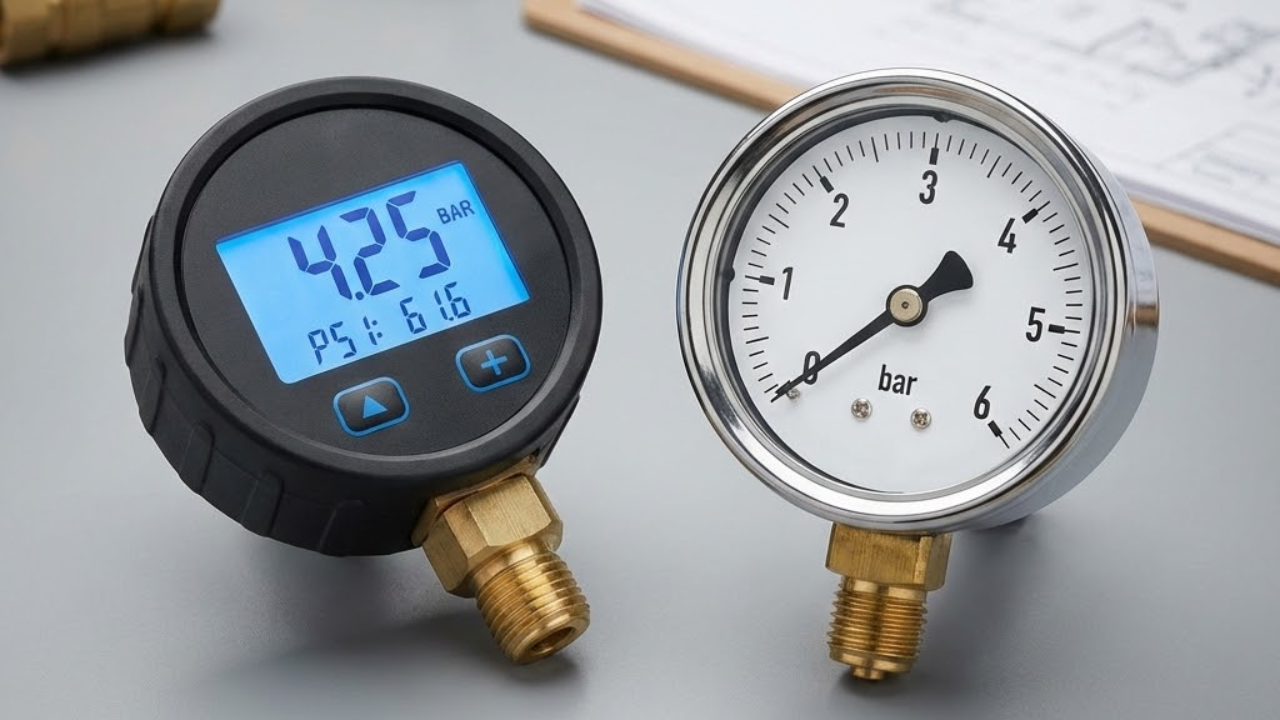
Pressure measurement sits at the heart of every heating and plumbing system worth specifying. Whether you're commissioning a commercial boiler, balancing a multi-zone underfloor heating manifold, or diagnosing a stubborn no-flow fault on a sealed system, the accuracy of your pressure gauge directly determines whether the job gets signed off or you're back on site the following week.
The choice between digital pressure gauges and analogue pressure gauges isn't just about budget or personal preference. It's about selecting the right tool for the measurement task at hand. Digital pressure gauges promise precision down to two decimal places and data logging capabilities, whilst analogue gauges offer proven reliability in harsh environments and instant visual feedback without batteries.
Understanding which technology delivers genuine accuracy for your specific application separates competent site work from guesswork.
What Actually Defines Gauge Accuracy
Before comparing digital versus analogue accuracy, you need to understand what "accuracy" actually means in pressure measurement. It's not a single number. It's a specification that describes how closely a gauge's reading matches the true pressure being measured.
Accuracy class defines the maximum permissible error as a percentage of full-scale range. A 10 bar analogue gauge with ±1.6% accuracy class can be off by up to 0.16 bar anywhere across its scale. That's the difference between a sealed heating system sitting at the correct 1.2 bar fill pressure or dropping to 1.04 bar. Potentially below the minimum operating pressure for upper-floor radiators in a three-storey property.
When you're setting pressures on a domestic system, that error margin matters.
Digital pressure gauges typically specify accuracy as a percentage of reading rather than full scale. A quality digital gauge might offer ±0.25% of reading accuracy. This means at 5 bar, the maximum error is just 0.0125 bar. Compare that to an analogue gauge reading the same pressure on a 16 bar scale at ±1.6% full scale. The potential error jumps to 0.256 bar. Twenty times larger.
That's the fundamental difference you need to grasp.
Think of it like measuring tools in construction. A tape measure works fine for rough cuts, but when you need to fit kitchen cabinets with millimetre precision, you use a laser measure. Digital gauges are the laser measure of pressure monitoring.
Here's what matters on site. Resolution (the smallest increment the gauge can display) and repeatability (whether you get the same reading twice under identical conditions) also affect practical accuracy. A digital gauge displaying to 0.01 bar resolution doesn't guarantee that level of accuracy unless the underlying sensor and calibration support it.
You can have a gauge that shows 1.23 bar, but if the sensor itself is only accurate to ±0.05 bar, that extra decimal place is meaningless precision. For pump commissioning with Grundfos equipment, understanding true accuracy versus display resolution is critical for optimal performance.
How Analogue Bourdon Tube Gauges Work
Analogue pressure gauges have dominated heating and plumbing applications for over a century because the Bourdon tube mechanism is brilliantly simple. A curved metal tube (usually brass or stainless steel) straightens slightly when pressurised. This mechanical movement connects via a linkage to a pointer that sweeps across a calibrated dial.
It's engineering elegance. No microprocessors, no firmware, just Newton's laws doing their thing.
The beauty of this design lies in its inherent reliability. No electronics. No batteries to go flat halfway through a commissioning session. No firmware glitches. Just physics and metallurgy doing what they've done since the Victorian era. Drop an analogue gauge off a scaffolding platform, and it'll probably still work. Try that with a digital pressure gauge.
But that mechanical simplicity comes with accuracy limitations. The pointer movement depends on precise machining of gears, pivots, and the Bourdon tube itself. Wear at pivot points introduces backlash. You'll notice this when tapping the gauge face causes the pointer to jump.
Temperature changes affect the elastic properties of the Bourdon tube metal, shifting readings by up to 0.4% per 10°C deviation from calibration temperature. On a winter morning in an unheated plant room, that thermal drift alone could throw your readings off.
Accuracy class for quality analogue gauges typically ranges from 0.6% to 2.5% of full scale span. An analogue gauge specified at 1.0% accuracy class on a 0-6 bar scale delivers readings within ±0.06 bar across the entire range. Perfectly adequate for setting expansion vessel pre-charge or checking static head on a domestic heating system.
The dial design matters more than most engineers realise. A 100mm diameter dial with clear graduation marks at 0.2 bar intervals allows far more accurate readings than a 63mm dial with 0.5 bar graduations crammed together. If you're squinting to interpolate between markings, you've already lost the accuracy advantage.
The gauge might be mechanically accurate to 1.0%, but if you can't read it better than ±0.3 bar, that specification is academic.
Digital Sensor Technology Explained
Digital pressure gauges use piezoelectric sensor or strain gauge transducer technology to convert mechanical pressure into an electrical signal. A piezoelectric sensor generates a voltage when pressure deforms a crystal element. Basically turning mechanical stress into electricity.
Strain gauge transducer models measure resistance changes in a metal diaphragm that flexes under pressure. Think of it like measuring how much a diving board bends when you stand on it, but translated into an electrical signal.
These electrical signals feed into an analogue-to-digital converter and microprocessor that displays the reading on an LCD display or LED screen. The entire measurement chain (from sensor to display) determines final accuracy, not just the sensor element alone. That's why cheap digital pressure gauges can be less accurate than quality analogue gauges despite the fancy electronics.
Quality digital pressure gauges from manufacturers like Honeywell achieve accuracy specifications of ±0.25% to ±0.5% of reading across their operating range. This "percentage of reading" specification means accuracy scales proportionally with the pressure being measured. Unlike analogue gauges where the error remains constant as a percentage of full scale.
The practical advantage becomes obvious when measuring low pressures. Checking a 0.8 bar fill pressure on a domestic sealed system using a 10 bar digital gauge at ±0.25% of reading gives a maximum error of just 0.002 bar. The same measurement on a 10 bar analogue gauge at ±1.6% full scale introduces up to 0.16 bar error. Eighty times worse.
When you're trying to set a pressurisation unit to 1.2 bar precisely, that difference matters.
Digital pressure gauges also compensate for temperature effects electronically. The microprocessor applies correction factors based on built-in temperature sensors, maintaining accuracy across the full operating temperature range (typically -10°C to +60°C) without the thermal drift that affects analogue Bourdon tubes.
On a rooftop installation where temperatures swing from 5°C to 35°C over a day, that compensation keeps readings consistent.
But here's the catch. Digital pressure gauges need power. Battery life ranges from 1,000 to 5,000 hours depending on display type and update rate. Forget to check battery condition before a critical commissioning job, and you're reaching for the analogue backup gauge you should've brought anyway.
Always carry spares of both types.
Accuracy Comparison Across Pressure Ranges
Let's put numbers to the accuracy debate with scenarios heating engineers actually encounter. These comparisons assume quality instruments. Cheap gauges of either type won't meet their stated specifications.
Low pressure measurement (0-4 bar range): Setting the fill pressure on a sealed heating system requires reading pressures between 0.8 and 1.5 bar accurately. A digital gauge with ±0.25% of reading accuracy at 1.2 bar gives ±0.003 bar maximum error. An analogue gauge rated ±1.6% of full scale (4 bar) introduces ±0.064 bar error. Twenty times larger.
For this application, digital wins decisively. You can see the pressure change as you turn the filling loop valve, not just watch the needle drift somewhere in the general vicinity.
Medium pressure measurement (0-10 bar range): Checking operating pressure on a commercial heating circuit running at 6 bar. Digital gauge at ±0.25% of reading gives ±0.015 bar error. Analogue gauge at ±1.0% full scale gives ±0.1 bar error. Digital still ahead, but the analogue gauge delivers acceptable accuracy for most system balancing and commissioning work.
You're not going to ruin a job with ±0.1 bar error at this pressure level.
High pressure measurement (0-16 bar range): Testing a pressure vessel or unvented cylinder safety valve set at 12 bar. Digital gauge at ±0.5% of reading gives ±0.06 bar error. Analogue gauge at ±1.0% full scale gives ±0.16 bar error. The accuracy gap narrows at higher pressures, and both gauges provide adequate precision for safety device testing within regulatory tolerances.
The pattern is clear. Digital pressure gauges maintain proportional accuracy across the measurement range, whilst analogue gauges suffer from constant absolute error that becomes proportionally worse at the low end of the scale. If you're regularly working at the bottom third of a gauge's range, digital technology delivers measurably better accuracy.
If you're measuring mid-scale or higher, analogue is often perfectly adequate.
Environmental Factors That Affect Accuracy
Pressure gauges don't operate in laboratory conditions. They face the reality of plant rooms, rooftop installations, and temporary site setups. Environmental factors degrade accuracy in ways that differ significantly between digital and analogue technologies.
Temperature effects hit analogue gauges harder. The Bourdon tube material's elastic modulus changes with temperature, shifting readings by up to 0.4% per 10°C deviation from the 20°C calibration standard. A gauge calibrated indoors then used on a winter rooftop at 0°C could read 0.8% low.
Digital pressure gauges compensate electronically, maintaining stated accuracy across their full operating range. Quality manufacturers like Danfoss integrate temperature compensation as standard across their digital gauge ranges.
Vibration and shock favour analogue gauges. The mechanical Bourdon tube mechanism tolerates repeated vibration without drift. You'll see the pointer oscillate, but it returns to the correct reading once vibration stops. Digital sensors, particularly piezoelectric sensor types, can suffer from electronic noise and signal drift under continuous vibration.
Glycerin-filled analogue gauges dampen pointer movement, making readings easier in high-vibration environments like pump skids or boiler houses.
Moisture and condensation pose different risks. Analogue gauges with sealed cases and blow-out backs handle damp conditions well. The mechanism itself isn't moisture-sensitive. Digital pressure gauges require IP67 rating or IP65 ingress protection ratings to prevent moisture entering the electronics.
Condensation on internal circuit boards causes erratic readings and premature failure. Check the IP rating before specifying digital pressure gauges for outdoor installations or humid plant rooms.
Electromagnetic interference doesn't affect analogue gauges at all. There's nothing to interfere with. Digital pressure gauges near variable-speed drive panels, large contactors, or radio equipment can display unstable readings if inadequately shielded. Quality digital pressure gauges include EMC filtering, but budget models often skip this protection.
Mount them away from VSD panels if possible.
Think of it this way. Analogue gauges are like naturally-aspirated diesel engines. Simple, tolerant of abuse, and predictable. Digital pressure gauges are more like modern common-rail systems. Higher performance when conditions suit them, but more sensitive to environmental factors outside their design envelope.
Both have their place.
Calibration Drift and Long-Term Stability
Accuracy specifications apply to newly-calibrated gauges. Real-world accuracy depends on how well instruments maintain calibration over months and years of service. This is where analogue and digital technologies diverge significantly.
Analogue gauge drift stems from mechanical wear and material fatigue. Pivot bearings develop play, introducing backlash that causes the pointer to "stick" at certain positions. The Bourdon tube undergoes elastic fatigue from pressure cycling, gradually losing its calibrated spring rate.
Expect analogue gauges to drift 1-2% over 12-24 months of regular use. More if subjected to frequent overpressure or pressure cycling.
Overpressure events accelerate drift dramatically. Taking a 6 bar gauge to 8 bar (even briefly) can permanently deform the Bourdon tube, shifting the entire calibration. You'll notice the pointer no longer returns to zero when pressure is released. A clear sign the gauge needs replacing.
That's why you always size gauges with headroom above maximum operating pressure.
Digital gauge drift primarily affects the sensor element. Strain gauge transducer models exhibit creep. A gradual zero offset that develops over time, typically 0.1-0.2% per year for quality sensors. Piezoelectric sensor types are more stable but sensitive to contamination. If process fluid enters the sensor cavity (a risk with liquid-filled systems), readings become erratic and unreliable.
The electronics themselves rarely drift. Digital circuitry either works correctly or fails completely. Battery voltage affects some designs. As batteries deplete, display update rates slow and accuracy can degrade in the final hours before shutdown. Quality digital pressure gauges monitor battery voltage and display low-battery warnings well before accuracy suffers.
Calibration intervals differ between technologies. Analogue gauges typically require annual recalibration for critical applications. 18-24 months for general heating and plumbing work. Digital pressure gauges hold calibration longer. 18-24 months for critical applications, 24-36 months for routine use. Both periods assume normal operating conditions without overpressure events or physical damage.
Here's the site reality. Most heating engineers never recalibrate gauges. They replace them when readings become obviously wrong. If that describes your approach, digital pressure gauges maintain accuracy longer before reaching the replacement point. But if you're running a test rig or commissioning company where gauge accuracy is critical, formal calibration schedules make sense for both technologies.
Reading Speed and Ease of Use
Accuracy means nothing if you can't read the gauge quickly and reliably during commissioning or fault-finding. The human factors separating digital from analogue gauges matter more than most specifications suggest.
Analogue gauges offer instant visual interpretation. Your eye processes the pointer position across the dial in milliseconds. You immediately see whether pressure sits in the normal range, runs high, or drops low. No need to focus on numerical digits or wait for display updates.
This makes analogue gauges superior for monitoring dynamic pressure changes. Watching pressure fluctuate during pump startup or tracking pressure drop during a tightness test.
The dial design dramatically affects readability. A well-designed analogue gauge uses colour bands to mark normal operating ranges, critical zones, and danger areas. One glance tells you whether the system operates correctly. Digital displays require you to read the number, then mentally compare it to acceptable ranges. An extra cognitive step that slows fault diagnosis.
Digital pressure gauges excel at precise numerical readings. When you need to set a specific pressure (say, 1.2 bar fill pressure or 3.5 bar expansion vessel pre-charge) the LCD display eliminates interpolation errors. You're not squinting at dial graduations trying to judge whether the pointer sits at 1.18 or 1.22 bar.
The display reads 1.20 bar, and you're done. That precision matters when commissioning pressurisation units or balancing multi-zone systems.
Display update rates matter for dynamic measurements. Budget digital pressure gauges update once per second. Too slow to track rapid pressure changes. Quality gauges update 2-4 times per second. Fast enough for most heating and plumbing applications but still noticeably slower than the continuous feedback of an analogue pointer.
Backlighting and display visibility give digital pressure gauges an advantage in poor lighting. Plant rooms, roof spaces, and under-floor voids rarely offer ideal lighting conditions. A backlit LCD display remains readable in near-darkness. Analogue gauges need a torch pointed at the dial. And you'll need both hands free to hold the torch whilst manipulating valves or pumps.
The trade-off is simple. Analogue gauges for monitoring and trending, digital pressure gauges for setting precise values. Experienced engineers often carry both. Different tools for different jobs.
Cost Considerations and Return on Investment
Price differences between digital pressure gauges and analogue pressure gauges reflect the underlying technology complexity. Understanding the total cost of ownership (not just purchase price) reveals which technology delivers better value for different applications.
Entry-level analogue gauges from reputable manufacturers cost £15-£30 for 63mm dial sizes in common ranges (0-4 bar, 0-10 bar). These basic gauges offer 2.5% accuracy class and bottom-entry connections. Perfectly adequate for routine system checks and non-critical applications. Step up to 100mm dials, 1.0% accuracy class, and stainless steel cases, and prices reach £40-£80.
Quality digital pressure gauges start around £60-£80 for basic models with ±0.5% accuracy and battery power. Professional-grade digital pressure gauges with ±0.25% accuracy, data logging, and multiple pressure units cost £120-£250. High-end instruments with wireless connectivity, programmable alarms, and ±0.1% accuracy exceed £300.
The price gap is real, but so is the accuracy advantage. If you're commissioning systems where precise pressure settings directly affect efficiency or compliance, the digital gauge pays for itself quickly. Setting a pressurisation unit 0.2 bar low on a 50-flat development because your analogue gauge wasn't accurate enough means callbacks, wasted journeys, and reputation damage worth far more than the £150 you saved on the gauge.
For expansion vessel applications with Altecnic Ltd products, the precision of digital gauges ensures optimal pre-charge settings that prevent system issues.
Calibration costs also factor into total ownership. Professional calibration services charge £25-£50 per gauge for analogue instruments. £40-£70 for digital pressure gauges (due to the more complex calibration process). If you're operating under quality systems requiring annual calibration, those costs accumulate over the gauge's service life.
Consider durability too. A quality analogue gauge withstands drops, impacts, and harsh environments that would destroy a digital pressure gauge. If you're working on rough construction sites or in heavy industrial environments, replacing broken digital pressure gauges every 18 months costs more than buying tougher analogue gauges upfront.
The smart approach? Invest in a quality digital pressure gauge for precision work (system commissioning, safety device testing, expansion vessel charging) and carry robust analogue gauges for routine checks and harsh environments. Different tools for different jobs.
That's how professionals work.
Which Gauge Type Suits Your Application
Choosing between digital pressure gauges and analogue gauges ultimately depends on the specific measurement task, operating environment, and accuracy requirements. Here's how to match gauge technology to real-world heating and plumbing applications.
Domestic sealed system installation and servicing: Analogue gauges handle this work perfectly. Fill pressures between 1.0-1.5 bar don't require precision beyond ±0.1 bar. A quality 63mm analogue gauge with 0-4 bar range and 1.6% accuracy class costs under £25 and delivers reliable readings for years.
The instant visual feedback helps when bleeding radiators or topping up pressure. You watch the pointer rise as you open the filling loop, no need to repeatedly check a digital display.
Commercial heating system commissioning: Digital pressure gauges justify their cost here. Balancing multi-zone systems, setting differential pressures across heat exchangers, and documenting commissioning data all benefit from ±0.25% accuracy and data logging capabilities. The ability to switch between bar, kPa, and psi units helps when working with mixed equipment specifications.
Expansion vessel and pressurisation unit setup: Digital pressure gauges excel at setting precise pre-charge pressures. The difference between 2.8 bar and 3.0 bar pre-charge affects system performance measurably. Digital resolution to 0.01 bar eliminates guesswork. Connect the gauge via a flexible hose to the Schrader valve, adjust pressure whilst watching the display, and you're confident the vessel is correctly charged.
Unvented cylinder and safety valve testing: Analogue gauges with 0-10 bar or 0-16 bar ranges suit this work. You're verifying that pressure relief valves open at their rated pressure (typically 6-7 bar for domestic cylinders), not measuring to high precision. A robust analogue gauge tolerates the harsh environment and potential water spray during valve testing.
The instant pointer movement clearly shows when the valve cracks open.
Pump performance testing and fault diagnosis: Digital pressure gauges with data logging capabilities prove invaluable here. Recording pressure readings over time whilst varying pump speed or system valves reveals performance curves and helps diagnose issues like blocked filters, air locks, or failing pump bearings. The numerical precision helps when comparing measured performance against manufacturer's pump curves.
Harsh environments (plant rooms, rooftops, temporary sites): Analogue gauges win on reliability and durability. They don't need batteries, they tolerate temperature extremes better, and they survive drops and impacts that would destroy digital pressure gauges. When you're working in a muddy trench or on a windy rooftop, the last thing you need is a delicate electronic instrument.
For sourcing both digital and analogue pressure gauges across all applications, Heating and Plumbing World stocks comprehensive ranges from trusted manufacturers with technical support to help you select the right gauge technology for each job.
Conclusion
The choice between digital pressure gauges and analogue pressure gauges isn't about one technology being universally superior. It's about matching the measurement tool to the application requirements, environmental conditions, and accuracy needs.
Digital pressure gauges deliver superior accuracy at low pressures, offer data logging and documentation capabilities, and excel at setting precise pressure values during commissioning. Their percentage of reading accuracy specification provides consistent precision across the entire measurement range.
Analogue gauges offer instant visual feedback, proven reliability in harsh environments, and mechanical simplicity that doesn't rely on batteries or electronics. They're the practical choice for routine monitoring, harsh site conditions, and applications where ±0.1 bar accuracy is adequate.
For professional heating engineers, the smart approach is carrying both. A quality digital pressure gauge for precision commissioning and critical measurements, and robust analogue gauges for routine checks and demanding environments. Different tools for different jobs. That's how you deliver consistently accurate work regardless of site conditions.
Whether you're setting fill pressures on domestic systems, commissioning commercial plant, or testing safety devices, understanding the genuine accuracy differences between these technologies ensures you select the right gauge for the job. Specification sheets tell part of the story, but real-world performance in heating and plumbing applications tells you which gauge belongs in your toolkit.
For guidance on selecting the right pressure gauge technology for your specific application, contact us and our technical team will help you match gauge capabilities to your measurement requirements.