

Flow Rate Requirements: Sizing Your Combination Boiler
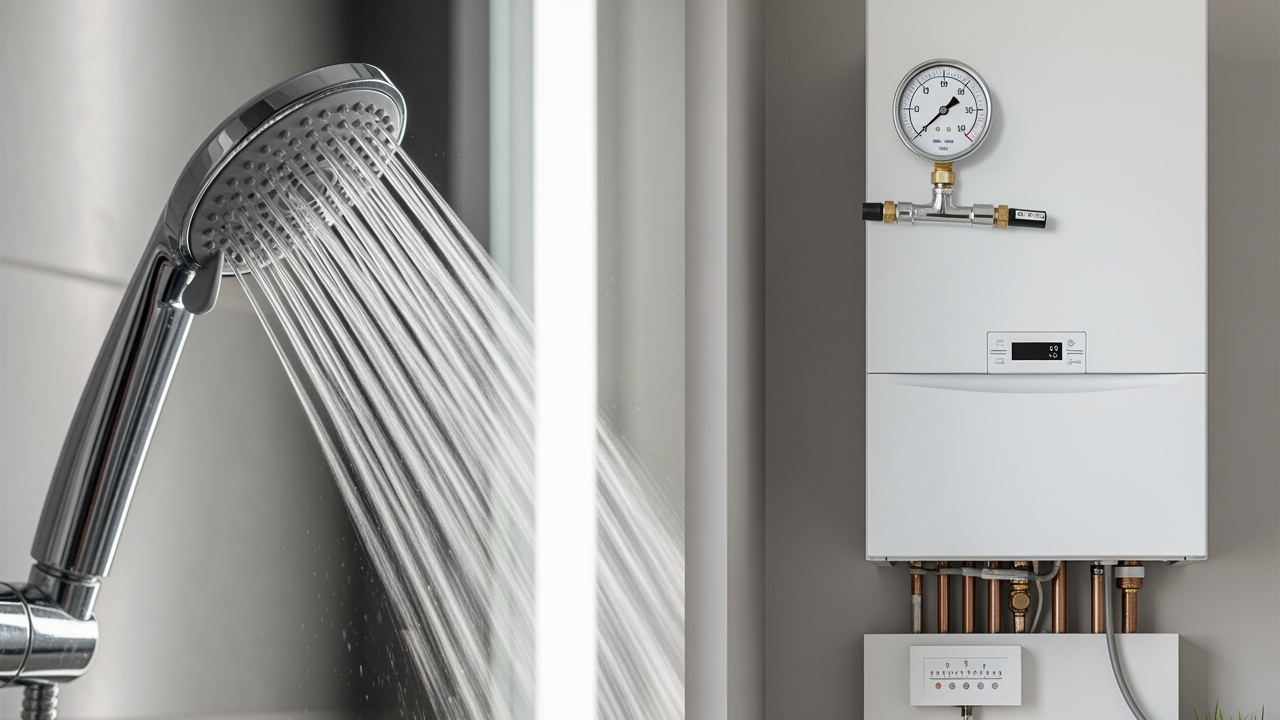
A combi boiler delivering 10 litres per minute sounds adequate until two people try to shower simultaneously. The combi boiler flow rate drops to 5 litres per minute each, and suddenly your morning routine includes complaints about weak water pressure and lukewarm showers.
Flow rate determines how much hot water your combi boiler can deliver at any given moment. Unlike conventional systems with storage cylinders, combi boilers heat water on demand. When you open a tap, cold water flows through the boiler's heat exchanger and emerges hot on the other side. The speed at which this happens, measured in litres per minute, defines your system's practical performance.
What Flow Rate Actually Means
Flow rate measures the volume of hot water a combi boiler delivers per minute at a specific temperature rise. A boiler rated at 12 litres per minute doesn't always deliver exactly 12 litres. That figure assumes your incoming cold water sits around 10°C and you want hot water at 50°C, a 40°C temperature rise.
When incoming water temperature drops to 5°C in winter, the same boiler might only deliver 10 litres per minute to achieve the same outlet temperature. The unit must work harder to heat colder water, which reduces the flow rate.
Most manufacturers rate their boilers at a 35°C temperature rise. This creates misleadingly high flow rates on specification sheets. A boiler claiming 16 litres per minute at 35°C might only deliver 11 litres per minute at the 40°C rise you actually need for a comfortable shower.
Calculating Your Household Requirements
Start by identifying simultaneous demand, the maximum number of hot water outlets you'll use at once. A realistic assessment matters more than theoretical worst-case scenarios.
A typical household pattern looks like this:
One bathroom home: One shower running = 8-10 litres per minute
Two bathroom home: One shower plus one basin tap = 10-12 litres per minute
Three bathroom home: Two showers running = 16-20 litres per minute
Kitchen taps add 4-6 litres per minute when running. Washing machines and dishwashers rarely create issues because they fill slowly, and people don't usually run them during peak shower times.
Actual flow rates get measured by timing how long it takes to fill a 10-litre bucket. A shower delivering 10 litres per minute fills the bucket in 60 seconds. This simple test reveals what your current system actually delivers versus what the specification sheet promises.
Matching Boiler Output to Property Size
The relationship between property size and required combi boiler flow rate isn't linear. A four-bedroom house doesn't automatically need twice the flow rate of a two-bedroom flat.
Small properties (1-2 bedrooms, one bathroom) function well with 24-28 kW combi boilers delivering 9-11 litres per minute. These homes rarely see simultaneous demand beyond one shower and one tap.
Medium properties (3 bedrooms, two bathrooms) need 28-35 kW units delivering 11-14 litres per minute. The second bathroom creates potential for simultaneous use, though actual patterns vary by household.
Large properties (4+ bedrooms, three bathrooms) require 35-42 kW boilers delivering 14-17 litres per minute. Beyond this point, system boilers with storage cylinders often make more sense than pushing combi boilers to their limits.
The key variable isn't bedroom count but bathroom usage patterns. Three teenagers sharing two bathrooms creates a higher simultaneous demand than a retired couple in a four-bedroom house.
How Mains Water Pressure Affects Performance
Your combi boiler's potential flow rate means nothing if incoming mains pressure can't support it. Dynamic mains pressure, measured whilst water flows, determines actual performance.
Minimum functional pressure sits around 1.0 bar. Below this, combi boilers struggle to operate reliably. Optimal performance requires 1.5-2.0 bar. Above 3.0 bar, you'll need a pressure-reducing valve to protect the system.
Test dynamic pressure by connecting a pressure gauge to an outside tap and running water at full flow. Static pressure (measured with no water flowing) always reads higher and doesn't reflect operational conditions.
Low mains pressure creates a bottleneck regardless of boiler capacity. A 35 kW boiler capable of 14 litres per minute delivers only 8 litres per minute if the mains pressure restricts the incoming flow. Properties sometimes receive boiler upgrades that change nothing because the supply pipe remains the limiting factor.
Properties on shared supply pipes or at the end of long rural connections frequently face pressure issues. Combination boiler installations in these locations might need an accumulator tank or pressure pump to achieve acceptable performance. Stuart Turner manufactures boosting systems that resolve low-pressure problems effectively.
Temperature Rise and Seasonal Variation
Incoming water temperature fluctuates 5-10°C between summer and winter. This swing directly impacts the combi boiler flow rate.
Summer water entering at 15°C needs heating by 35°C to reach 50°C. Winter water at 5°C needs a 45°C rise to hit the same temperature. That 10°C difference reduces flow rate by 20-25%.
A boiler delivering 12 litres per minute in July might only manage 9 litres per minute in January. This explains why shower performance feels inconsistent across seasons, even though nothing changed with the boiler itself.
Manufacturers rarely highlight this in specifications. The "12 litres per minute" claim usually assumes 10°C inlet temperature, warmer than the winter reality in most regions.
Sizing boilers based on worst-case winter conditions rather than annual averages accounts for this variation. A system that performs adequately in summer but fails every winter isn't properly sized.
The Impact of Pipe Sizing and Layout
Flow rate dies in undersized pipes. A perfectly specified boiler loses 30% of its performance when connected with a 15mm pipe, where a 22mm pipe belongs.
15mm pipe suits flow rates up to 12 litres per minute over short distances (under 10 metres). Beyond this, friction losses reduce pressure and flow.
22mm pipe handles 12-20 litres per minute and should be the minimum for combi boiler primary circuits. Long pipe runs (over 15 metres) or high-output boilers need this diameter. Polypipe supplies barrier pipe suitable for sealed heating systems.
28mm pipe becomes necessary for flow rates above 20 litres per minute or when multiple combi boilers work together in large properties.
The pipe run from the boiler to the shower matters most. A 15mm pipe running 20 metres from a ground-floor boiler to a second-floor bathroom will never deliver the flow rate you expect, regardless of boiler capacity.
Pressure drop across the system is measured by comparing the pressure at the boiler outlet with the pressure at the furthest tap. Drops exceeding 0.5 bar indicate undersized pipework or excessive fittings creating resistance. Quality compression and push-fit fittings minimise pressure loss in properly designed systems.
Modulation and Minimum Output
Combi boilers modulate their output to match demand. A 35 kW boiler doesn't always run at 35 kW; it adjusts down when you're only running a basin tap.
The modulation ratio describes this range. A boiler with 35 kW maximum output and 7 kW minimum output has a 5:1 modulation ratio. Better modulation ratios (6:1 or higher) provide more stable temperatures across different flow rates.
Minimum output matters when running single taps. If the minimum output sits too high, the boiler cycles on and off rapidly rather than running continuously. This creates temperature fluctuations and reduces efficiency.
A 35 kW boiler with 10 kW minimum output struggles to maintain a stable temperature for a single basin tap drawing 3 kW. The boiler overshoots the target temperature, shuts down, cools, then fires again. You feel this as alternating hot and cold water.
Modern condensing combi boilers with wide modulation ranges (8:1 or better) handle everything from a single tap to multiple showers without cycling or temperature swings. This capability matters as much as the maximum flow rate for daily comfort.
Pre-heat Functions and Response Time
Pre-heat functions keep a small volume of water hot inside the boiler, reducing the delay between opening a tap and receiving hot water. This feature trades a small efficiency penalty for immediate hot water delivery.
Without pre-heat, combi boilers take 5-15 seconds to detect flow, ignite, and heat water to the target temperature. During this delay, you're running cold water down the drain. In a typical household using hot water 20 times daily, this wastes 50-100 litres per day.
Pre-heat systems maintain a ready supply of hot water, delivering it instantly when you open a tap. The boiler fires periodically to maintain this reserve temperature, slightly increasing gas consumption.
The trade-off makes sense for most households. The comfort and water savings outweigh the minor efficiency reduction. Properties with long pipe runs between the boiler and taps benefit most, since they already waste water filling pipes before hot water arrives.
System Boilers vs Oversized Combi Boilers
Beyond 40 kW, combi boilers become expensive and inefficient compared to system boilers with storage cylinders. The crossover point depends on hot water demand patterns.
Combi boilers excel at intermittent demand, one or two outlets used briefly throughout the day. System boilers suit sustained demand, multiple showers, baths, or high-volume hot water use.
A property needing 18+ litres per minute continuous flow typically performs better with a 25-30 kW system boiler and a 200-250 litre cylinder. The cylinder stores hot water heated during off-peak periods, delivering high flow rates without requiring an oversized heat source. Gledhill and Kingspan manufacture cylinders designed for high-performance domestic hot water systems.
The stored water also maintains performance when multiple outlets run simultaneously. Three showers running from a cylinder deliver consistent flow and temperature. Three showers from a combi boiler share the available flow rate, reducing each shower's performance.
Installation costs favour combi boilers, no cylinder, fewer pipes, simpler controls. Running costs depend on usage patterns. Households with predictable hot water schedules (morning and evening peaks) see lower costs with system boilers. Unpredictable, intermittent use suits combi boilers better.
Practical Sizing Examples
Scenario 1: Two-bedroom flat, one bathroom, two occupants working full-time. Peak demand: one shower (9 litres per minute). A 24 kW combi boiler delivering 10 litres per minute provides comfortable headroom. Mains pressure measures 2.0 bar, adequate for reliable operation.
Scenario 2: Three-bedroom house, two bathrooms, family of four, including teenagers. Peak demand: two showers potentially running simultaneously (18 litres per minute). A 35 kW combi boiler delivering 14 litres per minute covers single shower use perfectly, but struggles with simultaneous demand. Options include accepting occasional reduced flow or upgrading to a system boiler with a cylinder.
Scenario 3: Four-bedroom house, three bathrooms, mains pressure 1.2 bar. Even a correctly sized 40 kW combi boiler underperforms due to pressure limitations. Solutions include installing a pressure accumulator or switching to a system boiler that's less pressure-dependent.
These examples illustrate why sizing requires understanding the complete system, boiler capacity, mains pressure, pipe sizing, and usage patterns, rather than just matching boiler output to property size.
Conclusion
Sizing a combi boiler starts with an honest assessment of simultaneous hot water demand, not aspirational thinking about what might happen. Most households never run three showers at once, even in properties with three bathrooms.
Calculate realistic peak demand by observing actual usage patterns over several weeks. Add 20% headroom for the occasional exception, but don't size for theoretical maximums that occur once a year.
Verify mains pressure before selecting a boiler. A 40 kW unit delivering 16 litres per minute means nothing if incoming pressure can't support that flow. Test dynamic pressure with water running, not static pressure with taps closed.
Check pipe sizing from the boiler to the outlets. Undersized pipes waste boiler capacity and create problems that no amount of heating power can overcome. The 15 metres of 15mm pipe running to your main bathroom might need replacing before you upgrade the boiler.
Consider seasonal variation in water temperature. A system performing adequately in summer but failing in winter is undersized. Base calculations on winter inlet temperatures, not annual averages.
Beyond 35-40 kW output, question whether a combi boiler remains the right choice. System boilers with cylinders often deliver better performance and lower running costs for high-demand properties. The installation cost difference shrinks when you factor in years of reliable operation versus a struggling oversized combi.
Proper sizing means comfortable hot water at multiple outlets without overshooting into inefficiency or undershooting into frustration. Get the combi boiler flow rate right, and your system delivers exactly what you need, exactly when you need it.
Heating and Plumbing World stocks a comprehensive range of combi boilers and system components from leading manufacturers. For technical advice on selecting the right flow rate for your property, contact us to discuss your specific requirements.