

Gledhill Boilermate BP: Plate Heat Exchanger Descaling And Sensor Replacement
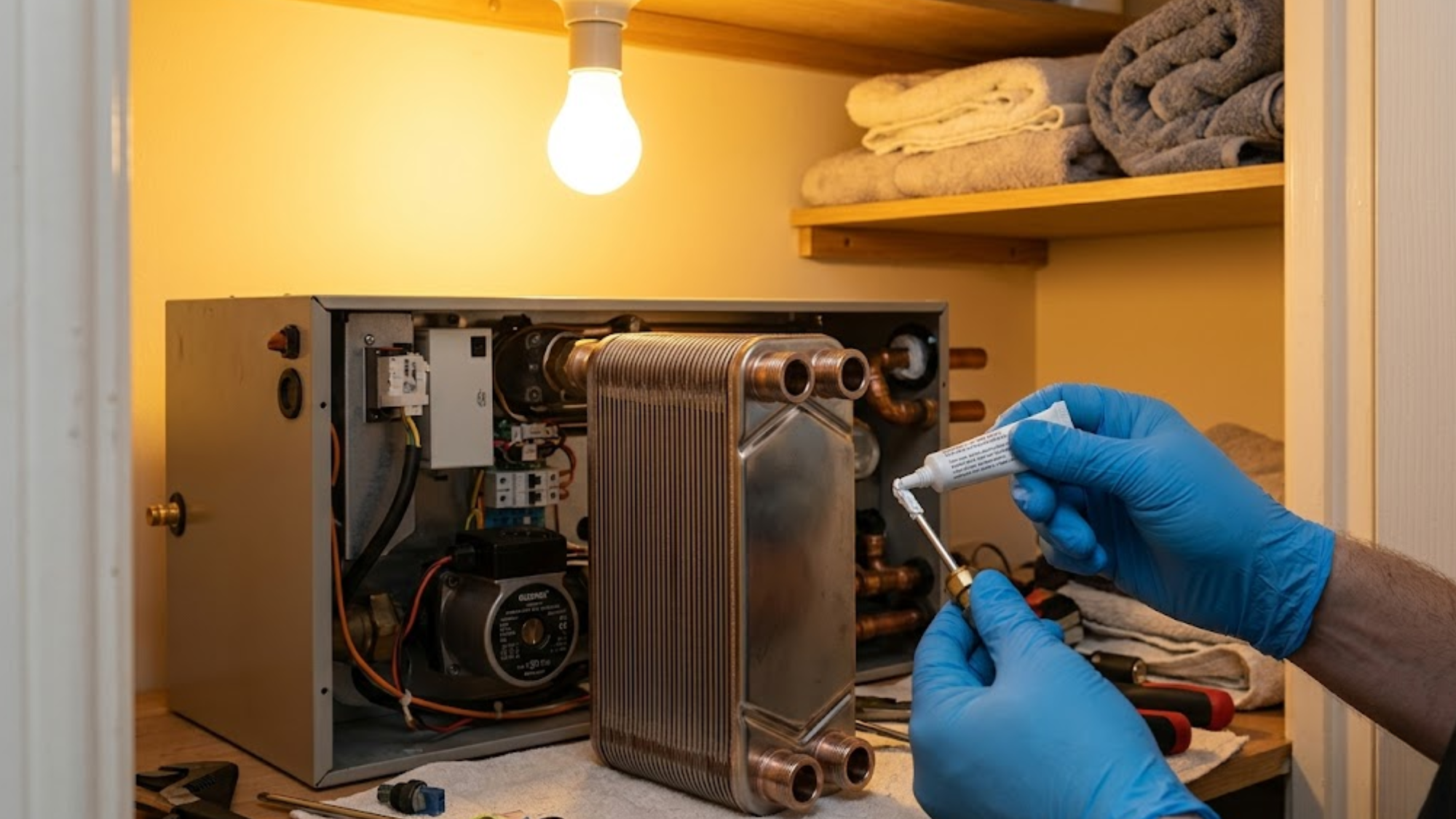
The Gledhill Boilermate BP sits in thousands of UK homes, quietly delivering hot water and heating through its clever thermal store design. When the plate heat exchanger scales up or sensors fail, most homeowners face a simple choice: pay for an expensive engineer or learn to perform the maintenance tasks themselves. This guide provides the technical steps required to restore your system to peak efficiency and ensure your thermal store performs as intended for its full design life.
Why the Plate Heat Exchanger Scales
The unit uses a stainless steel plate heat exchanger (PHE) to transfer heat from the thermal store to your domestic hot water supply. Cold mains water passes through one side of the plate heat exchanger (PHE) while hot water from the store flows through the other. The plates create turbulent flow, maximizing heat transfer in a compact space.
Hard water areas create the primary problem. When water temperatures exceed 60 degrees Celsius, calcium carbonate precipitates out of solution and bonds to metal surfaces. The narrow channels in the exchanger trap these deposits. Over twelve to eighteen months in hard water regions, calcium carbonate buildup can reduce flow rates by 40 to 60 percent. Specialists at Heating and Plumbing World often observe that ignored scaling is the leading cause of secondary thermal loss in unvented systems.
Identifying Symptoms of Failure
You will notice the symptoms before complete failure: shower temperature drops, hot water takes longer to arrive, or the flow reduces to a trickle while cold taps run normally. The thermal store might maintain temperature while hot water delivery suffers, which is a clear sign that you need to perform a gledhill boilermate bp plate heat exchanger descaling rather than looking for a boiler problem.
I once attended a site where a homeowner had ignored a slight drop in shower temperature for six months. By the time they called us, the hot water flow was a mere "pencil lead" trickle. They had been compensating by adjusting their heating valve control to the maximum, which only accelerated the mineral precipitation. A three-hour descale saved them from a full replacement, but it was a close call that could have been avoided with earlier intervention.
Think of the plate heat exchanger like the radiator in a high-performance car. If the tiny fins get clogged with debris, the engine cannot shed heat and eventually overheats. In your Boilermate, if the plates are clogged with scale, the water cannot pick up heat from the store, leaving you with a lukewarm shower regardless of how hot the main tank is.
Tools and Materials Required for the Job
Before starting a gledhill boilermate bp plate heat exchanger descaling or sensor swap, gather your tools. You will need two adjustable spanners, a bucket, and 10 litres of descaling solution. Professional installations often benefit from upgraded water heating systems that incorporate better filtration before the PHE.
You should also have thermal paste and a multimeter to test the electrical components accurately. Budget at least three hours for a first-time descale, as stubborn compression fittings can add significant time to the removal phase.
Isolating the System Safely
Turn off the boiler and close the isolation valve on the cold mains feed. You do not need to drain the entire store for PHE work, but you must isolate the DHW circuit. Locate the service valves on either side of the exchanger. If your system is integrated with smart radiator valves, ensure the heating demand is disabled so the pump does not trigger during the repair.
Close both service valves by turning them 90 degrees. Open a hot tap at the highest point in your house to release pressure. Water will run briefly then stop, which confirms the isolation of the secondary circuit was successful.
Removing the Plate Heat Exchanger (PHE)
Place your bucket under the unit to catch the residual water, which is usually around 2 to 3 litres. Using your spanners, loosen the compression nuts on all four connections. Support the plate heat exchanger (PHE) as you remove the final connection, as these units weigh about 4kg and will drop if unsupported.
Inspect the olive seals as you remove them. Crushed or corroded olives need replacement to prevent leaks during reassembly. If you find the fittings are severely corroded, consider whether your combi boiler or thermal store is suffering from broader system debris that requires a full chemical power flush.
The Descaling Process
For heavy deposits, you should establish a closed loop using a submersible pump and a bucket of descaling solution. Run the pump for 45 to 60 minutes. The solution circulates through the narrow channels, dissolving the calcium carbonate and flushing it into the bucket.
After chemical descaling, flush the unit with clean water. Run 20 litres through each circuit to remove all chemical residue. If you are modifying the pipework during this process, using high-quality push fit plumbing fittings can simplify the reinstallation of the secondary loop.
Identifying and Replacing Faulty Sensors
The Boilermate BP uses multiple NTC (Negative Temperature Coefficient) sensors to monitor temperatures. When NTC (Negative Temperature Coefficient) sensors fail, the control board receives incorrect readings, often causing the boiler to short-cycle or provide lukewarm water despite high store temperatures.
Test the sensors with your multimeter set to resistance mode. At 20 degrees Celsius, a functioning sensor should read 10,000 to 12,000 ohms. When replacing them, clean the pocket thoroughly and apply fresh thermal paste to the probe. Ensure you select a hot water cylinder sensor that matches the original Gledhill specification to ensure the resistance curve aligns with the control board logic.
System Restart and Testing
Open the service valves and the cold mains isolation valve to refill the system. Check all connections for leaks. Restore power and fire the boiler. As the system heats up, monitor the expansion vessel to ensure it is correctly absorbing the increased volume.
Once the store reaches 75 degrees Celsius, test the DHW delivery at the nearest tap. You should achieve 60 degrees Celsius water within 8 seconds at a flow rate of 12 to 15 litres per minute. Reduced flow after descaling suggests either incomplete scale removal or debris partially blocking the internal channels.
Preventing Future Scale Buildup
Scaling is inevitable in many regions, but you can slow the process by installing a scale inhibitor in the cold mains feed. Magnetic or electronic scale inhibitor devices can reduce scale formation by up to 50 percent. For the most effective solution, a full water softener removes the minerals entirely, preventing calcium carbonate from entering the PHE in the first place.
Conclusion
Executing a gledhill boilermate bp plate heat exchanger descaling and replacing failing sensors addresses the most common service issues in these systems. These tasks extend the system life by several years and cost significantly less than a full unit replacement.
By maintaining your PHE and ensuring your sensors are accurate, you keep your Boilermate running at its full design potential. If you need assistance with specific part numbers or require guidance on chemical concentrations, reach out to our experts for professional technical advice today.