

Gledhill PLUDR Slim EE Range: Electric Element Options For G3 Cylinders
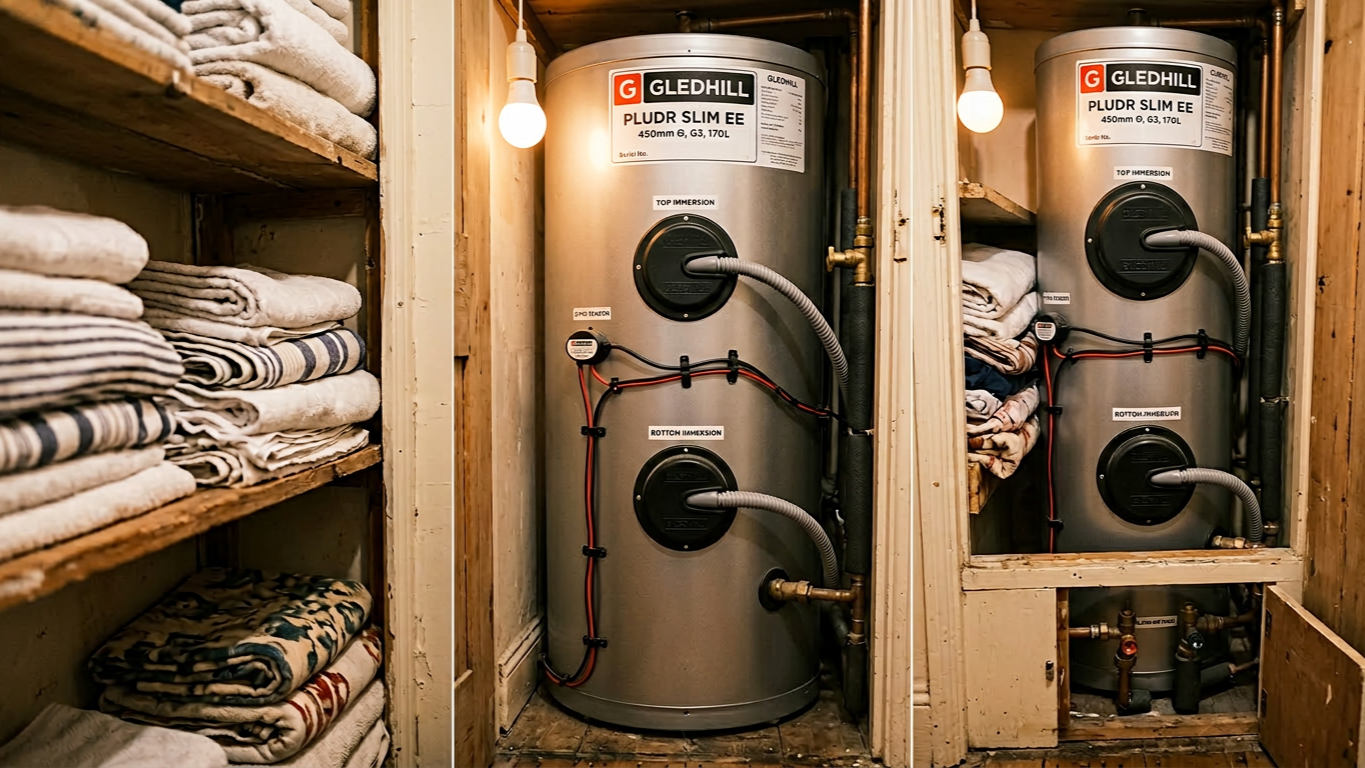
When you're specifying a hot water cylinder for a property with limited space, the Gledhill PLUDR Slim EE range solves a massive problem. These cylinders squeeze into the tightest spots while delivering the performance and safety standards you'd expect from a full-size unit.
The 'EE' designation stands for Electric Element. Unlike models that rely solely on an external boiler, this range integrates electric heating elements directly into the cylinder. Think of it like a self-heating kettle compared to a traditional pot on a stove. It generates its own heat internally, giving you incredible flexibility in properties where standard boiler configurations simply won't fit.
What Makes The Range Different
The Gledhill PLUDR Slim EE cylinders measure just 450mm in diameter. This compares to the standard 550mm you'd find on conventional unvented cylinders. That 100mm difference might not sound dramatic. However, it is often the margin between fitting a cylinder in a tiny bathroom airing cupboard or having to rip out structural walls.
We source premium trade heating supplies precisely because these physical dimensions matter. We've installed these units in Victorian terraces, modern apartments, and even narrowboat conversions. Furthermore, the slim profile doesn't compromise capacity. You can spec these cylinders from 90 litres right up to 250 litres.
Crucially, these are fully G3-compliant unvented cylinders. This means they meet strict Building Regulations requirements for unvented hot water systems in England and Wales. Every unit ships with factory-fitted safety controls. You get temperature and pressure relief valves, expansion vessels, and pressure-reducing valves already integrated.
Electric Element Configuration Options
Here is where the Gledhill PLUDR Slim EE gets genuinely interesting for system designers. You can order these cylinders with either single or dual immersion heater configurations. Choosing the right one depends entirely on how the property uses its hot water.
Single Element Models
The single-element versions typically feature a 3kW or 6kW immersion heater. These electric heating elements are positioned to heat the entire cylinder volume simultaneously. This setup works perfectly for properties with very consistent hot water demand throughout the day.
The element heats water from cold in around 90 minutes for a 150-litre cylinder. I regularly specify single-element models for rental properties where landlords want maximum simplicity. One element means one potential failure point. Furthermore, tenants can't accidentally leave an economy boost running during peak tariff hours.
Dual Element Models
Alternatively, dual-element cylinders feature two separate immersion heaters. You usually get a 3kW unit in the upper third of the cylinder and another 3kW element lower down. This dual immersion heater configuration gives you total flexibility.
The top element heats around 40-50 litres very quickly. This is perfect for a morning shower when you don't need the entire cylinder hot. Meanwhile, the lower element heats the full volume for evening baths. You can wire these elements to separate circuits and control them independently. Consequently, this opens up some incredibly clever possibilities with an overnight economy tariff.
Integration With Renewable Heat Sources
This range isn't strictly limited to pure electric heating. These cylinders also feature a single coil heat exchanger that connects to external heat sources. You can easily link them up to boilers, heat pumps, or solar thermal systems. The electric elements then act as a backup boost when the primary source can't keep up with demand.
This dual-fuel approach makes absolute sense with air source heat pumps. On mild days, the heat pump handles the base load efficiently. When temperatures plummet, the elements pick up the slack without leaving occupants shivering. While a large ACV Smartline SLE 160 indirect cylinder offers similar indirect capability, the slim electric model works brilliantly when transitioning away from gas in very tight spaces.
Control And Wiring Considerations
Getting the most from a dual immersion heater requires thoughtful wiring and control. The simplest approach uses two separate switches or timers. You set the top element to heat during morning and evening peaks. Then, you program the lower element to run overnight on a cheaper economy tariff.
More sophisticated installations integrate the cylinder with smart home platforms. Using a reliable wireless combi pack allows you to monitor the cylinder temperature remotely and adjust heating schedules based on occupancy patterns.
However, the electrical load absolutely matters. A 6kW element draws 25 amps at 240V, which needs appropriate circuit protection. Dual 3kW elements on separate circuits spread the load slightly, but you're still pulling 12.5 amps per circuit when both run simultaneously. Always check the property's electrical capacity before specifying high-wattage configurations.
Capacity Selection And Recovery Times
Choosing the right cylinder capacity involves much more than just counting bedrooms. You need to intimately understand peak demand patterns and acceptable recovery times between draw-offs.
A 150-litre Gledhill PLUDR Slim EE with a 6kW element recovers from cold to 60°C in roughly 90 minutes. That is fine for a couple who shower at different times. However, a family of four taking morning showers back-to-back will drain the cylinder faster than it can recover.
If space is so tight that only a single sink needs supply, a tiny Crown 45-litre wall-mounted cylinder might suffice. But for full domestic use, you must spec the correct volume. In high-demand scenarios, use a dual-element model where the top element delivers quick-recovery water between showers.
Installation And Maintenance Access
The slim profile that makes these cylinders fit tight spaces can complicate servicing. You must leave clear access to the immersion heater bosses. Please don't box these in completely. Always leave removable panels or adequate working clearance for future engineers.
Those internal electric heating elements will eventually fail. Limescale buildup in hard water areas heavily accelerates element degradation. We've pulled elements from cylinders in London that looked like limestone stalagmites after just three years.
On a recent job in a narrowboat conversion, an amateur installer had completely sealed the cylinder behind custom woodwork. We had to destroy a beautiful oak panel just to access a faulty thermostat, turning a routine 20-minute service into a costly nightmare. Additionally, replacing a failed Gledhill GT149 sensor or testing safety valves is an annual legal requirement for all G3-compliant unvented cylinders.
Comparing Options To Alternative Heating Methods
Electric immersion heaters cost more to run than gas boilers or heat pumps. However, they offer distinct advantages in specific situations. No flue requirements mean you can install these cylinders in internal cupboards where venting a gas boiler would be physically impossible.
The capital cost difference matters immensely. While a large Tribune HE pre-plumbed cylinder is fantastic for larger projects, a fully electric slim cylinder is far cheaper to install than a full heat pump system. A cylinder with elements fitted costs perhaps £800-1200. Compare that to a heat pump installation at £8,000-12,000, and electric elements start looking sensible for properties with modest demand.
If you eventually upgrade to gas or solar, the internal single coil heat exchanger ensures your cylinder remains perfectly viable. You aren't locked into pure electricity forever.
Specification Checklist For Pludr Slim EE Cylinders
When you are putting together a specification, work through these considerations systematically. Taking the time to plan prevents costly errors on site. Here is what you need to verify:
- Peak simultaneous demand: Calculate the number of outlets running at once.
- Available installation space: Verify both height and diameter constraints, including access routes.
- Electrical capacity: Check the circuit protection and available load.
- Element configuration: Choose single versus dual elements based on usage patterns.
- Tariff availability: Check if an overnight rate is available to lower running costs.
- Maintenance access: Ensure future element replacement is physically possible without demolition.
Conclusion
The Gledhill PLUDR Slim EE range isn't the cheapest way to heat water, nor is it the most energy-efficient. What it offers is incredible flexibility and practicality when space constraints completely rule out conventional solutions.
These G3-compliant unvented cylinders work brilliantly in properties where running gas pipes is totally impractical. The dual immersion heater option adds genuine value for properties using a smart economy tariff. Alternatively, single-element models keep things beautifully simple for rental properties.
Either way, you're getting a reliable cylinder that meets regulatory requirements while solving the fundamental problem of fitting hot water storage into an impossible space. If you need assistance sizing your next tight-space project or selecting the right components, speak to our team for expert guidance.