

Glycerin-Filled Pressure Gauges: Benefits for Vibration
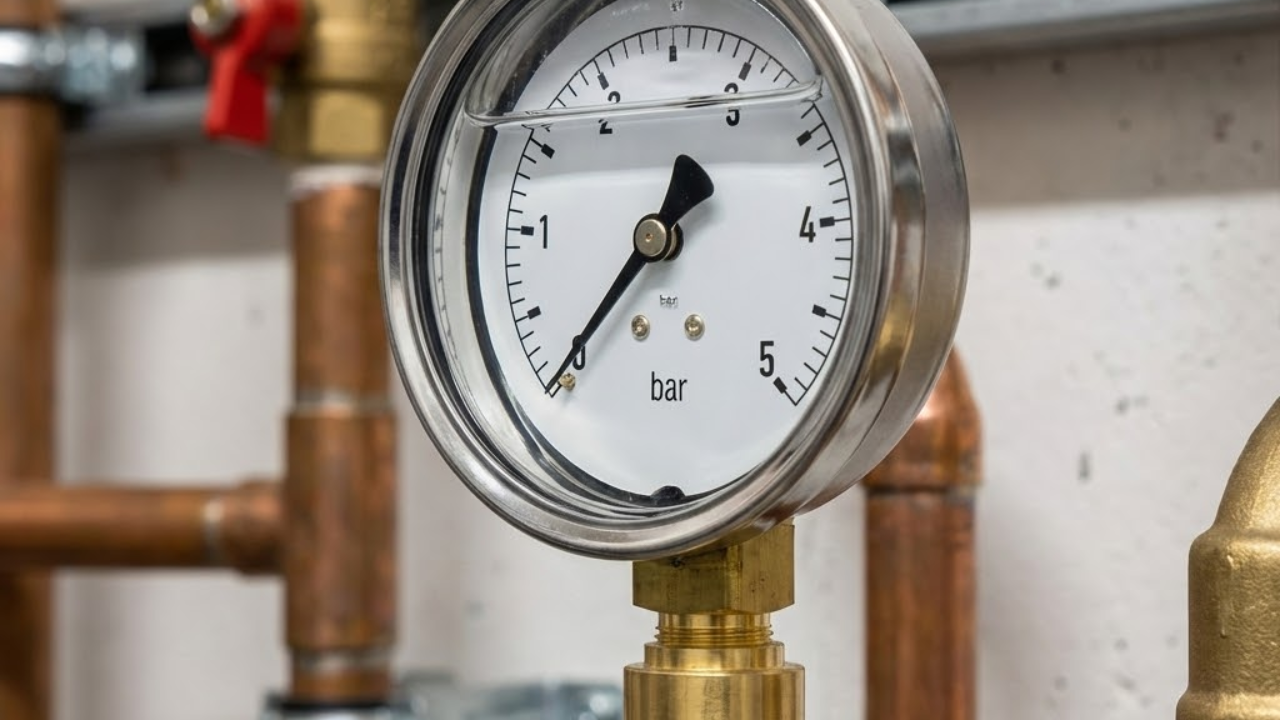
Every pressure gauge on a commercial heating system faces the same problem: vibration. Pumps cycle, valves slam shut, expansion vessels charge and discharge. That constant mechanical movement translates directly into needle flutter, gauge fatigue, and premature failure.
On a residential install, you might get away with a standard dry gauge for a few years. On a commercial job with multiple circulators running 24/7, that same gauge will be unreadable within months.
Glycerin-filled pressure gauges solve this by damping the internal mechanism. The viscous liquid absorbs shock loads and smooths out needle movement. This extends service life and maintains accuracy in environments where standard gauges simply can't cope.
For heating engineers working on pressurised systems, understanding when and why to specify a glycerin-filled model isn't optional. It's the difference between a gauge that lasts a decade and one you're replacing on every service visit.
How Glycerin Damping Works in Practice
The principle is straightforward. A standard pressure gauge uses a Bourdon tube. That's a curved, hollow metal element that straightens under pressure and moves a needle via a mechanical linkage. When the system pressure fluctuates rapidly, that linkage vibrates. The needle oscillates across the dial face, making it difficult to read and accelerating wear on the pivot points, gears, and hairspring.
It's like trying to read a clock whilst someone's shaking your wrist. The mechanism works, but you can't make sense of the reading.
Fill the gauge case with glycerin, and you've introduced a glycerin damping mechanism. The liquid surrounds the entire movement, creating resistance to rapid motion. When vibration hits, the glycerin absorbs the energy. It slows needle movement and prevents the wild swings you'd see in a dry gauge.
Think of it like shock absorbers on a car. Without them, every bump translates into chassis shake. With them, the ride smooths out and you can actually see where you're going.
Glycerin viscosity is critical. Too thin, and you lose damping effect. Too thick, and the needle becomes sluggish, especially in cold environments. Most commercial gauges use a glycerin-water blend (typically 60-70% glycerin) that balances damping performance with temperature stability.
Pure glycerin can crystallise below 0°C. That's why blended formulations are standard for HVAC applications. You don't want a gauge that works perfectly at 20°C but seizes up the first time the plant room drops to 5°C overnight.
The fill also prevents internal corrosion. Moisture ingress is a common failure mode for dry gauges, particularly in plant rooms with high humidity. Once condensation forms inside the case, the movement corrodes and seizes. A glycerin-filled pressure gauge is sealed. There's no air gap for moisture to penetrate, so the mechanism stays protected even in damp conditions.
That's worth remembering if you're specifying gauges for basement plant rooms or outdoor installations.
When to Specify Glycerin-Filled Gauges
Not every application needs glycerin fill, but most commercial heating systems do. Here's where they're essential:
High-vibration environments: Any system with multiple pumps, especially if they're mounted on the same frame or pipework. Circulator vibration transmits through the steelwork, and gauges mounted nearby take the full brunt.
Variable-speed drives can actually make this worse. The constant ramping up and down creates more frequent pressure pulses than a fixed-speed pump running continuously. If you can feel vibration through the pipework when the pumps are running, you need glycerin fill.
Rapid pressure cycling applications: Systems with frequent start-stop cycles, such as booster sets, pressurisation units, or anything controlled by a pressure switch. Each cycle hammers the Bourdon tube. A dry gauge might handle a few thousand cycles. A glycerin-filled pressure gauge can manage hundreds of thousands without drift or mechanical wear.
Outdoor or unheated locations: Plant rooms, rooftop units, external boiler houses. Temperature swings cause case condensation in dry gauges. Glycerin fill prevents this and maintains readability in cold conditions where a standard gauge might fog up or freeze internally.
The last thing you need is a gauge that's illegible when you're diagnosing a no-heat fault at 6am in January.
Critical monitoring points: Anywhere you need accurate, reliable readings for system diagnosis or safety. The primary flow and return on a commercial boiler, the discharge side of a circulator, or the fill point on a pressurisation unit. If a gauge failure could delay commissioning or cause a system fault, specify glycerin fill.
The cost difference is negligible compared to the operational impact of unreliable monitoring. For pump installations, Grundfos circulators benefit from glycerin-filled gauges on both suction and discharge monitoring points.
You'll also see them used on hydraulic test rigs, where gauges are subjected to repeated pressure spikes during valve testing or system flushing. A dry gauge used for pressure testing might last a season. A glycerin-filled model will still be accurate after years of hard use.
Comparing Glycerin vs Silicone Fill
Silicone oil fill is an alternative damping fluid, and it's worth understanding the trade-offs. Silicone has a wider operating temperature range. It won't crystallise in extreme cold and remains stable at higher temperatures than glycerin. For applications below -20°C or above 60°C, silicone oil fill is often the better choice.
However, silicone is more expensive, and the performance difference in typical HVAC applications is negligible. Most plant rooms operate between 5°C and 40°C, well within glycerin's comfort zone. Quality manufacturers like Danfoss offer both glycerin and silicone-filled options, allowing you to select based on actual environmental conditions rather than unnecessary specification.
Silicone also has a slightly lower viscosity, which means marginally less damping. For most heating engineers, glycerin-filled pressure gauges offer the best balance of cost, performance, and availability.
There's also a practical consideration. If a glycerin-filled gauge case cracks, the leak is obvious. You'll see glycerin dripping or pooling around the gauge. Silicone oil fill is less viscous and can seep through smaller gaps, making leaks harder to spot until the gauge has lost most of its fill and the damping effect disappears.
When you're doing a site inspection, a visible glycerin leak tells you immediately that the gauge needs replacing. A slow silicone seep might go unnoticed for months.
Installation Best Practices
Mounting position affects gauge longevity. Ideally, install gauges with the dial face vertical and the connection pointing downwards or horizontally. This minimises stress on the Bourdon tube and reduces the risk of glycerin leakage if the case seal degrades over time.
Isolating valves are non-negotiable on any pressure gauge in a commercial system. Use a needle valve or ball valve on the gauge connection so you can isolate and replace the gauge without draining the system. On high-vibration applications, consider gauge snubber fittings. That's a small restrictor fitting that sits between the valve and the gauge, damping pressure spikes before they reach the Bourdon tube.
This is particularly useful on pump discharge lines or anywhere you've got water hammer issues.
A pulsation dampener takes this concept further. It's essentially a small accumulator that absorbs pressure pulses in particularly harsh applications. Think of gauge snubber fittings as passive protection (just a restrictor) and a pulsation dampener as active protection (a pressure buffer).
Both work alongside glycerin fill to maximise gauge life on brutal applications like hydraulic test rigs or high-cycling booster sets.
Gauge sizing matters for readability and accuracy. A 63mm dial is the minimum for commercial work. Anything smaller is difficult to read from a distance, and the smaller Bourdon tubes are less robust. For main plant room monitoring, 100mm dials are standard. They're easier to read during commissioning, and the larger mechanism is more durable.
The extra cost is trivial compared to the improvement in operational visibility.
Check the pressure range. A gauge should operate in the middle third of its scale for best accuracy. If your system runs at 1.5 bar, don't fit a 0-10 bar gauge. You'll be reading in the bottom 15% of the scale, where accuracy is poorest and needle movement is minimal.
A 0-4 bar or 0-6 bar gauge gives you a much clearer indication and better resolution for fault diagnosis. For systems with Altecnic Ltd expansion vessels, proper gauge sizing is critical for accurate pressure monitoring and system diagnostics.
Real-World Performance Differences
Here's a scenario that plays out on commercial sites regularly. A facilities manager calls because the pressure gauge on a primary circuit pump keeps failing. Every six months, the needle either sticks or bounces so wildly it's unreadable. The engineer replaces it with another dry gauge from the van, and the cycle repeats. Six months later, same problem. Another £20 gauge, another service call, another frustrated customer.
Switch to a glycerin-filled pressure gauge, and the problem disappears. The needle movement smooths out, readings stabilise, and the gauge is still functioning accurately years later. The cost difference is marginal (perhaps £10-15 more than a dry gauge) but the reduction in callouts and the improvement in system monitoring easily justifies the upgrade.
That's the difference between reactive maintenance (replacing gauges every six months) and proactive specification (fit the right gauge once and forget about it).
Another common issue is pressure gauges on pressurisation units. These systems are designed to maintain a constant fill pressure, but they're also subject to thermal expansion cycles as the heating system heats and cools. A dry gauge will show needle flutter as the expansion vessel charges and the pump cuts in and out.
With a glycerin-filled pressure gauge, the reading stays steady. This makes it far easier to set the cut-in and cut-out pressures accurately during commissioning. You're not guessing at where the needle's actually sitting. You can see the exact pressure value. This is particularly important when working with Kingspan pressurisation equipment where precise pressure control is essential.
On hydraulic test rigs, the difference is even more pronounced. Testing a batch of thermostatic radiator valves involves repeated pressure cycling. Ramp up to test pressure, hold, release, repeat. A dry gauge will lose accuracy within a few hundred cycles.
Glycerin-filled pressure gauges on the same rig will still be reading true after tens of thousands of cycles, with no drift or mechanical wear. That's the difference between recalibrating your test equipment quarterly and only checking it annually.
Maintenance and Troubleshooting
Glycerin-filled pressure gauges require minimal maintenance, but they're not indestructible. The most common failure mode is case leakage. If you notice the glycerin level dropping (you'll see an air gap forming at the top of the case) the seal has failed. This can happen due to thermal cycling, case damage, or simply age.
Once the fill level drops significantly, damping performance degrades, and you'll start seeing needle flutter again.
Cloudy or discoloured glycerin is another sign of trouble. This usually indicates moisture ingress, which means the case seal is compromised. Whilst the gauge might still function, accuracy will deteriorate over time as internal corrosion begins. Better to replace it before it fails completely mid-winter when you can't get parts delivered.
Needle sticking can occur if the glycerin has thickened due to contamination or if the gauge has been subjected to extreme cold. If a gauge is installed in an unheated location and the glycerin crystallises, the needle will become sluggish or stop moving altogether.
Warming the gauge usually restores function, but repeated freeze-thaw cycles will eventually damage the fill and the mechanism. For consistently cold environments, specify silicone oil fill instead.
Pressure spikes beyond the gauge's rated range can burst the Bourdon tube, even in a glycerin-filled pressure gauge. This is why it's critical to size the gauge correctly and use gauge snubber fittings on applications with severe water hammer or rapid valve actuation.
Glycerin fill protects against vibration and rapid cycling, but it can't save a gauge from a 10 bar spike on a 6 bar gauge.
If you're diagnosing a system fault and the gauge reading seems suspect, always verify with a calibrated test gauge before assuming the installed gauge is accurate. Glycerin fill extends service life and improves vibration resistance, but it doesn't make a gauge immune to mechanical failure or calibration drift. When in doubt, check.
Regulatory and Standards Compliance
BS EN 837-1 is the European standard covering pressure gauges for industrial applications, including HVAC systems. It specifies accuracy classes, case protection ratings, and environmental resistance. Most commercial glycerin-filled pressure gauges are Class 1.6 or Class 1.0. This means they're accurate to within 1.6% or 1.0% of full-scale deflection.
For heating systems, you'll also need to consider the case protection rating. IP54 rating is typical for plant room installations. That's dust-protected and splash-resistant. That's fine for indoor plant rooms with basic environmental protection.
For outdoor or high-humidity environments, IP65 rating (dust-tight and water-jet resistant) is preferable. If you're mounting gauges on an external wall or in a basement that floods occasionally, IP65 rating is non-negotiable.
Pressure Equipment Directive (PED) compliance is required for gauges used on systems above certain pressure and volume thresholds. Most commercial heating systems fall under Category I or II, which means gauges must be CE-marked and meet the relevant safety standards. Always check that the gauge you're specifying carries the appropriate certification for the application.
Cost vs Value Analysis
A standard dry pressure gauge for a commercial heating system costs around £15-25. A glycerin-filled pressure gauge equivalent is £25-40, depending on size and specification. That's a modest upfront premium, but the operational cost difference is significant.
Consider a commercial building with ten pressure monitoring points. Primary flow and return, secondary circuits, pump discharge lines, and pressurisation unit. If you fit dry gauges and they fail every two years due to vibration, you're looking at ten replacements per cycle. That's £150-250 in parts, plus labour for each callout.
Over a ten-year period, you could easily spend £750-1,250 on gauge replacements alone.
Fit glycerin-filled pressure gauges from the start, and you'll likely see one or two failures over the same period. Perhaps £80-160 in total. The labour saving is even more significant. Each gauge replacement on a pressurised system means isolating, draining down (or at least venting the gauge line), fitting the new gauge, refilling, and venting.
That's 30-45 minutes per gauge, assuming no complications. Multiply that by repeated failures, and you're looking at hours of wasted time that could be spent on productive maintenance.
For critical applications (boiler primary circuits, pressurisation units, anything that affects system safety or performance) the cost argument is irrelevant. The reliability and accuracy of a glycerin-filled pressure gauge make it the only sensible choice. You wouldn't fit cheap thermostatic radiator valves on a £50,000 boiler system. Don't compromise on pressure monitoring either.
Selecting the Right Gauge for Your Application
When specifying a glycerin-filled pressure gauge, consider these factors:
Pressure range: Size the gauge so normal operating pressure sits in the middle third of the scale. For a system running at 1.5 bar, a 0-4 bar or 0-6 bar gauge is ideal. For higher-pressure applications, such as pressurisation units or booster sets, you might need 0-10 bar or 0-16 bar.
Dial size: 63mm for general use, 100mm for main plant room monitoring where readability from a distance is important. Larger dials also tend to have more robust mechanisms.
Connection type: Bottom-entry or back-entry, depending on pipework layout. Bottom-entry is more common and generally preferred for vertical mounting. Back-entry is useful for panel mounting or where space is tight.
Case material: Steel cases are standard and adequate for most plant rooms. Stainless steel is necessary for corrosive environments or outdoor installations. Plastic cases are lighter and cheaper but less durable. Avoid them for commercial applications.
Accuracy class: Class 1.6 is acceptable for general monitoring. Class 1.0 is better for commissioning and fault diagnosis. Class 0.6 is overkill for most HVAC work but may be required for specific test equipment.
Temperature rating: Standard glycerin fill is good for -20°C to +60°C. If you're installing in an extreme environment, check the manufacturer's specification or consider silicone oil fill.
For trade professionals looking to source reliable pressure monitoring equipment, Heating and Plumbing World stocks a comprehensive range of glycerin-filled pressure gauges suitable for commercial and industrial heating applications across all major manufacturers and specifications.
Alternatives and Complementary Technologies
Digital pressure gauges are becoming more common, particularly on new builds and high-specification commercial systems. They offer better accuracy, data logging, and remote monitoring capability. However, they're significantly more expensive (£150-300+), require power, and are more complex to install and maintain.
For most retrofit and mid-range commercial work, analogue glycerin-filled pressure gauges remain the practical choice.
Pressure transducers with separate displays are another option, particularly for building management systems (BMS) integration. These allow you to monitor multiple points from a central control panel and set alarms for out-of-range conditions. Again, cost and complexity are higher, and you still need local gauges for commissioning and manual fault diagnosis.
Gauge snubber fittings and pulsation dampeners are complementary devices that work alongside glycerin-filled pressure gauges to further reduce vibration and pressure spikes. Gauge snubber fittings are simple restrictor fittings that slow the rate of pressure change reaching the gauge. A pulsation dampener is a more sophisticated device, essentially a small accumulator that absorbs pressure pulses.
Both are worth considering on particularly harsh applications, such as pump discharge lines or systems with known water hammer issues.
For critical monitoring points, consider installing dual gauges. That's two gauges on the same test point, one for continuous monitoring and a second, calibrated gauge for verification during commissioning and annual checks. This approach is common on large commercial boiler installations and district heating systems. The extra cost is trivial compared to the confidence of having redundant monitoring.
Conclusion
Glycerin-filled pressure gauges aren't a premium option. They're the baseline standard for any commercial heating system subject to vibration, pressure cycling applications, or harsh environmental conditions. The glycerin damping mechanism protects the internal mechanism, extends service life, and maintains accuracy in high-vibration environments where dry gauges fail repeatedly.
For heating engineers, specifying glycerin fill is a straightforward decision that reduces maintenance callouts, improves system monitoring, and delivers long-term cost savings.
The upfront cost difference is minimal, typically £10-20 per gauge, but the operational benefits are substantial. Systems with glycerin-filled pressure gauges require fewer replacements, provide more reliable readings during commissioning and fault diagnosis, and reduce the risk of undetected pressure faults that could lead to system damage or failure.
Whether you're installing a new system, upgrading an existing plant room, or simply replacing failed gauges on a service visit, make glycerin fill the default choice. Pair them with isolating valves and gauge snubber fittings on high-vibration applications. Size them correctly for the operating pressure range. Mount them properly to maximise service life.
If you need advice on gauge selection or system-specific requirements, contact us for technical support tailored to your installation.