

Grundfos Alpha3: System Balancing Using The Grundfos GO Reader
Hydronic heating systems fail most often not from equipment breakdown, but from poor balance. When radiators heat unevenly or circulation pumps run at maximum capacity to compensate for flow restrictions, the root cause is almost always the same. Nobody took the time to balance the system properly.
Mastering grundfos alpha3 system balancing transforms how engineers approach this problem. Instead of guessing at flow rates or relying on temperature differentials alone, you can now measure actual performance at each zone and adjust accordingly.
What System Balancing Actually Means
Heating and Plumbing World supports trade professionals who see the results of poor balancing every day. A balanced hydronic system delivers the correct hydronic system flow rate to each heating zone. It does not deliver maximum flow, but the correct flow. A room with standard panel radiators sized for 9 litres per minute doesn't heat better when you push 18 litres per minute through it. It just wastes pump energy and starves other zones.
Think of system balancing like watering a large garden with multiple sprinklers connected to a single hose. If you open the first sprinkler fully, the ones at the very end of the hose barely get a trickle. Balancing is the process of partially restricting those first few sprinklers so that the water pressure distributes evenly all the way to the last one.
Hundreds of unbalanced systems show a repeating pattern. Rooms closest to the pump get too much flow, distant rooms get too little, and the circulator runs on high speed trying to overcome the imbalance. Energy costs climb 30-40% compared to a properly balanced system.
The traditional balancing method uses temperature measurements and manual calculations. You measure supply and return temperatures at each radiator, calculate the delta-T, estimate flow rates, and adjust balancing valves incrementally. It works, but it requires multiple site visits and extensive documentation.
How The Alpha3 Measures Flow Directly
The core of grundfos alpha3 system balancing relies on direct measurement. The Alpha3 doesn't just move water; it monitors what happens in real time. The internal sensors handle the differential pressure monitoring continuously, tracking power consumption and motor speed. The pump's algorithm then converts these measurements into flow rate data accurate within 10%.
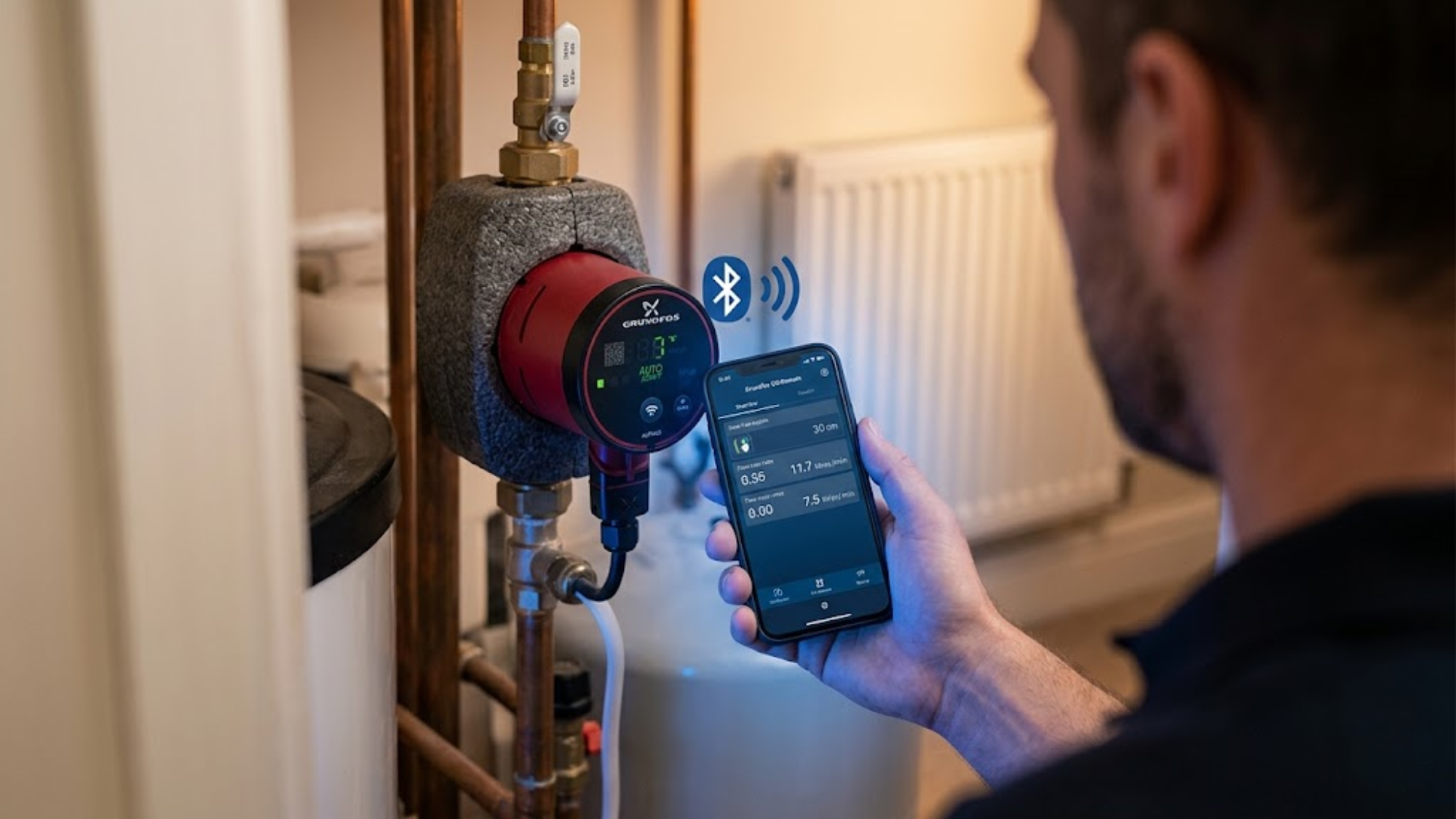
Whether navigating complex heating pipe systems or simple loops, this accuracy matters because you are no longer estimating. When connected via Bluetooth, actual flow rates are displayed accurately on the GO Remote reader interface. You see immediately whether a zone receives 7.5 l/min or 10 l/min.
The pump stores 30 days of performance data. This historical information helps identify problems that only appear under specific conditions. A zone that flows correctly at startup but drops off after two hours of operation signals a different problem than one that never achieves target flow.
Setting Up The GO Remote Reader
The Grundfos GO Remote app works on iOS and Android devices. Download it, enable Bluetooth, and hold your phone within 30 centimetres of the Alpha3 pump. The connection establishes in just a few seconds.
The main display shows current operating mode, flow rate, pump speed, power consumption, and any error codes. For balancing work, navigating the GO Remote reader interface gives you access to three primary screens: real-time flow, pressure curve, and historical data.
Before you start measuring, activate the constant pressure mode setting to maintain consistent differential pressure regardless of flow changes. This gives you stable readings as you adjust balancing valves. Ignoring the constant pressure mode setting during testing masks the effects of your adjustments, because proportional pressure modes compensate automatically while you work.
The Actual Balancing Process
Start with a system schematic showing all zones, their design flow rates, and valve locations. If you lack design specifications, calculate the required flow using radiator output ratings and system temperature differential. Most residential systems run an 11°C delta-T, while commercial systems vary from 5-22°C depending on the application.
On a recent commercial project, an engineer bypassed balancing completely, assuming a smart pump would automatically push water evenly through 24 separate zones. Within a week, the occupants in the top-floor offices were complaining of freezing temperatures, while the ground floor was sweltering. It turned out the pump was pushing 80% of the flow to the closest radiators. Taking just 45 minutes to properly map the zones and balance the valves resolved the issue permanently. It was a stark reminder that technology doesn't replace foundational engineering.
When conducting grundfos alpha3 system balancing, you should open all balancing valves fully. With the constant pressure mode setting engaged at a medium-high level, let the system run for 20 minutes to stabilise.
Measure the flow at each zone. The Alpha3 shows total system flow, so to isolate individual zones, you must close valves to all other zones temporarily while measuring. Record the actual flow versus design flow for each zone. A simple spreadsheet works best for documenting the zone name, design flow, actual flow, percentage of design, and adjustment needed.
Start balancing at the zone with the highest flow relative to design. If Zone 1 needs 8 l/min but flows at 13 l/min, close its balancing valve partially. Check the flow reading as you adjust. When Zone 1 hits the correct hydronic system flow rate, move to the next highest zone. This process is iterative because closing one valve redistributes flow to others.
Reading The Pressure Curve Data
The app displays exactly where your system operates on the pump curve, showing the relationship between flow rate and pressure differential. Accurate differential pressure monitoring reveals exactly where restrictions exist.
A properly sized pump operates in the middle third of its curve. If your system sits at the far right (high flow, low pressure), you have oversized the pump or undersized the piping. Far left operation (low flow, high pressure) indicates excessive restriction caused by closed valves, clogged strainers, undersized plumbing fittings and supplies, or restrictive piping.
Systems operating outside the middle third of the pump curve consume 25-45% more energy than necessary. The Alpha3's adaptive performance helps, but it cannot overcome fundamental sizing problems.
Using Historical Data To Verify Balance
After balancing, switch the Alpha3 back to its normal operating mode. The pump will optimise its speed based on actual system demand. Check performance again 48 hours later by reviewing the historical data view within the GO Remote reader interface.
A well-balanced system shows consistent flow patterns that match occupancy schedules. Morning warmup should hit target flow quickly, then reduce as thermostats satisfy. Evening setback should drop flow smoothly.
Erratic flow patterns, such as sudden spikes, unexpected drops, or hunting behaviour where flow oscillates, indicate remaining balance issues. Hunting behaviour often traces back to oversized pumps, improperly set differential pressure, and thermostatic radiator valves fighting with zone valves.
Common Problems The GO Reader Reveals
Air in the system shows up as erratic flow readings that jump around even when nothing else changes. The Alpha3 has automatic air purge capability, but large air pockets need manual venting.
Clogged strainers or filters create low flow across all zones with high differential pressure. Relying on differential pressure monitoring highlights failed components early. The pressure curve data shows the pump working hard while accomplishing very little.
Failed check valves allow reverse flow that doesn't show on traditional temperature-based balancing. The GO Remote catches this because total system flow exceeds the sum of individual zone flows.
Undersized zone valves create velocity noise and excessive pressure drop. You will see adequate flow but higher than expected power consumption. The pump works harder than necessary to push water through these restrictions.
What Changes After Proper Balancing
Energy consumption drops first. Pump power frequently shows a 35-50% reduction after balancing typical residential systems. Commercial systems show even larger savings because the imbalance problems multiply with system complexity.
Comfort improves within hours. Rooms that ran cold start heating properly. Overheated spaces near the pump cool to their setpoint. Occupants stop adjusting thermostats constantly, which further stabilises the temperature control system operation.
Equipment life extends because the circulator isn't running at maximum capacity fighting system imbalance. A balanced hydronic system flow rate prevents unnecessary energy waste, meaning bearings, seals, and motor windings last significantly longer.
Beyond Initial Balancing
System balance is not permanent. Corrosion products accumulate in pipes, valve seats wear, and building modifications change heating loads. Annual verification using the GO Remote reader is highly recommended.
The process takes just 15 minutes once the system is initially balanced. Systems upgraded with smart radiator valves or new pipework will need an immediate re-balance. Connect to each Alpha3 pump, check current flow against baseline measurements, and note any significant changes. A zone that has dropped 20% from its baseline needs investigation.
Conclusion
Effective grundfos alpha3 system balancing eliminates the guesswork that made traditional balancing time-consuming and imprecise. Systems can now be balanced in one visit instead of three. Measurements replace assumptions, allowing building owners to see the results in lower energy bills and fewer comfort complaints.
Proper balance matters more than premium components or sophisticated controls. A perfectly balanced system with basic equipment outperforms an unbalanced system with the most advanced technology available. The Alpha3 and GO Remote reader simply make achieving that balance practical for every installation. If you require assistance with hydronic balancing tools or pump sizing, reach out to our team to get expert advice today.