

Hair Salon Hot Water Demand: Buffer Vessel Sizing For Multiple Simultaneous Outlets
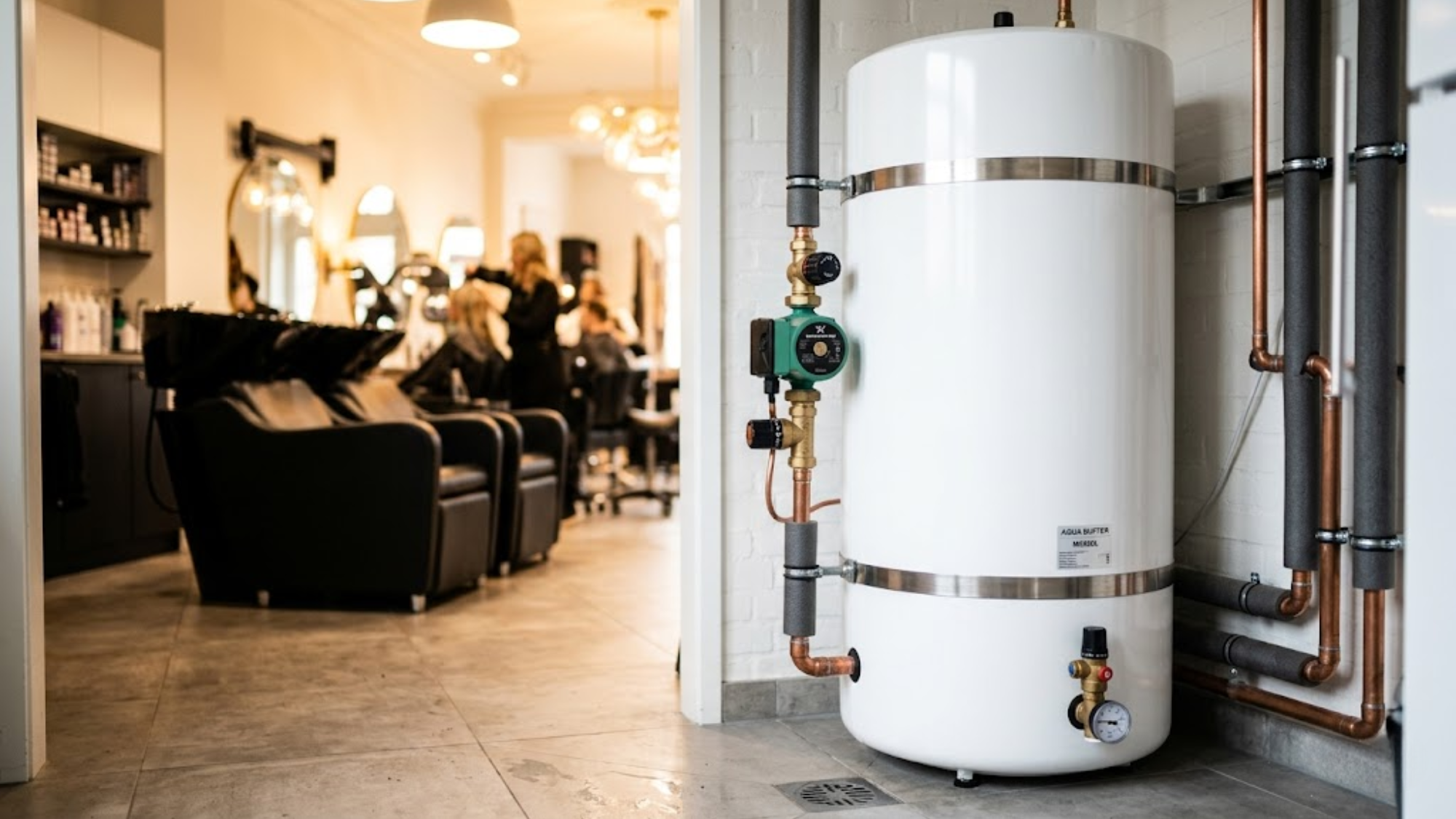
Hair salons create unique hot water demands that catch most HVAC designers off guard. A single basin sees minimal use, but when three stylists simultaneously rinse clients after colour treatments, your system needs to deliver 45–60 litres per minute at 38–40°C. Miss this calculation, and you'll hear about it from salon owners dealing with client complaints and interrupted services.
The challenge isn't just volume; it's the unpredictable timing. Unlike offices or retail spaces with steady, predictable usage patterns, salons experience sudden surges. Morning rush might have four basins running simultaneously, then nothing for 20 minutes, then another surge. This cyclical demand pattern requires buffer vessel sizing that accounts for both peak flow rates and recovery time between usage cycles.
Why Standard Hot Water Calculations Fail For Salons
Heating and Plumbing World provides technical advice for specialists dealing with these exact high-demand scenarios.
Most commercial hot water systems use diversity factors that assume not all fixtures run simultaneously. A building with 20 taps might size for 40% simultaneous use. This works for offices where bathroom usage naturally staggers. Salons break the standard model. When appointments align-which they do during peak hours-multiple stylists reach the rinse stage within minutes of each other. We've measured salon operations where 6 of 8 stations demanded hot water within a 90-second window. That's 75% simultaneous use, nearly double typical commercial assumptions.
The temperature requirement adds another layer. Handwashing tolerates 35–45°C variation. Hair rinsing doesn't. Clients immediately notice temperature drops below 38°C, and water above 42°C risks scalp discomfort and complaints. Your system needs consistent delivery within a 4°C window.
Calculating Actual Flow Demand Per Station
Each salon basin uses 12–15 litres per minute during active rinsing. A typical colour rinse takes 3–4 minutes, consuming 36–60 litres per client. Shampoo services use slightly less, roughly 25–35 litres per service.
For sizing calculations, use these baseline figures:
- Active flow rate: 15 L/min
- Service duration: 3.5 minutes average
- Volume per service: 52 litres
- Temperature requirement: 38–40°C
- 4–6 station salons: 60–75% simultaneous use
- 7–10 station salons: 50–60% simultaneous use
An 8-station salon should plan for 5 simultaneous outlets during peak periods. That’s 75 L/min demand. If your buffer vessel sizing and heating capacity can't sustain this for 3–4 minutes, temperatures will drop and complaints will follow.
Buffer Vessel Sizing Method
The buffer vessel serves two functions: it stores pre-heated water for immediate delivery during hot water demand surge periods, and it provides for heating system recovery between peak usage cycles.
- Step 1: Calculate peak draw volume 5 stations × 52 litres = 260 litres peak draw
- Step 2: Determine heating system recovery rate A continuous flow heater might deliver 40 L/min at your target temperature. During peak demand of 75 L/min, you're short 35 L/min. Over a 3.5-minute service cycle, that’s a 122-litre deficit your buffer must cover.
- Step 3: Add recovery buffer Salon operations typically show 8–12 minute gaps between major hot water demand surge cycles. Your heating system needs to replenish the buffer vessel during these windows. Add 30–40% capacity beyond your calculated deficit to ensure full recovery between cycles.
Base deficit: 122 litres. Recovery buffer (35%): 43 litres. Minimum buffer vessel: 165 litres. We typically specify 200–250 litre units for 6–8 station salons to provide headroom.
Heating Capacity Requirements
The buffer vessel only works if your heating system can replenish it. A 200-litre buffer means nothing if your heater takes 30 minutes to restore temperature. Calculate required heating capacity using this formula: Heating kW = (Buffer Volume × Temperature Rise × 4.186) / Recovery Time in seconds
For a 200-litre buffer with 35°C temperature rise and a 10-minute recovery target, you'll need roughly 49 kW. This represents continuous heating capacity. Heat pump systems need higher nominal capacity since they deliver lower flow temperatures.
I remember a job in a high-end boutique salon where the hot water storage system was sized based on residential laundry habits. By the time the third client hit the chair for a rinse, the water was lukewarm. The owner was losing money on redos because the colour wouldn't set properly in cold water. We swapped in a high-capacity buffer, and it's been smooth sailing since-it's a classic example of why you don't skimp on the math.
Think of your buffer vessel like the battery on a cordless drill. The battery stores the energy you need for a quick, powerful burst of work. If the battery's too small, the drill dies before you're done. If the charger's too slow, you're stuck waiting around for the next job. You need a big enough 'battery' and a fast enough 'charger' to keep the salon moving.
System Configuration Options
The most common commercial configuration pairs a 200–300 litre buffer vessel with a gas heater. The heater maintains buffer temperature and supplements flow during peak demand. This configuration works well for salons with natural gas access. Recovery times stay short even during consecutive peak periods.
Salons without gas access or those prioritising energy efficiency use heat pump systems with 300–500 litre buffer vessels. The larger buffer compensates for slower heating system recovery rates. Heat pumps deliver 60–70% energy savings compared to electric resistance heating, but they require careful sizing. A hot water cylinder sized for average conditions will underperform exactly when the salon needs it most during winter.
Temperature Control And Mixing
Storing water above 60°C prevents Legionella growth but creates scalding risk at outlets. Every salon hot water system needs thermostatic mixing valves (TMVs) that blend stored hot water with cold to deliver safe outlet temperatures.
Install TMVs as close to point-of-use as practical. Long pipe runs between the TMV and outlet create dead legs where water temperature drifts. For salon applications where stylists frequently start and stop flow, this temperature inconsistency becomes immediately noticeable. High-quality TMVs maintain ±2°C accuracy. Reliable water heating systems depend on these precision components to keep clients safe.
Recirculation Requirements
Dead legs in hot water systems waste water and energy while frustrating users who wait for hot water delivery. Salons need water circulation pump systems that maintain temperature throughout the distribution network.
Size recirculation pump units to turn over the entire distribution volume every 8–10 minutes during operating hours. Don't oversize these pumps; excessive flow velocity accelerates pipe erosion. A properly sized heating pumps installation maintains temperature while minimising operating costs.
Installation Considerations
Buffer vessels need accessible placement for maintenance and eventual replacement. A 250-litre vessel weighs 250kg when full; structural support matters. Don't assume existing floor framing can handle this load without verification.
Locate vessels to minimise pipe runs to the furthest outlet. Every metre of pipe adds thermal loss and delivery delay. A centrally positioned buffer vessel reduces both issues. Furthermore, ensure you've accounted for expansion in the domestic hot water system. Heating water causes roughly 2% volume expansion, which must be handled by properly rated expansion vessels.
Conclusion
Hair salon hot water systems demand more careful engineering than their size suggests. The combination of high simultaneous usage, narrow temperature tolerances, and cyclical demand patterns requires buffer vessel sizing that goes beyond standard commercial calculations.
Start with accurate demand assessment: count stations, measure actual flow rates, and observe usage patterns during peak periods. Calculate buffer vessel sizing based on actual simultaneous usage rather than diversity factors designed for different building types. Match heating capacity to ensure 10-minute or faster recovery between demand cycles.
The difference between adequate and inadequate hot water delivery in a salon isn't subtle. If you're struggling with fluctuating temperatures or slow recovery times, speak to our team to find a solution that keeps your stylists productive and your clients comfortable.