

Heating Solutions for Schools and Educational Facilities
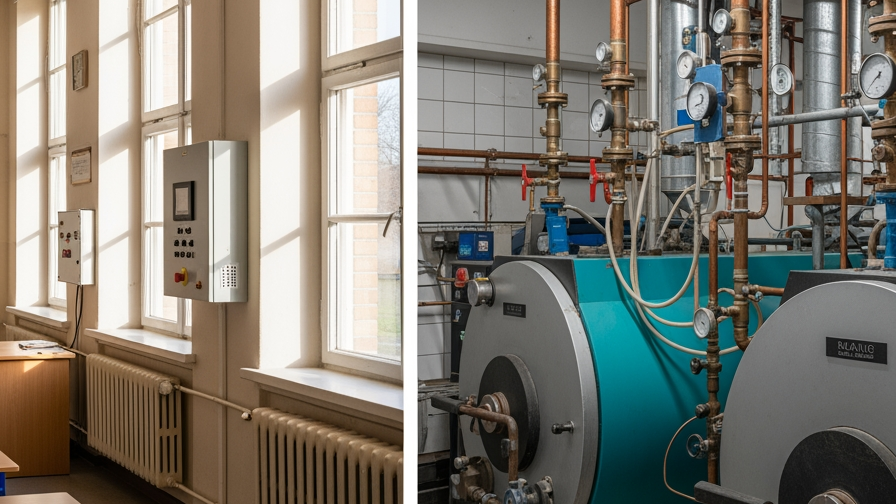
Schools operate under constraints most commercial buildings never face: tight budgets, inflexible schedules, and the non-negotiable requirement to keep hundreds of children comfortable and safe. A heating failure at 8 am on a January morning isn't an inconvenience; it's a safeguarding issue that forces difficult decisions within minutes.
Facility managers often inherit systems installed in the 1970s, running on obsolete parts and held together by institutional knowledge that walks out the door when the caretaker retires. The challenge isn't just fixing what breaks; it's building heating infrastructure that survives budget cycles, works across term breaks, and doesn't require a mechanical engineering degree to maintain.
Why School Heating Systems Fail Differently
Educational facilities experience heating demands that swing violently. Buildings sit empty for 13 weeks a year, then suddenly need to warm 30 classrooms simultaneously at 7 am on a Monday in February. This isn't a gradual load increase; it's thermal shock applied to ageing infrastructure.
The typical failure pattern: boilers that worked fine through October half-term fail within 48 hours of the Christmas restart. Expansion vessels corrode during shutdown periods. Pumps seize because they've sat idle. Temperature drops of 8°C in primary school classrooms can occur within 90 minutes of a circulation pump failure; cold enough to send children home and trigger Ofsted concerns about site management.
Most schools run heating systems at 70-80% capacity during occupied hours, leaving minimal headroom for component degradation. A commercial office might tolerate a 20% efficiency loss before anyone notices. In a school, that same loss means Year 2 classrooms at 16°C whilst the head teacher fields parent complaints.
Zoning Requirements That Actually Match How Schools Operate
The Victorian-era approach: one boiler, one thermostat, hope for the best; wastes roughly 30% of heating energy in a typical primary school. Different spaces need different strategies:
Classrooms require a rapid morning warm-up (15°C to 20°C in under 90 minutes), then stable temperatures during occupied hours. Modulating controls that anticipate occupancy rather than react to it deliver better results. Pre-heating starts at 6 am for an 8:30 am start, using weather compensation to adjust timing when outdoor temperatures drop.
Halls and gyms need flexibility. A hall used for assembly, lunch, and after-school clubs experiences four distinct thermal loads in a single day. Fixed-schedule heating fails here; you either overheat during setup periods or leave evening users freezing. Occupancy sensors linked to setback controls cut energy use by 35% in these spaces whilst improving comfort.
Administrative areas run different hours from teaching spaces. Heating the staff room to 21°C at 7 am when two people arrive makes sense. Heating it that way at 4 pm when it's empty doesn't. Separate zoning for admin spaces typically pays back investment within 18 months through reduced gas consumption.
Corridors and circulation spaces function as thermal buffers. Schools sometimes heat corridors to the same temperature as classrooms, wasting energy on transitional spaces that children occupy for 3 minutes per hour. Reducing corridor temperatures to 17°C causes zero comfort complaints and cuts whole-building heat loss by 12-15%.
Component Selection for Minimal Maintenance Access
School facility managers typically have 2-3 hours of accessible maintenance time per week during term. Everything else happens during holidays when parts availability becomes critical. This reality shapes every specification decision.
Boiler redundancy isn't a luxury; it's risk management. N+1 configurations work best where physically possible: if 400kW of heating capacity is needed, install two 250kW boilers rather than one 400kW unit. When one fails, partial heating continues whilst sourcing parts. Single-boiler schools face binary outcomes: everything works or nothing does.
Pump specifications need to account for extended idle periods. Standard circulation pumps develop seized bearings after 6-8 weeks of inactivity. Pumps with ceramic bearings and automatic exercise routines that run weekly during summer shutdown; 30-second cycles that prevent seizure without meaningful energy cost; prove more reliable. Grundfos offers pumps designed for these intermittent operation patterns.
Control systems must be maintainable by non-specialists. The sophisticated BMS that requires annual software licences and certified technicians for parameter changes creates vendor lock-in that schools can't afford. Modular controls with accessible interfaces; systems where a caretaker can adjust schedules or override zones without calling a controls engineer at £95 per hour; work better in educational settings. Honeywell and EPH Controls provide solutions suitable for non-specialist operation.
Expansion vessels and pressure management cause disproportionate failures in educational settings. Systems that sit at a temperature for weeks, then experience rapid heating cycles, stress expansion vessels beyond design parameters. Oversizing vessels by 30% compared to commercial equivalents and specifying annual pressure checks during summer maintenance windows reduces failure rates. Altecnic Ltd supplies expansion vessels rated for these demanding duty cycles.
Managing Heating Across Split Sites and Temporary Buildings
Many schools operate across disconnected buildings: Victorian main blocks, 1960s extensions, and modern temporary classrooms that became permanent fifteen years ago. Each structure has different thermal properties and heating requirements.
Temporary classroom blocks lose heat 2-3 times faster than main buildings. Thin walls and minimal insulation mean these spaces need disproportionate heating input. Rather than oversizing the central system, electric panel heaters with local controls work better for isolated temporary structures; lower capital cost, faster response, and no pipework vulnerabilities during ground frost.
Listed buildings restrict both internal modifications and external additions. Planning restrictions sometimes prevent modern boiler installations in original locations. The solution: compact high-efficiency units in approved locations, connected via upgraded pipework that uses existing service routes. One Victorian primary school achieved 28% energy reduction by replacing a floor-standing cast iron boiler with a wall-mounted condensing unit that fit in a former storage cupboard.
Federated schools managing multiple sites face parts standardisation challenges. Operating three buildings with three different boiler manufacturers means three sets of spare parts and three sets of maintenance knowledge. Standardising on components across sites during replacement cycles delivers efficiency gains from bulk purchasing and simplified training that typically exceed 15%. Heating and Plumbing World stocks a comprehensive range from manufacturers like Danfoss that support multi-site standardisation strategies.
Budget Cycles and Phased Replacement Strategies
Schools can't usually replace entire school heating systems in a single budget year. Capital funding comes in irregular chunks, often with 6-8 week spending deadlines that make proper planning difficult. This creates pressure to pursue quick fixes that compound long-term costs.
Phased replacement works when properly sequenced. Start with distribution; pipework, valves, and controls, before touching boilers. Schools sometimes replace boilers first, then discover corroded pipework can't handle improved flow rates from efficient pumps. The new boiler runs inefficiently because the distribution system creates resistance that the old equipment was sized to overcome.
Summer installation windows run 6-8 weeks maximum. Complex projects need pre-fabrication and staging. Prefabricating manifold assemblies and control panels off-site during term time, then installing during July-August when buildings are accessible, compresses timelines. One secondary school replaced heating across 12 buildings in a single summer break using this approach; work that would have taken 18 months if done during occupied periods.
Emergency repair budgets need protecting. Schools that spend their entire maintenance budgets on planned work have no buffer for failures. Holding 15-20% of annual heating budgets for reactive maintenance provides enough buffer to handle a boiler failure or major leak without triggering emergency funding requests that take weeks to approve.
Compliance Requirements Specific to Educational Settings
Schools face regulatory oversight that commercial buildings avoid. School heating solutions intersect with safeguarding, health and safety, and educational standards in ways that affect specification decisions.
Surface temperature limits prevent burns. Radiators and pipework accessible to children under eight must not exceed 43°C surface temperature. This requires either low-temperature systems (expensive to retrofit) or radiator guards (which reduce heat output by 15-20% and must be factored into sizing calculations). Slotted guards with 25mm standoff provide adequate protection whilst maintaining 88% of nominal output.
Legionella control in heating systems often gets overlooked; focus goes to water services. But any system with water storage (including expansion vessels and buffer tanks) needs temperature management. Flow temperatures above 60°C at calorifiers and return temperatures above 50°C prevent bacterial growth, and then blending valves at distribution points achieve safe output temperatures.
Ventilation integration matters more in schools than in most buildings. Post-COVID, ventilation rates increased significantly; many schools now operate with windows partially open year-round. Heating systems designed for sealed buildings can't maintain temperature when ventilation increases by 40%. Factoring 3-4 air changes per hour into heat loss calculations, roughly double pre-2020 standards, ensures adequate capacity.
Emergency shutdown accessibility must meet current safety standards. Boiler room emergency stops need to be accessible without entering spaces where danger exists, and clearly marked for emergency services. Original boiler room layouts sometimes buried emergency controls behind the equipment they're meant to isolate; configurations that fail current safety audits.
Performance Data From Educational Installations
Theory meets reality when school heating systems run through actual school schedules. Tracking performance across installations identifies what works beyond specification sheets.
One 450-pupil primary school reduced gas consumption by 34% after replacing a single oversized boiler with two modulating units and adding zone controls. The capital cost of £47,000 delivered annual savings of £6,200; a 7.6-year payback that improved as energy costs increased. More importantly, the school eliminated the three emergency callouts per year they'd averaged over the previous five years, saving roughly £1,400 annually in reactive maintenance.
A secondary school with split sites standardised on modular heating system components that maintenance staff could swap without specialist tools. Over three years, this reduced average repair time from 4.2 hours to 1.8 hours; the difference between losing a morning of heating versus a full day. Student absence rates on cold days dropped by 8% after the upgrade, though the school acknowledges multiple factors influence attendance.
A special educational needs school needed precise temperature control for students with specific medical requirements. Zone controls with ±0.5°C accuracy in medical rooms and sensory spaces, whilst running standard ±2°C control in circulation areas, met requirements. The mixed approach costs 18% less than specifying high-precision control throughout, whilst meeting actual needs.
Conclusion
School heating solutions succeed or fail based on how well they accommodate educational reality: limited budgets, seasonal occupancy, and the requirement to keep working regardless of maintenance access. The effective approach isn't necessarily the most sophisticated technology; it's the system that facility managers can actually maintain with available resources and time.
Reliability matters more than efficiency in educational settings, though the two aren't mutually exclusive. A system that runs at 88% efficiency but never fails serves students better than one that achieves 94% efficiency but requires specialist intervention three times per year. The goal is a heating infrastructure that becomes invisible; maintaining comfortable learning environments without consuming administrative attention or emergency budget allocations.
Schools replacing heating systems now will likely operate that equipment for 15-25 years. Specification decisions made under budget pressure in 2024 will affect students not yet born. That timeframe demands components that remain supportable, controls that stay accessible, and designs that accommodate changing educational needs without requiring complete replacement. The best school heating solution is the one that still works properly in 2040, maintained by staff who weren't there when it was installed.
For technical advice on selecting appropriate components for educational facilities, contact us to discuss your specific requirements.