

Hotel En-Suite Pressurisation: Booster Set Accumulator Vessel Sizing Calculations
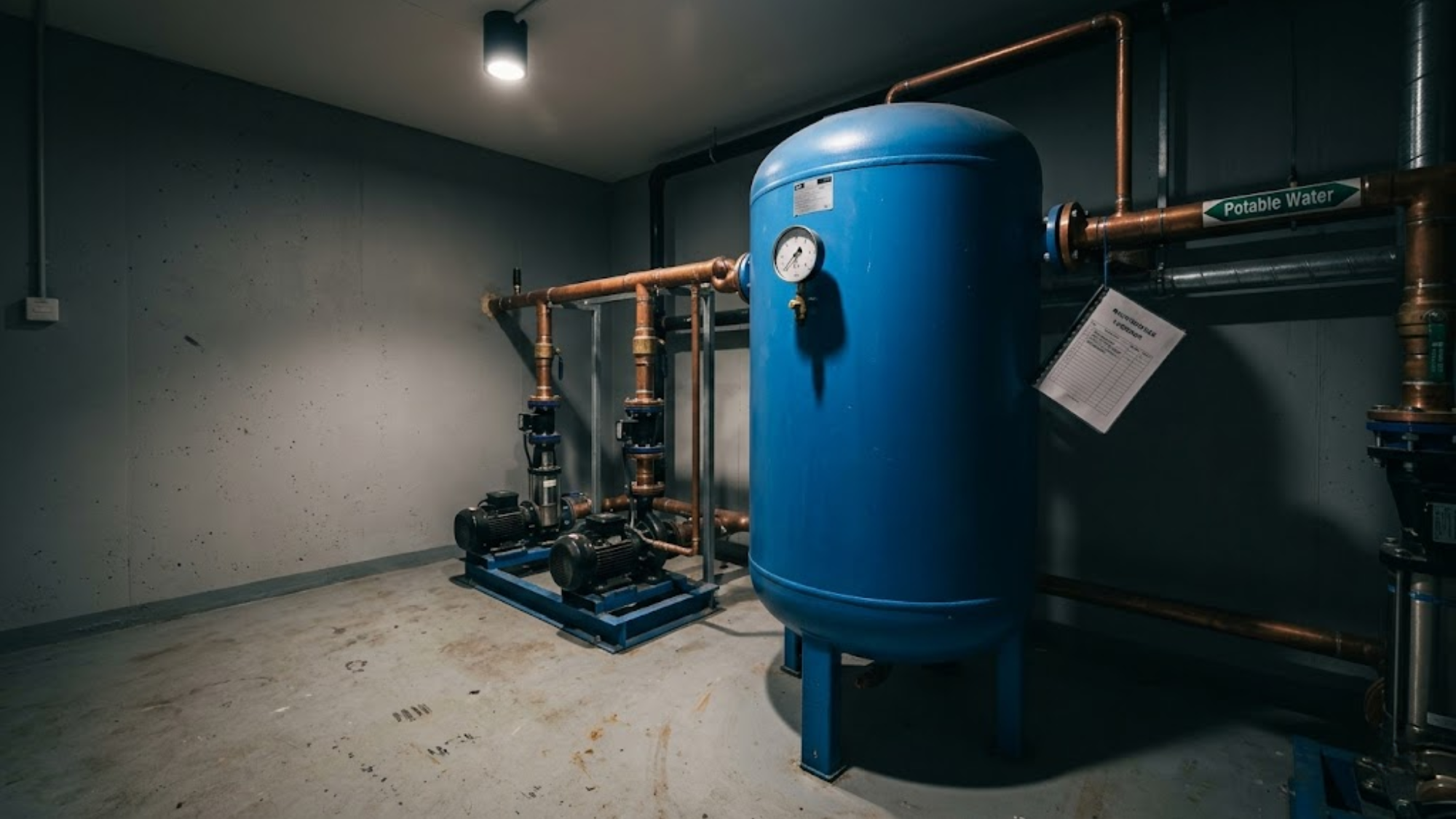
Guest complaints about weak shower pressure rank among the top five maintenance issues in hotels. When 40 rooms on upper floors experience simultaneous morning showers, undersized accumulator vessels cause pressure fluctuations that no amount of reactive maintenance can fix. The accumulator vessel in a booster set acts as a pressure buffer and reduces pump cycling. Size it incorrectly, and pumps cycle every 30 seconds during peak demand. Size it correctly, and the system maintains steady pressure while extending pump life by 60%.
Why Accumulator Vessel Sizing Matters
An accumulator vessel stores pressurised water that cushions the system when demand spikes. Without adequate storage capacity, pumps start and stop repeatedly, which is a phenomenon called short-cycling that destroys motor bearings and wastes energy.
Heating and Plumbing World provides the high-capacity components necessary to ensure building services can withstand these heavy demand cycles.
Hotels face unique challenges. Unlike office buildings with predictable water use patterns, hotels experience sharp demand peaks between 6–9 AM when guests shower simultaneously. A 200-room hotel can see 80 bathrooms in use within a 30-minute window. Short-cycling creates pressure fluctuations where guests experience temperature swings mid-shower, leading to equipment failure and significant energy waste.
Fundamental Accumulator Vessel Sizing Parameters
Four variables determine the result of your accumulator vessel sizing calculation. You must account for total system volume, the pressure differential between cut-in and cut-out, the usable drawdown capacity, and the maximum acceptable pump starts per hour.
Reliability is significantly improved when you specify a high-performance domestic shower pump as part of the wider booster assembly. To ensure the system handles the load, facilities teams should monitor the internal mechanics regularly to confirm they align with the system's static head requirements. Most manufacturers recommend limiting pump starts to 6–10 per hour for standard duty motors, as high-frequency starts generate heat that degrades winding insulation.
The Sizing Calculation Method
The basic formula for accumulator vessel sizing is V = (Q × t) / [(P2 - P1) / P0]. In this equation, V represents the vessel volume in litres, Q is the system flow rate, and t is the time between pump starts. It is essential to convert gauge pressures to absolute by adding 1 bar of atmospheric pressure.
When configuring the pump cut-in pressure, most engineers set it 0.5 bar above the static head requirement of the highest fixture. Monitoring the expansion vessel pressure is a vital step here to ensure that the pre-charge does not fall below the static head of the property. The pre-charge pressure should typically be set 0.5 bar below this cut-in point to ensure the bladder doesn't collapse entirely during drawdown capacity cycles.
Determining System Flow Rate
Calculate peak flow by counting simultaneous fixture use. Hotel bathroom fixtures typically consume 12 litres per minute for a shower, 6 for a basin, and 2 for a WC flush. For 40 rooms on a riser with 60% peak occupancy and 70% simultaneous use, you are looking at roughly 17 rooms in use at once.
This represents a substantial water flow capacity requirement. This figure is the foundation for accurate booster set pressurisation and ensures the vessel is large enough to handle the morning rush. Applying a diversity factor of 0.7 for systems serving more than 30 fixtures brings the actual peak flow to 238 litres per minute.
Working Through A Real Example
A 12-storey hotel requires 4.5 bar at top-floor showers. The booster set sits in the basement, adding 36 metres of static head. Total pressure needed, including a safety margin, is 9.1 bar. Set the cut-out pressure at 9.5 bar gauge and the pump cut-in pressure at 7.5 bar gauge.
For practical installation, you might specify a 3,000-litre vessel with a 2.0 bar pressure differential. This ensures the drawdown capacity is sufficient to limit pump starts to 15 per hour during peak demand. Using a booster shower pump within each en-suite can also help maintain local pressure and guest satisfaction.
I remember a project at a luxury city centre hotel where the original installer used residential-grade diversity factors. During their first fully booked weekend, the booster set was cycling every 12 seconds. By Sunday afternoon, the primary motor had burned out, leaving half the guests with no water. We had to install a temporary bypass just to get them through the week while we retrofitted the correctly sized accumulator. It is a costly lesson in why en-suite demand cannot be treated like a standard domestic flat.
Think of an accumulator vessel like the shock absorbers on a mountain bike. If you have no suspension, every bump in the road is felt by the rider and puts stress on the bike's frame. The accumulator absorbs the "bumps" or pressure spikes in the plumbing system, allowing the pumps to run smoothly without taking the full impact of every single tap being turned on or off.
Practical Adjustments For Real Systems
Theoretical calculations provide a starting point, but the pre-charge pressure tends to degrade by 0.2–0.3 bar annually. Bladder-type vessels must be checked quarterly. If the pre-charge pressure is not maintained, you lose up to 40% of the effective drawdown capacity.
Furthermore, for systems with extensive horizontal distribution, you can often reduce the calculated vessel size by 10% because the pipework itself acts as additional capacity. Ensuring you have a properly maintained expansion vessel for heating system and potable water loops is critical for overall building booster set pressurisation stability.
Verification After Installation
Commission the system by measuring actual pump cycling during peak occupancy. Install a data logger on the pump starter for 48 hours covering a weekend and weekday. Aim for 8–12 starts per hour. If cycling exceeds 15 starts, you must either increase the accumulator vessel sizing or raise the pressure differential.
Checking the pump cut-in pressure against the static head during these peaks will reveal any dynamic pressure drops. In some instances, having a reliable water pressure pump on standby or for bypass testing during commission can help verify the setpoints are robust enough for full occupancy.
Conclusion
Accurate accumulator vessel sizing determines whether a hotel booster set provides reliable pressure or generates constant maintenance headaches. The calculation balances vessel cost against pump longevity and guest comfort. Start with a peak flow analysis, set your pump cut-in pressure and pre-charge pressure with appropriate margins, and choose a differential that maximises drawdown capacity.
Properly sized systems eliminate guest complaints while extending equipment life beyond manufacturer ratings. If you are experiencing pressure fluctuations or need a technical review of your booster set pressurisation, contact our technical team to ensure your hotel's water system is engineered for reliability.