

Hotel Hot Water Demand: Sizing Your Commercial System
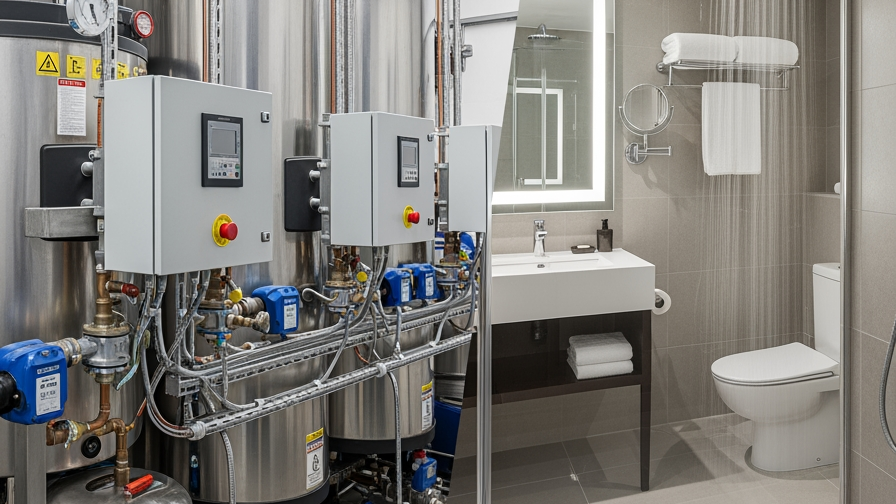
A 150-room hotel uses between 6,000 and 15,000 gallons of hot water daily. Get this calculation wrong, and you'll face guest complaints, energy waste, or both. We've sized hotel hot water systems for properties ranging from boutique establishments to 500-room chains, and the difference between adequate capacity and proper capacity often comes down to understanding peak demand patterns.
How Hotels Use Hot Water Differently Than Other Buildings
Hotels concentrate hot water demand into specific windows. Between 6-9 AM, 60-80% of occupied rooms run showers simultaneously. This creates demand spikes that dwarf typical commercial building usage.
A single hotel room generates 14-20 gallons of hot water demand per occupied night when you account for showers, bathroom sinks, and housekeeping. But that average misleads. During morning peak, a 100-room hotel at 80% occupancy needs to deliver 1,600-2,400 gallons within three hours, roughly 530-800 gallons per hour.
Compare this to office buildings, where hot water use spreads across 8-10 hours with minimal peak demand. Or restaurants, where dishwashing creates predictable cycles. Hotels face the challenge of residential-style usage patterns at a commercial scale.
Calculating Base Hot Water Demand
Start with occupancy data, not room count. A 200-room hotel running 65% occupancy requires a different capacity than the same property at 85% occupancy. We size systems for projected occupancy plus a 10-15% buffer for seasonal peaks.
Guest rooms: 14 gallons per occupied room per day (minimum) Luxury/suite properties: 20-25 gallons per occupied room per day Extended stay properties: 18-22 gallons per occupied room per day
These figures account for showers (10-12 gallons), bathroom sinks (2-3 gallons), and in-room amenities. They don't include common areas, kitchens, or laundry.
Fitness centre showers: 15-20 gallons per use. Pool/spa showers: 10-15 gallons per use Meeting room restrooms: 2-3 gallons per attendee. Restaurant kitchens: 1.5-2 gallons per meal served Laundry facilities: 2-3 gallons per pound of linen
A 150-room hotel at 75% occupancy (113 occupied rooms) needs approximately 1,600 gallons for guest rooms alone. Add 400 gallons for a 50-seat restaurant, 300 gallons for fitness facilities, and 800 gallons for on-site laundry, and you reach 3,100 gallons daily base demand.
Peak Hour Demand Drives System Size
Daily totals don't determine system capacity; peak hour demand does. The water heater must recover quickly enough to meet concentrated morning demand without depleting storage tanks.
Standard peak hour calculation: Take 40% of the daily demand as the peak hour requirement. For our 150-room example with 3,100 gallons daily demand, peak hour reaches 1,240 gallons. This assumes 40% of guests shower between 6-9 AM, creating the highest demand window.
Properties with business travellers often see sharper peaks, up to 50% of daily demand in a single hour. Resort properties with leisure guests distribute demand more evenly, sometimes dropping to 30-35% peak concentration.
Recovery rate requirements: A properly sized system recovers 70-80% of tank capacity within one hour. For continuous operation during peak periods, your commercial water heater needs input capacity matching peak hour demand minus storage contribution.
If you have 500 gallons of storage and need 1,240 gallons peak hour capacity, your heating system must deliver 740+ gallons per hour recovery (1,240 minus 500 gallons from storage).
Storage Tank Capacity vs. Heating Capacity
Many hotel hot water systems fail because they overemphasise storage while underestimating heating capacity. Large tanks without adequate heating input just delay the inevitable; you run out of hot water, it just happens 30 minutes later.
Storage Tank Sizing
We recommend storage capacity equal to 25-40% of daily demand for hotels with predictable occupancy patterns. Properties with variable occupancy or multiple demand peaks need 40-50% storage capacity.
Our 150-room example with 3,100 gallons daily demand needs 775-1,240 gallons of storage. Most installations use multiple tanks, typically 2-4 tanks of 250-500 gallons each, for redundancy and easier maintenance. Quality Kingspan cylinders and Gledhill storage solutions offer the reliability required for commercial hospitality applications.
Heating Input Calculation
Your heating system must deliver peak hour demand minus one-third of storage capacity. Using our example: 1,240 gallons peak demand minus 330 gallons (one-third of 1,000-gallon storage) equals 910 gallons per hour heating capacity required.
For gas-fired systems, this translates to approximately 1.1-1.3 million BTU/hour input (assuming 80-85% efficiency). Electric systems need 325-375 kW to match this recovery rate.
System Configuration Options
Central Storage With Multiple Heaters
This configuration uses 2-4 large storage tanks (250-500 gallons each) with multiple heating sources feeding them. We install this setup in 60% of hotel projects because it provides redundancy; if one heater fails, others maintain partial capacity.
The system includes commercial boiler components that feed heat exchangers or direct-fired heaters. Staging controls activate heaters based on demand, improving efficiency during low-occupancy periods.
Instantaneous/Tankless Systems
High-capacity tankless heaters work for properties with space constraints or extremely consistent occupancy. A 150-room hotel needs 3-5 instantaneous units rated at 199,000-250,000 BTU each, installed in parallel.
These systems eliminate standby losses but require careful sizing. Undersized installations can't meet peak demand. We only recommend tankless for properties where we can verify consistent inlet water temperature and adequate gas supply; many existing buildings lack the gas line capacity for multiple high-input heaters.
Hybrid Configurations
Combining storage tanks with instantaneous heaters provides the best performance for many properties. Base load comes from storage (handling 60-70% of demand), while tankless units boost capacity during peaks.
This approach reduces the size and cost of both components. Instead of 1,000 gallons of storage, you might use 600 gallons plus two 199,000 BTU tankless units.
Temperature Considerations and Legionella Prevention
Hotels must balance energy efficiency against safety. Water stored below 140°F creates Legionella risk. Water delivered above 120°F creates scalding risk.
Storage and Distribution Temperatures
We set storage tanks at 140-150°F to prevent bacterial growth. Thermostatic mixing valves then reduce the distribution temperature to 120°F at fixtures.
This requires additional calculations. Your system must heat water to 140°F, not 120°F. The temperature difference affects recovery time and heating capacity requirements. Heating water from a 60°F inlet to a 140°F storage requires 17% more energy than heating to 120°F.
Recirculation Systems
Hotels need continuous hot water at fixtures, which means recirculation pumps running 24/7. These systems return cooled water from distant fixtures back to heaters, maintaining temperature throughout the building. Grundfos and Lowara manufacture commercial-grade circulation pumps specifically designed for continuous-duty hotel applications.
Recirculation adds 15-25% to heating demand due to heat loss from piping. Proper insulation reduces this to 10-15%. We calculate pipe heat loss at 25-35 BTU per hour per linear foot for uninsulated copper lines, dropping to 8-12 BTU per hour per foot with 1-inch insulation.
Energy Source Selection
Natural Gas Systems
Gas-fired heaters cost £8,000-£15,000 per million BTU/hour capacity. Operating costs run £0.80-£1.20 per therm (100,000 BTU). For our 150-room example using 3,100 gallons daily, expect 350-450 therms daily, or £280-£540 per day in gas costs at current rates.
Gas systems heat water faster than electric, making them better suited for high-demand applications. They also cost less to operate in most markets.
Electric Systems
Electric heaters cost £3,000-£6,000 per 100 kW capacity but require substantial electrical infrastructure. Operating costs reach £0.10-£0.15 per kWh. Heating 3,100 gallons from 60°F to 140°F requires approximately 2,050 kWh, costing £205-£308 daily.
Electric makes sense where gas isn't available or where electrical rates are exceptionally low (some areas with hydroelectric power).
Heat Pump Water Heaters
Commercial heat pumps deliver 2.5-3.5 units of heat per unit of electricity consumed. They cost £25,000-£45,000 for hotel-scale installations but reduce operating costs by 60-70% compared to electric resistance heating.
Heat pumps work best in warm climates where they can extract heat from ambient air year-round. They struggle in cold climates and may need supplemental heating during winter.
Redundancy and Reliability Requirements
Hotels can't afford hot water system failures. We design every system with redundancy that maintains at least 60% capacity if any single component fails.
N+1 Heating Configuration
If calculations show you need three heaters to meet peak demand, install four. The system runs on three units during peaks, with the fourth providing backup. During normal demand, units rotate to equalise wear.
Multiple Storage Tanks
Four 250-gallon tanks provide better redundancy than one 1,000-gallon tank. If one tank needs maintenance or fails, you retain 75% storage capacity. Manifolded tanks also allow staged heating; you only heat the water volume needed for the current occupancy.
Monitoring and Controls
Modern systems include temperature sensors at multiple points, flow metres, and automated alerts. We install monitoring that notifies maintenance staff when tank temperatures drop below setpoints or when recovery rates slow.
This catches problems before guests notice. A failing heating element or scaled heat exchanger shows up as gradually increasing recovery time; the system still works, but efficiency drops. Early detection prevents complete failures.
Maintenance Impact on Capacity
A new system sized correctly becomes undersized within 2-3 years without proper maintenance. Scale buildup, sediment accumulation, and component wear reduce both storage capacity and heating efficiency.
Scale Formation
Hard water deposits reduce tank volume and insulate heating elements from water. A half-inch of scale buildup in a 500-gallon tank costs you 30-40 gallons of usable capacity and reduces heat transfer efficiency by 15-20%.
Regular water treatment prevents scale. We recommend water softeners for areas with hardness above 7 grains per gallon and chemical treatment for all commercial systems, regardless of water hardness.
Sediment Management
Hotels should flush storage tanks quarterly. Sediment settles at tank bottoms, displacing water volume and insulating tank floors from burner flames. A 500-gallon tank can lose 50-80 gallons of effective capacity to sediment within six months without flushing.
Anode Rod Replacement
Sacrificial anode rods protect tanks from corrosion but deplete over time. We replace anodes every 2-3 years in commercial installations. Neglected anodes lead to tank failure within 5-7 years instead of the expected 15-20 year lifespan.
Sizing for Future Expansion
Many hotels add rooms, restaurants, or amenities after initial construction. Smart system design accommodates 20-30% capacity growth without complete replacement.
Modular Design
Instead of maxing out a single boiler or heater, install multiple smaller units that can be supplemented later. A system using three 400,000 BTU heaters can add a fourth unit more easily than a system built around one 1.2 million BTU heater.
Oversized Infrastructure
Gas lines, electrical panels, and water supply piping should be sized for planned expansion. Upgrading these systems later costs 3-4 times more than installing adequate capacity initially.
Control System Capacity
Modern control systems should have unused zones and input channels for additional equipment. This costs almost nothing up front but saves thousands in control system replacement when you expand.
Making the Right Sizing Decision
Hotel hot water system sizing comes down to understanding peak demand, not average usage. A 150-room hotel needs 3,000-4,000 gallons daily, but the system must deliver 1,200-1,500 gallons during the three-hour morning peak. This requires 800-1,000 gallons per hour recovery capacity, typically achieved with 1.0-1.5 million BTU heating input and 750-1,200 gallons of storage.
The most reliable hotel hot water systems separate storage from heating capacity, use multiple smaller units instead of single large ones, and include redundancy that maintains 60-70% capacity during component failures. They also account for recirculation losses, maintain proper temperatures for Legionella prevention, and include monitoring that catches problems before they affect guests.
Undersizing saves money initially but costs far more in guest complaints, emergency repairs, and reputation damage. Oversizing wastes energy and capital. Proper sizing based on actual peak demand patterns, with appropriate redundancy and maintenance planning, delivers reliable hot water at the lowest total cost of ownership.
For comprehensive commercial hot water solutions, including cylinders, pumps, and system controls, Heating and Plumbing World stocks trusted brands like Stuart Turner booster systems and Danfoss valves. Should you need expert guidance on sizing your hotel's hot water system, get in touch with our technical team.