

How to Balance Your Radiator System for Even Heat Distribution
Uneven heating across radiators isn't just uncomfortable, it's a sign your system is working harder than it should. One room feels like a sauna whilst another stays stubbornly cold, and your boiler is cycling more frequently than necessary. The culprit? Poor hydraulic balance.
When water takes the path of least resistance through your heating system, radiators closest to the pump get all the flow whilst those furthest away barely get warm. balancing your radiator system redistributes flow correctly, ensuring every radiator receives its design flow rate. This improves comfort, reduces energy waste, and extends equipment life. For heating professionals and experienced DIYers, understanding that balancing your radiator system properly transforms an inefficient installation into a finely tuned setup is crucial.
Balancing isn't complicated, but it requires patience and the right approach. Get it right, and you'll eliminate cold spots, reduce boiler short-cycling, and potentially cut heating bills by 10-15%.
Why Radiator Systems Need Balancing
At Heating and Plumbing World, we've seen countless systems running at 60-70% efficiency simply because no one has touched the lockshield valves since installation. Water follows the easiest route through your pipework. In an unbalanced system, radiators with lower resistance, typically those closest to the pump or with larger pipe diameters, receive excessive flow. Meanwhile, distant radiators struggle to heat up because insufficient water reaches them.
Think of it like a motorway junction. If one exit has no traffic lights and another has three sets, most drivers take the clear route. Your heating system works the same way. Water flows preferentially through unrestricted paths unless you deliberately throttle the flow using lockshield valves.
This imbalance creates several problems:
- Temperature differentials between rooms of 5-8°C or more.
- Increased pump energy consumption as the system works harder to overcome uneven resistance.
- Boiler short-cycling because some radiators heat too quickly whilst others lag.
- Reduced system efficiency as return temperatures stay higher than optimal.
- Occupant complaints and constant thermostat adjustments.
Modern condensing boilers rely on low return temperatures (below 54°C) for maximum efficiency. When some radiators receive excessive flow, they return water hotter than necessary, preventing the boiler from condensing properly. Balancing reduces return temperatures by ensuring each radiator has adequate dwell time to transfer heat.
Understanding Lockshield and TRV Functions
Every radiator has two valves. The thermostatic radiator valves (TRVs) or wheelhead valves control room temperature by modulating flow based on air temperature. The lockshield valve, located on the opposite end, sets the maximum flow rate through that radiator.
The lockshield is your balancing tool. It's typically covered with a plastic cap and requires an adjustable spanner or lockshield key to turn. By partially closing lockshields on radiators closer to the pump, you increase resistance, forcing more water to distant radiators.
Here's a common mistake: opening all lockshields fully and relying on TRVs to control temperature. TRVs can't compensate for poor hydraulic balance. They'll modulate what little flow reaches them, but if a radiator only gets 30% of its design flow rate, it'll never heat properly regardless of the TRV setting.
Proper balancing means setting lockshields so each radiator receives its design flow rate when the system is running at full capacity. TRVs then fine-tune room temperatures without fighting against fundamental flow imbalances.
Essential Tools for Balancing Radiators
You don't need expensive equipment to balance a domestic radiator heating system properly. Here's what you'll need:
- Lockshield valve key or adjustable spanner to adjust lockshield valves.
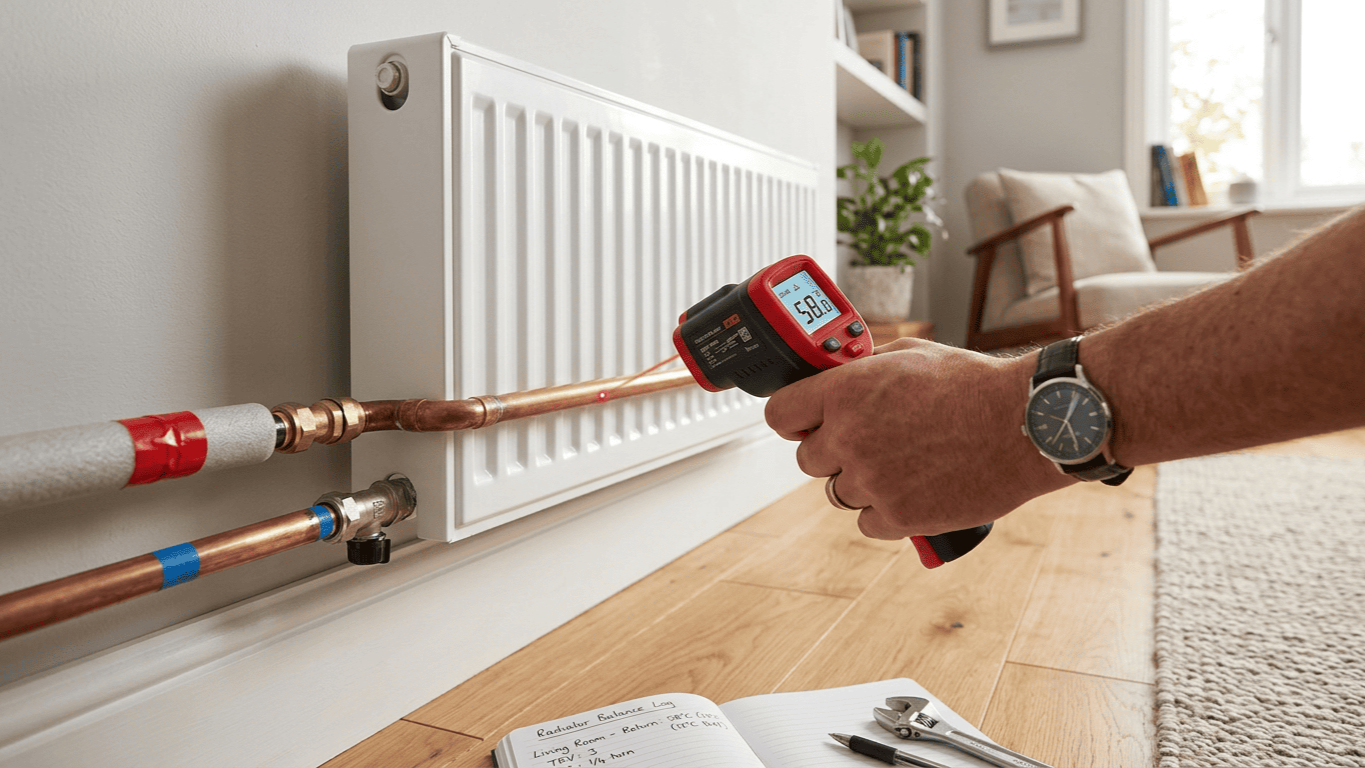
- Two digital thermometers or an infrared thermometer to measure flow and return temperatures accurately.
- Notepad and pen to record valve positions and temperature readings.
- Screwdriver to remove lockshield caps.
- Patience: balancing takes 2-4 hours for a typical domestic setup.
For commercial systems or precise diagnostics, a differential pressure gauge and ultrasonic flow meters provide accurate measurements, but they aren't necessary for most residential work. Temperature-based balancing delivers excellent results when done methodically.
Brands offer diagnostic tools for larger installations, but a £20 infrared thermometer handles most domestic balancing jobs perfectly well.
Step-by-Step Radiator Balancing Process
Balancing requires a systematic approach. Rushing through it or skipping steps wastes time and delivers poor results. Here's the proven method:
Turn off all radiators Start with every TRV set to maximum and every lockshield valve fully closed (turn clockwise until snug, but don't force them). This gives you a known starting point. If your radiators have manual radiator valves instead of TRVs, open them fully. Wait 30 minutes for the system to cool down. You need stable starting conditions for accurate measurements.
Identify your radiator order Map your system from the boiler outward. The radiator closest to the pump is first. The furthest radiator, often upstairs at the opposite end of the house, is last. In systems with multiple loops or zones, identify the order within each zone. Draw a simple schematic if needed. This order determines your balancing sequence.
Open the first radiator fully Open the lockshield valve on your closest radiator completely (typically 10-12 quarter turns anticlockwise). This radiator becomes your reference point. It'll receive maximum flow, and you'll restrict others relative to it. Fire up the boiler and let the system reach operating temperature. The first radiator should heat quickly and evenly from top to bottom.
Measure the temperature drop Once the first radiator is fully hot, measure temperatures at the flow pipe (where water enters) and return pipe (where it exits). You're aiming for a temperature differential of 10-12°C between flow and return. If the flow measures 70°C, the return should read 58-60°C. This indicates proper dwell time. If the differential is too small (say, 5°C), water is moving too quickly. For your first radiator running fully open, you'll typically see an 8-12°C drop.
Balance subsequent radiators Move to the second-closest radiator. Open its lockshield valve fully and let it heat up. Measure the difference. It'll likely be lower than your target because it's receiving less flow than the first radiator. Gradually close the lockshield on the first radiator by quarter-turns, waiting 10-15 minutes between adjustments. As you restrict the first radiator, more flow diverts to the second. Your goal is to achieve a 10-12°C temperature differential on both radiators.
Continue this iterative process through every radiator. By the time you reach the last radiator, you might only need minor tweaks to the earlier ones.
Record lockshield positions As you achieve correct balance on each radiator, note how many turns open the lockshield is. Count from fully closed. Mark these on your schematic. These numbers are invaluable if someone accidentally disturbs a valve or you need to drain the system for maintenance.
Troubleshooting Common Balancing Issues
On a recent job in a five-bedroom detached house, the homeowner was convinced their five-year-old boiler was undersized because the master bedroom never got warm. After spending an hour properly balancing your radiator system, that cold radiator was outputting full heat. It wasn't a boiler issue at all, just poor flow distribution that had been neglected during the initial installation.
Even with careful work, you'll encounter situations that don't follow the textbook. Here's how to handle them:
Radiator won't reach target differential: If you've fully opened a lockshield and the radiator still shows a 15-20°C temperature drop, it's receiving insufficient flow. This suggests undersized pipework, a partially blocked radiator, or excessive system resistance elsewhere. Check for sludge buildup, consider a system flush, or verify pipe sizing.
Last radiator stays cold: If your furthest radiator barely warms even with its lockshield fully open and others restricted, your pump may lack sufficient head pressure. Older systems with 15mm microbore pipework particularly struggle. Upgrading to higher-head pumps or installing a secondary circulation pump might be necessary.
Radiators heat unevenly: If the top of a radiator is hot but the bottom stays cold, you've got trapped air or sludge. Bleed the radiator and consider a chemical flush if the problem persists.
System pressure drops during balancing: Adjusting valves can release trapped air, causing pressure loss. Top up the system to the correct pressure and bleed radiators again. If pressure continues dropping, you've got a leak that needs addressing.
Differential temperatures won't stabilise: Fluctuating readings suggest the boiler is cycling on and off, preventing steady-state conditions. Increase the boiler's minimum output setting if possible, or temporarily disable the room thermostat to maintain continuous firing during balancing.
The Role of System Design in Balance
Whilst balancing improves any system, good design minimises the need for extreme lockshield adjustments. Properly sized pipework, correctly specified pumps, and thoughtful radiator placement create systems that balance easily.
Pipe sizing matters: Systems using 10mm or 15mm microbore to multiple radiators create high resistance, making balance difficult. Where possible, use 22mm or 28mm primary pipework with 15mm branches to individual radiators.
Pump selection affects balance: An oversized pump forces too much water through low-resistance paths, exacerbating imbalance. An undersized pump can't deliver adequate flow to distant radiators. Modern variable-speed heating pumps automatically adjust output to match system demand, maintaining better balance across varying loads.
Reverse return pipework: In commercial installations or large domestic systems, reverse return piping ensures every radiator has similar total pipe length, naturally equalising resistance. The first radiator on the flow becomes the last on the return.
Maintaining System Balance Over Time
Once balanced, your system should maintain performance for years. However, certain events require re-balancing:
After system modifications: Adding or removing radiators changes system hydraulics. Re-balance after any alterations. If you've added a radiator to an existing circuit, you'll need to restrict flow to other radiators on that circuit to accommodate the new one.
Following a system flush: Chemical cleaning or power flushing removes sludge that was affecting flow patterns. After flushing, the system's hydraulic characteristics change, often improving flow to previously restricted radiators.
Pump replacement: If you have had to replace your circulator due to pump problems, the new pump with different characteristics requires re-balancing. Even replacing like-for-like, subtle performance variations between pumps affect balance.
Annual heating checks: During routine maintenance, verify that lockshield positions haven't changed. A quick check of the first and last radiators reveals whether the system has maintained balance.
Advanced Balancing Techniques
For complex systems or when temperature-based balancing proves difficult, advanced methods deliver more precise results:
Differential pressure balancing: Using a differential pressure gauge across each radiator's valves provides direct flow measurement. Set lockshields to achieve equal pressure drops across all radiators. This method is faster and more accurate than temperature measurement but requires specialised equipment.
Flow meters: ultrasonic flow meters measure actual flow rates through each radiator. Calculate design flow rates based on radiator output and system temperatures, then adjust lockshields to match. This is the gold standard for commercial installations.
Automatic balancing valves: Products from leading manufacturers incorporate pressure-independent heating controls, maintaining constant flow regardless of system pressure fluctuations. These cost more than standard lockshields but eliminate manual balancing automatically.
The Impact of Proper Balance on Efficiency
A balanced system isn't just about comfort, it directly affects running costs. When radiators receive correct flow rates, several efficiency gains occur:
Lower return temperatures: Proper dwell time in each radiator drops return temperatures by 3-5°C compared to unbalanced systems. This allows condensing boilers to operate in condensing mode more often, improving seasonal efficiency by 5-10% through optimal hydraulic balance.
Reduced pump energy: Balanced systems require less pump pressure to overcome resistance, reducing electrical consumption. Whilst pump energy is small compared to boiler fuel use, it's still worth 50-100 kWh annually in a typical home.
Eliminated overheating: Rooms with excessive flow no longer overheat, reducing the tendency to open windows or turn down thermostats prematurely.
Conclusion
Correctly balancing your radiator system transforms heating performance without spending money on new equipment. The process requires patience and systematic work, but the results: even heat distribution, improved efficiency, and enhanced comfort, absolutely justify the effort.
Start by understanding your system layout and gathering basic tools. Work methodically from the closest radiator outward, adjusting lockshields to achieve the optimal temperature differential across each circuit. Record your settings for future reference.
If you encounter persistent issues or extreme lockshield adjustments, investigate underlying issues or poor system design. For complex systems or if you're uncomfortable with the process, a qualified heating engineer can balance your system professionally in a single visit.
Combined with quality components from reliable suppliers, a balanced system delivers reliable, efficient heating throughout its service life. For further guidance on system optimisation, contact us to get expert advice tailored to your specific requirements.