

How to Reduce Heating Bills by 20% Without Replacing Your Boiler
Most heating engineers will tell you the same thing: you don't need a brand-new boiler to slash your energy bills. In fact, the majority of systems we see running inefficiently aren't failing because the boiler's old; they're failing because the system around it hasn't been maintained, balanced, or optimised properly.
A 20% reduction in heating costs is entirely achievable through targeted improvements to your existing setup. We're talking about system balancing, control upgrades, insulation, and hydraulic efficiency-practical interventions that pay for themselves within a couple of heating seasons. These aren't theoretical gains. They're the kind of savings we see on commercial and domestic projects when engineers take the time to diagnose what's actually wrong rather than just quoting for a replacement.
Think of your heating system like a car engine. You wouldn't buy a new car just because the tyres were flat and the oil was dirty, yet people replace perfectly functional boilers every day for the same reason. A simple tune-up of the existing components is often all it takes to restore peak performance.
Let's walk through the most effective ways to reduce heating bills without the expense and disruption of a full boiler swap.
Balance Your Radiators Properly
An unbalanced system is one of the most common causes of wasted energy. When radiators aren't balanced, some rooms overheat while others stay cold. The boiler runs longer than it needs to, cycling on and off inefficiently, and fuel gets burned for no real benefit.
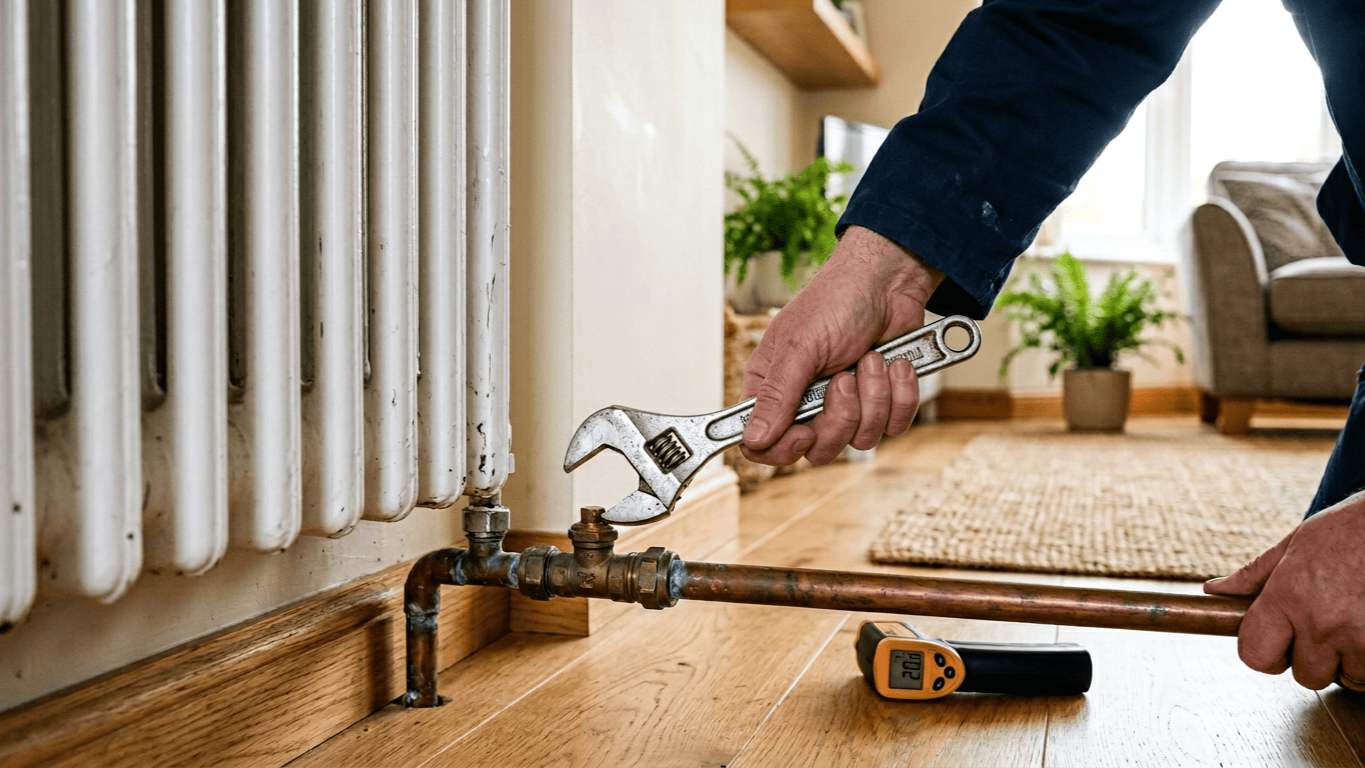
Balancing means adjusting the radiator lockshield valve on each unit so that hot water distributes evenly across the system. It isn't complicated, but it does require patience and a decent thermometer.
- Turn off all radiators except the one nearest the boiler.
- Open that radiator lockshield valve fully and let it heat up.
- Move to the next radiator in the circuit and open its valve slightly less.
- Aim for a 12°C temperature drop between the flow and return pipes.
This ensures every radiator gets the right amount of heat without starving those at the end of the run. A properly balanced system reduces boiler cycling, cuts gas consumption, and improves comfort.
Upgrade To Smart Thermostatic Controls
Old-school mechanical timers and single-zone thermostats are crude tools. They treat your entire home as one thermal zone, which means you're heating rooms you're not using and wasting energy on a massive scale.
Modern smart radiator valves and programmable room thermostats give you precise control over when and where heat is delivered. If you're heating a four-bedroom house but three of those bedrooms sit empty most of the day, you're paying to heat air nobody's breathing. With intelligent controls, you can keep those rooms at 16°C while maintaining 21°C in the living areas you actually use.
OpenTherm-compatible controls are worth the investment if your boiler supports them. OpenTherm allows the thermostat to modulate the boiler's output based on actual demand rather than running it flat-out every time it fires. This is called weather compensation or load compensation, and it's one of the most effective ways to improve efficiency without touching the boiler itself.
Insulate Pipework And Reduce Heat Loss
Uninsulated heating pipes are a silent budget drain. Every metre of bare copper pipe running through an unheated space-loft, garage, or basement-radiates heat you've paid for into areas you don't need to warm.
Pipe insulation is cheap, easy to fit, and pays for itself within months. Use Class O foam pipe lagging with a wall thickness of at least 25mm for pipes in unheated areas. Don't forget the primary flow and return pipes near the boiler. We've measured surface temperatures above 70°C on uninsulated primaries; that's heat that should be going to your radiators, not warming the boiler cupboard.
While you're at it, check your cylinder insulation. Modern hot water cylinders come with factory-fitted foam insulation, but older copper cylinders often have inadequate jackets or none at all. An 80mm British Standard insulation jacket costs less than £20 and can save £50-£70 per year on hot water heating.
If you've got a modern unvented hot water cylinder with good insulation, you can also reduce the boiler's hot water flow temperature slightly, improving condensing efficiency when the boiler fires for hot water. Just make sure you're not creating a Legionella risk.
Fit A Smart Circulator Pump
Most domestic heating systems still run on old fixed-speed circulators. These pumps run at full power regardless of demand, consuming electricity and creating unnecessary flow velocities that increase system noise and wear.
A smart circulator pump from Grundfos or Lowara adjusts its output to match the system's actual requirements. When TRVs close down and demand drops, the pump slows, reducing electrical consumption. High-efficiency heating pumps don't just save on your electric bill; the real benefit comes from improved system balance and reduced boiler short-cycling.
The smart circulator pump ensures that water isn't forced through a system with half its radiators closed, which helps the boiler operate more efficiently and burns less gas. Installation is straightforward for any qualified engineer if the connection sizes match.
Bleed Radiators And Purge System Air
Trapped air in a heating system reduces heat transfer, causes cold spots, and forces the boiler to work harder. It's one of the simplest problems to fix, yet it's often overlooked.
Bleed every radiator at least once a year, ideally before the heating season starts. Check the heating system pressure afterwards and top up if needed; most modern boilers need to run between 1.0 and 1.5 bar. If you're constantly bleeding radiators, you've likely got a bigger problem, such as a leaking pump seal.
A water circulation pump that's forced to work against air pockets will eventually fail prematurely. Ensuring the hydraulic circuit is purged of non-condensable gases is a foundational step to reduce heating bills and protect your investment in high-quality hardware.
Check And Service The Expansion Vessel
The expansion vessel absorbs the pressure increase that happens when water heats up and expands. If the vessel fails or loses its pre-charge, the heating system pressure becomes unstable, the pressure relief valve starts weeping, and the boiler short-cycles.
On a recent project, a homeowner was told they needed a £3,000 boiler replacement because their system kept losing pressure. After a ten-minute inspection, I found the expansion vessel was simply flat. We recharged the pre-charge to 1.0 bar and the system has worked perfectly ever since. It's a classic example of why diagnostics matter more than replacement quotes.
If no water appears when you press the Schrader valve, check the air pressure with a tyre gauge. If the diaphragm has failed, replacement vessels from leading brands are affordable and straightforward to fit.
Reduce Flow Temperature For Condensing Efficiency
Here's something most homeowners don't realise: condensing boilers only condense when the return temperature drops below 54°C. If your system's running too hot, you're losing the efficiency gains that condensing technology is supposed to deliver.
Lowering the flow temperature to 60-65°C forces the boiler into condensing mode more often, improving condensing boiler efficiency by 5-8%. Your radiators will still get hot; they'll just take slightly longer to warm up. This works best on systems with oversized radiators or underfloor heating.
Maintain And Clean The Boiler Annually
A poorly maintained boiler burns more fuel and breaks down more often. Annual servicing isn't just about safety; it's about efficiency. A boiler running with a dirty heat exchanger or incorrect gas pressure can lose 10-15% efficiency. That's money up the flue.
If your system's old and hasn't been chemically cleaned in years, consider a powerflush or chemical cleanse. Heating and Plumbing World stocks everything from smart controls to expansion vessels and high-efficiency circulators to help you get the most out of your heating system.
Conclusion
Cutting your heating bills by 20% doesn't require a new boiler. It requires a systematic approach to improving how your existing system operates-balancing radiators, upgrading controls, insulating pipework, and eliminating inefficiencies that waste energy every day.
These aren't expensive interventions. Most cost less than £500 in total, and many you can do yourself with basic tools and a bit of patience. The payback period is typically one to three years, after which the savings go straight into your pocket.
If you're ready to start your system optimisation, please contact our technical team for expert advice on the best components for your specific heating setup.