

Identifying Common Boiler Error Codes for Vaillant and Baxi
When your boiler throws up an error code at 6am on a January morning, you need answers fast, not a manual written in technical jargon. Boiler faults don't wait for convenient moments. Understanding what those flashing Vaillant boiler error codes mean can be the difference between a quick reset and an expensive callout.
Vaillant and Baxi dominate the UK domestic heating market, and for good reason. Both manufacturers build reliable, efficient boilers that serve millions of homes. But even the best equipment develops faults. When it does, the boiler's diagnostic system communicates the problem through error codes displayed on the front panel.
This guide decodes the most common Vaillant boiler error codes you'll encounter, alongside Baxi's equivalents. It explains what has actually gone wrong, and crucially, tells you whether you can fix it yourself or need to call a Gas Safe registered engineer. We'll also cover the underlying causes, preventative measures, and when a recurring fault signals a bigger system problem.
Why Boiler Error Codes Matter
Modern condensing boilers are sophisticated pieces of kit. They monitor dozens of parameters every second: water pressure, flame detection, flue gas temperature, and flow rates. When something falls outside safe operating limits, the boiler locks out to prevent damage or danger.
Think of a boiler's printed circuit board like the engine management system in a modern van. It takes readings from dozens of sensors. If just one reading, like air pressure or water flow, doesn't match what the map says it should be, the system cuts the power to protect the engine. Error codes aren't there to frustrate you. They're diagnostic shortcuts that tell an engineer exactly where to look, potentially saving hours of troubleshooting. For homeowners, they provide an early warning of developing issues before they escalate into complete system failures.
Understanding these codes also helps you communicate effectively with your heating engineer. When you call and say you have an F75 fault, that's infinitely more useful than simply saying the boiler isn't working.
Common Vaillant Boiler Error Codes
Vaillant uses alphanumeric codes, typically an F followed by numbers, to indicate specific faults. Here are the Vaillant boiler error codes you're most likely to encounter.
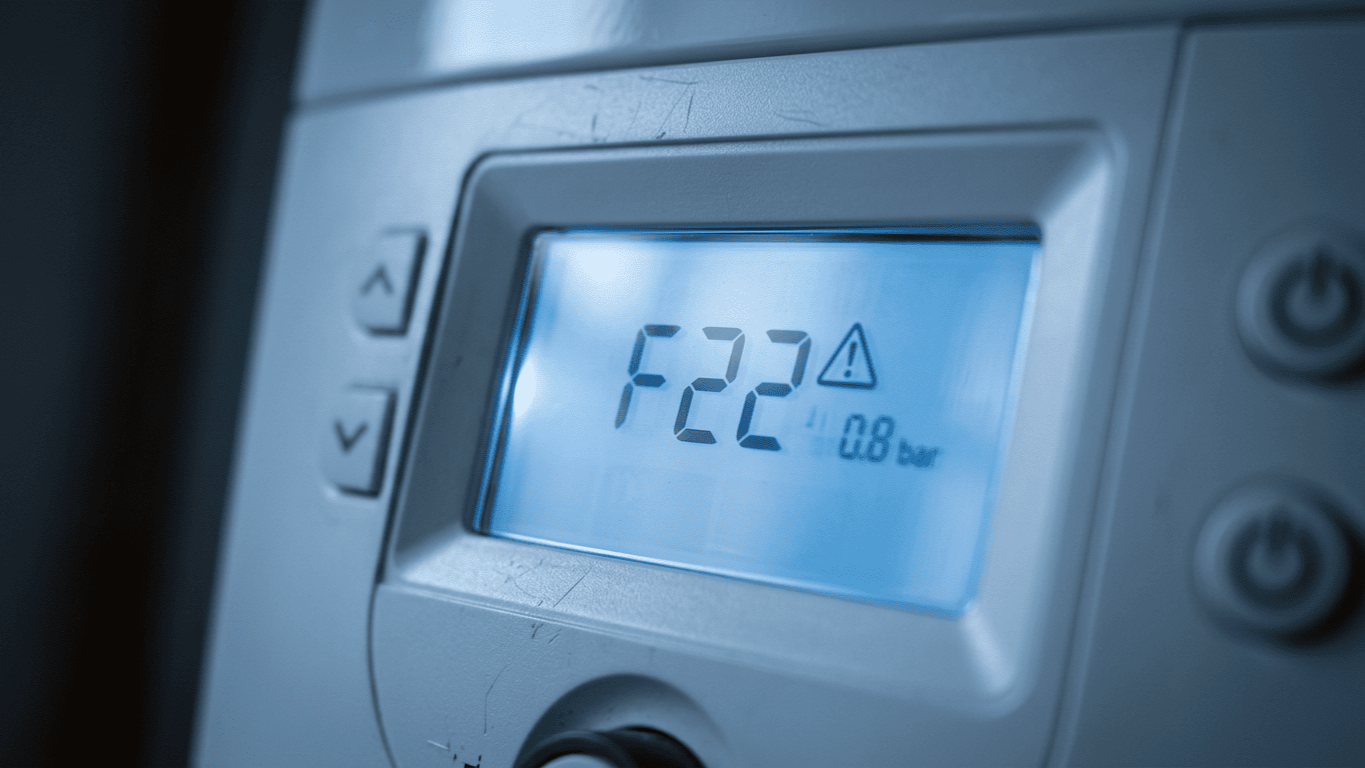
F22: Low Water Pressure
This is the most common Vaillant fault by a considerable margin. F22 appears when system pressure drops below 0.3 bar, which prevents the boiler from firing safely. This usually stems from small leaks in radiators, pipework, bleeding radiators without topping up the system, or a faulty pressure relief valve that's weeping.
It can also be caused by natural water loss through evaporation over time or a failing expansion vessel. Can you fix it yourself? Usually, yes. Locate the filling loop, typically two flexible braided hoses with valves underneath the boiler. Open both valves slowly and watch the pressure gauge on the boiler front panel. You want it between 1.0 and 1.5 bar when the system is cold. Close both valves firmly once you've reached the correct pressure.
If the pressure drops again within days, you've got a leak somewhere. Check radiator valves, pipe joints in the airing cupboard, and look for damp patches on ceilings below radiators. Persistent pressure loss needs a Gas Safe engineer to investigate properly.
F28 and F29: Ignition Failures
F28 means the boiler has tried to ignite and failed. F29 indicates the flame has been detected but then lost during operation. Both point to combustion problems, such as gas supply issues, a faulty ignition electrode, or gas valve problems.
It might also indicate a blocked burner, a restricted primary heat exchanger, or incorrect gas pressure at the meter. Check your gas supply first. Does the hob work? If other gas appliances work fine, the problem is boiler-specific. Try resetting the boiler by pressing the reset button for three seconds. If it fires up and runs without fault, you might have had a temporary glitch.
If F28 or F29 returns immediately or within hours, call an engineer. Ignition faults involve gas and combustion, which is not DIY territory. An engineer will test gas pressure, check the ignition electrode gap (which should be 3-4mm), inspect the burner for debris, and verify the gas valve is operating correctly.
F75: Pressure Sensor or Pump Fault
F75 typically indicates the boiler has detected a pressure sensor issue or the pump isn't circulating water properly. This fault is more complex than F22 because it isn't about system pressure, it's about the boiler's ability to detect and respond to pressure changes.
Causes include a faulty pressure sensor, air trapped in the pump, or general pump problems like seizing. It can also point to a blocked primary heat exchanger restricting flow, or a wiring fault to the sensor.
This needs professional diagnosis. An engineer will test the pressure sensor with a multimeter, check the pump is running at the correct speed, and verify there's no blockage restricting flow. On older boilers, replacing the pressure sensor often resolves this fault permanently.
F62: Gas Valve Fault
F62 signals a problem with the gas valve's closing mechanism. The boiler has detected the valve isn't responding correctly to control signals.
This is a safety-critical component. The gas valve controls fuel supply to the burner, and if it's not operating reliably, the boiler shuts down as a precaution. Don't attempt DIY fixes. This requires a Gas Safe engineer to test the valve electrically, check the printed circuit board outputs, and replace the valve if necessary.
Common Baxi Boiler Error Codes
Baxi uses a different coding system, typically E followed by numbers, and their fault patterns differ slightly from Vaillant's.
E133: Low System Pressure
This is Baxi's equivalent of Vaillant's F22. E133 appears when pressure drops below the minimum operating level, usually around 0.5 bar depending on the model. The fix is identical to the Vaillant process. Use the filling loop to repressurise the system to 1.0-1.5 bar. Baxi filling loops are often integrated into the boiler casing rather than external flexible hoses, but the principle is the same.
If you're topping up weekly, you've definitely got a leak. Check the pressure relief valve discharge pipe outside. If it's dripping, the valve is passing and needs replacing. Otherwise, methodically inspect every radiator valve, pump gland, visible pipe joint, and verify the expansion vessel pressure.
E110: Overheating
E110 means the boiler has detected excessive temperature in the heat exchanger and shut down to prevent damage. This fault indicates water isn't circulating properly, so heat is building up in the boiler rather than being distributed around the system.
This can be caused by pump failure, a blocked heat exchanger, or closed radiator valves preventing circulation. It might also be a faulty thermistor giving false temperature readings.
Reset the boiler. If it runs briefly then locks out with E110 again, turn it off and call an engineer. Continuing to reset an overheating boiler can damage components permanently.
E125: Pressure Sensor Error
E125 indicates the printed circuit board isn't receiving correct signals from the pressure sensor. This could be the sensor itself, the wiring, or the board's input circuitry.
Similar to Vaillant's F75, this needs professional diagnosis. The engineer will test sensor resistance, check connections for corrosion, and verify the signals are being processed correctly.
E160: Fan Fault
E160 appears when the boiler's fan isn't running at the correct speed or the air pressure switch isn't detecting adequate airflow. The fan extracts combustion gases and creates the negative pressure needed for safe operation. Fan and flue faults are safety-critical. The fan ensures toxic combustion gases are expelled safely outside. Never attempt DIY repairs on fan or flue components.
When Error Codes Point to Bigger Problems
Sometimes, recurring faults indicate underlying system issues rather than simple component failures. Last winter, I attended a callout where a homeowner had spent two days repeatedly resetting their boiler over an intermittent F28 fault. When I arrived, it took exactly three minutes to find the culprit: the gas meter outside had iced over and tripped the regulator. They'd been convinced the boiler was ruined, but it was just doing its job by locking out safely.
Repeated pressure loss often points to a pressure relief valve passing intermittently, micro-leaks in the primary heat exchanger, or expansion vessel failure. Cycling ignition faults might indicate a partial blockage in the burner.
If your boiler is throwing multiple different error codes, this often points to a printed circuit board fault rather than multiple simultaneous component failures. The control board is the brain of the boiler, and when it starts malfunctioning, you get erratic behaviour and false error codes. When this happens, sourcing the right boiler spares quickly becomes essential.
Preventative Measures That Actually Work
You can significantly reduce error code frequency through straightforward maintenance practices. At Heating and Plumbing World, we always stress that prevention is cheaper than cure.
Annual servicing isn't just a legal requirement for rental properties. It's preventative maintenance that catches developing faults before they cause breakdowns. A service includes safety checks, ensuring your carbon monoxide detector honeywell unit isn't your only line of defence against poor combustion.
System inhibitor protects against internal corrosion and sludge formation. Most systems need inhibitor topping up every 5-7 years. Without it, you'll get accelerated corrosion, pump seizures, and radiator cold spots. Additionally, your expansion vessel pressure should match the system static pressure, preventing fluctuations that cause lockouts.
What Engineers Actually Look For
When you call out an engineer for a fault code, they interrogate the boiler's fault history. Most modern boilers store the last 10-20 faults with timestamps. This reveals patterns you might not have noticed. If the boiler has had three F28 faults in the past month but you only called about today's, that is significant diagnostic information.
Combustion analysis using a flue gas analyser tells them if the boiler is burning efficiently. High CO readings indicate incomplete combustion. Electrical testing with a multimeter verifies components like the ignition electrode are receiving correct voltages.
When to Replace Rather Than Repair
Error codes sometimes signal it's time to consider replacement rather than ongoing repairs. Age matters significantly. Boilers over 12-15 years old are approaching the end of their economic life. Finding boiler replacement parts becomes harder, efficiency has degraded, and you're repairing obsolete technology.
Repair costs should be weighed against replacement. If you're facing a £600 repair on a 12-year-old boiler, investing that money in a new unit makes more financial sense. You'll get reliable operation, improved efficiency, and a manufacturer's warranty. That said, don't let anyone talk you into unnecessary replacement. A 6-year-old boiler with a faulty pump needs a new pump, not a whole new system.
Conclusion
Boiler error codes are your heating system's way of communicating specific problems before they escalate into complete failures. Understanding what Vaillant boiler error codes like F22, F28, and F75 actually mean empowers you to respond appropriately.
Some faults you can resolve yourself. Low pressure lockouts are usually straightforward to fix with the filling loop. Anything involving gas, combustion, or safety-critical components requires a Gas Safe registered engineer. Knowing the difference prevents wasted time and potentially dangerous DIY attempts.
For replacement parts, technical support, or advice on boiler maintenance, Heating and Plumbing World stocks components for all major manufacturers. Our trade-focused range covers both Vaillant and Baxi systems comprehensively.
If you need specific technical queries answered about fault diagnosis or system design, please contact our technical team for expert guidance.