

Installing Grab Rails and Wall-Hung Basins for Doc M Compliance
Compliance with Doc M regulations requires absolute engineering accuracy during any commercial washroom fit-out. If you get the heights or structural supports wrong, you severely compromise user safety and guarantee a failed building control inspection. Facility managers and installers share a strict legal duty under the Equality Act 2010. You must provide safe, highly functional environments for vulnerable users.
When installing grab rails alongside accessible sanitaryware, every single measurement must perfectly align with the established legal framework. You cannot simply estimate the placement of these critical physical components. Taking the time to properly assess the wall structures, pipework routes, and spatial layout ensures the finished bathroom is entirely safe and fully compliant.
Understanding Doc M Spatial Requirements
Before you drill a single hole into the tiles, you must verify the exact physical dimensions of the room. A compliant accessible washroom must provide a perfectly clear wheelchair turning circle of exactly 1500mm. You can't allow basins, exposed pipework, or bulky radiators to infringe on this highly critical transfer space.
If the room is too tight, users simply won't be able to manoeuvre their wheelchairs safely alongside the fixtures. The team at Heating and Plumbing World provides a range of compliant commercial sanitaryware designed specifically to maximise these tight spatial footprints safely. Beyond physical space, the regulations also mandate strict visual contrast rules to assist visually impaired users.
You must carefully calculate the Light Reflectance Value (LRV) between the finished wall surfaces and the physical hardware. The rails and the toilet seat must offer a minimum contrast difference of exactly 30 points against the background tiling. Getting the LRV contrast wrong is one of the most common reasons a newly fitted washroom fails its initial accessibility inspection.
Specifying and Installing Grab Rails
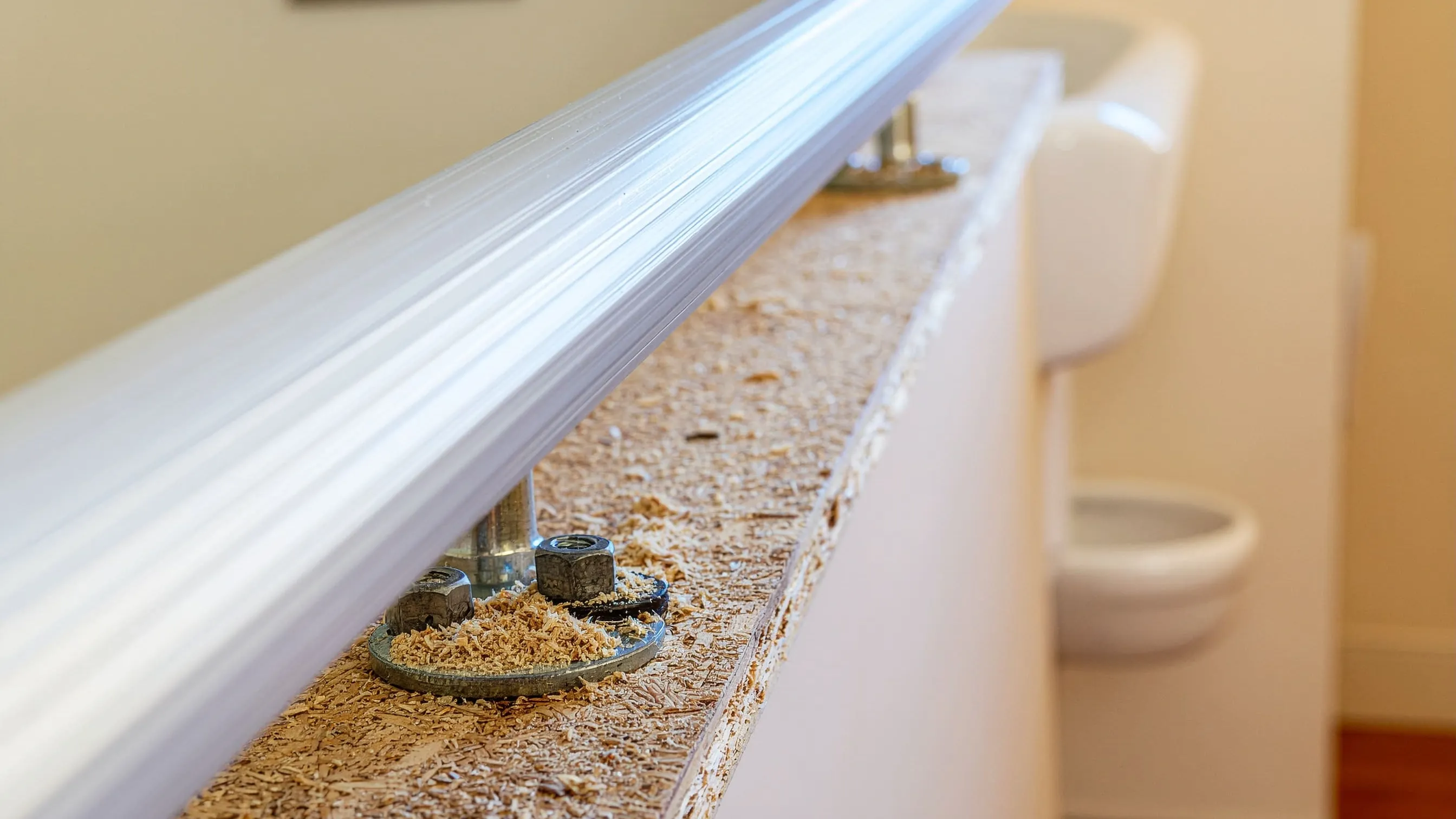
When selecting hardware for visually impaired or elderly users, the physical texture of the rail is just as critical as its colour. Specifying a fluted grip surface actively prevents wet hands from slipping during a heavy, completely unassisted transfer. A fluted grip surface provides essential mechanical friction, giving vulnerable users total confidence when supporting their entire body weight on the fixture.
Alongside the fixed wall rails, a compliant layout absolutely requires a hinged drop-down support mounted on the open transfer side of the toilet pan. This hinged drop-down support must project exactly 800mm from the rear wall. It must extend just beyond the 750mm projection of the accessible toilet pan to provide adequate leverage.
When the user finishes their transfer, they can easily lift the hinged drop-down support back out of the way to create more space. You must ensure the folding mechanism features a smooth, dampening drop action so it doesn't slam down unexpectedly and cause a physical injury. Installing grab rails that feature highly durable powder-coated aluminium or stainless steel construction guarantees the hardware survives decades of intense commercial abuse.
Structural Integrity and Wall Preparation
Standard 12.5mm plasterboard simply cannot withstand the immense dynamic loads placed on accessibility hardware. You must integrate solid load-bearing wall fixings behind the finished wall surface long before you even begin the tiling process. If you ignore this critical structural requirement, the installation is inherently dangerous.
Think of load-bearing wall fixings exactly like the deep concrete foundations of a bridge. Just as a bridge relies entirely on its hidden foundations to carry the weight of heavy traffic safely, the rail relies entirely on hidden timber noggins to support the user. Similarly, if you are mounting the heavy metal casing of an LST radiator heating system into solid blockwork, you must use heavy-duty masonry anchors to achieve the required structural strength.
On a recent public library refurbishment, the contractor used standard hollow wall anchors on a weak stud partition for the main support rails to save time. Within a month, a heavy user slipped and grabbed the rail, which immediately ripped clean out of the wall and caused a severe injury. We had to completely strip the partition wall and install heavy 18mm structural plywood blocking to rectify the highly dangerous mistake. Installing grab rails correctly the very first time completely prevents this kind of catastrophic, expensive failure.
Wall-Hung Basin Heights and Positioning
The accessible finger rinse basin must sit exactly 720mm to 740mm above the finished floor level to accommodate a seated wheelchair user comfortably. The physical area underneath the basin must remain completely clear of any scalding hazards or physical obstructions that could trap a user's legs. To achieve this safely, utilising a reliable semi-pedestal trap concealment keeps the immediate area clean and entirely protected.
A properly fitted semi-pedestal trap concealment completely hides the hot plumbing connections from highly vulnerable skin. This ensures strict compliance with Part M regulations regarding thermal protection. When running the hot and cold feeds to these tight basin locations, reliable plastic pipe systems allow you to navigate the structural framework easily and discretely.
You must always use TMV3 certified thermostatic blending valves to cap the basin water delivery at a perfectly safe 41 degrees Celsius. It is absolutely crucial to place these blending valves as close to the tap tails as physically possible. This placement eliminates warm water dead legs and actively prevents Legionella bacteria from breeding inside the walls.
Secure Pipework Connections
Commercial washrooms frequently require transitioning from older, legacy plumbing materials to modern feeds. You can connect these newly routed feeds safely using robust copper pipe joiners hidden securely behind the sanitaryware. Using highly secure push-fit technology ensures a leak-free transition without ever needing a dangerous hot works permit in a confined public building.
Keeping the connections watertight is critical, as a slow leak behind a Doc M pack can ruin the structural plywood blocking holding the rails. You must ensure all concealed pipe runs are perfectly clipped and supported to prevent water hammer vibration. A vibrating pipe will quickly loosen a joint and cause severe internal water damage.
Mechanical Boosting for Water Pressure
Older commercial properties frequently suffer from low dynamic water pressure that completely ruins the performance of accessible sequential mixer taps. If the incoming mains feed is poor, installing water pump equipment guarantees a steady, compliant flow rate directly at the basin. A dedicated booster ensures the user gets a highly reliable, comfortable spray every single time.
Sequential mixer taps require a specific minimum pressure to open their internal ceramic discs properly. If the pressure drops below 0.5 bar, the water will simply dribble out, making thorough hand washing completely impossible for a disabled user. Stabilising the property's incoming mains delivery is a fundamental step before signing off on the washroom.
Localised Hot Water Generation
In large commercial buildings, the main boiler is often located hundreds of metres away from the accessible washroom. If the property lacks a central loop, connecting dedicated water heating systems directly in the washroom ceiling void prevents dangerous dead legs in the pipework. This localised hot water generation is incredibly efficient and highly reliable.
This setup ensures the feed arrives at the basin instantly. It prevents the vulnerable user from sitting and shivering while waiting for the water to slowly warm up. Generating the heat locally also drastically reduces the overall energy consumption of the building by eliminating massive heat loss across long pipe runs.
Washroom Temperature Control
The broader washroom environment also requires careful temperature control to keep vulnerable users completely comfortable. When specifying the washroom's heating plumbing supplies, integrating commercial-grade thermostatic radiator valves guarantees the room stays warm. These valves must be highly durable to withstand daily public use without breaking.
You must ensure that any radiators placed in an accessible washroom feature low surface temperature technology. This specialised casing prevents accidental contact burn hazards if a wheelchair user brushes against the unit during a complex transfer. This ensures the environment is both physically comfortable and strictly legally compliant.
Conclusion
Successfully installing grab rails and accessible basins demands rigorous attention to both structural engineering and precise spatial planning. You must ensure the hardware provides a highly secure fluted grip surface anchored perfectly into heavy-duty load-bearing wall fixings. Keeping the basin pipework totally safe with a solid semi-pedestal trap concealment prevents thermal injuries and guarantees full physical accessibility.
Never compromise on the structural blocking or the strict Doc M hardware projections. A hinged drop-down support must always be fitted perfectly level and tested for smooth operation. If you need assistance selecting the correct hardware or calculating the spatial requirements for your next commercial retrofit, get expert advice from our dedicated technical support team today.