

Kingspan AUSI180ERP Twin Coil Cylinder: Solar Thermal Integration Guide
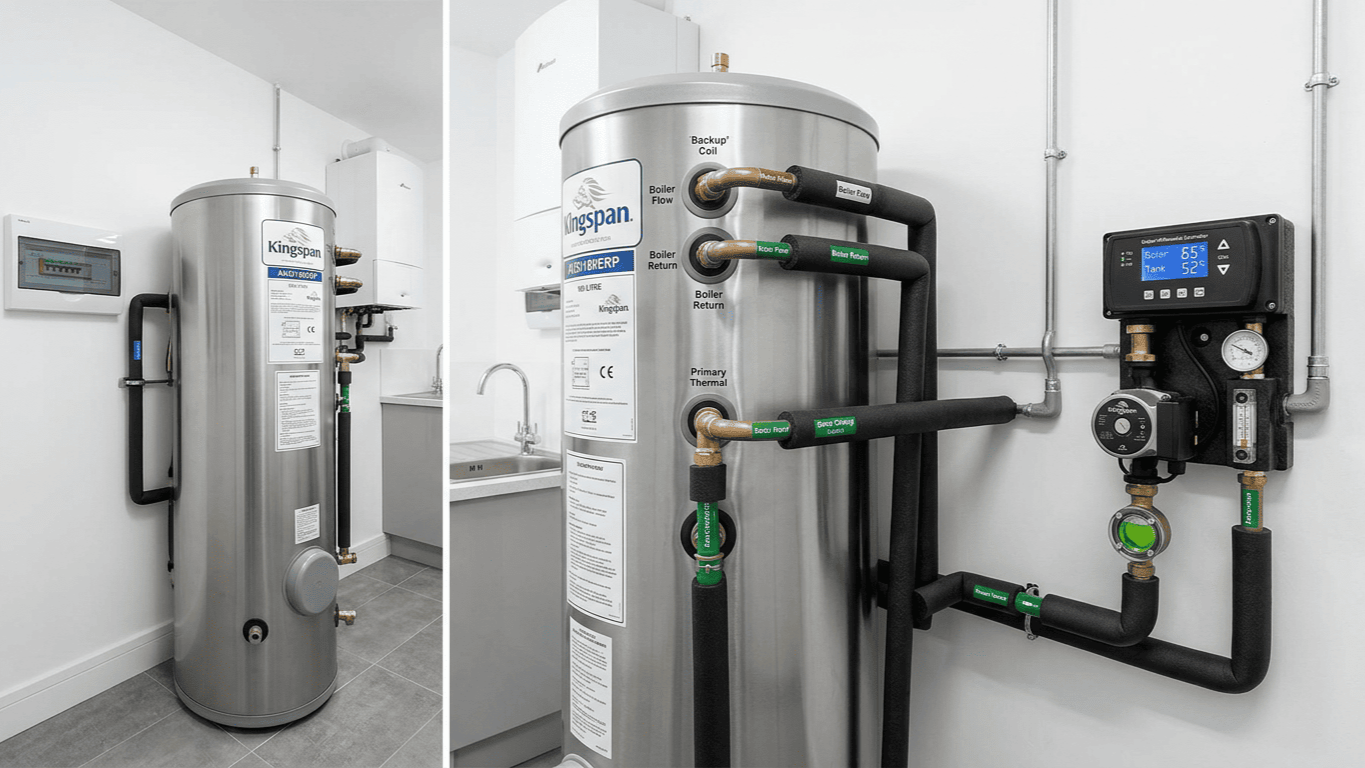
Solar thermal systems promise lower energy bills and reduced carbon footprints, but only if you pair them with the right cylinder. The Kingspan AUSI180ERP twin coil cylinder sits at the heart of many effective solar heating installations across the UK, offering 180 litres of storage capacity and two dedicated heat exchange coils. One coil connects to your solar panels, while the other connects to your conventional boiler or heat pump.
Getting this integration wrong costs you efficiency, wastes renewable energy, and can leave you with lukewarm water when you need it most. Industry experience across dozens of these systems proves the difference between a properly configured setup and a rushed job shows up immediately in performance data and customer satisfaction.
The Kingspan AUSI180ERP twin coil cylinder isn't just another hot water tank. It's a thermal battery designed to capture solar energy when the sun shines and release it when your household needs hot water. Understanding how to connect, position, and optimise this cylinder determines whether your solar investment pays back in five years or fifteen.
Why Twin Coil Cylinders Matter For Solar Integration
Single coil cylinders force you to choose between solar heating and conventional backup. That's fine until you hit three cloudy days in November and your family runs out of hot water. Twin coil systems solve this by dedicating the lower coil to solar thermal collectors and the upper coil to your existing heating system.
Think of a twin coil cylinder like a hybrid car's powertrain. The solar coil is your battery, doing the heavy lifting whenever conditions allow, while the upper coil acts as your combustion engine, seamlessly taking over only when the primary renewable source runs low. Using high-quality components from Heating and Plumbing World ensures this handover is perfectly reliable.
This arrangement isn't arbitrary. Solar-heated water enters through the bottom coil because solar thermal systems work best with lower flow temperatures. Your boiler or heat pump connects to the upper coil, providing rapid top-up heating when solar input drops. The stratification effect keeps hotter water at the top of the cylinder where your taps draw from it. The 180-litre capacity suits most three to four-person households. Smaller cylinders can't store enough solar energy to cover evening demand, while oversized units lose too much heat overnight. Engineers calculate capacity based on daily hot water usage patterns, not guesswork.
Solar Coil Configuration And Connection Points
The lower solar coil spans roughly the bottom third of the cylinder volume. This positioning allows solar-heated fluid to warm the maximum volume of stored water, even when collector temperatures barely reach 50°C to 60°C on overcast days. Connect your solar primary circuit to the 22mm compression fittings marked for the lower coil on your hot water storage cylinder.
Flow direction matters more than most installers realise. Solar fluid should enter at the bottom coil inlet and exit from the outlet, creating a smooth circulation path through the heat exchanger. Reversing this flow reduces heat transfer efficiency by up to 15%.
The upper coil handles conventional heating input from your primary heat source. Installers must pay careful attention to the cylinder thermostat wiring to ensure this upper coil only activates when absolutely necessary. Proper cylinder thermostat wiring prevents your backup heating from firing when solar has already heated the water sufficiently. Set the target temperature to 60°C for Legionella control, but configure your solar controller to prioritise solar heating up to 55°C first. Accurate cylinder thermostat wiring ensures this process operates flawlessly.
Optimising Solar Primary Circuit Design
The pipework connecting your roof collectors to the cylinder determines how much solar energy actually reaches your stored water. Systems can lose 30% of collected heat in poorly insulated pipe runs or badly designed circulation loops. Keeping pipe runs short and direct between the collectors and the primary solar pump station is essential.
Solar primary circuits operate at higher temperatures and pressures than conventional heating systems. Summer stagnation conditions can push fluid temperatures above 120°C when the cylinder reaches maximum temperature and circulation stops. You must install a properly sized expansion vessel to accommodate this thermal expansion safely without venting.
A dedicated solar pump station manages the fluid delivery. The pump must overcome the head loss through the collector array, pipework, and cylinder coil. Specifying a variable speed solar pump saves electricity and reduces wear, but fixed-speed units work fine if sized correctly.
Integrating Conventional Backup Heating
Your boiler or heat pump connection to the upper coil provides essential backup during low solar periods. The control strategy determines whether this backup complements your solar system or undermines it by firing unnecessarily.
On a recent domestic installation, an apprentice wired the backup boiler to trigger whenever the tank dropped below 55°C. By mid-morning, the boiler was doing all the work before the sun even hit the panels. Reconfiguring the controls to delay the backup until evening saved the customer nearly 40% on their gas bill.
This is exactly why staged control strategies that give solar priority are vital. A separate timer only enables backup heating during specific windows, such as early morning before peak usage or in the evening when solar input has ended. This applies whether you are using a heat pump or a standard combi boiler. The Kingspan AUSI180ERP twin coil cylinder works beautifully with these delayed staging controls.
Positioning And Installation Considerations
Where you locate the cylinder affects both system performance and installation cost. Ideally, position the unit as close as possible to your main hot water draw-off points. Every metre of distribution pipework costs you heat and water waste during the wait for hot water to arrive.
The cylinder must sit vertically and level for proper stratification, much like a carefully balanced thermal store. Installations where the cylinder tilts just 5 degrees off vertical create circulation currents that mix the hot and cold layers. Use a spirit level during installation and shim the base if necessary.
Ensure you have a minimum 500mm clearance around the cylinder for maintenance access, particularly to reach the variable speed solar pump connections and the temperature relief valves.
Solar Controller Setup And Optimisation
Your solar controller acts as the brain of the system, deciding when to circulate fluid through the collectors and cylinder coil. Basic differential controllers simply compare collector and cylinder temperatures, running the primary solar pump station when the difference exceeds a set threshold.
More sophisticated controllers offer collector array temperature limiting to prevent stagnation damage and multi-zone support. Setting the correct differential threshold depends on the power consumption of the equipment on your solar pump station. Setting the threshold too low means the water circulation pump runs without a net energy gain.
The cylinder sensor location dramatically affects controller performance. Position it about two-thirds up the cylinder height, not at the very bottom where it only reads the coldest water. This placement gives the controller accurate information about the main stored water temperature without triggering on the small volume of highly heated water at the very top.
Maximising Solar Contribution Throughout The Year
Solar thermal systems deliver different performance across the seasons. Summer often provides more hot water than you can use, while winter requires careful optimisation to capture every available watt. The Kingspan AUSI180ERP twin coil cylinder is designed to help you adapt to these changing conditions.
During summer months, your solar system might heat the entire cylinder to 60°C by mid-afternoon. Without intervention, the collectors stagnate. Modern controllers handle this by running occasional cooling cycles via the variable speed solar pump to prevent damage while dumping excess heat. Adjusting hot water usage patterns improves annual solar contribution. Running dishwashers and washing machines in the late afternoon uses solar-heated water directly, rather than storing it overnight with inevitable heat loss.
Winter presents different challenges. With weaker sun angles and shorter days, you might only achieve 30°C cylinder temperatures from solar alone. The upper coil backup becomes essential, but smart control prevents wasting the solar contribution you did capture.
Maintenance And Long-Term Performance
Solar thermal systems require less maintenance than conventional boilers, but they aren't fit-and-forget appliances. The Kingspan AUSI180ERP twin coil cylinder itself needs minimal attention, mainly checking the temperature relief valve annually and inspecting visible pipework.
The solar primary circuit demands far more care. The glycol heat transfer fluid degrades over time, losing frost protection and becoming acidic. Engineers must test the glycol heat transfer fluid condition every three years using pH strips and refractometer readings. Degraded glycol heat transfer fluid damages pumps, valves, and heat exchangers rapidly, so timely replacement saves money and prevents catastrophic failure.
The twin coil design offers excellent diagnostic advantages. If your backup heating works normally but solar contribution drops to zero, the fault lies in the solar circuit. If both coils underperform, check for cylinder issues like scale buildup or failed thermostats.
Conclusion
The Kingspan AUSI180ERP twin coil cylinder delivers highly reliable solar thermal integration when properly specified, installed, and controlled. Its dual coil design separates solar collection from conventional backup, maximising renewable energy use while maintaining consistent hot water availability.
Success depends on correct primary circuit design, appropriate backup heating control, and strategic positioning. The difference between a 40% and a 70% annual solar fraction often comes down to precise details: sensor placement, pipe insulation, and control thresholds. If you require assistance sizing the primary circuit or specifying the correct complementary components for your project, contact our support team to ensure your system performs flawlessly from day one.