

Kingspan Horizontal vs Vertical Unvented: Loft Space Installation Considerations
When evaluating Kingspan horizontal vs vertical unvented models, most loft installations fail because installers treat cylinder orientation as an afterthought. They measure the space, order the unit, and only discover the clearance problem when the delivery arrives.
We've replaced dozens of incorrectly specified cylinders over the years. The pattern is always the same. Someone assumed a horizontal cylinder would fit in a tight loft without checking the actual access route or servicing requirements. As a result, this leads to wasted money, frustrated customers, and a second installation job that could've been avoided.
Kingspan's unvented cylinders come in both horizontal and vertical configurations for good reason. Each orientation solves specific spatial challenges. However, choosing the wrong one creates problems that compound over time. This isn't about preference. Instead, it's about matching the cylinder design to your actual installation constraints.
Why Cylinder Orientation Matters More Than You Think
At Heating and Plumbing World, we know the difference between horizontal and vertical cylinders extends far beyond how they sit in your loft space. Each design affects heat stratification, servicing access, pipe routing, and long-term maintenance costs.
Understanding heat stratification is vital because hot water naturally rises. In horizontal cylinders, heat stratification works differently. It creates a temperature gradient along the length of the unit rather than from top to bottom. For most domestic applications, this makes minimal practical difference. You'll still get hot water when you need it.
Think of heat stratification in a vertical cylinder like a perfectly poured pint of stout. The distinct layers remain separate and stable. Conversely, a horizontal cylinder is more like a settling pond where the temperature gradient spreads out lengthwise. Vertical cylinders maintain clearer temperature layers. The hottest water sits at the top, while cooler water sits at the bottom. This can improve efficiency slightly in homes with irregular usage patterns. However, we're talking about marginal gains of perhaps 2-3% in ideal conditions.
The real differentiator is access and maintenance. A horizontal cylinder installed in a loft with 900mm headroom might seem like a clever space-saving solution. That is, until you need to replace the immersion heater or service the expansion vessel. We've seen engineers lying flat on joists, working at awkward angles for jobs that should take 20 minutes with proper access.
Measuring Your Loft Space Correctly
Before you even look at cylinder specifications, you need three measurements to assess Kingspan horizontal vs vertical unvented options. None of them should be approximations. Here is what you need to check:
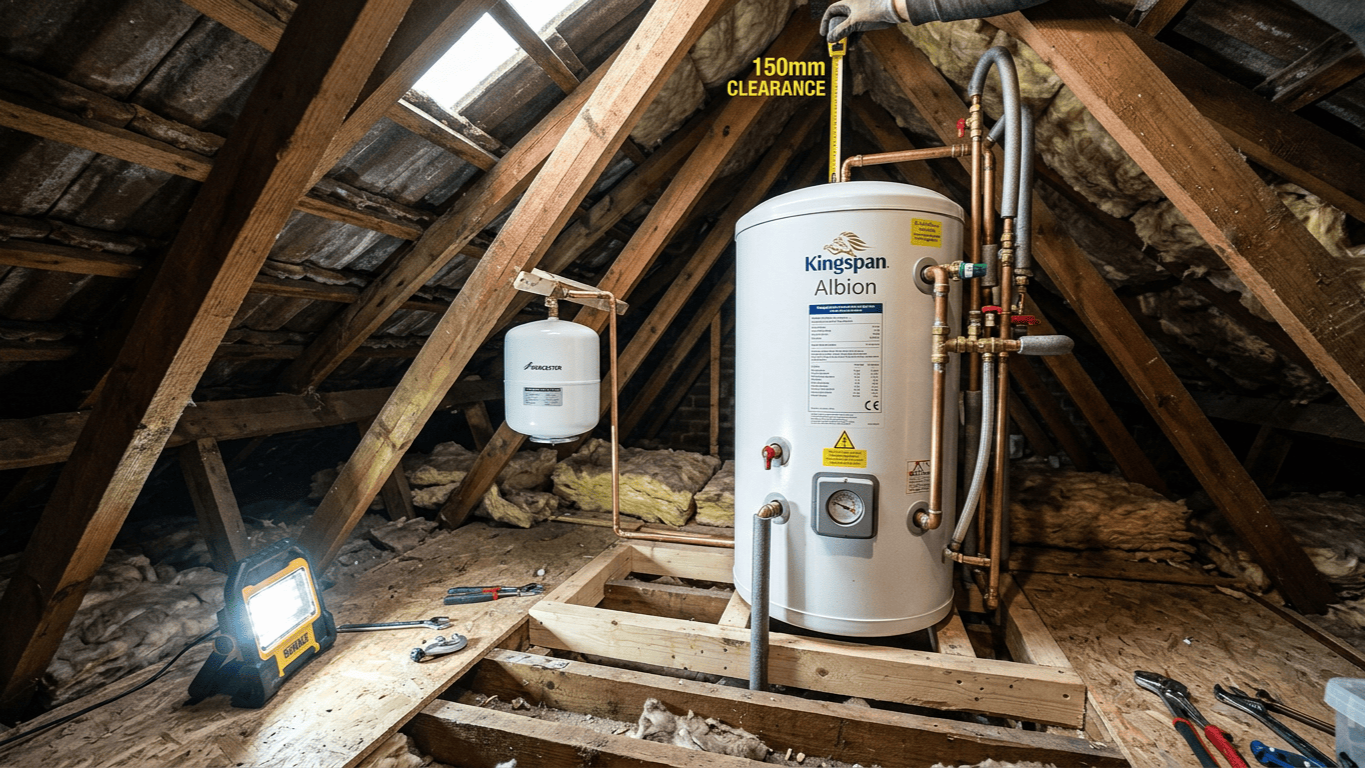
- Measure the clear height: Start from the top of the joists to the lowest point of the roof structure. Don't measure to the underside of the felt. Instead, measure to any collar ties, purlins, or structural members that will restrict vertical space. Add 150mm to the height of a Kingspan 150-litre unvented cylinder for clearance. This tells you if a vertical unit is viable.
- Measure the access route: This catches out more installers than any other factor. You must account for your loft hatch opening, stairwell width, and any tight corners. The cylinder needs to navigate all of these. A 1200mm vertical cylinder won't magically bend around a 90-degree turn in a narrow hallway.
- Measure the available floor space: Remember to account for servicing clearance. A horizontal cylinder might be 1500mm long but only 600mm in diameter. However, you need an additional 500mm of clear space around the unit for an engineer to work comfortably. That 1500mm cylinder now requires a 2000mm × 1100mm clear area.
We use a simple test. If you can't comfortably kneel beside the cylinder with a toolbox open, you haven't left enough space.
Structural Load Considerations
When comparing the weight distribution of Kingspan horizontal vs vertical unvented cylinders, both orientations require structural reinforcement. A 250-litre unvented cylinder weighs approximately 250kg when full. This equates to the weight of three adult men concentrated on your loft joists. Most modern homes built after 2000 have joists designed for light storage loads of around 25kg per square metre. That's nowhere near sufficient.
Vertical cylinders concentrate this load in a smaller footprint. A typical 300-litre vertical unit might have a base diameter of 600mm, creating a circular footprint of roughly 0.28 square metres. That is 1,071kg per square metre when full. This represents over 40 times the standard loft load rating.
Alternatively, horizontal cylinders spread the same load across a larger area. A 300-litre horizontal unit might be 1400mm long with a 550mm diameter. This creates an effective load-bearing area of around 0.77 square metres. While this remains well above standard ratings, the load distribution is significantly better.
We typically install a load-spreading platform using 150mm × 50mm joists at 400mm centres. This spans at least three existing joists. Furthermore, the platform extends 200mm beyond the cylinder footprint in all directions. One installer we know skipped building a load-spreading platform on a horizontal cylinder installation. He assumed the length would distribute the load naturally. Within six months, the ceiling below showed visible sagging. As a result, the repair cost four times what proper reinforcement would have cost initially.
On a recent residential loft conversion, an apprentice assumed a 300-litre horizontal cylinder would safely rest across just two standard joists without any reinforcement. Fast forward six months, and the bedroom ceiling below had dropped by two inches under the immense weight. Ultimately, this led to a catastrophic repair bill.
Pipe Routing And Connection Points
Kingspan positions connection points differently on horizontal and vertical cylinders. Therefore, this affects your entire installation approach. On vertical cylinders, connections typically cluster at the top of the unit. Your cold feed, hot outlet, expansion relief valve, and tundish connections all sit within a 300mm radius. This makes pipework neat and accessible. However, it also means all your connections are at the highest point in your loft space.
If you're working in a loft with limited headroom, reaching these connections becomes awkward. You're working above shoulder height, trying to tighten compression fittings or solder joints in a confined space. It's doable, but it certainly isn't comfortable.
Horizontal cylinders spread connections along the length of the unit. The cold feed typically enters at one end, and the hot outlet is at the other. The immersion heater and expansion vessel connections sit along the cylinder body. This gives you more flexibility in pipe routing. As a result, you can approach from either end depending on where your cold water storage tank pipework runs.
We've found horizontal installations work particularly well in specific layouts. For instance, when a Kingspan 65-litre Fortic tank sits at one end of the loft, the hot water outlets can run down the opposite end. The cylinder then becomes part of the flow path rather than a final destination point.
The expansion relief valve discharge pipe presents specific challenges on both orientations. Building regulations require this pipe to discharge in a visible location. This typically runs through an external wall or into a purpose-made tundish. On a horizontal cylinder, you might need to route this pipe 3-4 metres to reach an appropriate discharge point. That means additional pipework, additional fall requirements, and additional potential failure points.
Servicing Access Requirements
Here's what actually happens when a cylinder needs servicing. An engineer arrives with a toolbox, possibly carrying a replacement immersion heater or a Worcester expansion vessel. They need to work on your cylinder for 30-60 minutes. If they can't access the components comfortably, the job takes longer and costs you more.
Immersion heaters fail. It isn't a matter of if, but when. On a vertical cylinder, the immersion heater sits in the top of the unit. To remove it, an engineer needs vertical clearance above the cylinder. This requires the immersion heater length plus about 300mm for leverage. For a standard 27-inch immersion, that's roughly 1000mm of clear space above the cylinder.
In a loft with 1200mm headroom and a 1500mm vertical cylinder, you simply don't have that space. The engineer ends up working at an angle. They struggle to get purchase on the immersion heater boss. Consequently, they risk damaging the thermostat or element in the process.
Horizontal cylinders mount the immersion heater on the end cap. You need clear space in front of the cylinder equal to the immersion heater length plus working room. This equates to about 1200mm total. This is usually easier to achieve in a loft installation. However, it means you need that clear space maintained permanently. Stack boxes in front of your horizontal cylinder, and you've just made servicing significantly harder.
An 18-litre wall-mounted vessel requires periodic recharging on both cylinder types. These typically mount to the side of the unit. You need space to access the valve, connect a pressure gauge, and operate a pump. We specify a minimum of 600mm clear space on the expansion vessel side for this exact reason.
Real-World Installation Scenarios
We installed a 250-litre horizontal Kingspan in a 1970s semi-detached property last year. The loft had 1100mm headroom at the ridge, dropping to 800mm at the eaves. A vertical cylinder was physically impossible. Even a compact model would have required structural modifications to the roof.
The horizontal unit fit with 200mm clearance above. This gave the homeowner a modern unvented system without major building work. The trade-off was that we needed to route the expansion relief discharge pipe 4.5 metres to reach an external wall. That's additional copper pipe, extra labour, and potential for issues if the pipe isn't installed with sufficient fall.
But it worked perfectly. The system has been operating for 18 months without issues. Furthermore, the homeowner has hot water performance that matches a new-build property.
Contrast this with a vertical installation we completed in a new-build townhouse. The loft was designed for a cylinder. It featured 2100mm headroom, reinforced joists, and a pre-installed Kingspan Albion Fortic tank. The vertical cylinder dropped directly into place. Connections clustered neatly at the top, and the entire installation took half the time of the horizontal job.
Both used the same cylinder capacity from the same manufacturer. Yet, they offered completely different installation experiences driven entirely by the available space and access.
The Access Route Problem
You can have perfect loft space and still face an impossible installation if you can't get the cylinder into position. We measure the access route before we quote on any job. In fact, we've walked away from projects where the access simply doesn't work.
Standard loft hatches measure 562mm × 726mm. A vertical cylinder with a 600mm diameter won't fit through. You're looking at enlarging the hatch or creating a temporary access point. In extreme cases, you might even have to remove roof tiles to crane the cylinder into position.
Horizontal cylinders offer more flexibility here. A 550mm diameter cylinder can angle through a standard loft hatch if you have enough clear space in the loft to manoeuvre. It's not elegant, but it is certainly possible.
We installed a 300-litre horizontal unit in a Victorian terrace. The stairwell was barely 800mm wide with a 90-degree turn at the landing. A vertical cylinder would have required removing the stairwell window to create temporary access. Fortunately, the horizontal unit angled through with about 20mm clearance on each side. That's the kind of problem-solving that determines whether a project proceeds or gets abandoned.
Efficiency And Performance Reality
Marketing materials suggest significant efficiency differences when comparing Kingspan horizontal vs vertical unvented setups. In practice, these differences are marginal for most domestic installations. Here is how they stack up:
- Recovery time: This is the time it takes to reheat the cylinder after use. It is virtually identical between orientations when using the same heat source. A 3kW immersion heater will take approximately 2.5 hours to heat a 250-litre cylinder from cold, regardless of whether it's horizontal or vertical.
- Standing heat loss: This varies slightly between designs. Kingspan quotes annual standing heat loss figures for each model. A typical 250-litre vertical cylinder shows standing losses of around 1.4 kWh/24 hours. Meanwhile, the equivalent horizontal model shows 1.5 kWh/24 hours. Evaluating the standing heat loss reveals that over a year, that's a difference of about £15 in energy costs at current electricity prices.
- Hot water delivery: The performance is identical. The cylinder stores hot water at the same temperature, delivers it at the same pressure, and reheats at the same rate. Your shower experience won't change based on cylinder orientation.
If that £15 annual saving requires structural modifications to fit a vertical cylinder, you'll never recover the additional installation cost.
Making The Decision
Start with your loft space constraints. If you have 1800mm or more clear headroom, reinforced joists, and good access, a vertical cylinder is usually the simpler installation. Connections cluster neatly, servicing is straightforward, and the footprint is compact.
If your headroom is limited to anything under 1500mm, a horizontal cylinder becomes the practical choice. You'll need more floor space and careful planning for pipe routing. However, you avoid the structural complications of trying to force a vertical cylinder into insufficient height.
The access route makes the final decision. We've specified horizontal cylinders in lofts with adequate height simply because the access route wouldn't accommodate a vertical unit. Ultimately, the best cylinder in the world is worthless if you can't get it into position.
Consider long-term servicing costs. If your horizontal cylinder requires an engineer to work lying flat on joists, that awkward access will cost you extra on every service call. Sometimes it's worth the additional expense of enlarging a loft hatch or improving access to accommodate a vertical cylinder that's easier to maintain.
Conclusion
Kingspan's horizontal and vertical unvented cylinders both deliver reliable hot water performance when installed correctly. The cylinder orientation choice isn't about which design is 'better'. Rather, it is about which configuration matches your specific installation constraints.
Measure your loft space accurately. This includes headroom, floor area, and the entire access route. Ensure you install a proper load-spreading platform to calculate structural loads and plan reinforcement accordingly. Consider how an engineer will service the unit in five years when components need replacement.
A horizontal cylinder in a low-headroom loft with good access beats a vertical cylinder that requires major structural work to accommodate. Similarly, a vertical cylinder in a purpose-designed space with adequate height provides simpler installation and easier long-term maintenance.
Ultimately, deciding between Kingspan horizontal vs vertical unvented cylinders depends entirely on your building, your budget, and your willingness to adapt the installation space to suit the cylinder. Make that assessment before you order, and you'll avoid the expensive mistakes that come from forcing the wrong orientation into an unsuitable space. If you need further guidance on specifying the right model for your next project, contact us to ensure you get the perfect fit.