

Kingspan Vs Gledhill Cylinders: Brand Comparison
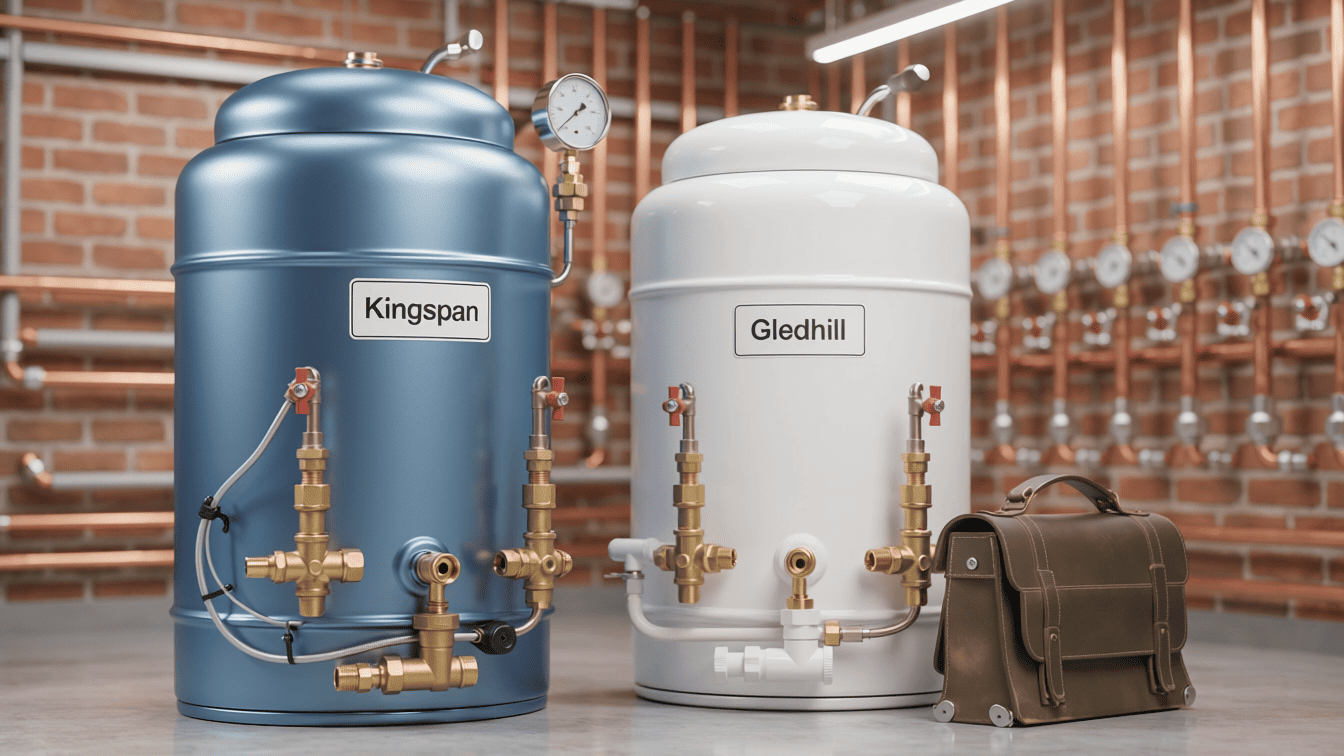
When you are specifying a hot water cylinder for a commercial building or a high-demand domestic property, the choice between Kingspan vs Gledhill cylinders isn't just about price. It is about system performance, longevity, and whether you will get a callback in six months. Both brands dominate the UK market for unvented cylinders, thermal stores, and buffer vessels, but they have taken different engineering routes to solve the exact same problem of delivering reliable domestic hot water and heating support.
Many engineers have worked on projects where a poorly matched cylinder caused everything from scalding complaints to complete system redesigns. The functional differences between these competing ranges aren't always obvious on a datasheet, but they become crystal clear when you are commissioning the system or responding to a fault call on a Sunday morning.
This comparison cuts through the marketing material and focuses on what actually matters on-site, including build quality, thermal efficiency, ease of installation, warranty support, and real-world performance. Whether you are retrofitting a Victorian terrace or designing a multi-zone heating system for a hotel, understanding the nuances of Kingspan vs Gledhill cylinders will help you specify the right unit the first time.
Brand Heritage And Market Position
Kingspan entered the cylinder market through acquisition, purchasing Albion in 2011 and Heatrae Sadia in 2017. That gave them instant access to decades of British engineering pedigree. Heatrae Sadia's famous Megaflo Eco range, for instance, has been the benchmark unvented cylinder since the 1980s. Kingspan's strength lies in deep integration. They manufacture insulation, renewables, and building services products, so their cylinders are designed to work seamlessly with heat pumps, solar thermal, and underfloor heating systems.
Gledhill, by contrast, has been family-owned since 1951 and focuses exclusively on water heating and storage. They are known for innovation. They pioneered the thermal store concept in the UK and developed the StainlessLite range, which uses robust duplex stainless steel for the inner vessel. Gledhill's reputation is built on extreme durability and excellent customer service. Their technical support team has bailed out many installers when sizing complex indirect cylinders for large care home projects.
Both of these exceptional brands supply the trade through Heating and Plumbing World, providing reliable access to their most popular models and specialist units exactly when you need them.
Cylinder Range And Application Focus
Kingspan organises their cylinders into clear families, each targeting a specific application. The Megaflo Eco is the classic unvented indirect cylinder, available from 90L to 300L. It is the absolute go-to for straightforward domestic installations where you have good mains pressure and a standard system boiler or heat pump.
The Albion Ultrasteel is a high-quality duplex stainless steel unvented range explicitly designed for hard water areas. The duplex construction resists corrosion significantly better than standard stainless, extending the service life heavily in high-limescale regions. Kingspan's core strength is thermal efficiency, and standing heat loss on the Megaflo Eco is typically under 1.5 kWh/24h for a 210L model.
Gledhill's portfolio is broader and more specialised. The Torrent is an indirect unvented cylinder with a massive focus on rapid reheat, recovering a full tank in under 30 minutes with a decent boiler output.
The Gledhill PulsaCoil is a unique electric thermal store explicitly designed for Economy 7 tariffs. The Gledhill PulsaCoil heats water overnight at cheap rates and delivers mains-pressure hot water throughout the day without requiring a pressure relief valve or discharge pipe. If you ever encounter unusual pump problems on complex circuits, Gledhill's versatile thermal stores effortlessly integrate multiple heat sources without requiring overwhelmingly complex secondary controls.
Build Quality And Materials
This is where the two manufacturing brands diverge most clearly. Kingspan cylinders use either mild steel with a vitreous enamel coating or premium duplex stainless steel. The enamel-lined models include a sacrificial anode to protect against ongoing corrosion. You will absolutely need to check and replace this sacrificial anode every few years, especially in aggressive hard water areas.
During a major care home renovation last year, an installer deliberately skipped the anode check on a five-year-old enamel cylinder. By year seven, the internal lining had completely failed due to aggressive local water chemistry, flooding the commercial laundry room below and costing thousands of pounds in water damage and replacement fees.
Gledhill cylinders predominantly use duplex stainless steel across their premium ranges. It is more expensive to manufacture, but it combines the corrosion resistance of stainless with the raw strength of mild steel. Most importantly, it completely eliminates routine sacrificial anode maintenance and extends the service life dramatically in highly aggressive water conditions.
Installation And Serviceability
Kingspan cylinders are relatively straightforward to install if you have done a few unvented training courses. The Megaflo Eco range comes with a comprehensive kit that includes the TPRV, expansion vessel, pressure reducing valve, and discharge fittings. The instructions are clear, and the components are totally industry-standard.
Gledhill cylinders require a bit more thought during installation, especially the thermal stores. The Gledhill PulsaCoil, for instance, doesn't need a TPRV or expansion vessel because it isn't a sealed system. However, you must understand exactly how the internal plate heat exchanger works to commission the controls properly.
Commissioning a complex thermal store without understanding the heat exchanger is exactly like trying to tune a guitar without knowing what notes the strings should play. You might make a sound, but it won't perform as the manufacturer intended, and the end user will notice the poor performance immediately.
If you ever need to verify overall system stability on a sealed unit, performing routine expansion vessel testing remains essential for ensuring any unvented setup operates safely within its design parameters.
Thermal Performance And Efficiency
Both brands meet or exceed ErP energy efficiency requirements, but their engineering approaches differ heavily. Kingspan achieves its exceptional efficiency through incredibly thick insulation and low surface area. The cylinder is tall and narrow, which effectively minimises heat loss per litre of stored water.
Gledhill's Torrent focuses almost entirely on rapid heat transfer. The internal coil has a much larger surface area and a more efficient baffle design, so you can achieve faster reheat times with a much lower boiler output.
For maintaining optimal temperatures across the entire property, pairing these high-performance cylinders with reliable smart radiator valves ensures minimal energy waste at the emitter level.
Furthermore, properly wrapping your distribution lines in high-quality pipework insulation guarantees that the hot water reaches the taps without losing significant thermal energy along the way.
Warranty And Aftercare
Kingspan offers a 25-year warranty on the inner vessel for their premium models, and 10 years on the Ultrasteel range. That is highly solid, but the warranty is strictly conditional on annual servicing by a qualified engineer and the use of a scale reducer in hard water areas. If you skip the service or fail to inspect the sacrificial anode, the warranty is completely void.
Gledhill also offers a 25-year warranty on the inner vessel for their premium ranges. Crucially, Gledhill's warranty on stainless models doesn't require anode replacement because there isn't one. This simplifies long-term maintenance drastically for the end user.
Both brands strictly require registration within thirty days to activate the full warranty. If you are fitting an advanced room thermostat alongside the new cylinder, registering all components simultaneously saves administrative headaches later.
Price And Value Considerations
This is where personal preference and the project budget come heavily into play. Kingspan cylinders are typically 10-15% cheaper than equivalent Gledhill models. That cost difference compounds rapidly on larger projects. If you are specifying twenty units for a housing development, evaluating Kingspan vs Gledhill cylinders usually highlights Kingspan's lower upfront unit cost very quickly.
But value isn't just about the initial upfront cost. Gledhill's stainless construction entirely eliminates anode maintenance, which saves the client serious money every few years. Over a 20-year lifespan, that can easily offset the initial price premium.
If your project also requires precise radiator balancing, fitting dependable thermostatic radiator valves helps to regulate the heat output and maximise the overall efficiency of whichever cylinder you select.
Real-World Scenario: A Retrofit Comparison
Picture this scenario. You are retrofitting a 1930s semi-detached house. The client desperately wants to replace an old vented cylinder with a modern unvented system, add solar thermal panels, and drastically improve shower performance.
With a Kingspan model, you would specify a 210L twin-coil unit. The installation is totally straightforward, and the provided kit includes everything you need. You would simply recommend a scale reducer to properly protect the vessel.
With a Gledhill twin-coil model, the installation is similarly straightforward, but you skip the scale reducer because the vessel doesn't need it. The highly engineered coil design gives you noticeably faster reheat times, which the client actively notices on back-to-back showers. No anode to service means the client's long-term maintenance cost is strictly lower.
For a long-term homeowner, the premium brand offers strong, undeniable value. For a landlord flipping a property in two years, the cheaper option often makes more immediate sense when comparing Kingspan vs Gledhill cylinders on a tight budget.
Conclusion
Choosing between these two excellent manufacturers isn't about one brand being objectively better than the other. It is strictly about matching the cylinder to the application and the client's overriding priorities. Kingspan delivers highly proven performance, competitive pricing, and a product range that covers the vast majority of domestic and light commercial applications brilliantly.
Gledhill excels massively in sheer durability, versatility, and technical support. Their duplex stainless construction eliminates long-term maintenance headaches, and their thermal store range solves problems that standard indirect cylinders simply cannot touch.
Get the answers to your peak demand and water hardness questions right, and the final choice between Kingspan vs Gledhill cylinders becomes perfectly obvious. For project-specific guidance, get expert advice from our team to ensure you specify the perfect unit for your next installation.