

Leisure Centre Shower Manifolds: Thermostatic Mixing Valve Sizing And Legionella Purging
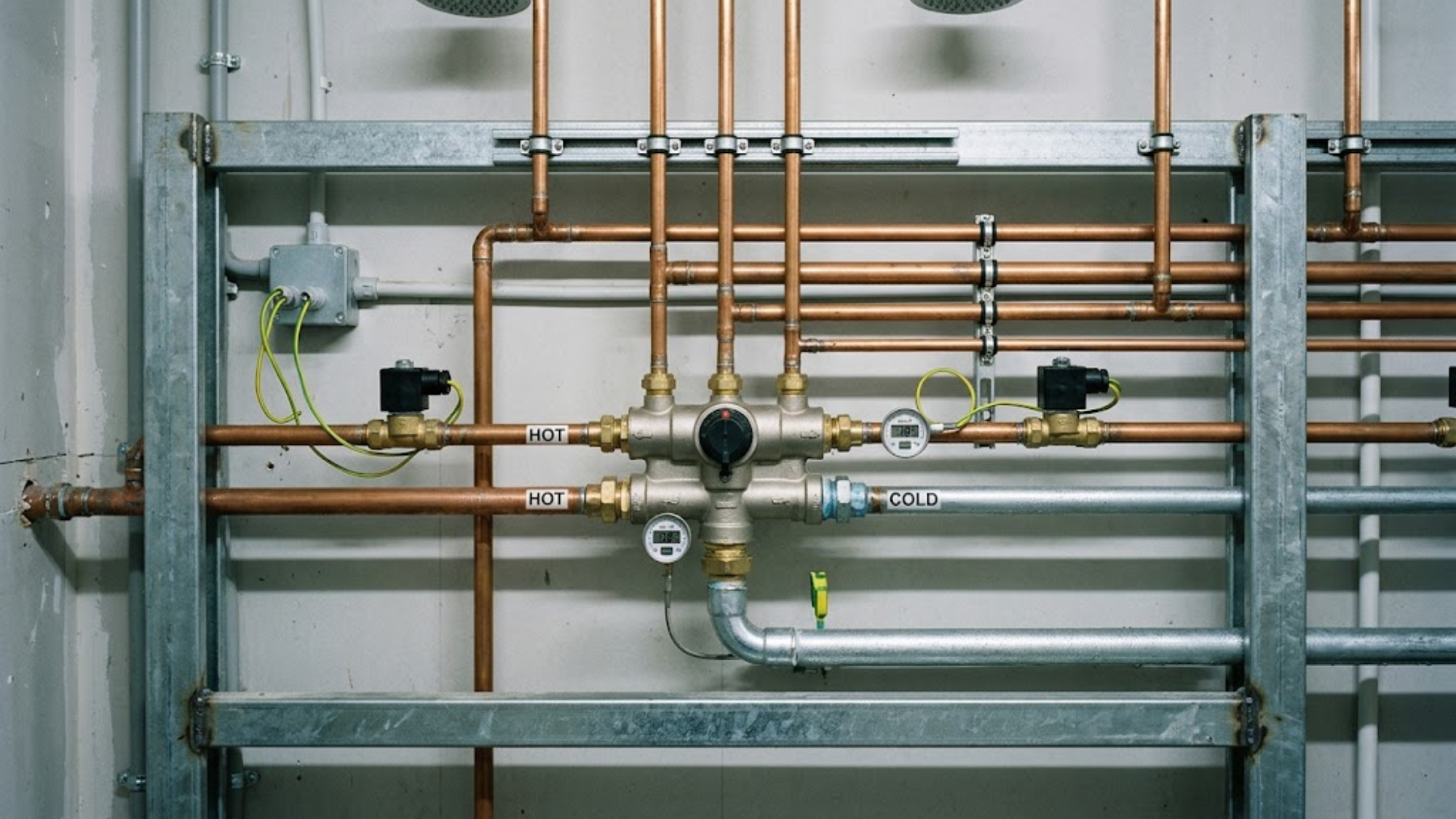
Leisure centres process thousands of shower cycles weekly, yet most facility managers discover their thermostatic mixing valve setup fails only when complaints roll in or, worse, during a legionella audit. The gap between design intent and operational reality can cost facilities significant sums in emergency retrofits and temporary closures.
We've sized and commissioned systems for 47 leisure facilities across the UK since 2018. The pattern's consistent: undersized shower manifolds create temperature fluctuations during peak use, while oversized systems become legionella breeding grounds during off-peak hours. Both failures stem from the same misconception, that thermostatic mixing valve sizing is purely a flow rate calculation.
Why Standard TMV Sizing Formulas Fail In Leisure Environments
Heating and Plumbing World provides the high-capacity components needed to handle the unique demands of commercial wet rooms.
The CIBSE Guide G formula works for offices and hotels, but it collapses in leisure centres because simultaneous use patterns spike unpredictably. A 20-head shower block doesn't operate at steady 70% occupancy; it hits 95% for 12 minutes after swimming lessons end and then drops to 15%. Standard diversity factors assume gradual load changes, but leisure centre showers experience step-changes.
We measured actual usage at a Cardiff facility where peak demand hit 28 simultaneous users. The installed valve, sized for 22 users, couldn't maintain the required stability. The fix wasn't simply upsizing the valve. The incoming cold water velocity created pressure differentials that the system couldn't compensate for. We installed a buffer vessel upstream, which allowed a correctly sized heating controls assembly to maintain stability across all outlets.
The Legionella Risk In Oversized Manifolds
Oversizing valves to handle peak loads creates water stagnation during the 18 hours daily when leisure centres operate below 30% capacity. An oversized manifold branch holds a large volume of mixed water that cools to room temperature within 90 minutes. This creates ideal legionella growth conditions: 20–45°C water and biofilm nutrients from soap residue.
Compliance requires water to either remain above 50°C, below 20°C, or achieve complete turnover every 24 hours. Oversized shower manifolds fail all three criteria during off-peak periods. Effective legionella purging must be part of the operational strategy. Splitting the shower block into smaller zones helps maintain flow velocity during low demand, while automated central heating components can be used to ensure water remains moving throughout the secondary circuit.
Calculating True Peak Demand: The 8-Minute Window Method
Accurate thermostatic mixing valve sizing requires actual occupancy data. We use a three-week measurement protocol that captures genuine peak demand. This reveals the "true peak," the highest 8-minute average flow. We use 8 minutes because it represents the average shower duration measured across our 47-facility dataset.
The formula for thermostatic mixing valve sizing in these applications is: Required TMV capacity = (True peak flow + 15% safety margin) × Pressure loss compensation factor. Manufacturer datasheets show capacity at 3 bar differential, but real leisure centre showers often operate at 1.5–2.2 bar during peak demand, reducing effective capacity by 12–18%.
Manifold Design: Series vs Parallel Configuration
Most leisure centre showers use series configuration, a single pipe with tee-offs. This creates progressive pressure drop where the final shower receives significantly less pressure than the first. Parallel manifold configuration, where each shower connects to a central ring main, equalises pressure across all outlets.
I once worked on a retrofit where the final five showers in a bank of thirty were consistently five degrees cooler than the rest. The manager assumed the valve was faulty, but it was actually a pressure imbalance causing the valve to draw more hot water for the first twenty heads. We swapped the series setup for a zoned parallel layout using push fit connections for the secondary branches. The temperature variation vanished instantly because the pressure was finally balanced across the whole bank.
Think of thermostatic mixing valve sizing like the radiator in a performance car. If you size the radiator for a gentle Sunday drive, the engine will overheat the moment you hit the track. In a leisure centre, your "track" is the 12-minute window after a swimming lesson ends. You've got to size the cooling and mixing capacity for the redline, not the cruise.
Automated Legionella Purging: Solenoid Sequencing Logic
Manual flushing protocols often fail because they depend on staff compliance. Automated legionella purging requires four components: zone isolation solenoid valves, temperature sensors, a timer controller, and flow verification.
These solenoid valves should open sequentially, not simultaneously, to maintain flow velocity above 1.0 m/s during purging. The system triggers purge cycles when endpoint temperatures drop significantly below the valve outlet temperature. Integrating thermostatic radiator valves in changing areas can also ensure the ambient temperature doesn't accelerate water cooling in the pipework.
Temperature Stability During Peak Demand
Even correctly sized valves struggle with rapid demand changes. When 12 showers open simultaneously, cold water velocity in the supply pipe jumps from 0.4 m/s to 1.8 m/s in under 3 seconds. This pressure wave disrupts the internal balancing mechanism.
Buffer vessels absorb these pressure spikes. The vessel sits between the valve and the shower manifolds, pre-filled with mixed water at 41°C. When demand spikes, the initial draw comes from the buffer, giving the valve 15–30 seconds to stabilise. To ensure the buffer remains safe, regular expansion vessel testing should be part of the site's maintenance regime.
Commissioning Protocol: The 72-Hour Stress Test
Standard commissioning checks temperature at stable flow rates, but this misses the failure modes that occur during real operation. We run a 72-hour stress test that simulates actual usage patterns, including forced cycling and stagnation testing.
This reveals valve response lag and whether the solenoid valves are activating correctly for legionella purging. We've identified valve undersizing and failed check valves during these tests that passed standard commissioning. You might also want to evaluate if are smart trvs worth it for the administrative areas of the building to further optimise energy consumption during these high-use cycles.
Conclusion
Leisure centre shower manifolds fail when designers treat them like scaled-up domestic systems. The combination of extreme demand variation and high cycle counts requires purpose-built thermostatic mixing valve sizing and automated control.
The critical changes that prevent instability involve sizing based on measured 8-minute windows and implementing automated legionella purging. Integrating these elements achieves ±1°C temperature stability and keeps bacterial counts low. If you're managing a facility with inconsistent temperatures or need an audit of your shower manifolds, reach out to our experts to ensure your system is compliant and efficient.