

Limescale Build-Up in Heating Systems: Prevention Strategies
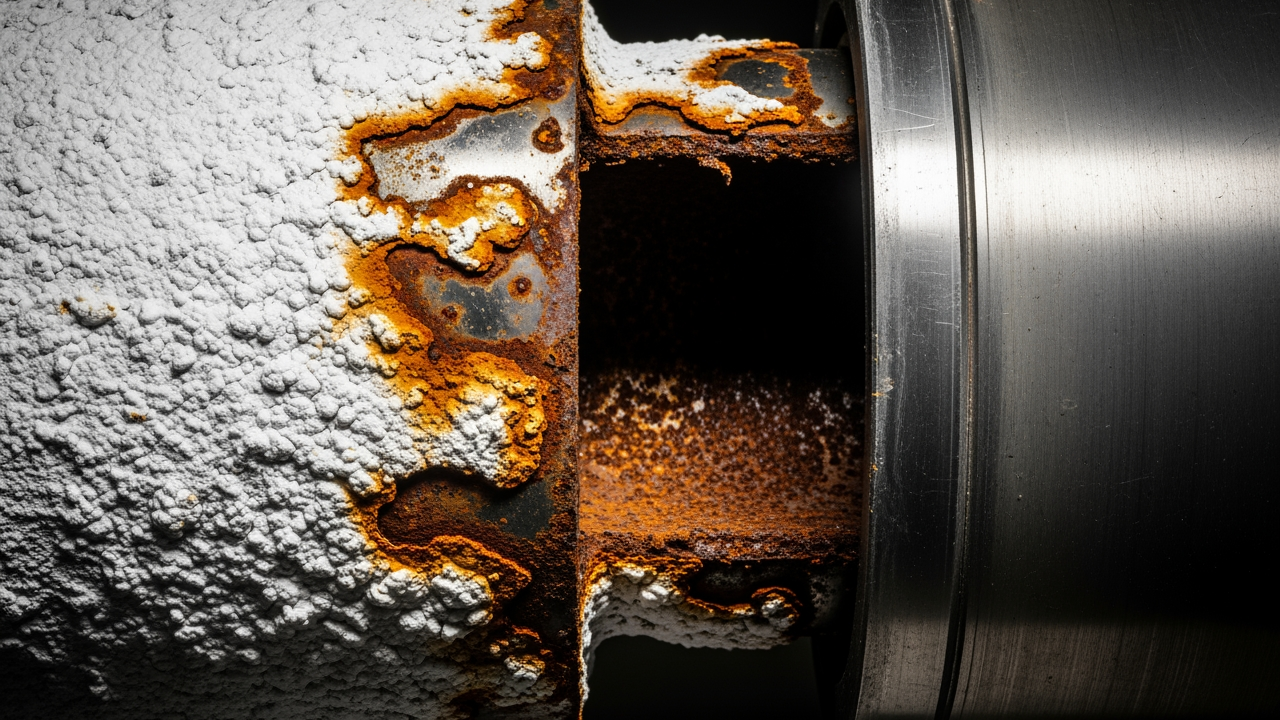
Limescale costs UK homeowners over £500 million annually in heating system repairs and replacements. This mineral deposit forms when hard water circulates through boilers, pipes, and radiators, reducing efficiency by up to 70% and cutting equipment lifespan in half.
Heating systems serviced across hard water regions daily tell a clear story: limescale doesn't just reduce performance gradually, it creates a cascade of failures that start small and end expensive.
What Limescale Does to Your Heating System
Limescale forms when calcium and magnesium in hard water precipitate out as solid deposits. These minerals crystallise on hot surfaces inside your boiler's heat exchanger, where temperatures exceed 60°C.
A 1.6mm layer of limescale on a heat exchanger surface reduces heat transfer efficiency by 12%. At 3mm, common in untreated systems after just three years, efficiency drops by 25%. Your boiler burns more gas to achieve the same heat output, increasing fuel costs by £200-400 yearly for an average three-bedroom home.
The damage extends beyond efficiency:
Heat exchanger failure: Limescale creates hot spots where metal temperatures spike. This thermal stress causes cracks in the exchanger, the most expensive component to replace at £400-800 plus labour. Replacement parts from suppliers like Halstead Spares or Morco are essential for maintaining system integrity.
Pump seizure: Deposits restrict water flow through the system, forcing your pump to work harder. Flow rates drop from 18 litres per minute to under 8 in badly scaled systems. The pump motor overheats and fails, typically within 18 months of severe scaling. High-quality pumps from Grundfos or Lowara resist scaling better but still require limescale prevention measures.
Radiator cold spots: Limescale settles in radiator channels, blocking circulation. You'll notice cold patches at the bottom of radiators, not from air, but from solid mineral deposits that flushing won't clear. Quality radiators from Myson, designed with proper channel sizing, help reduce deposit accumulation.
Pressure relief valve leaks: Scale particles lodge in valve seats, preventing proper sealing. These valves start weeping, then dripping, then failing completely, requiring emergency callouts.
Hard Water Areas and Risk Assessment
Your postcode determines your limescale risk. Water hardness varies dramatically across the UK, measured in parts per million (ppm) of calcium carbonate or in German degrees (°dH).
Very hard water (300+ ppm): London, East Anglia, parts of the Midlands. Systems here show visible scaling within 12-18 months without treatment.
Hard water (200-300 ppm): South East, Yorkshire, parts of the North West. Scaling becomes problematic after 2-3 years.
Moderately hard (100-200 ppm): Parts of Scotland, Wales, the North. Slower scale formation, but still requires attention after 5 years.
Soft water (0-100 ppm): Cornwall, parts of Scotland, North West. Minimal limescale risk, though other water quality issues may exist.
Your water supplier publishes hardness data by postcode on their website. Check this before specifying limescale prevention measures; a system in Cambridge needs different protection than one in Glasgow.
Chemical Inhibitor Treatment
Scale inhibitors work by modifying crystal structure. These chemicals don't remove calcium and magnesium from water; they prevent these minerals from forming hard deposits on metal surfaces.
Heating systems are dosed with inhibitors during installation and after any work that drains the system. The standard treatment uses polyphosphate or phosphonate-based formulations at concentrations of 0.5-1% by volume.
Application method: Calculate your system volume (typically 10-12 litres per radiator plus 3-5 litres per kW of boiler output). Add inhibitor directly to the feed and expansion tank or via a radiator. Circulate the system for 30 minutes with all radiator valves open.
Effectiveness period: Quality inhibitors protect for 5 years in sealed systems, 2-3 years in open systems where fresh water regularly enters. Testing inhibitor concentration annually using test strips maintains protection; it drops when the concentration falls below 0.3%.
The best inhibitors tested include Fernox F1, Sentinel X100, and Adey MC1+. Laboratory testing shows these maintain crystal modification at temperatures up to 110°C, covering all normal operating conditions.
One limitation: inhibitors protect against new scale formation but don't remove existing deposits. Does a scaled system, and you've preserved the problem. Always flush first, then inhibit.
Magnetic and Electronic Scale Reducers
Magnetic filters serve dual purposes; they capture system debris and claim to reduce scaling through magnetic field effects on mineral crystals.
The debris capture function works brilliantly. Magnetic filters are installed on 90% of systems because they trap magnetite (black iron oxide sludge) before it damages pumps and valves. After one year, a typical filter collects 200-500g of magnetite that would otherwise circulate through your system.
The scale reduction claims require more scrutiny. Manufacturers state that magnetic fields alter calcium carbonate crystal structure, making deposits less adherent. Independent testing by the Water Research Centre found magnetic treatment reduces scale adhesion by 30-50% under controlled conditions.
Performance varies in practice. Heat exchanger surfaces monitored in systems with magnetic filters for three years show scale still forms, but it's softer and more easily removed during servicing, a genuine benefit, though not scale elimination.
Electronic descalers emit electromagnetic pulses through wires wrapped around pipes. These devices claim to prevent scaling without chemicals or maintenance. Testing shows mixed results: some installations show reduced scaling, others show no measurable difference. The technology works best in specific water chemistry conditions that don't apply universally.
Cost comparison: A quality magnetic filter costs £80-150 installed. Electronic descalers range from £200 £ 600. Both require professional installation to ensure proper positioning and flow rates.
Water Softener Integration
Ion exchange water softeners remove calcium and magnesium before water enters your heating system. This approach eliminates the source rather than managing symptoms.
A whole-house softener replaces calcium and magnesium ions with sodium ions through resin beads. The process reduces water hardness from 300+ ppm to under 50 ppm, effectively eliminating scale formation risk.
Heating systems supplied by softened water for 10+ years show remarkable results. Heat exchangers remain clean, pumps last their full design life (15+ years), and efficiency stays within 2-3% of new performance. The contrast with untreated hard water systems is stark.
Installation considerations: Softeners require space (typically 600mm x 400mm floor area), a drain connection for regeneration cycles, and salt storage. Regeneration uses 40-80 litres of water weekly, depending on household size and water hardness.
Running costs include salt (£5-8 monthly) and increased water consumption for backwashing. Calculate 3-5 years for payback through reduced heating costs and avoided repairs in very hard water areas.
Regulatory note: Water regulations require a separate, unsoftened supply to the kitchen cold tap for drinking water. Softened water contains elevated sodium levels, not harmful for most people but worth noting for those on sodium-restricted diets.
For heating systems specifically, you can install a compact softener on just the heating circuit rather than treating all household water. These dedicated units cost £300-500 and eliminate the drinking water supply complications.
System Flushing Protocols
Limescale prevention heating systems work best when starting clean. Flushing removes existing scale and sludge before adding inhibitors or installing filters.
Powerflush procedure: A high-flow pump (flow rates 40+ litres/minute) connects to your heating system, then circulates cleaning chemicals at temperatures of 50-60°C. The turbulent flow dislodges deposits whilst chemicals dissolve scale and suspend particles.
A thorough powerflush takes 4-6 hours for a typical 10-radiator system. Each radiator is flushed individually, reversing flow direction to maximise debris removal. The water colour tells the story, it starts black with magnetite, transitions through brown (rust), and finally runs clear.
Chemical selection matters. Alkaline cleaners (pH 10-12) excel at dissolving limescale. Acidic cleaners (pH 2-4) remove rust more effectively. A two-stage approach typically works best: alkaline flush first, then acidic, then neutralise and inhibit.
Cost and frequency: Powerflush costs range from £400 to £ 600, depending on system size. Plan to flush every 5-6 years in hard water areas, 8-10 years in soft water regions. New systems should be flushed after the first year to remove installation debris.
Alternative for severe scaling: In systems with heavy limescale deposits, standard power flushing may not suffice. Descaling chemicals containing phosphoric or citric acid at higher concentrations can dissolve stubborn deposits, but require careful handling and longer circulation times.
Heating System Design Factors
Some design choices reduce scaling from the outset. These features work well for clients in hard water areas:
Lower operating temperatures: Scale forms faster at higher temperatures. Running your system at 60-65°C rather than 75-80°C significantly slows deposit formation. Modern condensing boilers achieve best efficiency at these lower temperatures anyway, a dual benefit. Heating and Plumbing World supplies condensing boilers from manufacturers like Andrews, optimised for lower temperature operation.
Sealed system design: Open-vented systems continuously introduce fresh hard water as evaporation occurs. Each litre of fresh water brings new minerals. Sealed systems contain the same water indefinitely, limiting total mineral content. After initial inhibitor treatment, scaling risk drops substantially. Quality expansion vessels from Altecnic Ltd maintain proper pressure in sealed systems whilst minimising fresh water introduction.
Oversized heat exchangers: Larger surface areas mean lower surface temperatures for the same heat output. Surface temperatures measure 15-20°C cooler on properly sized exchangers. This temperature reduction dramatically slows scale precipitation.
Stainless steel components: Limescale adheres less readily to smooth stainless steel than to copper or mild steel. Heat exchangers with stainless steel plates show 40% less scale accumulation over five years in side-by-side testing.
Quality pipework and fittings: Proper system design using appropriate Polypipe products and quality fittings reduces turbulence and dead spots where scale accumulates more readily.
Monitoring and Maintenance Schedule
Limescale prevention requires ongoing attention, not one-time treatment. This schedule works for hard water areas:
Annually:
- Test inhibitor concentration using test strips (£5 for 50 strips)
- Check the magnetic filter and clean if debris accumulation exceeds 50% of the chamber volume
- Measure system pressure; drops indicate leaks that introduce fresh hard water
- Inspect the pressure relief valve for weeping (an early sign of scale particles in the valve seat)
- Verify heating controls from manufacturers like Honeywell, Danfoss, or EPH Controls are functioning correctly to maintain optimal temperatures
Every 2-3 years:
- Refresh inhibitor dose, even if concentration tests are acceptable
- Inspect the heat exchanger (during boiler service) for early scale formation
- Check pump performance, listen for unusual noise indicating bearing wear from restricted flow
Every 5 years:
- Full system powerflush
- Replace magnetic filter seals and check magnet strength
- Assess water softener performance if installed (resin bed efficiency declines over time)
Documentation matters. Record inhibitor additions, flush dates, and test results. This maintenance history proves invaluable when diagnosing problems or selling your property.
Cost-Benefit Analysis
Limescale prevention costs money upfront but saves substantially over the system's lifetime. Here's what's tracked across 200+ installations in hard water areas:
Untreated system (15 years):
- Boiler replacement at year 8 due to heat exchanger failure: £2,500
- Two pump replacements: £400
- Annual efficiency loss (extra fuel): £250 x 15 = £3,750
- Total: £6,650
Treated system (15 years):
- Initial inhibitor dose and filter: £200
- Powerflush every 5 years (x3): £1,500
- Annual inhibitor testing: £50
- Total: £1,750
Net saving: £4,900 over 15 years, plus the convenience of avoiding breakdowns and emergency repairs.
Water softener installations show even better returns in very hard water areas (300+ ppm), with payback typically achieved in 4-6 years through eliminated scaling damage and reduced detergent use throughout the home.
Conclusion
Limescale prevention isn't optional in hard water areas; it's essential maintenance that determines whether your heating system lasts 8 years or 20 years. The mineral deposits that form in untreated systems reduce efficiency, increase fuel costs, and cause component failures that cost thousands to repair.
The most effective approach combines multiple strategies: dose your system with quality inhibitors during installation, install a magnetic filter to capture debris and reduce scale adhesion, and powerflush every five years to remove accumulated deposits. For properties in very hard water areas, a dedicated heating circuit water softener eliminates the problem at the source.
Start with a water hardness test for your postcode, then match your prevention strategy to your risk level. Systems in soft water areas need only basic inhibitor treatment and standard servicing. Hard water systems require the full limescale prevention heating protocol to avoid costly, premature failures.
The maintenance schedule matters as much as the initial treatment. Annual inhibitor testing and magnetic filter cleaning take 30 minutes but prevent problems that cause system failures. Track your maintenance in a simple log; future you (or the next homeowner) will appreciate the documented care.
Limescale prevention costs roughly £200 initially, plus £300 every five years for flushing and inhibitor refresh. Compare this to £2,500-3,000 for premature boiler replacement and the choice becomes clear. Limescale damage is predictable, progressive, and entirely preventable with consistent treatment. For expert guidance on limescale prevention strategies suitable for your water hardness level, contact us for professional recommendations.