

Managing Pipework Routes for Open-Plan Layouts
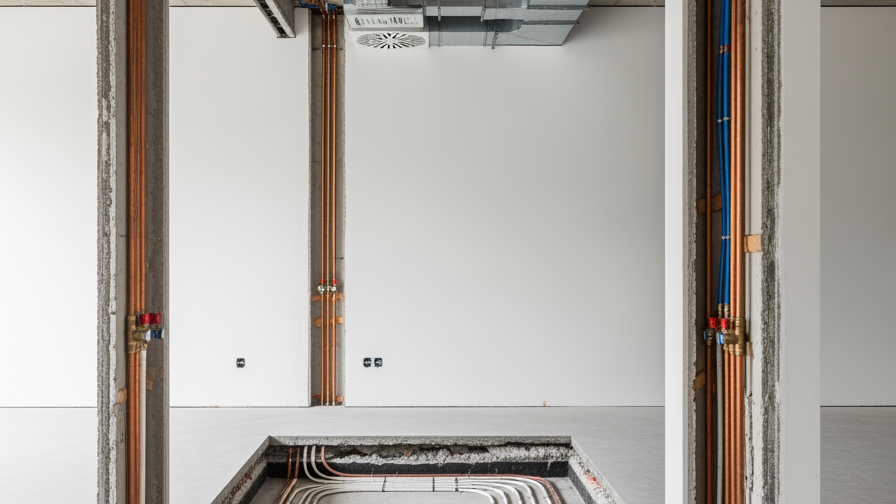
Open-plan living has transformed modern home design, creating spacious, light-filled environments that enhance family interaction and entertaining. However, removing walls that traditionally concealed plumbing infrastructure presents significant challenges for heating and water systems. Open-plan plumbing design requires innovative approaches to hide essential pipework whilst maintaining building regulation compliance and system performance.
The shift towards open spaces means fewer walls available for traditional pipe routing, forcing creative solutions that balance aesthetics with functionality. Understanding pipe routing for open spaces prevents compromising design vision whilst ensuring reliable plumbing and heating throughout the property. This guide explores proven strategies for managing pipework in open-plan layouts, from floor-based systems to ceiling voids and perimeter solutions.
Understanding Open-Plan Plumbing Challenges
The Design Conflict
Modern open-plan aesthetics celebrate clean lines, minimal visual clutter, and uninterrupted sightlines. Exposed pipework contradicts these principles, creating unsightly interruptions that diminish the architectural intent. Unlike traditional room layouts, where walls naturally conceal services, open spaces expose every routing decision to scrutiny.
The structural elements remaining after wall removal - steel beams, columns, and load-bearing walls - must accommodate essential services whilst maintaining their structural integrity. Drilling through load-bearing members requires structural engineer approval and careful execution. Many homeowners discover that removing partition walls eliminates convenient pipe routes, necessitating longer runs and more complex routing patterns.
Planning Constraints
Building regulations govern minimum pipe sizes, fall requirements for drainage, and ventilation standards regardless of architectural preferences. Waste pipes require specific gradients - typically 18-90mm fall per metre depending on diameter - which proves challenging when routing horizontally through shallow floor voids or ceiling spaces.
Floor construction depth limits available space for concealed pipework. Modern beam and block floors offer minimal depth, whilst suspended timber floors provide greater flexibility. Understanding these constraints during design stages prevents discovering limitations mid-construction when rectification proves costly and disruptive.
Strategic Pipe Routing Solutions
Floor-Based Routing Systems
Routing pipework beneath floors provides the most discreet solution for open-plan plumbing design. Screed depths of 65-75mm accommodate standard 15mm and 22mm heating pipes with appropriate insulation and protection. Deeper screeds allow larger diameter waste pipes, though structural loading must be verified.
Insulation prevents heat loss and protects pipes from screed damage during curing. Expansion vessels fitted to sealed heating systems compensate for thermal expansion in long floor-based pipe runs. Access points positioned beneath removable flooring sections or within cupboards enable future maintenance without destroying finishes.
Underfloor heating manifolds require discreet positioning, typically within purpose-built cupboards near external walls. These distribution points allow individual room control whilst centralising connections that would otherwise require multiple wall penetrations across open spaces.
Ceiling and Void Routing
Suspended ceilings create substantial voids for horizontal pipe runs, particularly effective in basement conversions and ground floor extensions where ceiling height permits reduction. Bulkheads around room perimeters accommodate services whilst maintaining central ceiling height, creating defined zones within open spaces.
Riser cupboards positioned strategically allow vertical distribution between floors without exposed pipework. These dedicated service spaces, typically 600mm x 600mm minimum, house soil stacks, heating risers, and water supplies. Positioning near external walls or within utility zones maintains open-plan aesthetics whilst ensuring accessibility.
Perimeter Wall Strategies
External walls provide natural concealment for vertical pipe runs serving radiators and outlets. Routing within wall cavities requires careful insulation to prevent freezing and condensation. Modern cavity insulation materials leave limited space, sometimes necessitating surface-mounted boxing or chasing into internal plaster layers.
Stud walls separating open-plan areas from bathrooms or utility spaces offer ideal service routes. Planning stud positions around anticipated pipe locations allows neat integration without compromising structural stability. Decorative boxing transforms necessary pipe concealment into architectural features, particularly effective with designer radiator connections or feature lighting integration.
Heating Solutions for Open Spaces
Radiator Placement Alternatives
Large open spaces require carefully positioned radiators to achieve even heat distribution. Perimeter placement beneath windows follows traditional principles, combating cold air infiltration whilst maintaining wall space efficiency. Low-profile radiators suit modern aesthetics, whilst vertical designs maximise output where wall width is limited.
Designer radiators function as architectural features rather than hidden necessities, with boiler spares available for maintenance ensuring long-term reliability. Column radiators provide substantial output in compact footprints, suitable for supporting open-plan heating demands where multiple small radiators would create visual clutter.
Underfloor Heating Systems
Underfloor heating eliminates visible radiators entirely, distributing warmth evenly across open spaces without compromising wall usage or sightlines. Wet systems circulate heated water through floor-embedded pipes, requiring 65-100mm floor build-up depending on system type and insulation requirements.
Manifold positioning determines pipe routing complexity. Centralised manifolds minimise total pipe length but require routing to distant zones, whilst multiple manifolds placed around room perimeters shorten individual circuit lengths at the expense of additional distribution points requiring concealment. Zone valves provide independent temperature control for different areas within open spaces, optimising comfort and energy efficiency.
Kitchen and Bathroom Integration
Island Kitchen Plumbing
Kitchen islands present particular challenges for pipe routing for open spaces, requiring waste and supply connections without visible pipework crossing floor areas. Waste pipes need adequate fall, often requiring a floor recess or pump-assisted drainage where gravity drainage proves impossible.
Vent pipes prevent siphonage in island sink drains, either rising through island cabinetry and venting through the roof, or connecting to air admittance valves concealed within island structures. Pump systems eliminate fall requirements, collecting waste water and pumping horizontally to existing drainage points, though requiring an electrical supply and creating potential maintenance considerations.
Open Bathroom Concepts
En-suite bathrooms opening onto bedroom spaces require careful waste management. Soil stacks traditionally hidden within stud walls need alternative concealment when walls are minimised. Boxing solutions or designer radiator-style covers transform functional necessity into intentional design elements.
Glass screening or half-height walls provide privacy whilst maintaining spatial connection, requiring floor-based drainage routing to avoid visible waste pipes. Heating and Plumbing World supplies a comprehensive range of concealed cisterns and wall-hung sanitaryware that minimise visible plumbing whilst maintaining functionality.
Material and Technology Choices
Modern Pipework Materials
Push-fit plastic systems revolutionise pipe routing for open spaces, allowing rapid installation in confined areas where soldering proves impractical. These systems use smaller diameter pipes than traditional copper, whilst maintaining equivalent flow rates, requiring less space in shallow floor voids or narrow wall cavities.
Multilayer composite pipes combine plastic core layers with aluminium barriers, preventing oxygen ingress in sealed heating systems whilst offering flexibility that simplifies routing around obstacles. Copper retains advantages for visible installations where aesthetic qualities matter, though it requires greater installation space and skilled soldering for concealed joints.
Smart Manifold Systems
Centralised distribution from manifolds simplifies open-plan plumbing design compared to traditional branch circuits. Individual feeds run from manifold to each outlet without intermediate joints, eliminating concealed connection points that create future leak risks. Manifolds with integral isolation valves allow individual circuit shutdown without affecting entire systems.
Remote manifold positioning in utility spaces or cupboards maintains service accessibility whilst keeping distribution points away from living areas. Worcester Bosch boiler spares and components ensure reliable system performance as heating demands increase with larger open spaces.
Practical Installation Considerations
Coordinating with Other Services
Electrical cables, data wiring, and ventilation ducts compete for limited concealment space in open-plan layouts. Early coordination between trades prevents conflicts and identifies optimal routing strategies that accommodate all services without compromise. Service drawings indicating proposed routes for all systems reveal potential clashes before installation begins.
Heating pipes require separation from electrical cables to prevent overheating, whilst drainage pipes need isolation from water supplies to prevent contamination risks. Structured approaches to service routing, establishing zones or layers within floor voids and ceiling spaces, maintain organisation and simplify future modifications or repairs.
Future Access and Maintenance
Strategic access panels positioned within cupboards, beneath removable flooring, or behind furniture zones enable maintenance without property-wide disruption. Manifold positions in accessible locations rather than concealed within structural elements allow valve operation and connection inspection without demolition work.
Leak detection systems provide early warning of problems in concealed pipework, using moisture sensors or pressure monitoring to alert homeowners before minor leaks become major damage events. Pressure relief valves protect against excessive pressure that might compromise concealed joints in systems where visual inspection proves impossible.
Conclusion
Successfully managing pipework routes in open-plan layouts requires thorough planning, appropriate material selection, and strategic concealment solutions. The challenges inherent in open-plan plumbing design demand creative approaches that respect both building regulations and aesthetic aspirations. Understanding pipe routing for open spaces enables homeowners and designers to create beautiful, functional living environments without compromising essential services.
Floor-based systems, ceiling voids, and perimeter wall strategies each offer advantages depending on specific property constraints and design objectives. Modern materials and manifold technologies simplify installation whilst improving long-term reliability and maintenance accessibility.
For expert advice on open-plan plumbing projects, quality components, and professional installation services, contact us to discuss specific requirements and explore solutions tailored to individual properties.