

MDPE Pipes for Underground Water Supply
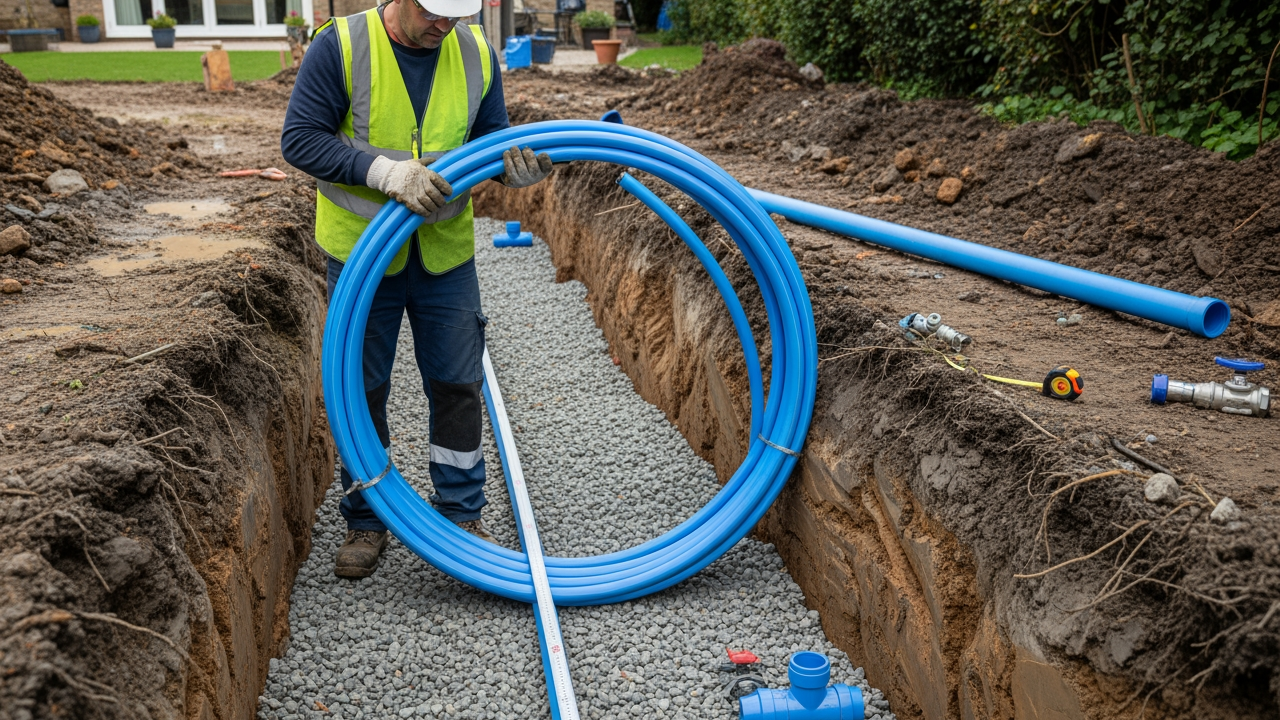
Medium-density polyethene (MDPE pipes) have become the standard for underground water supply systems across the UK. Their combination of flexibility, durability, and chemical resistance makes them superior to traditional materials for carrying potable water from the mains to buildings.
Experience with MDPE pipe underground installations spanning over 15 years shows the material consistently outperforms alternatives in practical conditions. Unlike copper or galvanised steel, MDPE pipes don't corrode, scale, or leach metallic tastes into water. The pipes flex rather than crack under ground movement, which explains the rarity of callbacks for underground leaks on MDPE installations.
What Makes MDPE Different From Other Pipe Materials
MDPE sits between low-density polyethene (LDPE) and high-density polyethene (HDPE) in terms of molecular structure. This middle ground delivers optimal characteristics for underground water supply: enough flexibility to coil into manageable lengths while maintaining structural integrity under pressure.
The material operates effectively in temperatures from -40°C to +60°C, though UK ground temperatures rarely push these limits. More importantly, MDPE pipes maintain their properties across decades of continuous use. Installations from the 1970s still function without degradation during system upgrades and inspections.
Key specifications include:
- Working pressure: typically 12 bar (PN12.5) or 16 bar (PN16)
- Lifespan: 50+ years in standard conditions
- Freeze resistance: expands up to 8% without rupturing
- UV resistance: requires burial or protection within 6 months of manufacture
The blue colouring isn't decorative. British Standard BS EN 12201 specifies blue for potable water systems to prevent confusion with other underground services. Gas pipes use yellow PE, and this visual distinction has prevented countless cross-connection errors on construction sites. Polypipe manufactures a comprehensive range of BS EN 12201-compliant MDPE systems for water supply applications.
Standard Sizes and Which to Choose
MDPE pipes for water supply typically range from 20mm to 63mm outside diameter (OD) for domestic applications. Larger diameters up to 180mm exist for commercial and municipal systems, but most residential work centres on three sizes:
20mm OD serves single-tap applications or low-demand properties. This size suits garden tap feeds, single bathroom extensions, or irrigation systems. Flow rate maxes out around 20 litres per minute, insufficient for modern homes with multiple bathrooms.
25mm OD handles most domestic properties with 1-2 bathrooms. This size delivers 30-35 litres per minute, enough for simultaneous use of a shower and kitchen tap without pressure drop. It's the default choice for standard three-bedroom homes.
32mm OD suits larger properties or those with high water demand. Commercial kitchens, properties with 3+ bathrooms, or installations requiring future-proofing benefit from this size. Flow capacity reaches 50+ litres per minute.
The sizing refers to the outside diameter because MDPE pipes use compression fittings that grip the exterior. Wall thickness varies with pressure rating; PN16 pipes have thicker walls than PN12.5 for the same OD, slightly reducing internal flow capacity but increasing pressure tolerance.
Installation Methods That Actually Work
MDPE's flexibility allows installation techniques impossible with rigid pipes. Coiling 25mm pipe in 25-metre or 50-metre lengths eliminates underground joints that create potential leak points. This single-run approach from boundary to building dramatically improves system reliability.
Trench requirements differ from rigid pipe systems. MDPE pipe underground installations need just 750mm minimum depth in gardens (1200mm under driveways) compared to the 900mm+ required for copper to prevent frost damage. The material's freeze resistance provides this advantage; frozen water expands the pipe temporarily rather than splitting it.
Bedding and backfill quality matter more than installers expect. Place 100mm of pea gravel or sand beneath the pipe, lay it without tension, then add another 300mm of fine material before backfilling with excavated soil. Sharp stones in direct contact with MDPE pipes can create stress points that develop into leaks after years of ground movement.
The coiling technique prevents kinks that restrict flow. Unroll MDPE in the direction it naturally wants to go, never forcing it straight. The pipe retains memory of its coiled shape, and fighting this creates internal stress. On cold days, the material stiffens, waiting until afternoon when sunlight has warmed the coil proves more effective than wrestling frozen pipe into position.
The pipe needs support every 300mm when running above ground or through buildings. Without this, the material sags between fixing points, creating low spots where air accumulates. These air pockets cause noisy systems and reduce flow efficiency. Quality pipe fittings ensure secure connections throughout the installation.
Joining and Fitting Options
MDPE pipes use compression fittings almost exclusively for underground water supply. These mechanical joints require no heat, glue, or special tools beyond spanners, making them reliable even when installed in muddy trenches by cold-fingered plumbers.
Standard compression fittings consist of a body, grab ring (collet), and cap nut. The grab ring has internal teeth that bite into the pipe exterior when the cap nut tightens, creating both a mechanical grip and a seal. Insert the pipe until it bottoms out in the fitting, then tighten the nut hand-tight plus one full turn with a spanner.
Over-tightening causes more problems than under-tightening. Excessive force crushes the pipe wall, reducing internal diameter and creating a weak point. The grab ring needs to bite just enough to hold, usually around 40-50Nm torque for 25mm fittings, though field work relies on feel rather than torque wrenches.
Electrofusion fittings provide permanent joints for critical applications. These specialised fittings contain embedded heating elements. When connected to an electrofusion control unit, they melt and fuse with the pipe interior, creating a homogeneous joint stronger than the pipe itself. This method suits mains connections and commercial projects where the £200+ cost of the control unit justifies the added reliability.
Transition fittings connect MDPE pipes to other materials. Brass or gunmetal fittings with MDPE compression on one end and BSP thread on the other form the bridge to copper pipe, stop taps, or appliances. These create the vulnerable point in most systems, 80% of underground leaks trace to transition fittings where dissimilar materials meet.
Pressure Ratings and System Design
PN ratings indicate maximum sustained working pressure in bar. PN12.5 pipe handles 12.5 bar continuously, while PN16 tolerates 16 bar. UK mains water typically runs at 2-4 bar, occasionally reaching 6 bar in valley-bottom properties, so either rating provides a substantial safety margin.
The higher rating isn't always better. PN16 pipe has thicker walls for the same outside diameter, reducing internal flow capacity by roughly 10% compared to PN12.5. For a 25mm OD pipe, this translates to about 3 litres per minute less flow, noticeable in high-demand situations.
PN16 becomes necessary for:
- Properties receiving mains pressure above 5 bar
- Systems with pressure-boosting pumps
- Commercial installations requiring future-proofing
Pressure loss calculations determine sizing for longer runs. MDPE pipes lose approximately 0.1 bar per 10 metres at typical domestic flow rates through 25mm pipe. A 50-metre run from boundary to house drops pressure by 0.5 bar, which matters when starting pressure sits below 3 bar. Grundfos booster pumps can restore pressure in marginal situations.
The material resists most chemicals found in UK soils. Chlorinated water, sodium hypochlorite from septic systems, and agricultural lime don't affect MDPE pipe underground installations. The pipe maintains integrity in contact with concrete, which corrodes copper through electrolytic action.
Weedkiller and fertiliser don't permeate MDPE pipes at concentrations found in residential gardens. Laboratory testing shows the material remains stable with direct exposure to common herbicides and lawn treatments, though maintaining 300mm separation from chemical storage areas remains good practice.
Common Installation Mistakes
Inadequate support causes the majority of above-ground MDPE failures. The material needs continuous support or clips every 300mm horizontally, every 500mm vertically. Installers familiar with rigid pipes often space clips at 1-metre intervals, allowing MDPE pipes to sag and stress at connection points.
Kinked pipes restrict flow without creating obvious leaks. A 90-degree bend in 25mm MDPE needs roughly 200mm radius to maintain full bore. Tighter bends collapse the inner wall, reducing the effective diameter. "Low pressure" complaints sometimes trace to a kinked pipe buried years earlier. The system worked initially, but ground settlement gradually tightened the kink until flow became restricted.
Mixed pipe generations create compatibility issues. MDPE pipes manufactured before 2010 used slightly different dimensions than the current BS EN 12201 standard pipe. Old and new pipes look identical but differ by 0.2-0.3mm in OD. Compression fittings sized for modern pipe may not seal properly on older material, and vice versa. When extending existing systems, measuring pipe OD with callipers proves more reliable than assuming compatibility.
Insufficient insertion depth prevents fittings from sealing. Each fitting has a stop that the pipe must reach, typically 25-30mm insertion for 25mm fittings. Installers sometimes fail to push the pipe fully home, leaving 5-10mm gap. The compression seal still forms initially but fails within months as pressure cycles work the pipe loose.
UV exposure degrades MDPE pipes within 6-12 months of sunlight exposure. The blue colouring fades to grey, and surface checking appears. The damage penetrates 0.5-1mm deep, creating stress points that fail prematurely. Five-year-old installations have failed because the pipe sat in sunlight for 8 months during construction delays. Any above-ground MDPE needs UV-resistant lagging or enclosure.
Maintenance and Longevity
MDPE pipes require essentially no maintenance once installed correctly. The material doesn't corrode, scale, or degrade in normal underground conditions. Monitored installations dating to 1998 show no performance decline after 25+ years of continuous service.
Leak detection proves more challenging with MDPE pipes than metallic pipes. Electronic leak detectors that work by sensing electrical conductivity fail on plastic pipes. Acoustic methods work instead, using sensitive microphones that detect the specific frequency signature of water escaping under pressure. This requires experience to distinguish leak sounds from background noise in busy areas.
Tracer wire installation solves the location problem. Running continuous electrical wire alongside MDPE pipe underground during installation, with access points at each end, creates a locatable path that standard cable detectors can follow. This marks the pipe route for future excavations. The wire costs £15-20 per 100 metres and prevents the "where does this pipe go?" problem that plagues unmarked plastic installations.
Freeze protection happens automatically with MDPE pipes. Frozen water expands the pipe by 6-8%, then the material returns to its original dimensions when thawed. Laboratory testing involving freezing and thawing a 25mm pipe 15 times produced no leaks or dimensional changes. The copper pipe fails on the first freeze cycle.
The one maintenance consideration involves fittings rather than pipe. Compression fittings can work loose over 10-15 years as ground movement cycles stress on joints. Accessible fittings for critical connections and annual visual inspection of any above-ground compression joints remain recommended practices.
Cost Comparison With Alternative Materials
MDPE pipes cost 40-60% less than copper for equivalent underground water supply installations. A typical 20-metre run from boundary to house in 25mm costs £80-100 in materials for MDPE versus £180-220 for copper pipe and fittings.
Labour costs favour MDPE pipes even more dramatically. The coiled format eliminates underground joints, cutting installation time by 30-40% compared to copper systems that require joints every 3 metres. A single plumber installs 20 metres of MDPE in 90 minutes, including trenching and backfill. The same run in copper takes 3-4 hours with multiple soldered joints.
Barrier pipe adds 30-35% to material costs but remains cheaper than copper. This MDPE variant includes an aluminium layer that prevents petroleum permeation. Specification near petrol stations, industrial estates, or contaminated sites requires this variant. The installation method and labour requirements match standard MDPE pipes.
Galvanised steel costs similarly to copper but requires threading equipment and specialist skills. Galvanised pipe for underground water supply has fallen out of favour, the material corrodes from both inside and outside, typically failing within 20-30 years in UK soil conditions.
PEX pipe offers comparable material costs to MDPE pipes but requires different installation techniques. The material can't coil in long lengths like MDPE, and compression fittings work differently. PEX suits internal plumbing better than underground supply runs.
Regulatory Compliance and Standards
BS EN 12201 governs MDPE pipe for water supply in the UK. This standard specifies dimensions, pressure ratings, material composition, and testing requirements. Only pipe marked with BS EN 12201 approval meets Wthe ater Supply (Water Fittings) Regulations 1999 requirements for potable water contact.
WRAS approval (Water Regulations Advisory Scheme) confirms specific products comply with UK water regulations. Both pipe and fittings need individual WRAS approval; checking the approval number against the online directory before specifying products for potable water systems ensures compliance.
Building Regulations Part G addresses water efficiency and installation standards. The regulations don't specify pipe materials but require adequate flow rates and pressure at outlets. MDPE pipes sizing must account for pressure loss over distance, roughly 0.1 bar per 10 metres in a 25mm pipe at typical flow rates.
Installation requirements include:
- Stop tap within 300mm of the boundary
- Pipe depth minimum 750mm (1200mm under roads)
- Separation from other services: 300mm from gas, 350mm from electricity, 150mm from telecoms
- Tracer wire or marker tape for plastic pipes
Notification requirements differ between companies. Some require advance notice for any connection to the mains, others only for new properties. Checking local water company requirements before starting work proves essential; retrospective approval costs 3-4x more than proper advance notification.
For comprehensive support with underground water supply projects, Heating and Plumbing World stocks complete MDPE systems, including Polypipe blue water pipe and quality compression fittings. Need technical guidance on sizing or installation specifications? Get in touch for expert advice from experienced water systems specialists.
Final Considerations for Underground Water Systems
MDPE pipes have earned their position as the default choice for underground water supply through decades of reliable performance. The material's flexibility, chemical resistance, and freeze tolerance address the specific challenges of buried water systems better than traditional alternatives.
MDPE has evolved from a copper substitute to the preferred option across residential and commercial applications. The technology has matured, manufacturing quality remains consistent, fittings have standardised, and installers understand the material's characteristics. Modern MDPE pipe underground systems fail less frequently than any other underground water supply method.
The material isn't perfect. UV sensitivity requires prompt burial, permeation necessitates barrier pipe in contaminated areas, and the flexibility that enables easy installation also demands proper support in above-ground sections. These limitations matter far less than the advantages for underground applications.
Cost efficiency combined with a 50+ year lifespan makes MDPE pipes the rational choice for new installations and system replacements. The material costs less upfront, installs faster, and requires no maintenance while outlasting copper, steel, and most other alternatives. Properties fitted with MDPE in the late 1990s continue operating without intervention; the same can't be said for copper systems from that era, many of which have required partial or complete replacement.
For anyone planning underground water supply work, MDPE pipes represent the proven solution. The technology has moved beyond experimental status into mature reliability, backed by millions of successful installations across the UK and Europe.