
 -
- Multi-Boiler System Rotation: Load Balancing Strategies
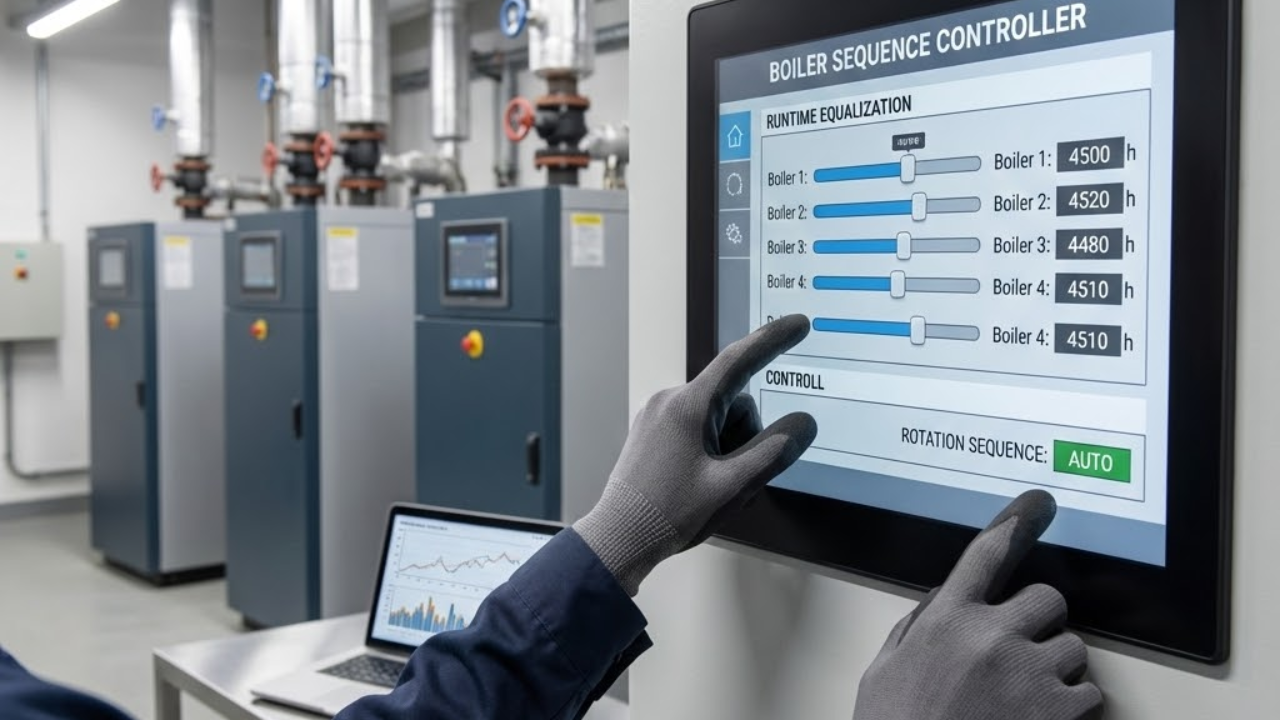
Most commercial heating systems don't fail because a single boiler breaks down. They fail because the workload gets distributed poorly across multiple boilers, causing one unit to shoulder 80% of the demand whilst its partners coast along at minimal output. That's not just inefficient. It's a fast track to premature component failure and expensive emergency callouts.
When you're running a multi-boiler system, the goal isn't simply to keep buildings warm. It's to spread the thermal load intelligently across all available units, ensuring each boiler operates within its optimal efficiency range whilst equalising wear patterns. Get the rotation strategy right, and you'll extend equipment lifespan by years. Get it wrong, and you'll be replacing heat exchangers and burners on a predictable, costly cycle.
The principle behind multi-boiler system rotation is straightforward: no single boiler should become the workhorse whilst others sit idle. But implementing effective load balancing requires understanding how sequencing controls work, how to match boiler capacity to actual demand, and how to configure rotation schedules that respond to real-world heating loads rather than theoretical calculations.
Why Load Balancing Matters in Multi-Boiler Installations
Heating and Plumbing World supplies comprehensive commercial heating components supporting intelligent multi-boiler control strategies and performance optimisation.
A properly balanced multi-boiler setup delivers three critical advantages. First, it maximises fuel efficiency by ensuring boilers fire only when needed and at their most efficient operating point. Second, it equalises runtime across all units, preventing one boiler from accumulating disproportionate wear. Third, it provides genuine redundancy. If one unit fails, the system continues operating without dramatic performance loss.
Consider a four-boiler system serving a large office building. Without intelligent rotation, the sequencing controller defaults to a fixed firing order: Boiler 1 fires first, followed by Boiler 2 when demand increases, and so on. Sounds logical, except Boiler 1 now runs 60% more hours annually than Boiler 4. That lead boiler experiences accelerated wear on igniters, heat exchangers, and pumps whilst the lag boilers barely break a sweat.
Think of runtime equalisation like rotating tyres on a vehicle. If you never rotate, the front tyres wear out whilst the rears remain pristine. You've paid for four tyres but only got half the mileage value. Multi-boiler systems work the same way. Rotate the lead position regularly, and all units age evenly, giving you the full value of your investment.
The financial impact becomes clear over a five-year period. The lead boiler requires a heat exchanger replacement at year three, a burner overhaul at year four, and a full pump replacement at year five. The lag boilers? They're still running on original components. You've effectively paid for four boilers but gotten the lifespan of 2.5 units.
Equalised runtime through runtime equalisation addresses this imbalance directly. By rotating which boiler serves as the lead unit (daily, weekly, or based on accumulated runtime), you distribute wear evenly. Each boiler ages at the same rate, meaning maintenance intervals align, replacement costs spread predictably, and you avoid the cascade failure scenario where one worn-out boiler triggers a domino effect of breakdowns.
How Sequencing Controls Manage Load Distribution
Modern boiler sequencing controls use one of three primary strategies to manage multi-boiler systems: fixed sequencing, timed rotation, or runtime equalisation. Each approach suits different applications, and understanding the distinctions helps you specify the right control strategy for your installation.
Fixed sequencing designates a permanent firing order. Boiler 1 always fires first, Boiler 2 second, and so forth. This method works acceptably in applications with highly variable loads where all boilers cycle frequently. Think industrial processes with rapid heating demands. The constant cycling means no single unit dominates runtime. But in steady-state applications like space heating, fixed sequencing creates the exact imbalance problem we're trying to avoid.
Timed rotation switches the lead boiler at predetermined intervals, typically daily or weekly. At midnight each day, the controller shifts the firing order: yesterday's Boiler 1 becomes today's Boiler 4, yesterday's Boiler 2 becomes today's Boiler 1, and the sequence rotates. This approach works well for installations with predictable, consistent loads. A hotel with steady hot water demand, for example, benefits from daily rotation because heating requirements remain relatively constant throughout the year.
The limitation? Timed rotation doesn't account for actual runtime. If Boiler 1 serves as lead during a mild week with minimal heating demand, it accumulates far fewer operating hours than Boiler 2 did during its lead week in January's cold snap. Over a heating season, these discrepancies compound, and you're back to unequal wear patterns.
Runtime equalisation solves this by tracking accumulated operating hours for each boiler and automatically rotating the firing order to balance runtime. The sequencing controller monitors which unit has the fewest hours and promotes it to lead position. When heating demand requires multiple boilers, the system fires units in ascending order of accumulated runtime. This strategy delivers true wear equalisation regardless of seasonal load variations or partial-load operation.
For most commercial heating applications, runtime equalisation represents the optimal strategy. It requires more sophisticated controls, typically a dedicated Grundfos sequencing controller or Honeywell control system implementation, but the investment pays back through extended equipment life and reduced maintenance costs.
Staging Strategies for Different Load Profiles
Effective load balancing extends beyond rotation schedules. You also need intelligent boiler staging logic that determines when additional boilers fire and when they shut down. Poor staging creates short-cycling, where boilers fire briefly, shut off, then fire again moments later. A pattern that destroys efficiency and accelerates component wear.
The key is matching boiler capacity to actual heating load whilst maintaining adequate hysteresis. The temperature differential between firing and shutdown points. Let's say your system uses four 500kW boilers to serve a 1,500kW peak load. At design conditions, you'll run three boilers at full capacity. But what happens on a mild autumn day when the building only needs 400kW?
A poorly configured controller fires one boiler, which quickly satisfies the demand and shuts down. Five minutes later, the system temperature drops, and the boiler fires again. This short-cycling pattern repeats throughout the day, causing excessive igniter wear and reducing combustion efficiency.
Proper staging logic introduces sufficient hysteresis to prevent this behaviour. The controller might set a 10°C differential: the lead boiler fires when system temperature drops to 70°C and doesn't shut down until it reaches 80°C. This wider band allows the boiler to run for longer periods, improving efficiency and reducing cycle counts.
For modulating boilers, staging becomes more nuanced. Modern condensing boilers can modulate down to 20-30% of rated capacity, allowing a single unit to handle low loads without cycling. Your staging logic should exploit this capability: keep the lead boiler modulating across its full range before firing a second unit. Proper hydraulic separation ensures clean staging transitions without flow interference between boiler circuits. Only when the lead boiler reaches maximum output for a sustained period (typically 5-10 minutes) should the lag boiler fire.
This approach maintains boilers in their most efficient operating range whilst minimising the number of units online. Fewer boilers running means lower standby losses, reduced pump energy, and less wear on components. It's the difference between running two boilers at 40% capacity each (inefficient, high cycling) and one boiler at 80% capacity (efficient, stable operation).
Parallel Positioning vs Sequential Firing
When multiple boilers do need to run simultaneously, you face another strategic choice: parallel positioning or sequential firing. These terms describe how the controller manages output from multiple active boilers, and the distinction significantly impacts efficiency.
Sequential firing brings each boiler to full capacity before starting the next unit. The lead boiler ramps to 100% output, and only then does the lag boiler fire. This method works well with on/off boilers that lack modulation capability. You're simply staging units in response to demand. But with modulating boilers, sequential firing misses an opportunity for optimisation.
Parallel positioning modulates all active boilers equally. If you're running two boilers to meet a 60% load, each unit operates at 60% capacity rather than one at 100% and one at 20%. This approach keeps both boilers in their optimal efficiency range, particularly important for condensing boilers, which achieve peak efficiency at partial loads when return temperatures stay low.
Here's why this matters: a condensing boiler achieves maximum efficiency around 50-70% capacity when return water temperatures allow sustained condensing operation. Running one boiler flat-out whilst another barely fires means the lead unit operates at higher flow temperatures (reduced condensing, lower efficiency) whilst the lag unit short-cycles (poor efficiency, increased wear). Parallel positioning keeps both units in the sweet spot.
The catch? Parallel positioning requires compatible boilers with identical capacity and modulation ranges. You can't effectively parallel position a 500kW boiler with a 300kW unit. The smaller boiler will reach maximum output whilst the larger one still has headroom, defeating the purpose. For retrofit projects with mixed boiler sizes, sequential firing remains the practical choice.
Practical Configuration for Common System Types
Let's translate these principles into actionable configurations for typical multi-boiler installations. The specifics vary by system size and application, but these examples illustrate how to implement effective rotation strategies.
Four Modulating Boilers
Four modulating boilers (400kW each, 1,600kW total capacity):
- Use runtime equalisation with daily rotation checks
- Set parallel positioning mode for all active boilers
- Configure 10°C hysteresis between staging points
- Stage second boiler when lead unit exceeds 80% capacity for 5 minutes
- Stage third boiler when both active units exceed 80% capacity for 5 minutes
- Maintain minimum 20-minute runtime before allowing boiler shutdown
- Enable anti-cycling lockout: 10-minute minimum off-time between firing cycles
This configuration keeps boilers in their most efficient 50-80% operating range whilst preventing short-cycling. The runtime equalisation ensures wear distributes evenly over the heating season, and the staging delays prevent hunting behaviour during transitional weather.
Six On/Off Boilers
Six on/off boilers (300kW each, 1,800kW total capacity):
- Use runtime equalisation with continuous monitoring
- Configure sequential firing (parallel positioning not applicable to on/off units)
- Set 15°C hysteresis to accommodate larger capacity steps
- Stage additional boilers when system temperature drops 5°C below setpoint
- De-stage boilers when system temperature exceeds setpoint by 3°C for 15 minutes
- Rotate firing order based on accumulated runtime, updating every 100 operating hours
- Implement boiler-specific shutdown delays to prevent simultaneous staging
With on/off boilers, you can't fine-tune output like modulating units. The wider hysteresis and longer staging delays compensate for the coarser control, preventing the system from hunting as boilers cycle on and off. The 100-hour rotation interval ensures runtime balances over weeks rather than days, appropriate for the larger system capacity.
Mixed Capacity System
Mixed capacity system (two 400kW + two 300kW, 1,400kW total):
- Use timed rotation with weekly lead boiler changes (runtime equalisation impractical with mixed capacities)
- Configure sequential firing: fire larger boilers first, smaller units as final stage
- Set 8°C hysteresis for larger boilers, 6°C for smaller units
- Stage first 400kW boiler as lead, second 400kW boiler when lead reaches 90% capacity
- Stage first 300kW boiler when both 400kW units exceed 90% capacity
- Stage final 300kW boiler only during peak demand (system temperature drops 8°C below setpoint)
- Rotate which 400kW boiler serves as lead on weekly basis
This compromise configuration acknowledges the limitations of mixed-capacity systems. You can't achieve perfect runtime equalisation, but weekly rotation prevents one large boiler from dominating whilst sequential staging with capacity-based priorities maintains reasonable efficiency.
Monitoring and Optimisation Over Time
Installing intelligent sequencing controls isn't a set-and-forget proposition. Effective load balancing requires ongoing monitoring to verify the rotation strategy delivers expected results and adjustment when operating patterns reveal inefficiencies.
Most modern controllers log accumulated runtime, cycle counts, and efficiency metrics for each boiler. Review these logs quarterly to confirm runtime remains balanced within 10% across all units. If one boiler shows significantly higher hours, investigate whether the rotation logic functions correctly or whether physical issues (slow ignition, modulation problems) cause the controller to favour other units.
Cycle count matters as much as runtime. A boiler that accumulates 2,000 hours over a season but cycles 15,000 times experiences far more wear than a unit with 2,200 hours and 8,000 cycles. If cycle counts diverge significantly, your staging logic needs refinement. Likely tighter hysteresis or longer minimum runtimes.
On a large hospital project, the facilities team noticed Boiler 2 logging 30% more cycles than the other three units despite similar runtime hours. Investigation revealed the sequencing controller was staging Boiler 2 first during morning warm-up because it had a faster ignition sequence. They adjusted the staging logic to include a 2-minute delay before allowing Boiler 2 to fire, giving other units priority. Within a month, cycle counts balanced across all four boilers.
Seasonal adjustments improve performance as heating loads change. During peak winter months, you might tighten staging thresholds to bring additional boilers online sooner, ensuring adequate capacity during high-demand periods. In shoulder seasons, widen the hysteresis and increase staging delays to keep fewer boilers running, maximising efficiency when loads drop.
Pay particular attention to overnight and weekend operation. Many commercial buildings reduce heating during unoccupied periods, but the setback strategy impacts load balancing. If your system maintains a deep setback (15°C) overnight, the morning warm-up fires all boilers simultaneously, defeating rotation logic. A more modest setback (18°C) allows the system to recover using one or two boilers, maintaining proper sequencing.
Common Mistakes That Undermine Load Balancing
Even well-designed rotation strategies fail when undermined by configuration errors or installation issues. These problems crop up repeatedly across different system types and scales.
Oversized boilers represent the most common issue. When each boiler provides far more capacity than typical loads require, the lead unit satisfies demand whilst barely firing, then shuts down. The result? Excessive short-cycling despite sophisticated rotation controls. Right-sizing boilers to actual loads (typically 25-30% of total capacity per boiler in a four-boiler system) allows units to run at efficient partial loads rather than cycling on minimum fire.
Inadequate hydraulic separation causes phantom load imbalances. If the primary/secondary piping doesn't properly decouple boiler flow from system flow, you'll see flow-induced staging problems: the controller calls for one boiler, but hydraulic interference causes a second unit to fire unnecessarily. Proper low-loss headers or Altecnic hydraulic separators prevent this cross-contamination.
Mismatched pump speeds create artificial load imbalances in systems with boiler-specific pumps. If Boiler 1's pump delivers 20% more flow than Boiler 2's pump, the controller perceives Boiler 1 as more responsive and favours it in the firing order. Verify all boiler pumps deliver equivalent flow rates at design conditions, adjusting speed settings or impeller sizes as needed.
Disabled rotation features plague retrofit projects. The existing controller includes runtime equalisation, but it's disabled in the settings menu because the previous engineer didn't understand its function. Always verify rotation features are active and configured correctly. Don't assume factory defaults match your application requirements.
Ignoring outdoor reset integration misses an opportunity for optimisation. When supply temperature resets based on outdoor conditions, boilers operate at lower temperatures during mild weather, improving condensing efficiency. But if your rotation logic doesn't account for the reduced setpoint, you might stage additional boilers unnecessarily. Ensure staging thresholds reference the active reset setpoint, not a fixed temperature.
Conclusion
Effective multi-boiler system rotation isn't about complex algorithms or expensive control systems. It's about understanding how heating loads actually behave, configuring staging logic that responds intelligently to real-world demand, and implementing rotation strategies that equalise wear across all units. The difference between a well-balanced system and a poorly managed one shows up in maintenance costs, fuel bills, and equipment longevity. Typically adding three to five years of service life whilst cutting annual operating costs by 15-20%.
Start with runtime equalisation if your boilers have similar capacities, or implement timed rotation for mixed systems. Configure staging logic with adequate hysteresis to prevent short-cycling, and use parallel positioning with modulating boilers to maintain optimal efficiency. Monitor performance quarterly, adjust seasonal settings as loads change, and verify rotation features remain active.
The investment in proper load balancing pays back quickly. Fewer emergency callouts, predictable maintenance schedules, and extended equipment life transform multi-boiler systems from maintenance headaches into reliable, efficient heating plants. For technical guidance on specific applications or specialist components, contact us to discuss your system requirements.