

Multi-Vessel Installations: Parallel vs Series Configuration for Large Systems
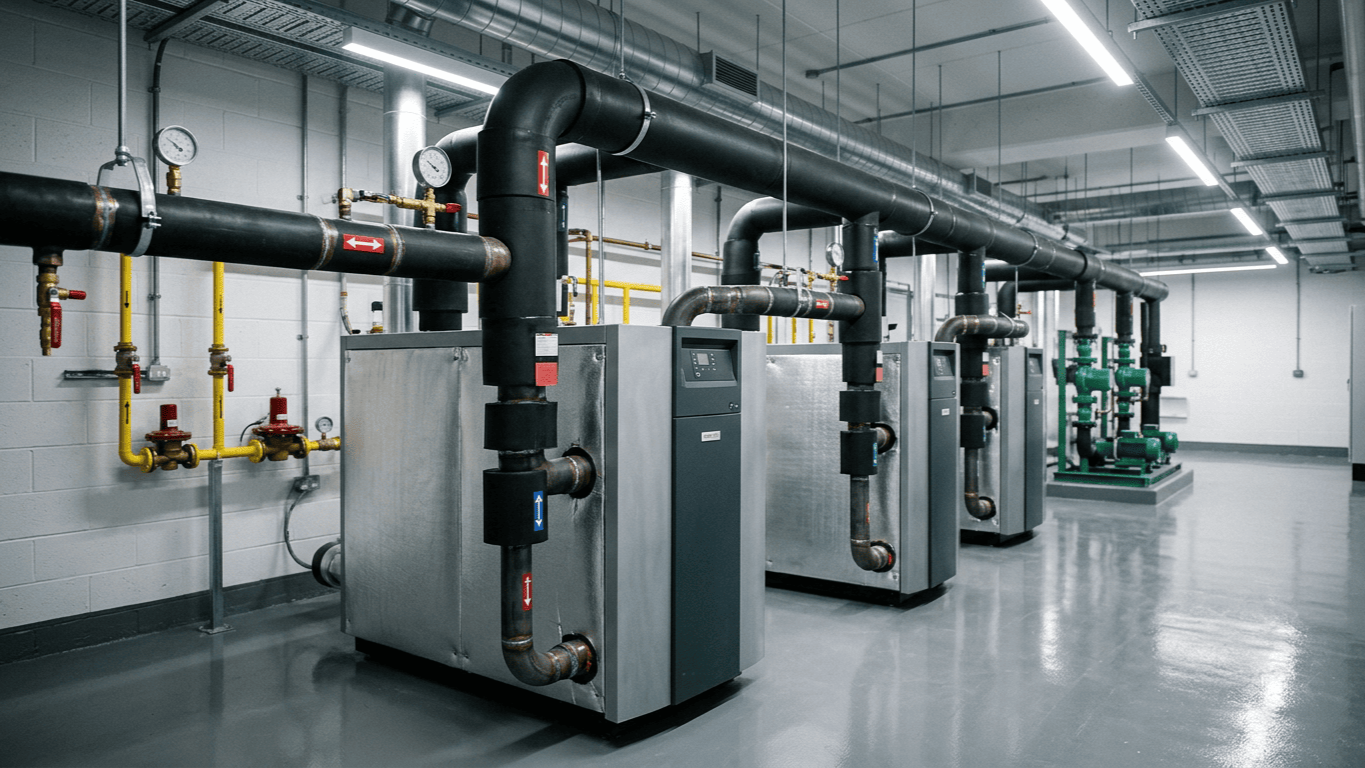
Large commercial heating systems don't run on a single boiler anymore. They can't. When you're heating a hospital wing, a university campus, or a manufacturing facility, redundancy isn't optional - it's survival. One vessel fails, and you'll need backup running before anyone notices.
We've installed both parallel and series configurations across dozens of large-scale projects. The choice between them isn't about preference; it's about load profile, space constraints, efficiency targets, and what happens when something breaks at 2am on a Sunday. Most engineers default to parallel because it's familiar. However, series configurations solve problems that parallel setups create, particularly around part-load efficiency and temperature staging. Neither's universally better, but both have specific applications where they excel.
How Parallel Configuration Actually Works
Parallel vessel installations connect multiple boilers or heat exchangers to common supply and return headers. Each unit operates independently, drawing from the same return line and feeding into the same supply manifold. Heating and Plumbing World supplies high-capacity equipment suitable for these complex manifolds.
Think of parallel configuration like lanes on a motorway. Each vessel is its own lane, and flow can move through any combination of them simultaneously. You can run one vessel, three vessels, or all of them, depending on demand. If one lane's closed for maintenance, the others simply pick up the slack without stopping the traffic.
The control logic's straightforward. Lead-lag sequencing brings vessels online as load increases and takes them offline as demand drops. For example, an AIC Nesta 100kW condensing boiler might handle the base load, with additional units staging in at 80-90% capacity.
- Full redundancy: Lose one vessel, and the others compensate.
- Modular capacity: Match output precisely to changing loads.
- Maintenance flexibility: Isolate and service units without system shutdown.
- Simplified controls: Standard sequencing keeps operation predictable.
When Series Configuration Makes More Sense
Series installations connect vessels sequentially, with the outlet of one feeding the inlet of the next. Flow passes through each vessel in order, with each unit adding temperature incrementally. This isn't common, but it's the right choice when you need precise control over supply temperature.
On a project for a pharmaceutical facility, the client required a supply temperature tolerance of ±1°C to protect sensitive chemical processes. We installed two vessels in series, with the first handling the bulk heating and the second providing the final "trim" to hit the setpoint. A parallel setup simply couldn't have achieved that level of precision because the staging jumps were too large for the control valves to smooth out.
Condensing efficiency improves dramatically in series configurations when designed properly. The lead vessel operates at lower return temperatures, spending more time in condensing mode. However, the hydraulics get complicated fast as you're stacking pressure drops. If you're using a high-output Ecoflam gas burner, ensure your pump sizing accounts for the cumulative resistance of the heat exchangers.
Efficiency Comparison Across Load Profiles
Part-load efficiency's where configuration choice shows its real impact. Most commercial heating systems operate at full capacity less than 5% of the year. The other 95% is part-load operation, and that's where efficiency is won or lost. Parallel configurations excel at matching capacity to load. Four 500kW vessels can run one unit at 100% efficiency rather than four units at 25% efficiency.
Series configurations shift the efficiency profile. The lead vessel operates at higher utilisation rates because it handles all flow, all the time. The lag vessel only fires when additional temperature lift's needed. For a two-vessel system, the series advantage emerges in the 40-70% load range. If your plant includes a Bentone 90W burner motor, the electrical efficiency of the auxiliary components also becomes a factor in these calculations.
Hydraulic Design Considerations
Header sizing in parallel systems determines whether your configuration works as designed or fights itself. Undersized headers create velocity problems, while oversized headers add cost without benefit. We size supply and return headers targeting a velocity of 1.2–1.5 m/s.
For series configurations, the pressure drop calculation's different because resistance compounds. Two vessels in series might create 40 kPa of resistance, compared to 20 kPa for a single vessel in parallel. This demands a variable-speed pump capable of handling higher head pressures. (Note: While this boiler link refers to the unit, the internal pump logic remains central to the discussion).
- Parallel: Size headers for 1.2-1.5 m/s; target pressure drop below 5 kPa.
- Series: Account for additive resistance; select high-head pumps.
Control Strategy Differences
Parallel control logic follows standard lead-lag sequencing. The controller monitors supply temperature, compares it to the setpoint, and stages vessels to maintain that target. We program controllers to rotate the lead vessel weekly to prevent uneven wear.
Series control's more sophisticated. The lead vessel typically operates on outdoor reset, while the lag vessel handles the trim. This prevents "hunting" - where the system constantly switches on and off - and maintains stable supply temperatures. Whether you're integrating a Tribune HE pre-plumbed cylinder or a direct process heater, the logic must be rock solid.
Space and Installation Requirements
Parallel installations need more floor space. Four vessels side-by-side can consume 50 square metres once you add headers and isolation valves. Most mechanical contractors are familiar with this layout, which reduces installation risk.
Series configurations offer a more compact footprint. Two vessels can be positioned closer together because they don't require large common headers. However, the trade-off's more complex piping between the units. We always maintain a minimum clearance of 1 metre on the service side to ensure technicians can pull burners or clean exchangers easily.
Conclusion
The choice between parallel and series vessel configurations isn't about which's better - it's about which matches your specific application. Parallel systems deliver redundancy and familiar installation practices. Series systems provide efficiency gains and precise temperature control.
Design your system around the load profile and redundancy requirements. The configuration that looks optimal on paper needs to work in practice, with real technicians servicing real equipment. If you're designing a large-scale project and need specific component advice, don't hesitate to contact our technical team.