

Oil Tank Gauges: Mechanical vs Electronic Options
Running out of heating oil in the middle of winter isn't just inconvenient, it can leave your home freezing for days whilst you wait for an emergency delivery at premium rates. Yet thousands of UK households face this exact scenario each year, often because they simply couldn't tell how much oil remained in their tank.
The solution seems straightforward: fit a gauge. But walk into any heating supplies shop and you'll find yourself choosing between mechanical gauges that have served us for decades and electronic systems promising smartphone alerts and precision readings. Each option has genuine strengths, and the right choice depends on factors most homeowners don't consider until they've already made the wrong purchase.
Supply experience with both types across thousands of UK customers reveals remarkably consistent questions: "Will a mechanical gauge work on my old tank?" "Do electronic gauges really need WiFi?" "What actually breaks first?" This isn't about which technology sounds more impressive; it's about matching the gauge type to your specific tank, location, and how you actually use your heating system.
How Mechanical Oil Tank Gauges Actually Work
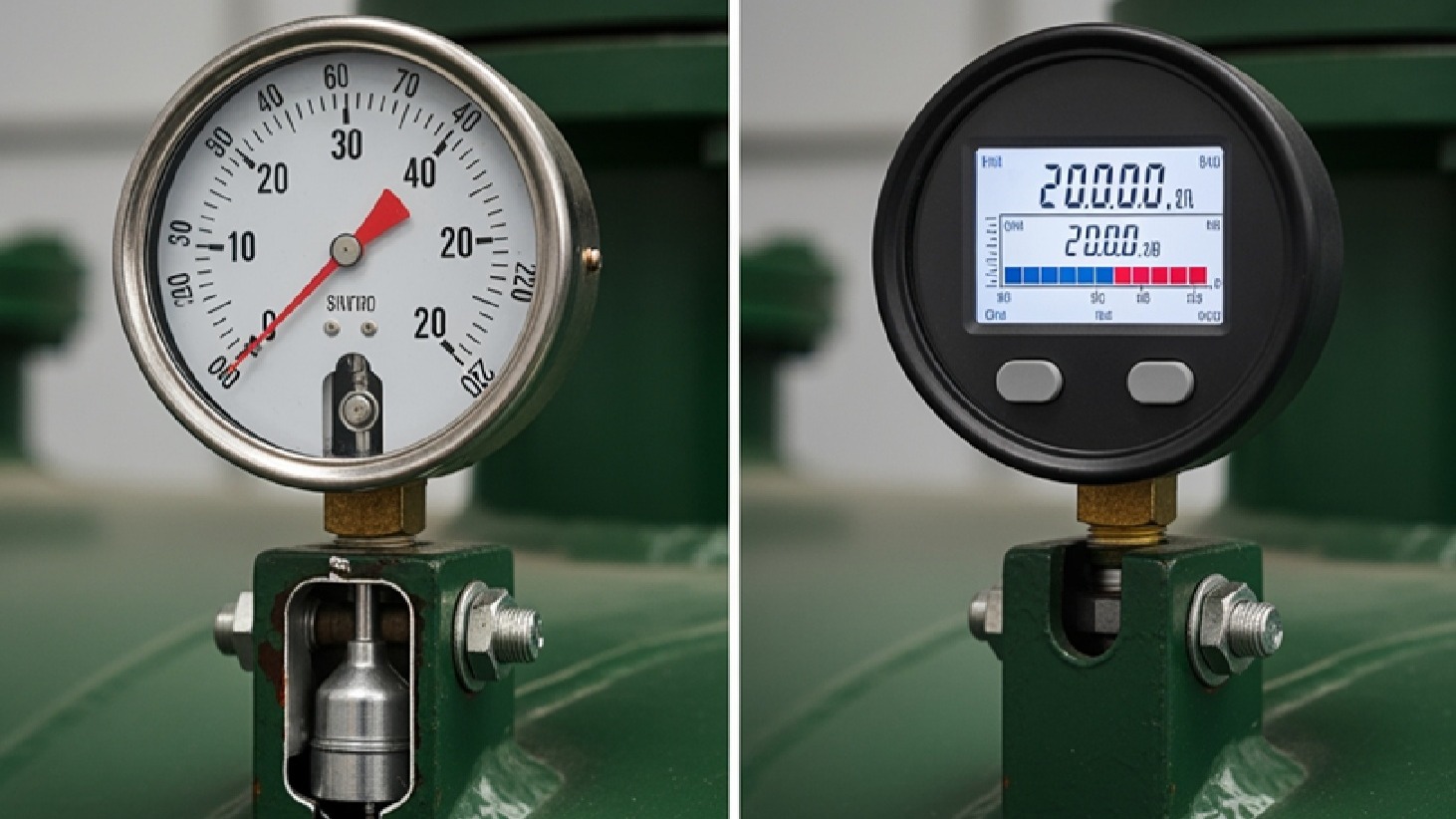
Mechanical gauges operate on a beautifully simple principle that hasn't changed much since the 1950s. A float sits on the surface of your oil, connected by an arm to a dial on the outside of your tank. As the oil level drops, the float descends, rotating the dial to show your remaining fuel. No batteries, no sensors, no complicated electronics, just physics and mechanical linkage.
The most common design uses a magnetic coupling. The float arm connects to a magnet inside the tank, which drives another magnet on the outside connected to your dial. This means the tank itself remains sealed; you're not drilling holes that penetrate both walls. The gauge typically mounts on top of the tank, though side-mounted versions exist for specific installations.
These oil tank gauges usually display your oil level in quarters: full, three-quarters, half, one-quarter, and empty. Some models include finer graduations, but the quarter-system remains standard because it matches how most people actually think about their oil supply. When you see the needle drop into the bottom quarter, you know it's time to order.
Advantages and Limitations
The mechanical simplicity creates genuine advantages. These gauges work in any weather; they function perfectly through Scottish winters that would kill most electronic devices. They need no power source, so there's nothing to go flat at the worst possible moment. Installation takes minutes if you have the right tank fitting, and many older tanks already have the mounting boss in place.
But this simplicity has limits. Mechanical gauges can only tell you what's happening right now, at the exact moment you walk outside to check. If you're away from home for a fortnight, you have no idea whether your oil is running low. They also require a clear line of sight. If your tank sits behind your garage or in a locked compound, checking the gauge becomes a deliberate task rather than a quick glance.
Accuracy varies with installation quality. A poorly fitted gauge will stick, giving false readings that can leave you genuinely surprised when the boiler cuts out. The float mechanism can also accumulate sludge over time, particularly in older tanks where sediment builds up. Gauges can read "half full" on tanks that contain perhaps 100 litres of usable oil beneath a layer of water and debris.
Electronic Oil Tank Gauges and Their Technology
Electronic gauges measure oil level through sensors rather than floats, though the specific technology varies between manufacturers. The most common systems use ultrasonic sensors mounted on top of the tank, sending sound waves down to the oil surface and calculating the distance based on echo time. Other designs use pressure sensors at the tank bottom or capacitance probes that measure the electrical properties of the oil column.
This sensor data feeds to a display unit, which might sit on your tank, be mounted on your house wall, or connect wirelessly to your home network. Modern systems often include smartphone apps, letting you check your oil level from anywhere with internet access. Some integrate with smart home systems, whilst others send text alerts when levels drop below your chosen threshold.
The sophistication extends beyond simple level reading. Electronic gauges can calculate your burn rate, how quickly you're using oil based on recent consumption. This lets them estimate when you'll need a refill, accounting for seasonal variations and usage patterns. Several systems supplied through heating controls manufacturers like EPH include this predictive feature, which proves particularly valuable for holiday home owners who need to schedule deliveries around occupancy.
Installation and Power Considerations
Installation complexity varies dramatically. Basic electronic gauges with wired displays install almost as easily as mechanical versions, you mount the sensor, run a cable to the display, and you're done. WiFi-enabled systems require network connectivity, which can prove challenging if your oil tank sits in a metal shed or 50 metres from your router. Countless "gauge won't connect" issues trace back to WiFi coverage rather than the gauge itself.
Battery life matters more than most people anticipate. Many electronic gauges run on standard AA batteries that last 12-24 months, but some use lithium cells that require specific replacements. The inconvenience isn't just the battery change; it's remembering to do it before the gauge stops working. Several customers only discovered their gauge had died when they ran out of oil and realised they'd been seeing the same reading for weeks.
The accuracy advantage of electronic gauges shows most clearly in large tanks. Where a mechanical gauge might show "half full" for 500 litres of oil variation in a 2,500-litre tank, an electronic system can display "1,247 litres remaining." This precision helps when planning deliveries, particularly if you're trying to take advantage of price fluctuations by ordering exactly when your tank reaches a specific level.
Comparing Reliability in Different Conditions
Reliability discussions often descend into tribal loyalty, mechanical advocates insist electronics always fail, whilst technology enthusiasts dismiss mechanical gauges as obsolete. The reality observed across thousands of installations is more nuanced and depends heavily on your specific circumstances.
Mechanical gauges fail in predictable ways. The most common issue is sticking; the float mechanism seizes due to sludge, corrosion, or a damaged bearing. This typically happens gradually, so you'll notice the gauge becoming sluggish before it stops working entirely. The magnetic coupling can also weaken over time, particularly on cheaper models, causing the external dial to lose synchronisation with the float position.
Temperature extremes affect mechanical gauges less than you'd expect. Components supplied to customers in the Highlands from manufacturers like Danfoss show mechanical gauges working flawlessly through winters that regularly hit minus fifteen. The all-mechanical design means there's nothing to freeze except the oil itself, and if your oil has frozen, you have bigger problems than gauge accuracy.
Electronic Gauge Challenges
Electronic gauges face different challenges. Battery failure tops the list, followed by sensor contamination and connectivity issues. Ultrasonic sensors can give false readings if condensation forms on the sensor face or if foam develops on the oil surface. This happens particularly in tanks that have just been filled; the turbulence creates bubbles that confuse the sensor until the oil settles.
WiFi connectivity proves surprisingly vulnerable to weather. Heavy rain or snow can disrupt the signal path between the tank and the house, particularly if your gauge uses a budget WiFi module. This doesn't damage the gauge, but it creates frustrating gaps in monitoring when you're trying to track consumption during cold weather, exactly when you need the data most.
The reliability equation changes with usage patterns. If you check your tank weekly and only need to know roughly how much oil remains, mechanical reliability wins. Suppose you need precise readings, remote monitoring, or consumption tracking. In that case, electronic gauges provide value that justifies their higher failure rate, provided you accept that "failure" often means changing batteries or resetting WiFi rather than a complete system breakdown.
Selecting Between Oil Tank Gauge Types
Property occupancy patterns strongly favour electronic gauges for part-time residents. Holiday home owners need remote monitoring to avoid returning to a frozen house because the oil ran out mid-winter. Landlords managing multiple properties can check all their tanks from one dashboard. For these situations, the electronic gauge isn't a luxury; it's essential infrastructure that prevents expensive problems.
Budget constraints create genuine decisions. If you're choosing between a £30 mechanical gauge and a £250 electronic system, the mechanical gauge might be the only realistic option. But if you're comparing a £60 quality mechanical gauge to a £120 basic electronic model, the price difference becomes less significant relative to the convenience gain.
Tank size influences the value of precision. In a 1,200-litre tank, the difference between "quarter full" and "287 litres" matters less than in a 3,500-litre tank, where "half full" could mean anything from 1,500 to 2,000 litres. Larger tanks benefit more from the precision electronic gauges provide, particularly when you're trying to optimise delivery timing around price fluctuations.
Your heating system's reliability affects how much you need gauge accuracy. If you're running a modern condensing boiler with excellent controls from suppliers like Honeywell, your oil consumption will be predictable, and a mechanical gauge provides adequate information. If your system is older or less efficient, the consumption tracking electronic gauges offer help you spot problems early. Andrews heating systems also demonstrate this predictable consumption pattern.
Practical Tips for Whichever System You Choose
Regardless of which gauge type you select, proper installation determines whether you'll be satisfied or frustrated. For mechanical gauges, ensure the float has a full range of motion. Installations exist where the float hits the tank bottom or top before the gauge reads empty or full, rendering the readings meaningless. Test the gauge by filling the tank and watching the reading change smoothly as the level rises.
Electronic gauge positioning requires more thought. Ultrasonic sensors need mounting directly above the oil surface with nothing obstructing the signal path. Side-mounted fill pipes, internal baffles, or floating debris can all interfere with readings. Take time to identify the optimal sensor position before drilling mounting holes. For WiFi models, test signal strength at the tank location before committing to the installation.
Calibration and Maintenance
Calibration matters particularly for electronic systems. Most require you to tell them your tank dimensions so they can convert sensor readings to volume. Measure carefully, an error of 10cm in tank height translates to hundreds of litres of error in volume calculation. Some gauges let you calibrate using known fill amounts, which provides more accuracy than relying on manufacturer specifications.
Regular maintenance prevents the most common failures. For mechanical gauges, this means checking that the dial moves smoothly and the glass face remains clean enough to read. Annual inspection takes two minutes and catches problems before they leave you guessing about your oil level. Electronic gauges need battery checks and sensor cleaning; condensation and dirt on the sensor face cause more problems than actual failures.
Keep installation documentation accessible. Electronic gauges particularly need this; you'll forget the WiFi password you used, lose the app download link, or need the sensor serial number for warranty claims. Photograph the installation instructions and store them in the same place you keep your boiler service records.
Consider backup systems for critical installations. Some customers fit both a mechanical and electronic gauge, using the mechanical as a backup if the electronic system fails. This adds cost but provides redundancy for situations where running out of oil creates serious problems. At a minimum, know how to manually check your oil level using a dipstick if both gauge types fail.
Understanding Common Problems and Solutions
Mechanical gauge sticking ranks as the most common complaint. The needle stops moving or updates only when you tap the gauge face. This usually indicates sludge accumulation on the float mechanism or corrosion in the pivot bearing. Sometimes you can free a stuck gauge by gently working the float arm through its full range, but often you're better off replacing the unit than trying to clean internal mechanisms.
Electronic gauges displaying obviously wrong readings, showing full when you know the tank is half empty, or jumping between different levels, typically indicate sensor problems. Condensation on ultrasonic sensors causes this, as does foam on the oil surface. The solution is usually cleaning the sensor face with a soft cloth and ensuring proper drainage of any water that accumulates in the sensor housing.
Connectivity issues plague WiFi-enabled gauges more than any actual measurement problem. The gauge works perfectly but won't connect to your network or keeps dropping offline. Before assuming the gauge is faulty, check whether other WiFi devices work at that location. Countless "faulty gauge" issues have been solved by adding a WiFi extender or repositioning the router.
Battery and Calibration Issues
Battery drains faster than expected, usually points to connectivity problems rather than battery issues. If your gauge constantly struggles to maintain a WiFi connection, it burns through batteries trying to reconnect. Moving to a location with a stronger signal often extends battery life dramatically. Some gauges also offer "low power mode" settings that reduce update frequency to conserve batteries.
False low-level alerts from electronic systems can indicate sensor drift or calibration errors. If you're getting "low oil" warnings when you know the tank is half full, recalibrate the system using the manufacturer's procedure. This typically involves either entering tank dimensions again or performing a "full tank" calibration after a delivery.
The Future of Oil Tank Monitoring
The technology continues evolving, though oil heating itself faces an uncertain long-term future as the UK moves toward heat pumps and alternative heating systems. Current development focuses on integration rather than revolutionary new sensing technology. Gauges that connect to home energy management systems let you view oil consumption alongside electricity and gas usage, providing a complete picture of your home's energy profile.
Predictive algorithms are becoming more sophisticated. Rather than simply calculating "days until empty" based on recent usage, newer systems account for weather forecasts, historical seasonal patterns, and even your calendar if you've shared it. The gauge knows you'll use more oil next week when temperatures drop and can suggest ordering now rather than waiting.
Supplier integration represents the next convenience step. Several oil suppliers now offer systems where your gauge automatically requests a delivery when levels drop below your threshold, subject to your approval. This removes the mental overhead of monitoring and ordering, though it requires trust in both the gauge accuracy and the supplier's pricing.
The technology might become obsolete before it wears out. Government plans to phase out oil heating in new builds and eventually existing homes, which means today's gauge might outlast the heating system it monitors. This doesn't change the purchase decision if you need a gauge now, but it suggests favouring lower-cost options over expensive systems whose advanced features you might never fully utilise.
Making the Right Choice for Your System
Oil tank gauge types serve different needs, and understanding these differences prevents expensive mistakes. Mechanical gauges provide reliable, weather-proof monitoring for permanently occupied properties where someone can physically check the tank regularly. Their simplicity translates to longevity; a quality mechanical gauge installed correctly can last decades without maintenance.
Electronic gauges excel when you need remote monitoring, precise readings, or consumption tracking. They're essential for holiday homes, rental properties, and situations where physical tank access is inconvenient. The additional cost buys convenience and data, but you'll trade some reliability for these features.
The best installations sometimes use both. A mechanical gauge provides immediate visual confirmation when you're on-site, whilst an electronic system offers remote monitoring and alerts. This redundancy costs more initially but eliminates the single point of failure that leaves you guessing about your oil level at the worst possible moment.
Quality matters regardless of type. Cheap mechanical gauges stick and corrode. Budget electronic systems lose connectivity or drain batteries rapidly. Investing in proven components from established manufacturers ensures your gauge actually solves the problem it's meant to address rather than creating new frustrations.
For quality oil tank monitoring solutions and heating system components that work reliably in UK conditions, Heating and Plumbing World stocks a comprehensive range from trusted manufacturers. Need advice on selecting the right gauge type for your specific tank and usage pattern? Get in touch with specialists who understand both mechanical and electronic monitoring systems and can recommend solutions that match your requirements.