

Old Plumbing Fitting Details for Replacement Stock Orders
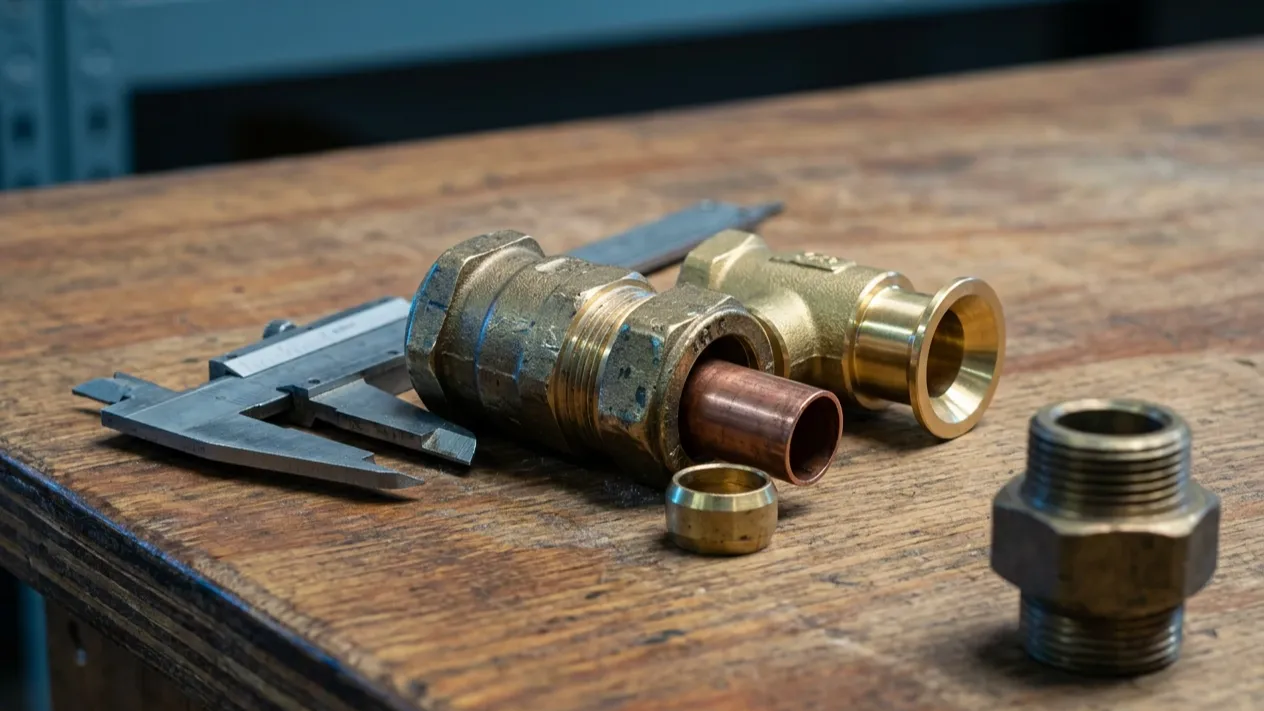
Keep the failed fitting where it is safely available. Its dimensions, connections and legible marks can help identify a replacement, but they do not prove that the old part was suitable. Service duty means the fluid or system the fitting serves, such as drinking water or heating. That duty and the connection requirements need to agree with the proposed replacement. Leave any removal to a competent person who can make the system safe.
If the old fitting has already been discarded, record which details remain unconfirmed. A measurement or part number from a nearby fitting should not be treated as evidence for the missing one. A body that is still installed but inaccessible presents a different gap: there may be an earlier photograph or maintenance record tied to that exact location. State whether the evidence describes the fitting itself or only the surrounding installation. That distinction matters when the original cannot be inspected.
Read The Body Before You Name A Replacement
With a safely removed fitting on a stable surface, record the pipe’s outside diameter, the type of connection, and any material or maker marks. Read an identification plate, if present, for its printed product details. A compression connection uses a nut to squeeze a sealing ring, called an olive, around the pipe. Put these details in the order notes before naming a replacement.
Where a mark remains legible, record it before cleaning or handling obscures it. Avoid grinding or scraping a stamp to reveal characters. If paint, corrosion or a break has made it unreadable, note that limitation rather than guessing a brand or model when comparing plumbing stock. Safely retained fragments may still show a partial mark or connection.
For a partial stamp, copy only the characters you can distinguish and show gaps explicitly. Keep a possible reading separate from the transcription, especially where one damaged character could change a model suffix: the final letters or numbers identifying a version. If a fragment carries the final letters, associate it with the body it came from rather than completing another fitting’s mark from memory.
If you have the safely removed fitting, keep it available for comparison. Take square-on photographs of the stamp face and each end, plus the pipe it came from if safely accessible. Include an overall view so the close-ups can be tied to the same body.
Use a confirmed measurement for the old fitting’s pipe connection. If the relevant pipe is concealed, keep its size unconfirmed unless an accessible measurement is established to belong to the same unchanged run.
An earlier photograph can record a feature that is now concealed, but note when it was taken and whether alterations have occurred since. Describe evidence as historical where the present connection has not been checked. This preserves the useful old record without presenting a past arrangement as an observation of today’s fitting.
Separate Connections, Valve Function and Operation
Record the end connections separately from what the valve does and how it is operated. A lever ball valve uses a handle to turn an internal ball that opens or closes the flow. It can have compression or threaded ends, so the handle alone does not establish the joint.
Write the confirmed connection description, such as BSP (British Standard Pipe) thread or compression, rather than calling it standard. Keep any safely removed nut or olive with the old body as identification evidence, but check whether new components are required for the replacement.
Record any readable thread designation alongside the model reference. Rc identifies a female tapered thread: an internal thread that tapers rather than staying the same diameter. BSPT means British Standard Pipe Tapered. A lever-operated valve can have threaded or compression ends, so an old note saying only lever valve leaves the connection unresolved. Keep the thread designation in the order notes rather than reducing it to female thread, and confirm both ends before choosing replacement stock.
If the assembly changes between push-fit, where the pipe is held by an internal gripping mechanism, and compression, describe each connection separately. A note that only says mixed leaves the transition unidentified.
For a body with different connections at its two ends, record each end’s size and sealing arrangement separately. A compression end seals by squeezing an olive around the pipe; a female flat-seal threaded end seals against a flat face rather than along the thread. G identifies a parallel BSPP thread, meaning British Standard Pipe Parallel, rather than the tapered Rc thread. Keep that designation separate from the sealing description. If two possible replacements share the same threaded end but have different compression sizes, the thread alone cannot settle the order. Confirm the old assembly’s compression pipe size before choosing between them.
Mixed Metals And Marks That Matter
Record legible material and approval marks without inferring the metal from colour alone. Drinking water, heating and discharge are different duties. A mark on the old body is one identification input; it does not establish that a different product is suitable for the same use.
If the old marking and current product information disagree, pause selection until the actual duty and specification have been reconciled. The failed part may have been unsuitable or superseded; its presence in the installation does not override the requirements for the replacement. Drinking-water fittings in England and Wales are subject to the water fittings regulations.
When the Fitting Is Unidentified or Obsolete
If the description is incomplete, use available marks, dimensions and photographs to narrow the identification before choosing a product. A name alone is not a specification.
If the fitting appears to be a special or obsolete pattern, record the exact marks and any dimensions that differ from current products. A near-fit may require a different connection arrangement, which needs confirming rather than assuming the current part is a direct replacement.
For replacement stock orders, keep the obsolete reference alongside the current candidate instead of overwriting it with a modern name. Record which feature has changed: the connection description, the body dimensions or the operating arrangement. If no current manufacturer information establishes a successor, describe the candidate by its own specification. That preserves a distinction between identifying the old pattern and selecting a different arrangement for assessment.
Conflicting Measurements and Previous Replacements
If making a written enquiry, separate the identifying fields from the account of the leak. Fault history can explain why a replacement is being considered, but it does not identify the connections or the required product.
For a previous replacement, distinguish the invoice date from the date the failed body was actually fitted, if those records are available. A purchase reference without a clear link to that location remains background information. Where a later repair introduced another body, keep the sequence visible so the older invoice is not mistaken for the identity of the part now removed.
Where two measurements conflict, repeat the measurement at the identified connection before relying on either value. Keep the disputed detail marked as unconfirmed until it is resolved.
Record what each disputed measurement describes. One figure may refer to the complete old assembly and another to the remaining body after a broken end was lost. Those are different reference points, not necessarily competing readings of the same feature. Identify the surviving surfaces before requesting a fresh comparison.
If this location has suffered repeated failures, keep the previous invoice or product reference with the current record. Matching that number can establish what was ordered before, but it is not a reason to repeat the order automatically. The cause of failure and present suitability need appropriate assessment.
Photographs of Damaged or Incomplete Fittings
Use enough light to show the connection details without glare obscuring them. If the images remain unclear, identify what cannot be read rather than estimating a size from the photograph.
If part of an end has broken away, label the image as incomplete and identify the missing portion. A surviving fragment can preserve a thread or part of a stamp without preserving the original overall length. Keep those observations separate so the photographed remnant is not treated as a complete dimensional sample.
Place a ruler beside the relevant feature in the same plane when it is safe to do so. A scale closer to the camera can distort the comparison, and a photograph should support a recorded measurement rather than replace it.
For several old fittings, keep each body or photograph set with its own record. Two parts with the same nominal size, the standard size designation rather than every measured dimension, can still have different connections. They should remain separate order lines.
Give each old body a simple reference and use it consistently on its photographs and notes. Keep loose fragments associated only where their origin is known; mark an unassigned piece as unassigned. If two nearly identical bodies came from different positions, preserve both position records. A complete mark on one should not silently fill a missing mark on the other.
Compare Mixed Ends and Offset Centres
For an old fitting with offset ends, the openings are displaced sideways rather than sharing one straight centreline. Record that offset and the positions of the centres of both openings in millimetres. Compare these with the proposed replacement’s shape and manufacturer drawings. A straight-bodied replacement may be unsuitable if its connection centres cannot align with the existing arrangement; the measurements must establish whether it can fit.
Write both end types if they differ. A body with a 15 mm compression end and a 22 mm solder end, joined using solder, needs both descriptions. Calling it only a 22 mm fitting hides the smaller connection.
For the offset comparison, state where each dimension begins and ends. Follow the dimension lines on the actual drawing to identify the surfaces or centres being measured. If a line ends at an inner mating face or pipe stop, where the connected part meets or enters the fitting, do not treat it as a measurement to the outer end. Compare the same reference points on the old fitting and proposed replacement, and retain a simple sketch showing which end is which when damage obscures that relationship.
Conclusion
A useful replacement stock order makes both the known details and the uncertainties visible. Check the old-part evidence against the current product specification and actual duty rather than relying on resemblance. If the fitting is obsolete, the mark is unreadable or the connections still do not align, contact us with the available details before completing the order. Where an old code leads to a current candidate, keep the resolved code and the reason for accepting that candidate together. Where it leads to several variants, identify the missing distinction before purchase. An enquiry can then ask a precise stock question, such as whether the specified connection combination is listed, rather than asking for an unnamed equivalent.