

Pressure Gauge Sizes: 40mm, 50mm and 63mm Dial Options
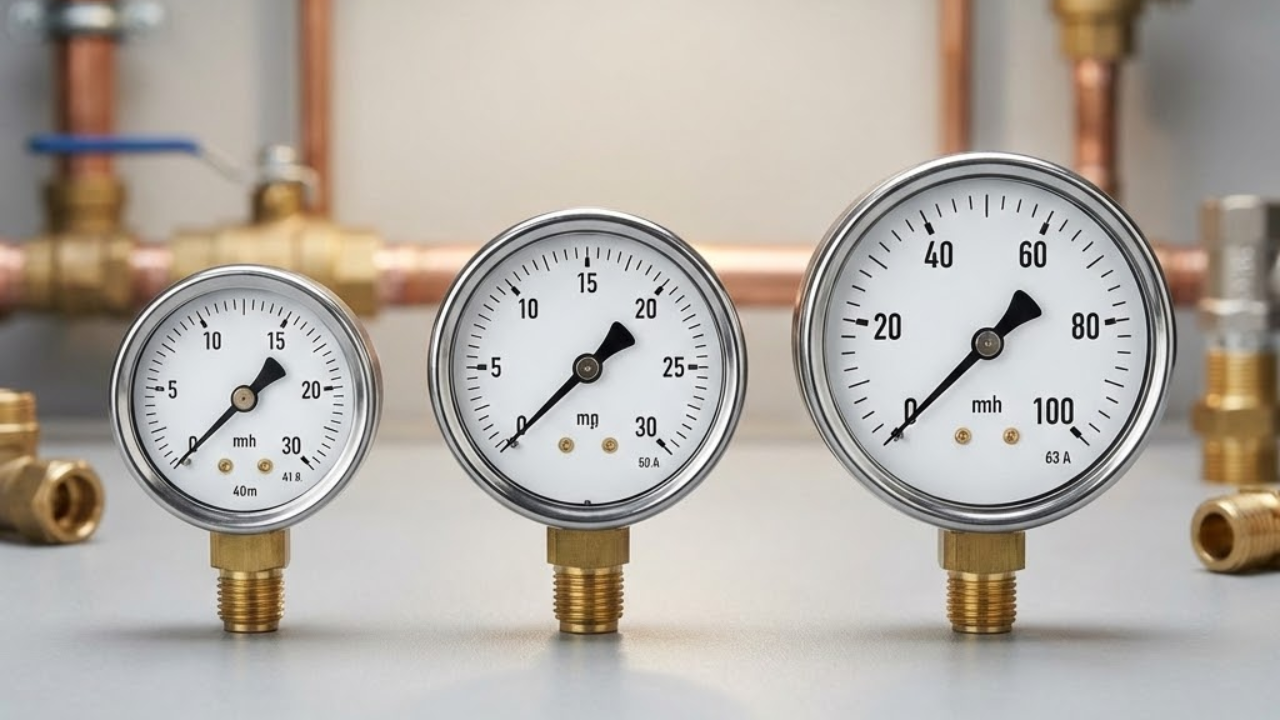
Walk into any plant room, and you'll see pressure gauges mounted on boilers, buffer vessels, and pump sets. Not every gauge is the same size, and picking the wrong dial diameter is a common mistake. The size directly affects how easily you can read it, where you can mount it, and if your system monitoring is effective. Pressure gauge dial sizes typically come in three standard options: 40mm, 50mm, and 63mm. For heating engineers and facilities managers, understanding these sizes ensures you select the right gauge for the job, not just one that fits the thread connection.
Why Dial Size Matters in Real Installations
The dial's diameter determines how easily an engineer can read the pressure from a distance. A small 40mm gauge might fit in a cramped boiler cupboard. However, a large 63mm dial is essential for accurate monitoring on a commercial unit mounted high on a wall.
Readability affects both safety and efficiency. A gauge that is too small for its location can lead to guesswork, misdiagnosis, and wasted site visits. When you get the size right, you can spot system faults faster and work from a safer distance with confidence in your reading. Think of it like a road sign—you wouldn't put a tiny street sign on a motorway. The same principle applies to gauges.
Dial size also impacts the gauge's physical size and weight. Larger dials need more mounting space and may require extra support. Smaller gauges are better for tight installations but are much harder to read in low light or from more than an arm's length away. For example, a facilities manager once complained about repeated pressure issues on a heating system. The engineer kept finding the pressure "about right." It turned out the 40mm gauge was mounted three metres high, and the engineer was guessing the reading from the floor. Replacing it with a 63mm dial showed the system was running 0.3 bar too low, which was starving the upper floors.
Standard Dial Sizes: 40mm, 50mm, and 63mm Explained
Most heating and plumbing systems use three main dial diameters, which are measured across the face of the gauge.
40mm Dial Gauges
The 40mm dial is the smallest standard option, perfect for installations where space is very tight.
- Key Applications: Domestic gas and oil boilers, wall-hung pressurisation units, compact expansion vessel installations, and manifold systems with limited clearance.
- Trade-off: Readability quickly drops off past one or two metres. They become a problem in dimly lit plant rooms or when mounted high up.
- Accuracy Note: Scale markings are tighter; a 0-10 bar range might have graduations every 0.5 bar, making it difficult to get precise readings.
50mm Dial Gauges
The 50mm dial offers a good balance between small size and easy reading. This is the most common size in light commercial and larger domestic systems.
- Typical Uses: Commercial boiler installations, pressurisation and expansion systems, buffer tanks and thermal stores, and pump sets.
- Best for: Gauges mounted at or slightly above eye level, allowing engineers to read them accurately from a few metres away.
- Accuracy Note: The larger dial face allows for clearer scale markings, usually 0.2 bar intervals on a 0-10 bar range, which improves reading accuracy.
63mm Dial Gauges
The 63mm dial is the largest standard option, designed for maximum visibility in challenging environments.
- Best Suited For: Large commercial boiler houses, industrial systems, and locations requiring readings from a distance.
- Precision: The larger face makes it easier to spot small pressure changes. You can get 0.1 bar graduations on a 0-6 bar range, allowing you to detect a 0.05 bar drop immediately.
- Mounting Note: They are bulkier and heavier, so they require secure mounting and enough clearance (about 70-80mm).
Choosing the Right Size for Your Application
Selecting the correct dial size should be based on the installation environment and system needs.
- Mounting Height and Distance:
- 63mm dial is best if the gauge is mounted above head height or more than two metres from the reading spot.
- 50mm dial is a good compromise for eye-level, well-lit areas.
- 40mm dial should only be used when space is severely restricted and you will read the gauge up close.
- Lighting Conditions: Poor lighting makes small dials harder to read. For basement plant rooms, you need larger dials with bold markings. Colour-coded zones (green/red) are only useful if clearly visible from your working position.
- System Complexity: Using uniform dial sizes improves workflow on systems with multiple gauges. For example, Grundfos pump sets often have suction and discharge monitoring. Consistent sizes, like 63mm, help you scan readings faster.
- Physical Constraints: A 63mm dial needs about 70-80mm of clearance. In tight spots, a 40mm gauge might be the only option.
- Connection Sizes:
- 40mm and 50mm dials typically use 1/4" BSP or 1/8" BSP.
- 63mm dials often feature 1/2" BSP connections.
- Always check the thread size and entry position (bottom-entry or back-entry). Larger dials require adequately supported pipework to handle the extra strain.
- Pressure Range: Match the pressure range to the system's operating pressure. For a typical sealed heating system running at 1.5-2 bar, a gauge with a 0-4 bar or 0-6 bar range provides far better resolution than a 0-10 bar gauge. The needle movement is more pronounced, and small pressure drops are immediately visible. When you're setting a Kingspan pressurisation unit to 3.2 bar precisely, that extra dial real estate matters.
Practical Scenarios: Which Size Fits Where?
- Domestic Boiler: In a standard cupboard at chest height. A 40mm dial is perfectly adequate.
- Commercial Unit: On a mezzanine level, read from the ground (4 metres away). A 63mm dial is essential.
- Buffer Tank: At eye level, 2 metres from controls. A 50mm dial is the sweet spot for clear, compact monitoring.
Gauge Accuracy and Dial Size
Dial size does not control the gauge's official accuracy class. However, larger dials make it easier to read precisely between the marked lines.
- A 63mm dial with 1.6% accuracy provides both the visual clarity and the mechanical precision needed for critical monitoring.
- A 40mm dial with 2.5% accuracy is fine for basic domestic pressures but may be inadequate for multi-zone commercial commissioning where precision matters.
When to Upgrade or Replace Gauges
It's time to upgrade the dial size if you are squinting, guessing readings, finding it hard to spot pressure changes, or using a torch to check pressure. The replacement is straightforward if the thread size and entry type match, and the improved operational confidence and safety are worth the cost. Budget £15-£30 for a quality 50mm dial gauge or 63mm dial from Danfoss or Altecnic Ltd. You'll wonder why you tolerated the old gauge for so long.
Sourcing and Design
Ensure clarity on the size, range, connection, and accuracy class when specifying a gauge. Reputable suppliers like Heating and Plumbing World stock a comprehensive range of dial sizes across leading brands. A poorly chosen dial size makes system monitoring harder. White or cream dials with black markings offer high contrast. Colour-coded zones (green/red) work well on the larger 63mm dial face but are barely visible on a 40mm dial. Choose a simple, uncluttered scale design for faster reading.
Conclusion
The choice between 40mm, 50mm, and 63mm dial gauges is critical for effective system monitoring.
- 40mm dial gauges: For compact, close-range jobs.
- 50mm dial gauges: The best balance for most commercial and larger domestic systems.
- 63mm dial gauges: Essential for high-mounted, distant, or critical monitoring points.
Always match the dial size to the installation environment, lighting, and mounting height. If you're unsure which size fits your project, contact us for guidance tailored to your specific system requirements.