

Programmable Thermostats vs Basic Controls: Energy Savings Analysis
Most heating engineers know the frustration: a client rings you three months after a boiler install, complaining their gas bills haven't dropped as expected. You've fitted a high-efficiency condensing boiler, balanced the system perfectly, and set the controls to what you thought were sensible parameters. The problem is that they're still using the basic mechanical timer and room stat that came with the property decades ago.
The difference between basic heating controls and modern programmable thermostats isn't just about convenience or fancy features. It's about real, measurable energy savings that can cut a domestic heating bill by 20-30% annually. For a typical UK household spending £1,200 per year on heating, that's £240-£360 back in their pocket.
Understanding why programmable controls save energy-and more importantly, how much they save in different applications-requires looking beyond the marketing claims and into the actual heating patterns of real buildings. It's the difference between a system that simply runs and a system that performs.
The Basic Control Problem
Traditional heating controls typically consist of three components: a mechanical heating timer, a single room thermostat, and possibly smart radiator valves. This setup gives you crude time-based control and basic temperature regulation, but it's fundamentally inflexible.
A mechanical heating timer operates on fixed on/off periods, usually in 15 or 30-minute increments. You might set heating to come on at 06:00 and off at 08:00, then on again at 17:00 and off at 22:00. That's fine if your routine never changes, but whose routine never changes? The system can't adapt to external conditions. If it's an unseasonably mild March day and the house is already at 18°C when the timer clicks on, the boiler fires up anyway.
Furthermore, a mechanical heating timer can't differentiate between weekdays and weekends. Many households leave for work at 08:00 Monday to Friday but are home all Saturday morning. With a basic timer, you either heat an empty house on weekdays or sit in the cold on Saturday. Room thermostats in the wrong location cause chronic inefficiency too. A stat mounted in a draughty hallway that never gets warm ensures the boiler runs constantly trying to satisfy an impossible target.
How Programmable Thermostats Actually Work
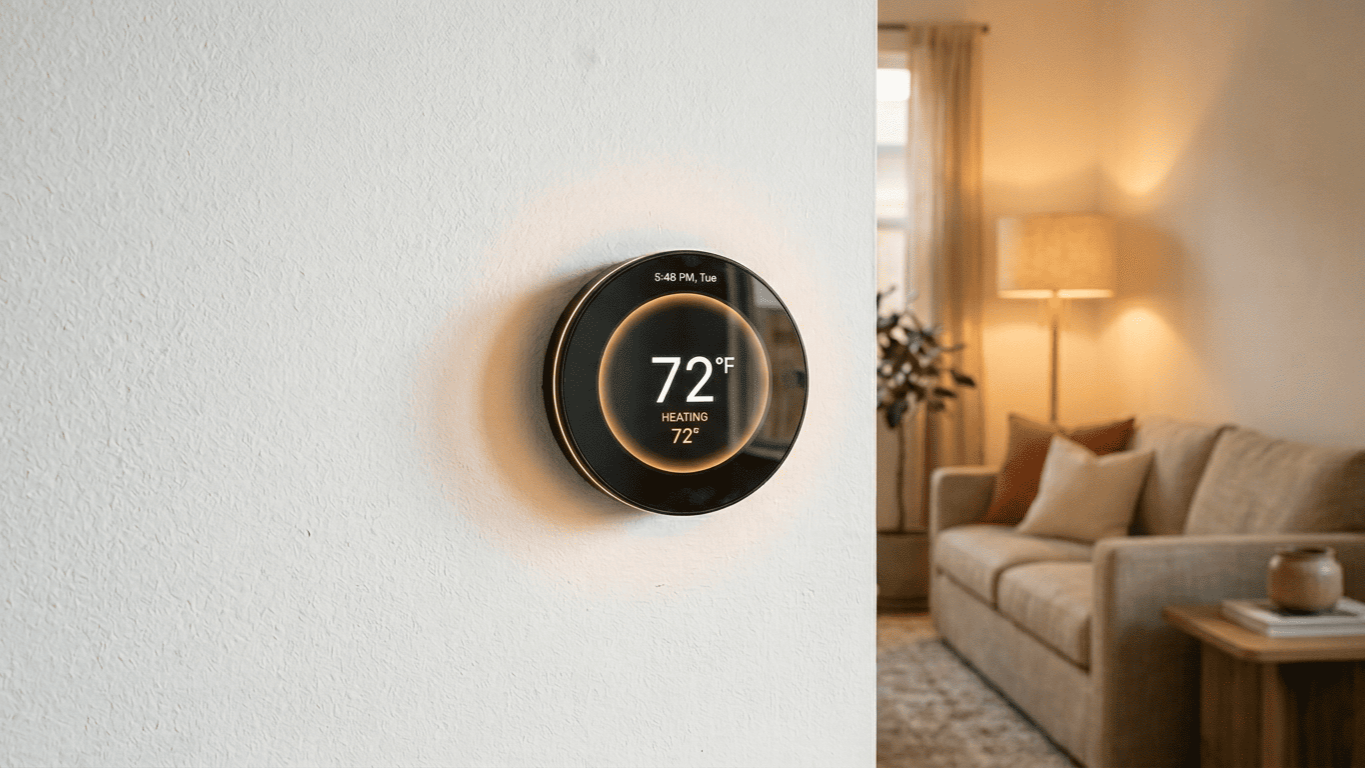
Modern programmable thermostats-whether traditional seven-day digital models or smart learning systems-give you granular control over heating schedules and temperature setpoints. The fundamental difference is temporal precision and spatial awareness.
A decent programmable thermostat allows you to set multiple heating periods per day, with different schedules for each day of the week. Temperature compensation is where real savings start. Advanced stats monitor the rate of temperature change in the property. If the house is warming up faster than expected, the system can delay the next heating cycle. This prevents overshoot-that wasteful period where the house gets hotter than needed because the boiler couldn't respond quickly enough.
The optimum start function learns how long your specific property takes to heat up and cool down. Instead of firing the boiler at 06:00 to reach 20°C by 07:00, the system calculates that it only needs to start at 06:32 on a mild morning. Think of it like setting off for a meeting. Basic controls are like leaving at the same time every day regardless of traffic; you either arrive too early or you're late and stressed. The optimum start function is like checking live traffic and leaving at precisely the right moment to arrive on time.
Quantifying The Energy Savings
The actual energy reduction you'll achieve depends on property type, insulation levels, and occupancy patterns. However, data from trials across the UK provides a reliable baseline for what these upgrades deliver.
Upgrading from a mechanical heating timer to a programmable thermostat typically results in a 10-15% reduction in heating energy consumption. Adding zone control, such as separate upstairs and downstairs programming, provides an additional 5-8% reduction. If you move further to a smart learning thermostat with weather compensation, you can realistically achieve 18-25% total energy savings without changing the boiler itself.
At Heating and Plumbing World, we often see that for a typical three-bedroom semi-detached house using 15,000 kWh of gas annually, a multi-zone programmable system can save nearly 3,750 kWh. At current gas prices, that is a substantial saving of over £200 per year. Installation costs for a mid-range unit typically run £200-£350, giving you a payback period of roughly two years. After that, it's pure profit for the homeowner.
The Occupancy Pattern Factor
Energy savings from programmable controls aren't uniform across all households. The biggest gains come from properties with predictable absence periods-homes that are genuinely empty for extended periods during the day.
If a working couple leaves at 07:30 and returns at 18:00, the house is empty for over ten hours. A basic timer might keep heating on until 09:00 and start again at 17:00, heating an empty house for 2.5 hours every single day. A smart learning thermostat eliminates this waste by cutting off exactly when the occupants leave. Over a 26-week heating season, that is hundreds of hours of eliminated runtime.
Even for retired couples who are home most days, the main gains come from the optimum start function preventing overshoot and more precise temperature control in different rooms. Being able to have the bedroom cooler at night while keeping the bathroom warm for morning showers is a quality-of-life upgrade that basic controls simply can't deliver.
Zone Control: The Multiplier Effect
Single-zone heating control-one thermostat governing the entire house-is inherently wasteful in any property larger than a one-bedroom flat. Different rooms have different heating requirements based on use patterns and solar gain.
Two-zone control allows you to match heating delivery to actual demand. Most households don't need bedrooms heated during the day, and you don't need the living room at full temperature at 02:00. We recently saw a four-bedroom house retrofitted with heating controls that divided the floors. Prior to the upgrade, the whole house was heated to 20°C whenever the system ran. Post-upgrade, the occupants achieved a 23% reduction in gas consumption simply by not heating the upstairs during the day.
Each additional zone typically requires an expansion vessel installation check and the addition of zone valves. While the initial cost is higher, the ability to prevent heating 40 square metres of unused space for six hours a day ensures the maths works out quickly.
Smart Thermostats: Worth The Premium?
A smart learning thermostat with geofencing and weather compensation represents the current top tier of domestic heating control. They automate the optimisation process that requires manual programming with traditional stats.
Geofencing uses your smartphone location to detect when you're approaching home, triggering heating to start so the house is warm when you arrive. Conversely, if everyone leaves unexpectedly, the system can enter an away mode. This ensures you never pay to heat an empty building if your plans change. Integrating these with high-efficiency heating pumps further refines the system's electrical and thermal consumption.
The additional savings from smart features typically add another 3-7% on top of what you'd achieve with a standard programmable stat. For larger properties, using radiator heating system components controlled by smart TRVs can push these savings even higher. For most households, that is an extra £30-£60 per year, making the investment well worth the upfront cost.
Common Installation Mistakes That Kill Savings
Even the most sophisticated programmable thermostats can't save energy if they are installed poorly. Thermostat positioning is the most common error. The stat needs to be in a room that's representative of the whole zone, away from heat sources and draughts.
On a recent job, a client had fitted a smart learning thermostat themselves but complained it was "useless" because the house never got warm. It turned out they'd wired it incorrectly, so it was calling for heat but the signal wasn't reaching the boiler. The learning algorithm had concluded the house was always at temperature because it never detected the boiler firing, and it eventually stopped calling for heat entirely. It's a classic example of why professional commissioning matters.
Handing over a sophisticated stat with a quick "it's all set up" doesn't work. Clients need to understand how to make simple schedule adjustments. They also need to know why they shouldn't just whack it up to 25°C when they're cold; it doesn't heat the house faster, it just overshoots the target and wastes money.
Integration With Modern Boilers
Modern condensing boilers work most efficiently when they are modulating rather than cycling on and off at full power. A boiler modulating control system using OpenTherm allows compatible thermostats to send proportional signals to the boiler.
A traditional thermostat works like a light switch: below setpoint, the boiler fires at maximum; above setpoint, it's off. A boiler modulating control sends variable signals, such as "we need 30% of maximum output." The boiler responds by modulating its burner, maintaining steady, efficient combustion. The efficiency gain from this type of control is typically 5-8% because the boiler spends more time in condensing mode.
If you're specifying a new system, ensuring the boiler and thermostat are compatible is a no-brainer. It keeps the boiler recovering latent heat from flue gases for longer periods and avoids the inefficient purge cycles that occur every time a system starts and stops.
Conclusion
Cutting heating bills by 20% or more often starts with the controls rather than the boiler itself. By replacing a crude mechanical heating timer with a precise programmable or smart system, you eliminate the waste of heating empty rooms and unneeded periods.
The comfort dividend is also significant. Being able to wake to a warm bathroom while keeping bedrooms cool for better sleep is a quality-of-life upgrade that makes these systems worth the investment. Each step in optimisation compounds the last, leading to a system that is cheaper to run and more reliable.
If you're looking to upgrade your system controls, please reach out to our experts for advice on selecting the most compatible components for your property.