

Pump Head Calculations For Multi-Storey Buildings: DHW Circulation
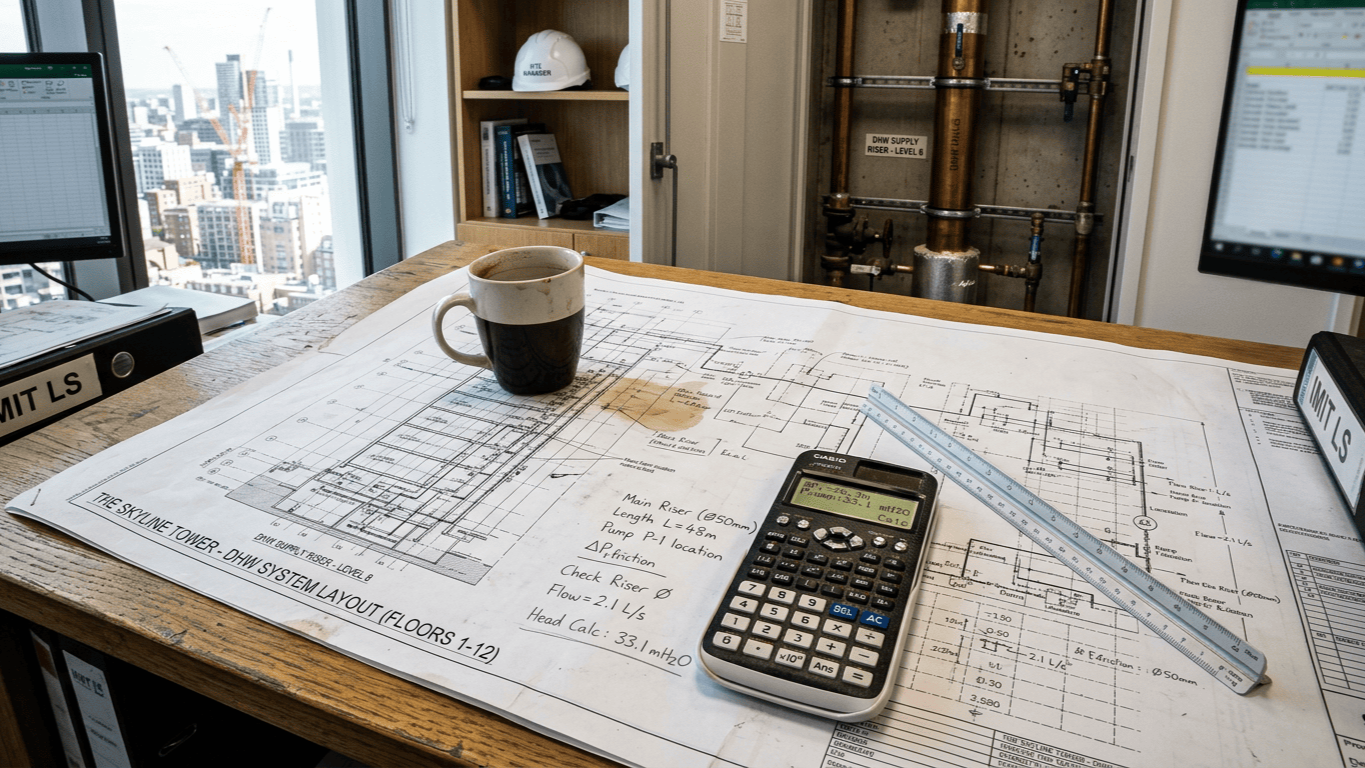
Getting the pump head calculation wrong in a domestic hot water (DHW) circulation system is a common error. It doesn't just mean lukewarm taps on the top floor. Instead, it leads to wasted energy, tenant complaints, and expensive call-backs. We've seen systems fail because someone guessed at the head requirements or copied figures from a different building type.
The physics remains the same, but the stakes have certainly increased. Modern tall buildings demand consistent hot water delivery across every floor and every tap. Achieving this requires understanding vertical lift, friction losses, and flow rates. You must account for every bend and valve between your plant room and the furthest draw-off point. Executing accurate pump head calculations for multi-storey buildings ensures your system actually works when the building goes live.
Think of a circulation pump like a hiker climbing a steep mountain with a heavy backpack. The vertical climb is your static height, but the weight of the pack is the friction and resistance from the pipes. If the hiker isn't strong enough to handle both, they will never reach the summit. Similarly, your pump must be powerful enough to overcome both the building height and the internal system resistance to deliver hot water to the penthouse.
Why DHW Circulation Matters In Tall Buildings
At Heating and Plumbing World, we know that circulation systems exist for one reason. They eliminate the frustrating wait for hot water at remote taps. Without these systems, users on upper floors would run taps for minutes while cold water clears the pipes. This wastes thousands of litres of water annually and creates comfort issues in hotels and hospitals.
The pump's job is to continuously move hot water through the loop to maintain a steady temperature. However, many installers forget that the pump isn't just fighting height. It is also fighting friction in every metre of pipe and resistance through every fitting. Heat loss also affects the fluid properties as the water moves further from the heat source.
If you get your pump head calculations for multi-storey buildings wrong, you will face two bad outcomes. You'll either undersize the pump, leading to inadequate flow, or you'll oversize it. Oversized pumps waste energy and often cause noisy pipes. Neither option is acceptable when you are three months into operation and facing tenant complaints.
The Components Of Total Pump Head
Total head for a DHW system comprises three main elements that you must sum together. Static head represents the vertical height the pump must overcome. In a ten-storey building with 3m floor heights, that's 30 metres to reach the top floor. But in a closed-loop circulation system, what goes up must come down.
The static head on the flow side is theoretically balanced by the return side. However, this perfect balance rarely exists in practice. Temperature differences between flow and return pipework change the water density. Hot water is less dense than cooler return water. This creates a thermosyphonic effect that can either assist or oppose your pump.
Friction losses in the pipework represent the real challenge for the engineer. Water flowing through pipes encounters resistance from the pipe walls. This resistance increases with the flow rate and pipe length. Conversely, it decreases as the pipe diameter increases. For most tall buildings, we maintain flow velocities between 0.5 and 1.0 m/s to balance energy costs against pipe sizing.
Calculating Static Head In Practice
Let's look at a real-world example of a 12-storey residential building. The plant room is at ground level, with 3.2m floor heights. The vertical distance to the highest tap is 38.4 metres. While this would cancel out in a perfect closed-loop circulation system, we must account for density. We usually apply a specific net static head factor to remain conservative.
Using a static head calculation helps determine the exact pressure needed. For a 60°C flow and 50°C return, we typically apply a 15% net static head factor. In this case, 38.4m multiplied by 0.15 gives us 5.76 metres. We would round this up to 6.0 metres for the final design.
This might seem minor compared to the building height, but it is a real pressure requirement. In some buildings where return pipework is poorly insulated, temperatures drop significantly. Consequently, the net static head factor can increase to 20% or more. Performing a thorough static head calculation prevents the pump from stalling under these conditions.
Determining Friction Losses Through Pipework
A friction loss calculation requires three key pieces of information. You need the pipe diameter, the flow rate, and the total pipe length. The flow rate is determined by how much heat the pipework loses. You must circulate enough water to replace that lost heat and maintain the target temperature.
A typical design goal is to keep the supply temperature within 5°C of the boiler output. If your pipework loses 50 watts per metre and you have 300 metres of pipe, you have 15kW of heat loss. To maintain that 5°C drop, you need a flow rate of approximately 0.71 l/s. This flow rate then dictates your required pipe sizes.
Each pipe size has different friction characteristics that impact your friction loss calculation. For example, 40mm copper pipe at 0.5 l/s has a loss of roughly 120 Pa/m. If your system uses a mix of 40mm, 28mm, and 22mm pipe, you must calculate the loss for each section. Summing these together gives you your baseline friction loss before you even look at the fittings.
Accounting For Fittings And Components
The equivalent length method is the most practical approach for factoring in fittings. Each elbow or tee is assigned a length of straight pipe that would create the same pressure drop. For instance, a 90-degree elbow in 28mm pipe might equal 1.2 metres of straight pipe. When a system has over fifty fittings, these "hidden" metres add up very fast.
If your building has 40 elbows and 60 tees, the equivalent length method might add an extra 120 metres to your calculation. This added length is then subject to the same friction loss calculation as your straight pipe. If you ignore this step, your total head will be significantly underestimated.
Don't forget specific components such as a Worcester boiler heat exchanger or strainers. Each of these creates a specific pressure drop that must be added to your total. We've seen 3-4 metres of head lost across poorly specified components alone. Always use the equivalent length method for standard fittings and manufacturer data for specific valves.
On a recent 15-storey luxury apartment project, the lead designer ignored the equivalent length method entirely. He only calculated the straight pipe runs from the basement to the roof. When the system was commissioned, the penthouse showers were barely lukewarm because the pump couldn't overcome the resistance of the 80+ additional elbows in the risers. We had to swap the pump for a much larger model at a cost of four thousand pounds.
Total Head Calculation And Pump Selection
Now we bring everything together for our 12-storey building. We have a static requirement of 6.0 metres and a pipe friction loss of 4.7 metres. After using the equivalent length method for the fittings, we add another 1.8 metres. Finally, we account for component losses, such as a Worcester expansion vessel and various valves, adding 2.0 metres.
Our total calculated head comes to 14.5 metres. It is standard practice to add a 10-15% safety margin to this figure. This accounts for future pipe roughening and uncertainties. Therefore, our final design head would be roughly 17.0 metres. You would then specify a pump capable of delivering 0.71 l/s at 17.0 metres of head.
Energy efficiency is vital in these 24/7 systems. A variable-speed pump can reduce running costs by up to 40% compared to fixed-speed models. If you integrate a high-quality IMIT LS1 limit thermostat, you can also ensure the system stays within safe operating temperatures. Over a twenty-year building life, these smart choices save thousands of pounds in electricity.
Common Mistakes That Kill System Performance
The most frequent error we see in pump head calculations for multi-storey buildings is forgetting the fittings. Designers often calculate pipe friction, add the building height, and stop there. Consequently, they wonder why the top floor never gets hot water. Fittings often represent 30% of the total system resistance.
Another mistake is using the wrong friction factors. You cannot copy figures from a heating system calculation. DHW systems operate at different temperatures and velocities, which changes the water's behaviour. Furthermore, undersizing pipework to save money is a false economy. Halving a pipe's diameter can quadruple the friction loss, requiring a much larger and more expensive pump.
Failing to account for heat loss also leads to undersized flow rates. If you don't move enough water to replace the heat lost through the pipe walls, temperatures will drop. This occurs regardless of your pump head. Finally, ignoring pipe insulation is a costly mistake. Uninsulated pipes lose five times more heat, which forces you to use bigger pumps and more energy.
Commissioning And Verification
Calculations are only valuable if you verify them on-site. During commissioning, you should measure actual flow rates at key points in the building. You should also check the differential pressure across the pump. Comparing these to your design values tells you if the system is performing correctly.
Temperature measurements at every floor level reveal if your circulation is effective. If a Gledhill temperature sensor on the top floor shows a drop of more than 5°C, your flow is insufficient. Balancing valves on each floor must be adjusted to ensure even distribution. Without balancing, the lower floors will hog all the flow while the upper floors starve.
Finally, you must document every reading. Record your pump speeds, temperatures, and pressure drops. This data is invaluable when investigating future performance issues. If a Baxi temperature sensor detects a future issue, you will have the baseline data to find the fault quickly.
Conclusion
Executing accurate pump head calculations for multi-storey buildings isn't glamorous work, but it is essential. The process is straightforward if you follow the steps. Calculate your static head, determine your friction losses, and use the equivalent length method for all your fittings. Finally, apply a sensible safety factor before selecting your pump.
The consequences of getting this wrong extend beyond simple inconvenience. Undersized pumps lead to Legionella risks when water temperatures drop too low. Conversely, oversized pumps waste money and damage your pipes. Every building is different, so there is no substitute for a proper, building-specific calculation.
The buildings we design today will operate for decades. Taking the time to perform a correct static head calculation ensures they deliver hot water efficiently for their entire service life. It is more than just good engineering; it is a professional responsibility. If you need help selecting the right circulation equipment for your next high-rise project, speak to our team for expert technical advice.