

Radiator Valve Jointing Products: Preventing Weeps at Connections
A weeping radiator valve connection isn't just an irritation. It's a symptom of improper radiator valve jointing that can lead to system corrosion, pressure loss, and callbacks that damage your reputation. Over fifteen years on commercial and residential heating projects, I've seen countless radiator valve failures traced back to the wrong jointing product, incorrectly applied sealant, or a fundamental misunderstanding of how different valve types require different sealing approaches.
The reality? Most radiator valve leaks occur within the first heating season, typically at the union nut or tail connection where thermal cycling and mechanical stress concentrate. Getting the thread sealing radiator valves right from installation prevents these failures and ensures long-term system integrity.
Heating and Plumbing World supplies comprehensive jointing products for professional heating engineers who understand that preventing valve weeps starts with proper material selection and application technique.
Understanding Radiator Valve Connection Types
Before selecting any jointing product, you need to understand the specific connection type you're working with. Radiator valve connections typically feature three distinct connection points, each requiring different sealing approaches.
The tail connection screws directly into the radiator body, creating a thread seal that must withstand both system pressure and thermal expansion. This connection typically uses either BSPT (British Standard Pipe Taper) or parallel threads with a compression washer, depending on the radiator manufacturer.
The union nut connection joins the valve body to the tail using a compression fitting with a cone-shaped seal. This mechanical joint relies on proper tightening torque and the integrity of the sealing surfaces rather than thread sealant.
The pipe connection at the valve inlet varies by valve type – compression fittings for copper pipe, push-fit connections for plastic systems, or threaded adaptors for steel pipe. Each demands specific jointing products matched to the materials and operating conditions.
PTFE Tape: Application Technique Matters More Than Brand
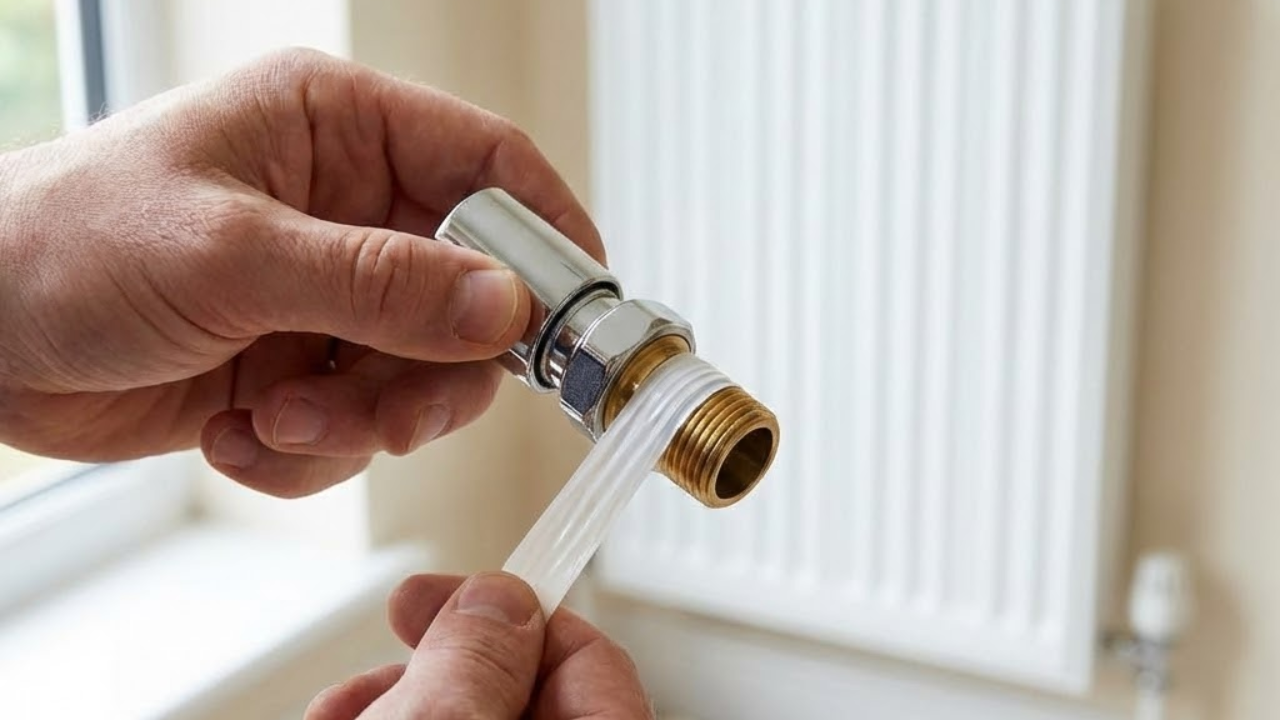
PTFE (polytetrafluoroethylene) tape remains the most common jointing product for radiator valve tails, but improper PTFE tape application causes more leaks than any inherent product failure. I've pulled apart countless weeping connections where PTFE tape was either wound the wrong direction, applied too thickly, or used on connections where it simply doesn't belong.
Wind PTFE tape clockwise when looking at the male thread end-on. This ensures the tape tightens as you screw the connection together rather than unwinding. Three to four wraps provide adequate sealing for most radiator valve tails. More than this and you risk splitting the radiator boss or creating hydraulic lock that prevents proper tightening.
Start the tape one thread back from the end. PTFE tape at the thread tip can shear off during assembly and contaminate the system, potentially blocking thermostatic radiator valve pins or fouling pump seals. Stretch the tape slightly as you apply it to ensure it beds into the thread roots.
Think of PTFE tape like cling film wrapping food – it needs to cover the surface completely without gaps, but too many layers just create bunching and problems. Thread sealing radiator valves with PTFE works by filling the microscopic gaps between thread peaks, not by creating a gasket. Over-tightening a PTFE-sealed connection doesn't improve the seal. It compresses the tape excessively and can actually create leak paths. Hand-tight plus one to one-and-a-half turns with a spanner typically provides optimal sealing.
Jointing Paste: When and Why It Outperforms Tape
Jointing paste, also called thread sealant or pipe dope, offers superior sealing for larger radiator valve connections and situations where thermal cycling creates challenges for PTFE tape. Quality jointing compounds from manufacturers like Fernox contain suspended particles that fill thread imperfections while remaining pliable through temperature changes.
Use jointing paste on radiator valve tails larger than 1/2 inch where the increased thread engagement and higher torque requirements can cause PTFE tape to shred. The jointing paste technique lubricates threads during assembly, allowing you to achieve proper tightening torque without galling the threads – particularly important with brass-to-brass connections.
Apply a thin, even coat to the male threads only, again starting one thread back from the tip. Excess paste squeezed into the system during assembly can contaminate inhibitor and affect system chemistry, so less is genuinely more. One complete circuit around the thread with a small brush provides adequate coverage.
The key advantage of jointing paste over PTFE tape becomes apparent during system commissioning. As the heating system cycles through its first heat-up, metal components expand at different rates. The jointing paste technique accommodates this movement. It remains semi-fluid, allowing microscopic movement without breaking the seal. PTFE tape, once compressed, can't accommodate this movement as effectively.
Hemp and Paste: The Traditional Combination for Heavy-Duty Applications
For larger radiator valve connections – particularly on commercial installations with 1-inch or larger valves – the traditional combination of hemp fibre and jointing paste provides unmatched reliability. This hemp and paste sealing method requires more skill than simply wrapping PTFE tape, but it creates a seal that withstands higher pressures and more severe thermal cycling.
Wrap the hemp clockwise around the male thread, starting two threads from the end and building up three to four layers. The hemp should fill roughly half the thread depth. Too much and you won't be able to assemble the joint; too little and the seal relies entirely on the paste.
Apply jointing paste liberally over the hemp, working it into the fibres with your fingers. The paste serves two functions: it lubricates the hemp during assembly and fills any remaining gaps in the seal. The combination creates a joint that actually improves with age as the hemp fibres swell slightly when wetted.
I've found hemp and paste sealing particularly valuable on older cast-iron radiators where thread tolerances may be less precise than modern products. The hemp-and-paste combination accommodates thread imperfections that would defeat PTFE tape or paste alone.
Liquid Thread Sealants: Modern Chemistry for Reliable Sealing
Liquid thread sealants – anaerobic compounds that cure in the absence of air – represent modern jointing technology increasingly specified for radiator valve installations. Products like Loctite 577 cure to form a tough, thermoset plastic that completely fills the thread space and resists system pressures up to 40 bar.
These liquid thread sealants offer several advantages over traditional jointing products. They cure to lock threads, preventing vibration loosening – particularly valuable on installations subject to water hammer or near circulating pumps. They're also unaffected by system inhibitors, unlike some jointing pastes that can break down over time.
Application requires attention to detail. Clean both male and female threads thoroughly with a degreaser. Any contamination prevents proper curing. Apply the liquid sealant to the male thread, again avoiding the first two threads. Assemble the joint within the working time specified by the manufacturer (typically 5-10 minutes) and allow the specified cure time before pressure testing.
The main limitation? Liquid thread sealants make future disassembly more difficult. The cured plastic must be broken loose, which can damage threads on brass components if you're not careful. For this reason, I reserve these sealants for permanent installations rather than connections I may need to service regularly.
Union Nut Connections: When Jointing Compounds Cause Problems
Here's where many installers go wrong: union nut connections on radiator valves don't require thread sealant. The seal forms between the tapered cone on the valve tail and the matching seat inside the union nut. Adding PTFE tape or jointing paste to these threads actually prevents proper sealing by interfering with the metal-to-metal contact.
Clean both the cone and the union seat before assembly. Any debris, old jointing compound, or scale prevents the surfaces from mating properly. A light smear of silicone grease on the cone helps achieve even contact and makes future disassembly easier, but this is a lubricant, not a sealant.
Tighten union nuts by hand until resistance is felt, then add three-quarters to one full turn with a spanner. Over-tightening distorts the cone or cracks the union nut – I've seen this countless times on installations where someone assumed "tighter is better." The seal relies on surface contact, not crushing force.
If a union nut connection weeps after proper assembly, the problem isn't inadequate jointing compound. It's damaged sealing surfaces. Replace the tail or valve body rather than attempting to seal a damaged connection with PTFE tape or paste, which creates a temporary fix that fails under thermal cycling.
Compression Fittings on Valve Inlets: Olive Integrity Matters Most
Radiator valve inlets using compression fittings for copper pipe create another connection type where jointing products are often misapplied. The olive (compression ring) creates the compression fitting seal, not thread sealant on the compression nut threads.
Clean the pipe thoroughly and ensure it's cut square. Slide the nut and olive onto the pipe, then insert it fully into the valve body until it bottoms out. The olive should sit 10-12mm from the pipe end. Too close and it may be pushed off during tightening; too far and the pipe won't fully engage.
Tighten the compression nut by hand, then add one to one-and-a-half turns with a spanner. The olive deforms during tightening to create a metal-to-metal seal against both the pipe and the valve body. Adding PTFE tape to the compression nut threads doesn't improve these compression fitting seals and can actually cause problems by affecting the tightening torque.
If you're working with plastic pipe systems and push-fit radiator valves, jointing products are completely unnecessary. These connections rely on O-rings and grab rings that seal and grip automatically when the pipe is fully inserted. Adding jointing compound can actually contaminate the O-rings and cause premature failure.
Preventing Weeps Through Proper Assembly Technique
Even the best jointing products fail if assembly technique is poor. I've diagnosed countless weeping radiator valves where the jointing product was appropriate but the installation method created the problem.
I once walked onto a site where an apprentice had installed twelve radiator valves without supporting the radiators during tightening. Every single tail connection wept within a week. The radiators had twisted during installation, creating stress concentrations that cracked three radiator bosses and distorted threads on the rest. Supporting the radiator body prevents this entirely.
Support the radiator body when tightening valve tails. Unsupported radiators twist during tightening, creating stress concentrations that crack radiator bosses or distort threads. Use a radiator spanner or adjustable wrench on the boss itself while tightening the tail. This prevents rotation and ensures the tightening force goes into creating the seal rather than stressing the radiator.
Never use excessive force. Brass threads are relatively soft and easily damaged. If a connection requires excessive torque to stop weeping, the problem is damaged threads, misaligned components, or incompatible parts – not insufficient tightening. Back off and diagnose the issue.
Allow jointing compounds to cure before pressure testing. Many liquid sealants and jointing pastes require 2-24 hours to achieve full strength. Pressure testing immediately after assembly can disturb the seal before it's fully formed, creating leak paths that wouldn't exist if you'd waited.
System Chemistry Compatibility
One aspect often overlooked when selecting radiator valve jointing products is compatibility with system inhibitors and water treatment chemicals. Traditional hemp and linseed oil paste, while excellent for gas systems, can break down in heating systems containing strong inhibitors – particularly those formulated for aluminium radiators.
Modern jointing pastes from reputable manufacturers are specifically formulated for compatibility with common heating system inhibitors. Check the technical data sheet to confirm compatibility with the inhibitor you're using. This is particularly important on systems with aluminium components where inhibitor chemistry is more aggressive.
PTFE tape and liquid thread sealants are generally inert and unaffected by system chemistry, making them safe choices for any inhibited system. However, some liquid sealants can contaminate system water during curing, potentially affecting inhibitor performance. Wipe away any excess before it enters the system.
Thermal Expansion and Jointing Product Selection
Radiator valve connections experience significant thermal cycling, from ambient temperature up to 80°C or higher in some commercial systems. This cycling causes differential expansion between brass valve bodies, steel or copper pipe, and cast-iron or steel radiators. Your jointing product must accommodate this movement without losing integrity.
PTFE tape application handles thermal cycling well on smaller connections where movement is minimal. On larger connections or systems with high flow temperatures, the tape can compress irreversibly during the first heat-up, creating leak paths when the system cools.
Jointing paste remains semi-fluid and accommodates thermal movement better than PTFE tape, making it preferable for systems with frequent temperature swings or high operating temperatures. Quality pastes remain effective through thousands of thermal cycles.
Liquid thread sealants cure to a thermoset plastic with some flexibility, but they're less accommodating of movement than paste. Reserve them for systems with stable operating temperatures rather than installations subject to frequent cycling.
When to Use Specialist Jointing Products
Certain radiator valve installations demand specialist jointing products beyond standard PTFE tape or paste. High-temperature systems – particularly those operating above 100°C in pressurised commercial installations – require jointing products rated for these conditions. Standard PTFE tape degrades above 260°C, but most jointing pastes lose effectiveness well below this temperature.
Systems using glycol antifreeze require jointing products specifically rated for glycol compatibility. Glycol is an aggressive solvent that can break down some jointing pastes, particularly those with petroleum-based carriers. Check the product data sheet and look for explicit glycol compatibility ratings.
Solar thermal systems present unique challenges due to stagnation temperatures that can exceed 150°C. Radiator valves in solar circuits require high-temperature jointing products, typically liquid sealants or specialist high-temperature pastes. Standard products fail rapidly under these conditions.
Diagnosing Existing Weeps: Jointing Product or Installation Issue?
When you're called back to diagnose a weeping radiator valve, determining whether the problem is the jointing product or the installation technique saves time and prevents repeat failures. A weep that appears immediately after commissioning suggests inadequate jointing product or improper application. A weep that develops after months or years of successful operation points to thermal cycling damage, corrosion, or mechanical stress.
Immediate weeps typically occur at the thread engagement – you'll see moisture wicking along the threads. This indicates inadequate thread sealing from insufficient jointing product, wrong product type, or improper application technique. Drain down, disassemble, and re-make the joint with appropriate jointing product properly applied.
Delayed weeps often originate from the radiator boss itself rather than the thread seal. Thermal cycling can crack cast-iron radiator bosses, particularly if the radiator wasn't properly supported during initial installation. If you see moisture appearing at the radiator body rather than wicking along threads, suspect boss damage rather than jointing product failure.
Weeps that appear only when the system is hot suggest thermal expansion issues. The joint seals adequately at ambient temperature but opens when components expand. This typically indicates over-tightening that has stressed threads or components, or use of a jointing product that doesn't accommodate thermal movement adequately.
Best Practices for Long-Term Seal Integrity
Creating radiator valve joints that remain leak-free through decades of service requires attention to details beyond just selecting the right jointing product. Clean threads thoroughly before applying any jointing compound – old PTFE tape, dried jointing paste, or corrosion products prevent new jointing products from sealing effectively.
Use the minimum effective amount of jointing product. Excess compound squeezed into the system during assembly can contaminate inhibitor, block thermostatic radiator valve mechanisms, or create deposits at flow restrictions. More isn't better – adequate coverage of threads with appropriate thickness provides optimal sealing.
Support radiators properly during installation. Wall-mounted radiators should be securely fixed to the wall before connecting valves. Floor-standing radiators should be level and stable. Any movement during valve tightening creates stress concentrations that can crack bosses or distort threads, leading to weeps regardless of jointing product quality.
Consider future serviceability when selecting jointing products. Liquid thread sealants that cure to hard plastics make future valve replacement more difficult. On installations where valves may need replacement – thermostatic radiator valves from Danfoss that wear out, or systems likely to be modified – traditional jointing paste or PTFE tape allows easier disassembly.
Conclusion
Preventing valve weeps at radiator valve connections comes down to matching the right jointing product to each specific connection type and applying it with proper technique. PTFE tape application works well for smaller threaded connections when applied correctly – clockwise winding, three to four wraps, starting one thread back. The jointing paste technique provides superior sealing for larger connections and better accommodates thermal cycling. Hemp and paste sealing remains the gold standard for heavy-duty commercial installations, while liquid thread sealants offer modern performance for permanent installations.
Remember that union nut connections and compression fitting seals don't require thread sealant – adding jointing products to these connections often causes problems rather than preventing them. The seal forms through metal-to-metal contact that proper tightening torque creates, not through thread sealant.
Support radiators during valve installation, use appropriate tightening torque, and allow jointing compounds adequate cure time before pressure testing. These fundamentals prevent more weeps than any specific brand of jointing product. When you do encounter a weeping connection, diagnose whether the problem is the jointing product, the application technique, or mechanical damage before attempting a repair.
Quality jointing products from established manufacturers provide the reliability your installations deserve. But even the best products can't compensate for poor technique. Master the fundamentals of proper radiator valve jointing product selection and application, and you'll create thread sealing radiator valves that remain leak-free through decades of thermal cycling and system operation. When working with quality components from manufacturers like Honeywell heating controls or Grundfos pumps, proper jointing product selection ensures your entire installation maintains integrity. If you need technical advice on specific jointing products for challenging installations, contact our technical team for guidance.