

Reflex 18L Potable Vessel vs 140L: Domestic vs Commercial Sizing Guide
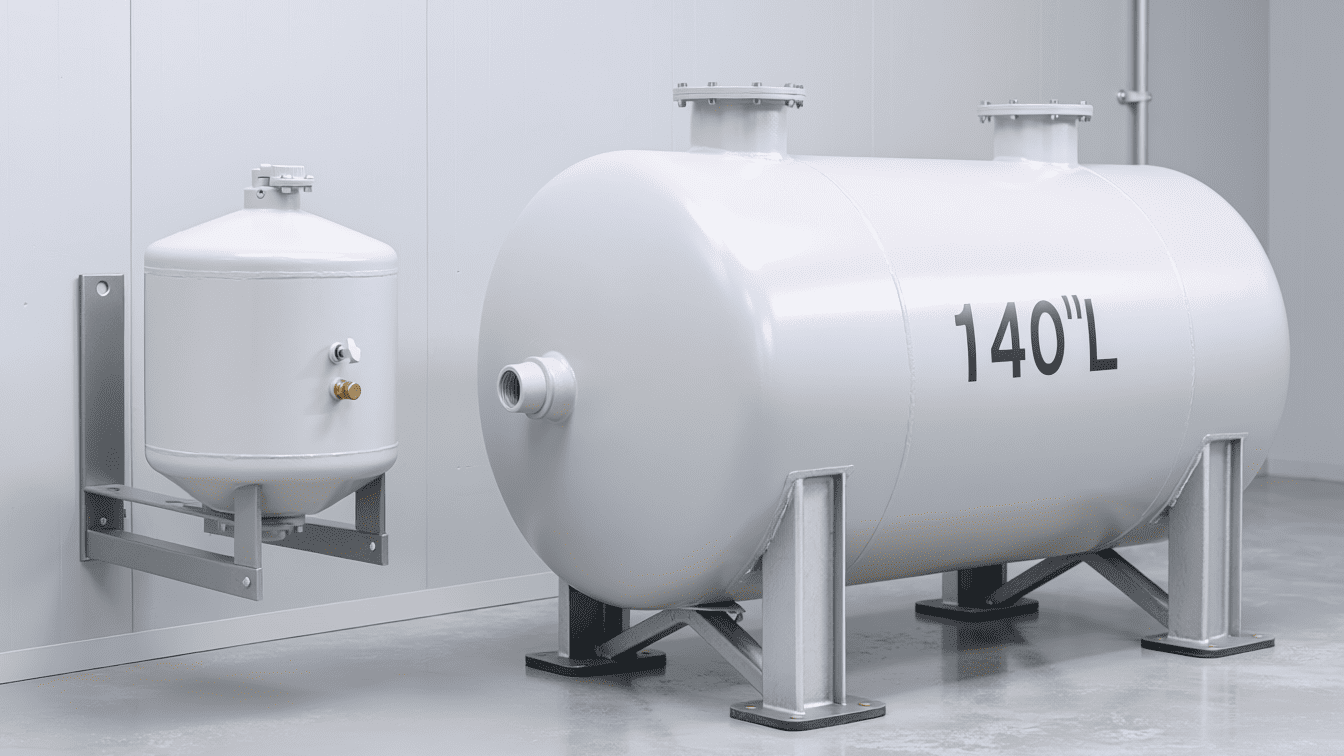
Expansion vessels sit quietly in plant rooms and airing cupboards across the country, doing a job most building occupants never think about. Yet if you specify the wrong size, you'll face pressure relief valve weeping, pump short-cycling, and callbacks that eat into profit margins. The gap between an 18-litre domestic vessel and a 140-litre commercial unit isn't just about capacity. It's the difference between a three-bedroom house and a 50-bed care home, between a simple replacement job and a calculated engineering decision.
This Reflex 18L vs 140L sizing guide explores why getting it wrong means the system won't just underperform, but will fail in ways that aren't always obvious until months down the line. We've sized hundreds of these systems, from compact flats to multi-storey commercial buildings. The principles haven't changed, but the consequences of poor specification have become more expensive as energy costs climb and building regulations tighten.
What Expansion Vessels Actually Do
Potable expansion vessels absorb the volume increase when water heats up in sealed systems. Water expands roughly 4% when heated from cold to 60°C. In sealed unvented cylinder systems, that expansion has nowhere to go unless you provide a cushion. Think of the expansion vessel like a small, highly flexible balloon packed inside a rigid steel box. As the water volume grows, the balloon compresses to make room so the rigid box doesn't crack under the pressure.
The vessel contains a rubber diaphragm separating water from a pre-charged air pocket. As water heats and expands, it compresses the air side. When taps open and pressure drops, the air pushes water back into the system. It's simple physics, but it remains critical to system integrity. Heating and Plumbing World supplies these essential components for both domestic and commercial setups. Without adequate expansion capacity, pressure builds until the relief valve lifts. That's not a safety feature working correctly. It's a design failure wasting water and energy during every heating cycle.
The 18-Litre Domestic Standard
The 18-litre domestic standard suits most domestic unvented cylinder systems up to 300 litres. We fit them in new-build houses, flat conversions, and replacement jobs where the old vented system gets upgraded. Typical applications include standard 250-litre unvented cylinders in three to four-bedroom homes, combination systems with modest hot water demand, and flat conversions with single bathroom layouts. This size handles daily heating cycles without the pressure relief valve operating. That's the benchmark. If your relief valve weeps during normal operation, your vessel is undersized or has failed. If you're fitting a Kingspan direct pressurised cylinder, you must ensure the vessel meets this 18-litre domestic standard to guarantee longevity.
Pre-charge pressure typically sits at 3.5 bar for domestic installations to match the system's cold fill pressure. This ensures the diaphragm doesn't bottom out when the system is cold, and it provides adequate expansion volume when heated. Physical installation is straightforward. Most 18L vessels mount on brackets near the cylinder, connected via 22mm copper or flexible hose. They're light enough for one person to handle and fit in tight airing cupboards. However, system volume isn't just the cylinder. Add the pipework, any buffer vessels, and the primary circuit if it's a thermal store. A 250L cylinder with extensive pipework might actually need a 25L vessel instead of the standard 18L option.
When 18 Litres Isn't Enough
We see undersized domestic vessels in three scenarios. First, installers often assume the cylinder size equals system volume. A 300-litre thermal store with 50 metres of 28mm primary pipe holds significantly more than 300 litres total. Second, systems get extended without recalculating expansion requirements. Adding an ensuite with another 15 metres of pipework changes the equation, meaning the original vessel now serves a larger volume.
On a residential project two years ago, a contractor added a large underfloor heating manifold to an existing layout but left the original 18L vessel in place. Within a week, the pressure relief valve was dumping five litres of heated water every night. We had to return, calculate the true total system volume, and upgrade the vessel to a 35L unit to stop the continuous waste of energy.
Third, pre-charge pressure drops over time. Vessels lose pressure gradually, which isn't a fault but simply physics. An 18L vessel at 2 bar effective pressure has half the expansion capacity of the same vessel at 3.5 bar. Warning signs of undersized vessels include a dripping pressure relief valve, excessive pressure gauge rises, pump short-cycling, and diaphragm failure within a few years. The fix isn't always a bigger vessel. Sometimes it's adding a second 18L unit in parallel to give you 36L total capacity without replumb work. Other times, you need to step up to commercial sizing. For instance, pairing a secondary vessel alongside an ACV indirect cylinder often solves capacity issues on large domestic extensions.
The 140-Litre Commercial Reality
A 140-litre Reflex vessel serves completely different applications. We're talking about care homes, apartment blocks, sports facilities, and commercial buildings where hot water demand spans multiple floors and dozens of outlets. These setups operate at higher volumes and higher temperatures while facing strict regulatory requirements. The vessel is built to different standards featuring commercial-grade diaphragms and robust flanged connections. Typical 140L applications include unvented cylinder systems ranging from 1,000 to 2,500 litres, district heating substations, and leisure centres with shower blocks. When installing a large Tribune HE pre-plumbed cylinder in a commercial block, these larger vessels become absolutely necessary.
The installation changes completely compared to domestic models. A 140L vessel weighs over 40kg empty and requires floor mounting or substantial wall brackets. Connection sizes jump to 1-inch or larger, so you're not squeezing this into an airing cupboard. Pre-charge pressure varies by system design. High-rise buildings might need 4-5 bar to prevent diaphragm collapse under static head, whereas ground-floor plant rooms might run at 3 bar. It's calculated rather than assumed, making commercial-grade diaphragms essential for handling these varied stresses.
Calculating Actual Requirements
The expansion volume formula is straightforward. You multiply the expansion coefficient by the total system volume and adjust for the pressure differential. Where Ve is the required vessel volume, the expansion coefficient is typically 0.04 for water heated to 60°C. But the formula doesn't tell you that total system volume includes everything that heats up. The cylinder matters, but so do the primary pipework, calorifiers, buffer vessels, and the heat exchanger volume in any thermal store. We measure actual system volumes by filling from empty and metering the water. It's far more accurate than basic calculations, especially in retrofit jobs where pipework routes aren't documented.
For a 250L domestic cylinder with 30 litres of associated pipework heated to 60°C, with an initial pressure of 3 bar and final limit of 6 bar, the required volume is 26.1 litres. That 250L cylinder needs a 25L or 35L vessel instead of an 18L one. The 18L vessel will work initially, but the relief valve will lift during heat-up. This wastes both water and energy. For a commercial system with a 1,500L cylinder bank and 200L of large-bore pipework, you would calculate approximately 158.7 litres. You would specify a 200L vessel to provide a safety margin, making the 140L option marginal at best. This Reflex 18L vs 140L sizing guide relies heavily on exact calculations rather than guesswork.
Installation Differences That Matter
Domestic vessels mount anywhere convenient near the cylinder. They're forgiving, meaning a few degrees off level doesn't matter and connection orientation is flexible. Commercial 140L vessels demand proper engineering. Floor loading calculations matter when you're adding 180kg of vessel plus water in a plant room. Wall mounting requires a structural assessment and substantial brackets rated for the full weight.
Key installation considerations for 140L vessels include floor loading capacity, clearance for inspecting commercial-grade diaphragms, and isolation valves sized for flow rates. Connection detail changes too. Domestic vessels typically use compression fittings. Commercial installations use flanged connections or welded pipework with proper support to prevent stress on the connection. We always fit a pressure gauge and isolation valve immediately adjacent to commercial vessels. You need to verify pre-charge pressure annually, and you can't do that with the vessel under system pressure. Isolation lets you depressurise the water side without draining the entire system.
Maintenance and Lifespan Expectations
An 18L vessel in a properly sized system lasts 8 to 12 years before diaphragm failure. We've seen them go 15 years in light-duty applications with stable pressure and moderate temperatures. A 140L commercial vessel faces harsher conditions, such as higher temperatures, more heating cycles, and often poorer water quality. Expect 7 to 10 years of service life, and budget for diaphragm replacement at year 5 or 6 if you're maintaining critical systems.
Pre-charge pressure drops naturally over time as gas permeates through the membrane. Check it annually on commercial vessels and every two to three years on domestic units. If it has dropped more than 0.5 bar, recharge through the Schrader valve using nitrogen rather than air, which contains moisture. Failed vessels show obvious symptoms. The pressure gauge swings wildly during heating cycles, and the relief valve drips constantly. Replacement is straightforward on domestic units, but commercial 140L replacements need meticulous planning because they don't fit through standard doorways. A complete Reflex 18L vs 140L sizing guide must account for this physical access.
Cost-Benefit Analysis
An 18L Reflex potable vessel costs £80 to £120 retail. Installation adds another £100 to £150 in labour for a straightforward domestic job, bringing the total project cost to around £200 to £250. A 140L commercial vessel runs £400 to £600 for the unit itself. Installation is a minimum of one day's work with proper bracketing and pipework, bringing the total project cost closer to £1,200. A failing unit on a domestic system might make replacing it with a Worcester boiler expansion vessel or similar unit necessary, depending on the boiler type.
The real cost comparison lies in undersizing either one. A domestic system with an 18L vessel that needs 25L wastes roughly five litres per heating cycle through the relief valve. Over the vessel's 10-year lifespan, that's £250 to £300 in wasted utilities. On commercial systems, the numbers multiply. An undersized 140L vessel on a system needing 200L might dump 30 litres per cycle. Three cycles daily in a care home equals nearly £100 in water charges plus £200 in wasted heating energy annually. The correct vessel pays for the difference in under two years through eliminated waste.
Making the Specification Decision
The choice between 18L and 140L is determined entirely by system volume and application. However, the middle ground often trips people up. For systems in the 500 to 800 litre range, you're looking at 50 to 80L vessel requirements. That's where multiple smaller vessels sometimes make perfect sense. Two 35L domestic vessels in parallel cost less than one 100L commercial unit and offer redundancy. We use parallel domestic vessels in light commercial applications like small office buildings or village halls.
For anything above 1,000 litres system volume, commercial vessels are non-negotiable. The installation is more complex, but the components are built for the heavy duty cycle. Don't forget that building regulations and insurance requirements sometimes mandate commercial-grade components regardless of size. A domestic care home with just 500L capacity or a system using a Kingspan Albion Fortic tank might still need commercial vessels to satisfy strict regulatory compliance. Following this Reflex 18L vs 140L sizing guide ensures you're covered legally and operationally.
Conclusion
The gap between an 18-litre domestic vessel and a 140-litre commercial unit represents the difference between residential and commercial HVAC engineering. One fits in an airing cupboard and serves a family home, while the other requires structural mounting and serves dozens of occupants. Both follow the same fundamental principle, which is to match the expansion volume to the system volume using the correct expansion coefficient.
We've seen too many callbacks from undersized vessels, and they're entirely preventable. Measure the total system volume, calculate the expansion requirement, add a 20% safety margin, and specify accordingly. Whether you're fitting an 18L vessel in a new-build flat or a 140L unit in a commercial plant room, the same principle applies. Size it right the first time, install it properly, and maintain it regularly. If you require further assistance specifying the correct capacity for your next project, please contact our technical team for expert advice.