

Reflex HV vs PV Series: Heating vs Potable Water Expansion Vessel Selection
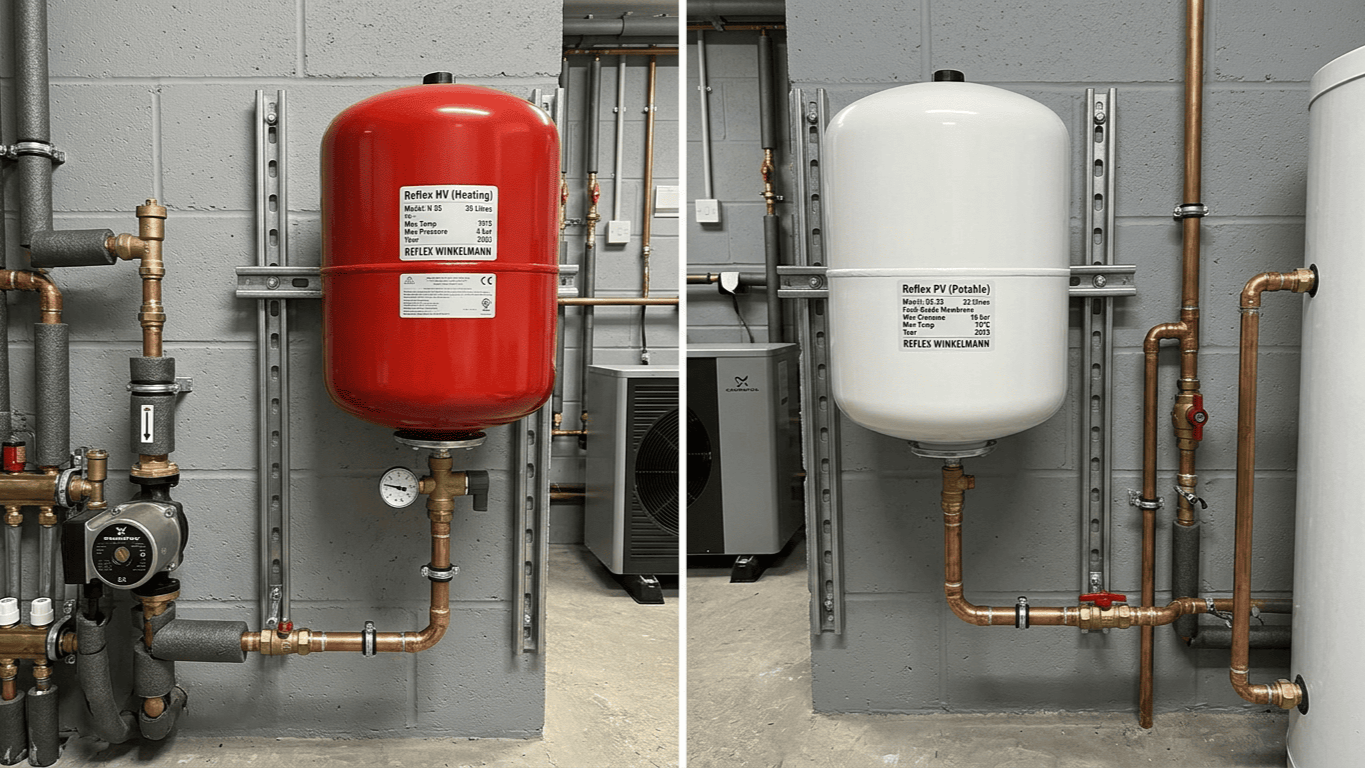
Choosing the wrong expansion vessel isn't just a minor oversight. It is a liability that can cost you a callback, a warranty claim, or a complete system failure. The difference between a heating vessel and a potable water vessel matters more than most installers realise. Mixing them up is one of the most common mistakes we see in the field. Understanding the Reflex HV vs PV series is crucial because these two product lines serve entirely different purposes.
Reflex makes this choice straightforward with two distinct product lines. They offer the HV series for heating systems and the PV series for potable water. Understanding why these vessels cannot be used interchangeably requires looking at what happens inside each system. You must also understand how the vessel responds to those specific conditions.
The Fundamental Difference Between Heating and Potable Water Systems
Heating systems and drinking water systems operate under completely different conditions. These differences dictate every aspect of expansion vessel design.
- Heating systems are closed-loop environments. The same water circulates repeatedly through boilers, radiators, and pipework. It heats up, expands, cools down, and contracts in a predictable cycle. Once filled and commissioned, this water rarely changes. Because it is isolated from the atmosphere, it doesn't need to meet drinking water standards.
- Potable water systems deliver fresh drinking water to taps, showers, and appliances. The water constantly changes as people use it. Therefore, it must remain uncontaminated, safe to drink, and compliant with strict health regulations.
Heating and Plumbing World provides the necessary WRAS approved components to ensure your potable installations remain legally compliant. Any component that touches this water must meet potable water certification standards.
Think of it like putting fuel in your van. You wouldn't put diesel in a petrol engine just because they both make vehicles move. Similarly, you cannot swap these vessels simply because they both handle pressure. The key distinction is that heating water doesn't need to be drinkable, while potable water absolutely does.
Why Material Selection Matters
This is where the HV and PV series diverge most significantly. The internal membrane that separates water from the pre-charged nitrogen gas must be compatible with the system it serves.
- HV Series (Heating): The HV line uses EPDM rubber membranes. EPDM performs exceptionally well in heating applications. It handles high temperatures, resists glycol-based antifreeze solutions, and maintains elasticity through thousands of expansion cycles. We have seen HV vessels run for over 15 years in commercial heating systems without membrane failure. However, EPDM lacks potable water certification in most regions. It is not necessarily dangerous, but it is simply not approved for drinking water applications.
- PV Series (Potable): The PV line uses butyl rubber membranes that carry full potable water certification. Butyl rubber meets WRAS approval in the UK and equivalent standards across Europe. It won't leach compounds into drinking water, maintains taste neutrality, and withstands chlorine.
Just as you ensure the seals on a close-coupled WC suite are appropriate for domestic water lines, your expansion vessels must carry the exact same safety assurances.
Temperature and Pressure Operating Ranges
Both series handle similar pressure ranges. They typically operate between 3 and 10 bar for residential and light commercial applications. However, their temperature capabilities differ greatly.
HV vessels are designed for heating system temperatures up to 120°C. High-temperature heating circuits regularly operate between 70 and 90°C. This is especially true for systems serving underfloor heating manifolds. The EPDM rubber membranes maintain flexibility and sealing integrity across this entire range.
PV vessels typically operate at lower temperatures. They rarely exceed 70°C, even in systems with recirculating hot water loops. Butyl membranes perform perfectly within this range while maintaining their potable water certification.
If you are installing an expansion vessel on a domestic hot water cylinder fed by an AIC Nesta wall-hung boiler, you need a PV vessel for the hot water side. If you are installing on the heating circuit of that same boiler, you need an HV vessel.
Sizing Calculations: Similar Process, Different Inputs
The formula for sizing both HV and PV vessels follows the same basic principle. You calculate the volume of water expansion to ensure the vessel can accommodate it without exceeding system pressure limits.
While the math is similar, the inputs differ significantly:
- Heating systems have larger temperature differentials but lower water volumes in many cases. For example, a typical residential heating system with 150 litres of water content needs roughly an 18-litre HV vessel. This assumes it operates from 1.0 bar cold to 2.5 bar maximum.
- Potable water systems deal with substantial stored volumes but more modest temperature changes. For instance, a 250-litre unvented hot water cylinder heated from 10°C to 65°C requires a 24-litre PV vessel.
If you are servicing an industrial Ecoflam gas burner, the immense heating circuit capacity will heavily dictate the required Reflex HV vs PV series choice.
Installation Position and Orientation
Both HV and PV vessels prefer vertical installation with the connection at the bottom. However, they will function horizontally if space constraints demand it. What matters more is where in the system you position them.
HV vessels should be installed on the cold return side of heating circuits. This is particularly important before large underfloor heating manifolds to ensure the vessel sees the full system pressure. Installing an HV vessel on the flow side exposes it to maximum temperatures constantly, which accelerates membrane fatigue. Alternatively, PV vessels connect directly to the cold water inlet of unvented cylinders.
During a recent commercial refit, an apprentice installed a cheaper HV vessel on an unvented hot water cylinder because they looked physically identical on the outside. The local building control officer rejected the entire installation due to the lack of proper WRAS approved components. We had to drain the system and replace the vessel entirely. This turned a minor initial cost saving into a massive financial loss. We always mount vessels where they are accessible for future maintenance to avoid these complications.
Pre-Charge Pressure: Factory Settings Versus Site Adjustments
Every Reflex expansion vessel leaves the factory with a nitrogen pre-charge. Relying solely on these factory settings is a common mistake.
For HV vessels, you must adjust the pre-charge to match your heating system's cold fill pressure. This is usually 1.0 to 1.5 bar for residential systems. Release nitrogen until the vessel pressure matches the system pressure with the boiler cold. For PV vessels, the pre-charge should match the incoming cold water pressure directly after the pressure reducing valve.
Always check the pre-charge with the vessel isolated from the system and completely drained. A standard Schrader valve on top of the vessel accepts a normal tyre pressure gauge. If you are installing a new Firebird plastic flue kit and need to move the boiler temporarily, always depressurise and re-check the vessel's air charge before firing the system back up.
Maintenance and Service Life Expectations
Both series are sealed units with no user-serviceable parts beyond the pre-charge adjustment.
HV vessels in properly maintained closed-loop environments regularly exceed 10 years of service life. The EPDM rubber membranes cycle predictably with daily heating patterns. They expand during the day and contract overnight. This regular, moderate cycling is ideal for longevity.
PV vessels face more variable conditions. In homes with high water usage, the vessel cycles frequently as the cylinder reheats. Butyl rubber handles intermittent cycling well, provided the chlorine levels do not exceed safe limits. If you find yourself repeatedly replacing a Bentone 90W burner motor due to short cycling, check if your expansion vessel has lost its charge and is causing severe pressure fluctuations.
Common Specification Mistakes and Compliance
The most frequent error we encounter is specifying an HV vessel for an unvented hot water cylinder simply because it is cheaper. The cost saving evaporates completely when the building control officer rejects the installation. Another common mistake is oversizing vessels dramatically to be safe. This just means you are paying for capacity you will never use.
Some installers specify PV vessels for heating systems with mixed water and glycol. They assume the butyl membrane offers better chemical resistance. It doesn't. EPDM actually handles glycol mixtures better than butyl.
In the UK, any expansion vessel connected to potable water must carry full potable water certification. The HV series does not and cannot legally be used on drinking water systems. Using correct WRAS approved components is entirely non-negotiable.
System Integration and When to Replace
For a proper installation, you must incorporate several essential auxiliary components:
- A ball valve for isolation.
- A pressure gauge to monitor system pressure.
- A drain valve for system servicing.
Expansion vessels don't get repaired. They get replaced. If the membrane fails or the connection corrodes, replacement is the only option. A heating system pressure rising excessively or dropping rapidly clearly indicates a failure.
You must ensure you select the appropriate unit from the Reflex HV vs PV series catalogue to avoid repeated failures on sensitive underfloor heating manifolds and standard radiator circuits. Both vessel types typically cost less than £100 for residential sizes, and replacement takes under an hour. Compare that to the cost of repeated callouts for pressure problems or the severe damage caused by relief valve discharge flooding a property.
Conclusion
Selecting between the two isn't complicated once you understand the fundamental rule. If the water is for drinking, washing, or cooking, use PV. If it is for heating only, use HV. That single principle covers 95% of installations. The remaining mixed closed-loop environments or unusual retrofit scenarios require closer examination of temperatures and pressures. We've installed thousands of expansion vessels, and the pattern is remarkably consistent. Correctly specified units run for a decade or more without issues.
The Reflex HV vs PV series makes the right choice obvious through clear product differentiation and comprehensive technical documentation. Choose based on what the water does, not what the vessel costs. Install according to manufacturer guidance, pre-charge to match system pressure, and always fit isolation valves. If you need help specifying the correct model for your next installation, please contact our technical team for expert advice.