

Reflex Pre-Charge Pressure Settings: 1.0 Bar vs 1.5 Bar for UK Sealed Systems
Most expansion vessel failures in UK sealed heating systems trace back to one overlooked detail, which is the pre-charge pressure. Reflex expansion vessels arrive with a factory pre-charge, usually 1.0 or 1.5 bar, but that does not mean you should leave it as is. Proper Reflex pre-charge pressure settings depend on your system's static head, fill pressure, and operating temperature. Set it right, and the system runs quietly for years. Get this wrong, and you are creating problems that look like pump failures, air locks, or continuous PRV discharge.
Why Pre-Charge Pressure Actually Matters
The expansion vessel's job is simple. It absorbs the volume increase when water heats up. However, it can only do that if the pre-charge pressure correctly matches the system's cold fill pressure. If the pressure is too low, the diaphragm stays compressed against the water side, leaving no room for expansion. If it is too high, the vessel never engages at all.
Think of the pre-charge pressure like a heavy-duty shock absorber on a mountain bike. If there is no air pressure in the cylinder, the suspension bottoms out immediately over the first bump. If there is too much air, the shock is rigid and never compresses at all. The pre-charge creates the vital cushion that allows the rubber diaphragm to move. Without it, you will quickly find yourself performing waterlogging diagnostics to figure out why the system pressure swings wildly as water heats and cools. Installers often blame the vessel itself, but nine times out of ten, it's a pre-charge issue.
Factory Settings: 1.0 Bar vs 1.5 Bar
Reflex vessels typically ship with one of two starting pressures. The 1.0 bar setting is standard for most domestic systems with fill pressures of 1.0 to 1.5 bar. The 1.5 bar setting is used for systems with higher static heads or commercial applications. The factory setting is merely a starting point rather than a final specification. Heating and Plumbing World supplies appropriate testing equipment to verify these critical system measurements before final commissioning.
You must adjust the pressure based on a precise static head calculation, which measures the vertical distance from the expansion vessel to the highest radiator or pipe. Static head adds approximately 0.1 bar per metre of height. A two-storey house with the vessel in the ground-floor airing cupboard might have a static head of 3 to 4 metres, or 0.3 to 0.4 bar. You add this to your desired cold fill pressure to find the right Reflex pre-charge pressure settings. For a system with 0.4 bar static head, you'd set the pre-charge to 0.6 or 0.7 bar.
When to Use 1.0 Bar Pre-Charge
A 1.0 bar pre-charge suits single-storey bungalows, ground-floor flats, or any system where the expansion vessel sits close to the highest point. The static head is minimal, often just 1 to 2 metres, so the pre-charge can stay low. If you are filling the system to 1.0 or 1.2 bar cold, a 1.0 bar pre-charge gives you just enough cushion. The vessel engages immediately as the system heats, absorbing expansion without pressure spikes.
I remember a callout last winter where an installer had left the factory 1.0 bar setting on a new three-storey townhouse installation. The system lost pressure every week because the pre-charge was lower than the static head, meaning the vessel never actually engaged and the PRV dumped water constantly. Using a wireless combi pack can help you monitor system behaviour remotely, but it won't fix fundamental physical setup errors like this.
When to Use 1.5 Bar Pre-Charge
A 1.5 bar pre-charge is necessary for systems with significant static head, typically anything over 4 or 5 metres. This includes most two-storey and three-storey houses, especially if the expansion vessel is located in a ground-floor utility room or basement. If the static head is 5 metres, you need a pre-charge of at least 0.7 to 0.8 bar to ensure the vessel engages.
However, many installers round up to 1.5 bar for a safety margin, especially if the system fill pressure is already 1.5 bar. The higher pre-charge prevents the diaphragm from bottoming out under static pressure. If you find yourself constantly adjusting pressures on taller buildings, upgrading to a larger Zilmet Hy-Pro expansion vessel might provide the extra capacity required to prevent a boiler lockout.
How to Check and Adjust Pre-Charge Pressure
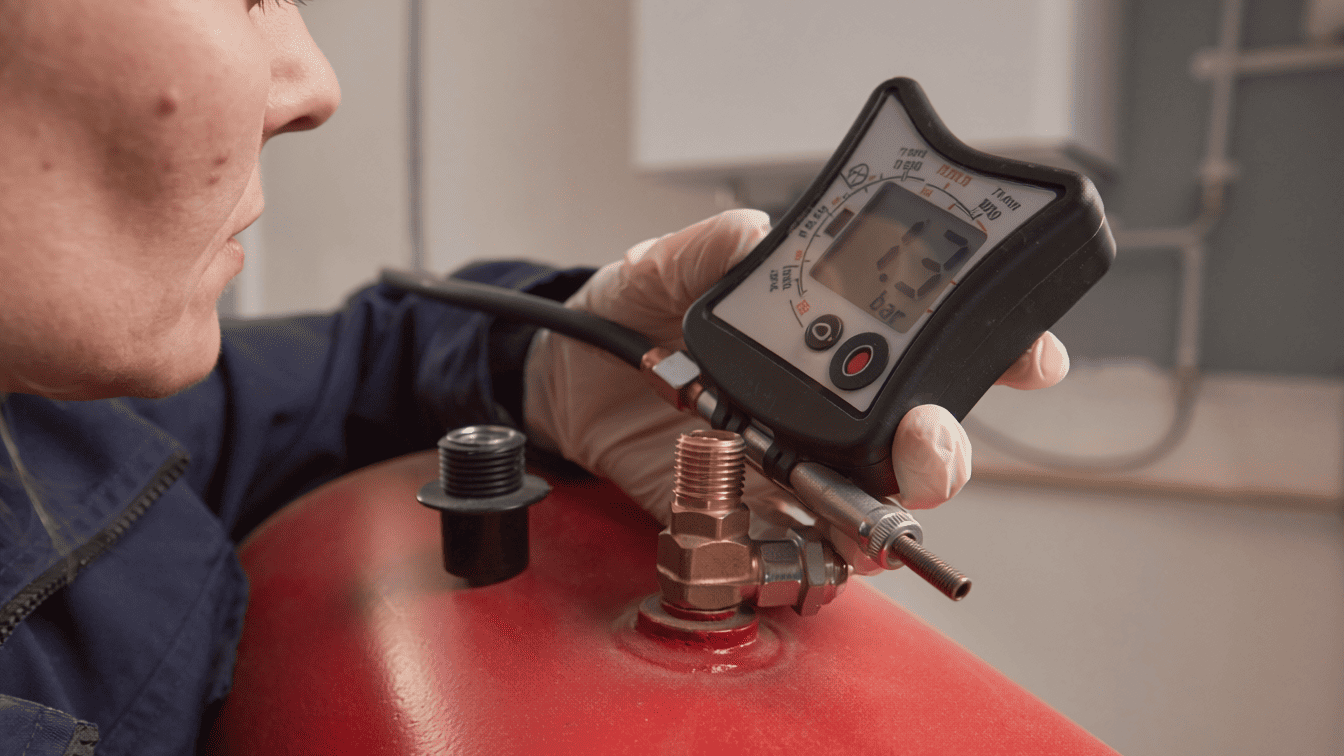
You will need a Schrader valve gauge and a pump, which is the exact same type used for car tyres. Most expansion vessels have the valve hidden behind a plastic cap on the top or bottom. Always isolate the vessel and drain the system pressure to zero first.
Remove the plastic cap and attach the Schrader valve gauge to note the current pressure. Add or release air to reach the target pressure determined by your static head calculation. Refit the cap and refill the system to the correct cold fill pressure. A common mistake is checking the pre-charge with the system still pressurised. The gauge will show the combined water and air pressure rather than the actual pre-charge. You can use a Baxi temperature sensor to verify system temperatures once everything is running again.
Matching Pre-Charge to System Fill Pressure
The pre-charge should always be slightly below the cold fill pressure, typically 0.2 to 0.3 bar less. This ensures the diaphragm moves as soon as the system heats, rather than waiting until the pressure rises further. For a system filled to 1.5 bar cold, set the pre-charge to 1.2 or 1.3 bar.
If the pressures are too close, the vessel barely engages. If the gap is too wide, the diaphragm is already compressed before heating even starts. The 0.2 to 0.3 bar gap is a sweet spot because it gives the vessel room to work without wasting capacity. Getting the Reflex pre-charge pressure settings right here prevents extreme pressure spikes that trigger a boiler lockout.
Vessel Sizing and Pre-Charge Interaction
Pre-charge pressure and vessel size are tightly linked. A correctly sized vessel can tolerate a slightly off pre-charge, but an undersized vessel cannot. Reflex publishes sizing charts based on system volume, temperature range, and fill pressure. For a typical 150-litre domestic system running a modern condensing boiler, you would need an 18-litre to 25-litre vessel.
Go smaller, and even perfect pre-charge will not prevent pressure swings. Check the Worcester Bosch condensate pump and surrounding components for signs of leaks if pressure rises above 3.0 bar when the system heats. If you see PRV discharges and the pre-charge is correct, the vessel is too small. Fit a larger one or add a second vessel in parallel.
Troubleshooting Pressure Loss and Waterlogging
If the system loses pressure every few days, check the pre-charge before replacing the vessel. Nine times out of ten, the air charge has leaked or was never set correctly. Drain the system, check the pressure with your Schrader valve gauge, and reinflate it if it is low. If it drops again within a week, the diaphragm has failed and you must replace the vessel.
Waterlogging diagnostics involve checking if the system pressure spikes when heating and drops when cooling. The gauge might swing wildly between 1.0 and 3.0 bar. To confirm your waterlogging diagnostics, tap the vessel with a screwdriver handle. A healthy vessel sounds hollow on the top half and dull on the bottom, while a waterlogged vessel sounds dull all over. Sometimes, a faulty Gledhill temperature sensor can cause the boiler to overheat and mimic pressure issues, so rule out electrical faults first.
Manufacturer Specifications and Warranty Considerations
Reflex specifies pre-charge pressures in the installation manual for each vessel model. Ignoring these can void the warranty, especially if the vessel fails prematurely. Common Reflex models like the Reflex N ship at 1.0 bar, while commercial Reflex S models ship at 1.5 bar.
If you adjust the pre-charge outside the manufacturer's range, you risk diaphragm damage. The rubber stretches beyond its design limit, leading to premature failure on your condensing boiler circuit. A reliable static head calculation ensures you stay within safe parameters. Always check the manual before adjusting.
Conclusion
The difference between 1.0 and 1.5 bar pre-charge is not arbitrary. It is dictated by your system's static head and fill pressure. Proper Reflex pre-charge pressure settings ensure the expansion vessel does its job silently for years. Get it wrong, and you will chase pressure loss, PRV discharge, and repeated boiler lockout events until you finally check the air valve.
For most UK homes running a standard condensing boiler, 1.0 bar works for single-storey systems with low static head, while 1.5 bar suits two-storey and three-storey properties. Don't rely on factory settings; measure the requirements for the specific property. If you require assistance calculating the correct pressures for your next installation, please contact our technical team for expert advice.