
 -
- Reflex PV140W Potable Expansion Vessel: Sizing for Unvented Hot Water Systems
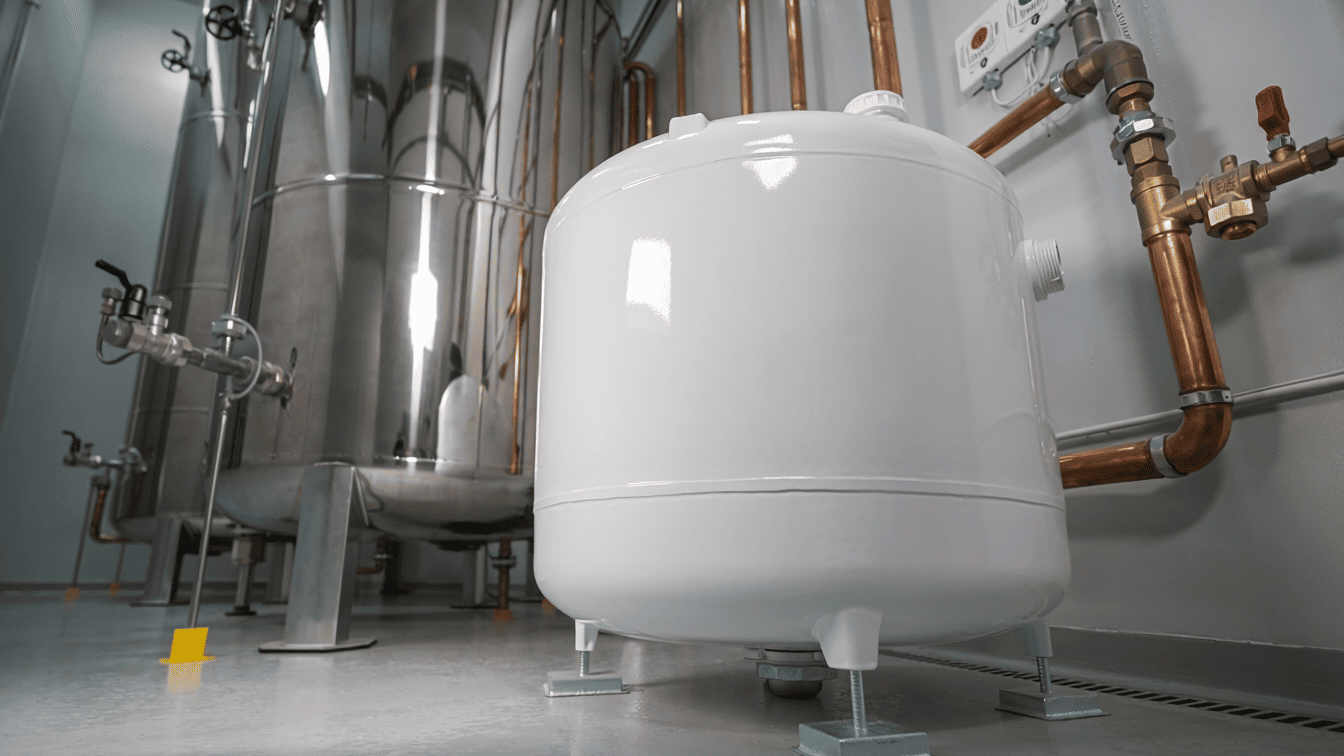
When water heats up, it expands. In a sealed system, that expansion has nowhere to go, and pressure builds fast. Without proper accommodation, you are looking at relief valve discharge, system stress, and premature component failure. The Reflex PV140W potable expansion vessel exists to solve exactly this problem, but only if it is sized correctly for the job.
We have specified hundreds of unvented cylinders across commercial and residential projects, and the expansion vessel is where many installers get it wrong. Too small, and the vessel cannot handle the expansion volume. Too large, and you have wasted money on unnecessary capacity. The Reflex PV140W potable expansion vessel sits in a sweet spot for mid-sized domestic installations, but understanding when it is the right choice requires working through the numbers.
How Expansion Vessels Work in Unvented Systems
An expansion vessel is essentially a pressurised tank divided by a flexible membrane. Think of an expansion vessel like the lungs of your plumbing system. When the water heats up and needs to take a deep breath to expand, the vessel provides the flexible space to accommodate that breath without breaking the rigid ribs of the pipework. One side contains compressed air or nitrogen at a pre-charge pressure. The other side connects to the water system. When heated water expands, it pushes against the membrane, compressing the gas side further and absorbing the increased volume without spiking system pressure. Heating and Plumbing World supplies reliable expansion vessels to keep your unvented systems safe and compliant.
The Reflex PV140W potable expansion vessel is purpose-built for potable water applications. This is critical because standard heating expansion vessels use materials not rated for drinking water contact. The PV140W features a high-quality butyl membrane that meets drinking water regulations and will not degrade from chlorine exposure over time. Pre-charge pressure on the PV140W is typically set to match the static cold water pressure in your system, usually between 3 and 4 bar for most UK mains supplies. This ensures the butyl membrane sits in the correct position when the system is cold, ready to accommodate expansion as the temperature rises.
Calculating Expansion Volume: The Numbers That Matter
Sizing an expansion vessel properly starts with understanding how much water will expand. This isn't guesswork because it is pure physics. Water expands predictably based on temperature change, and we can calculate the exact volume increase. For a standard unvented cylinder heated from 10°C to a typical hot water storage temperature of 65°C, water expands by approximately 2%. That percentage seems small, but it translates to significant volume in a large cylinder. If you are also monitoring the system with a Worcester temperature sensor, you will see exactly how quickly these temperatures climb during reheating.
Here is what that looks like in practice. A 200-litre cylinder produces 4 litres of expansion. A 250-litre cylinder produces 5 litres of expansion. A 300-litre cylinder produces 6 litres of expansion. However, the expansion vessel doesn't need to match this volume exactly. Because the vessel is pressurised, it doesn't need to be as large as the expansion volume itself. The acceptance capacity depends on three pressure points, which are the pre-charge pressure, the initial system pressure, and the maximum allowable system pressure.
The Acceptance Capacity Formula
The effective capacity of an expansion vessel is calculated using the acceptance capacity formula. For the Reflex PV140W with its 140-litre nominal volume, we assume a pre-charge pressure of 3.5 bar and a final pressure of 6 bar. To run the acceptance capacity formula, you multiply the vessel volume by the difference between the final pressure and the pre-charge pressure, divided by the final pressure.
That gives an acceptance capacity of approximately 58.3 litres. That acceptance capacity of approximately 58 litres is what actually matters for sizing. It is the volume of expansion the vessel can accommodate before system pressure reaches the relief valve setting.
When the PV140W is the Right Choice
Given its acceptance capacity, the PV140W works well for larger domestic or small commercial installations. We typically specify it for large domestic properties with 400 to 500-litre unvented cylinders. On a recent commercial refit, an apprentice sized an expansion vessel based solely on the cylinder volume without factoring in the long secondary return pipework. Within a week, the system was continually dumping water through the relief valve. It was an expensive lesson in measuring the entire heated volume before ordering parts.
The expansion volume from a 450-litre cylinder heated through a 55°C temperature differential is roughly 9 litres. The PV140W handles this comfortably with capacity to spare. Multi-bathroom homes with high simultaneous demand often run larger cylinders and may heat water to a slightly higher hot water storage temperature, increasing expansion volume. The PV140W provides a safety margin that smaller vessels cannot match. Commercial applications like small hotels or care homes with 500 to 600-litre cylinders cannot afford system failures, and the robust construction of the PV140W handles commercial duty cycles. We also use it in retrofit situations where the original expansion vessel was undersized. We have encountered numerous installations where a 12 or 18-litre vessel was fitted to a 300-litre cylinder. Upgrading to a PV140W eliminates this marginal operation.
Installation Considerations That Affect Performance
Even a correctly sized expansion vessel will underperform if installed improperly. The vessel must be positioned vertically with the water connection at the bottom. This prevents air accumulation on the water side of the membrane, which reduces effective capacity. The connection between the cylinder and expansion vessel should be as short as practical, with no valves that could isolate the vessel during operation. We have seen installations where someone fitted an isolation valve for maintenance and later closed it, effectively removing the expansion vessel from the system. The relief valve started weeping within weeks.
Pre-charge pressure must match the static cold water pressure. If your mains pressure is 4 bar but the vessel arrives with a 3 bar pre-charge, you will need to adjust it before commissioning. It should be positioned downstream of the pressure reducing valve so it reads the correct regulated pressure. You can check this with a Schrader valve pressure gauge on the air side of the vessel while the water side is depressurised. If you are fitting an additional Crown Hi-Store vertical cylinder, verify that the pre-charge values align across the entire circuit.
Comparing the PV140W to Other Capacity Options
Reflex manufactures the PV series in multiple sizes, and understanding where the PV140W sits in the range helps clarify when to step up or down in capacity. The PV80W suits standard domestic installations with 250 to 300-litre cylinders. It is the most common size for typical family homes and handles the expansion volume with an adequate margin. The PV100W bridges the gap for properties with 300 to 400-litre cylinders. It is often the better choice when you are borderline between sizes because the marginal cost difference is negligible compared to the cost of undersizing.
If you are specifying a Kingspan indirect Combi Fortic tank with integrated components, ensure you check the manufacturer's exact vessel requirements. The PV140W handles larger domestic and small commercial installations as discussed. It is also the sensible choice when you want maximum service life because operating an expansion vessel at 60% capacity rather than 90% reduces membrane fatigue. The PV200W enters true commercial territory, making it suitable for cylinders over 800 litres or multiple-cylinder installations.
Real-World Sizing Example
Let's work through a complete sizing calculation for a typical scenario we encounter regularly. Imagine a four-bedroom house with three bathrooms and a 350-litre unvented cylinder heated to 65°C. The temperature rise is 55°C from a base of 10°C, and the expansion coefficient is 2% for this range. This gives an expansion volume of 7 litres. If the static cold water pressure is 4 bar, the pre-charge pressure should match it at 4 bar. The relief valve setting is 6 bar, giving a pressure differential of 2 bar.
You can ensure the system doesn't exceed safe heat parameters by fitting an IMIT capillary limit thermostat. To find the required acceptance capacity, multiply the 7 litres by 1.5, giving 10.5 litres. Using the formula, the required vessel volume is 31.5 litres nominal. For this installation, a PV80W would be adequate. But if the property owner mentioned plans to upgrade to a larger cylinder in the future, or if we wanted maximum service life from the vessel, the PV140W would be defensible. It is not strictly necessary, but it is not wasteful either.
Common Sizing Mistakes We've Encountered
The most frequent error is sizing the vessel to match the cylinder capacity rather than the expansion volume. A 300-litre cylinder doesn't need a 300-litre expansion vessel. It needs a vessel capable of accommodating roughly 6 litres of expansion, which a much smaller vessel can handle through pressurisation. Another mistake is ignoring the pressure limits. If your static pressure is high and your relief valve setting is 6 bar, you only have 1 bar of differential to work with. The effective volume drops significantly when you run the acceptance capacity formula, and you will need a larger vessel to compensate.
We have also seen installers fail to account for temperature. If the cylinder is heated to 80°C for legionella control, the expansion coefficient increases. Water expands by approximately 3% over a 70°C temperature differential rather than 2% for a 55°C rise. That 50% increase in expansion volume requires a correspondingly larger vessel.
Maintenance and Service Life
The PV140W is a robust piece of kit, but it is not maintenance-free. The pre-charge pressure should be checked annually. Over time, gas can permeate through the butyl membrane, reducing pre-charge pressure and diminishing acceptance capacity. Check the pre-charge with the water side depressurised by isolating the vessel, draining the water side, and measuring the air pressure at the Schrader valve. If it has dropped more than 0.5 bar from the original setting, top it up with compressed air or nitrogen. Do not use oxygen because it is a safety hazard in compressed form.
Replacing a worn Worcester condensing trap washer set during your annual service is also good practice to prevent small leaks elsewhere. The membrane itself has a finite service life, typically 10 to 15 years in domestic applications. Commercial installations with frequent thermal cycling may see a shorter service life. Signs of failure include frequent relief valve discharge, pressure gauge fluctuations, or water discharge from the Schrader valve when you depress it.
Integration With Building Regulations
Part G of the Building Regulations requires unvented hot water systems to include specific safety components, and the expansion vessel is one of them. The vessel must be sized to accommodate the expansion volume without causing the relief valve to discharge during normal operation. It also must be correctly positioned in relation to the pressure reducing valve and incoming mains. Building Control will want to see calculations demonstrating proper sizing. Don't just specify a vessel and hope it works.
Document the cylinder capacity, temperature differential, system pressures, and the resulting expansion volume. Show that the chosen vessel's acceptance capacity exceeds the calculated expansion with an appropriate safety margin. For the PV140W in particular, its large capacity means you are rarely undersized. The risk is over-specification, which isn't a compliance issue but might raise questions about cost-effectiveness on a budget-sensitive project.
Cost Versus Performance Considerations
The PV140W typically costs £200 to £250 for trade, depending on the supplier and order volume. That is roughly double the cost of a PV80W. For installations where the smaller vessel is adequate, the PV140W represents unnecessary expenditure. However, in borderline cases, the additional cost buys you three things. It gives you an extended service life through reduced membrane stress, capacity for future system changes, and a reduced risk of undersizing if your expansion calculations were slightly optimistic.
We have learned to factor in the client's risk tolerance. A property developer building spec homes will size vessels to the minimum adequate capacity because there is no business case for over-specification. A high-end residential client or commercial operator values reliability over marginal cost savings and often accepts our recommendation to step up a size.
Conclusion
The Reflex PV140W potable expansion vessel delivers 58 litres of acceptance capacity, making it suitable for unvented cylinders in the 400 to 600-litre range under typical domestic pressure conditions. Proper sizing requires calculating actual expansion volume based on cylinder capacity and the specific temperature differential of the system. Then, you select a vessel whose acceptance capacity exceeds that expansion with an appropriate safety margin.
For most standard domestic installations with 200 to 300-litre cylinders, the PV140W is over-specified, meaning a PV80W or PV100W will do the job at a lower cost. But for larger properties, commercial applications, or situations where you want maximum service life and future-proofing, the PV140W represents solid value. It is a workhorse component that will operate reliably for a decade or more if installed correctly and maintained properly. The key is running the numbers rather than guessing. If you are unsure about the exact specifications for your unvented cylinder system, contact our technical team for expert sizing advice.